Showing posts with label Regime Change. Show all posts

Thursday, July 30, 2026

Media Review: US-Iran War is Igniting Regime Change Risks Across Arab Monarchies

    Thursday, July 30, 2026   No comments

 The Fragile Thrones

As the United States resumes its military strikes against Iran, the geopolitical fault lines of the Middle East are shifting inward. For years, Arab authoritarian regimes have operated on a precarious social contract: trading limited political representation for economic stability and security guarantees, almost always underwritten by Washington. However, as Jordan, Kuwait, Bahrain, and Saudi Arabia are increasingly perceived as facilitators of a US-Israeli war effort against the Islamic Republic, that social contract is fracturing. Regime change risk, once dismissed by Western analysts as a relic of the 2011 Arab Spring, is now a tangible and escalating reality. Nowhere is this dynamic more explosive than in the Hashemite Kingdom of Jordan.

Jordan: The Hashemite Crucible

For decades, the Hashimite regime has relied on a carefully curated narrative of religious legitimacy and royal lineage to consolidate power. This top-down approach has effectively centralized absolute authority in the palace, systematically robbing Jordanians of meaningful self-representation in government. The King retains the final say on all matters of state, a dynamic that has grown increasingly untenable as the kingdom’s foreign policy diverges sharply from the will of its people.

Today, Jordan’s close military alliance with the United States and its perceived complicity in the ongoing devastation of Palestine have sparked profound domestic outrage. This anger is compounded by a deep sense of betrayal regarding the Palestinian cause—a sentiment made more acute by the fact that Queen Rania is of Palestinian roots. To a populace watching neighboring Gaza and the West Bank suffer, the monarchy’s silence, coupled with its logistical facilitation of US-Israeli operations, is viewed not just as a foreign policy choice, but as a moral and political abdication.

The boiling point is now visible on the streets and in the halls of parliament. As recently reported, hundreds of Jordanian political, legal, and civil society figures have signed an open letter demanding the expulsion of US military forces. The letter explicitly warns that these bases expose Jordan to "security, political, and economic risks that serve no national interest" and increase the likelihood of the country being dragged into a regional conflict to which it is not a party.


Ninety-year-old veteran activist Sufyan al-Tell, who was detained by security forces in 2022 for planning to protest a speech by the monarch, framed the letter as a necessary revelation of the chasm between the rulers and the ruled. "We as Jordanian people do not accept the politics of the government and its exploitation of Jordan and its capabilities in one way or another to defend Israel," al-Tell stated, warning that the government’s predictable response is to "open the prison doors and drag us one after another to prison."

The tension is not confined to street activists. In a recent parliamentary session, a heated debate erupted when MP Ali al-Khalayleh suggested issuing formal condolences to Washington following the deaths of US soldiers in Iranian strikes targeting US bases in Jordan. He was swiftly met with furious shouts from fellow lawmakers, with one accusing the US military of killing "children, women, and the elderly."


This domestic fury is set against a backdrop of direct military escalation. Jordan has been among the leading Arab states facilitating US-Israeli attacks against Iran via its airspace and military sites. Consequently, it has become a direct target. Just hours ago, the kingdom reported intercepting Iranian missiles and drones launched in retaliation for the US resuming its strikes on July 30. For an already impoverished kingdom grappling with severe water scarcity, record unemployment, and crushing debt, the economic and security costs of hosting this conflict are becoming catastrophic. King Abdullah II may be forced to recalibrate his foreign and domestic policy, much as he did with limited political concessions during the 2011 Arab Spring. However, the margin for error is drastically thinner today, and the demands of the street are far more systemic.

The Ripple Effect: Kuwait, Bahrain, and Saudi Arabia

The tremors originating in Amman are being felt across the Gulf, where similar dynamics of authoritarian rule and fraught US alliances are creating volatile domestic environments.

In Bahrain, the ruling Al Khalifa family faces a perennial challenge from its Shia majority population, which maintains strong cultural and religious ties to Iran. Bahrain’s role as the headquarters of the US Fifth Fleet makes it a prime strategic asset for Washington, but also a primary target for Iranian retaliation. Any perception that Manama is actively enabling strikes against Tehran risks igniting widespread civil unrest that the regime, despite heavy Saudi backing, may struggle to contain without brutal repression that would further isolate it internationally.

In Kuwait, the dynamic is different but equally precarious. The country possesses a more vocal and active parliament than its neighbors, and there is a strong, historically rooted anti-interventionist sentiment among the public. Kuwaiti lawmakers and civil society have consistently pushed back against being drawn into US-led military adventures. As the threat of Iranian retaliation grows, the Kuwaiti government will face immense pressure to distance itself from US military operations, directly challenging the long-standing US-Kuwaiti defense pact and testing the limits of the ruling family’s authority.

Even Saudi Arabia, despite Crown Prince Mohammed bin Salman’s recent diplomatic outreach to Tehran and his focus on the "Vision 2030" economic transformation, is not immune. While Riyadh has publicly sought to avoid direct confrontation, its deep security integration with the United States makes it a vulnerable target. Any covert facilitation of US war efforts, or even perceived complicity, could invite devastating drone or missile attacks from Iran or its regional proxies. Such an escalation would shatter the illusion of stability and security that underpins the Crown Prince’s domestic legitimacy and economic ambitions.


The summer of 2026 marks a critical inflection point for Arab monarchies. The assumption that populations will silently endure the geopolitical ambitions of their rulers is no longer valid. By aligning themselves with a US-led war against Iran, these regimes are not merely making a foreign policy calculation; they are gambling with their own survival.

In Jordan, the intersection of economic despair, Palestinian solidarity, and the immediate, physical threat of Iranian retaliation has created a perfect storm. If the Hashemite monarchy, and others like it, cannot fundamentally recalibrate their relationship with both their people and Washington, the demand for regime change will transition from a whispered risk to an unavoidable reality. The era of unquestioned authoritarian stability in the Middle East is drawing to a close.


Thursday, July 23, 2026

Will the US War on Iran, Aimed at Regime Change in Tehran, Result in Regime Change in Jordan and the GCC?

    Thursday, July 23, 2026   No comments

In the annals of modern geopolitical irony, few developments are as stark as the current trajectory of the US war on Iran. Initially championed by Donald Trump and Benjamin Netanyahu with overt calls for the Iranian people to overthrow their government, the conflict has undergone a profound and dangerous shift. The stated objective is no longer regime change in Tehran, but rather the forced reopening of the Strait of Hormuz and the degradation of Iran’s military capabilities.

To achieve this, the United States is launching continuous attacks from military bases embedded within the territories of Jordan and the Gulf Cooperation Council (GCC) states. In doing so, Washington has inadvertently placed its most vulnerable allies—non-representative monarchies with long-standing grievances among their own populations—directly in the crosshairs. Now, Iran is skillfully exploiting this dynamic, driving a wedge between these regimes and their people, and raising the very real specter of regime change in Amman, Kuwait City, and beyond.

The Sovereignty Paradox: Iran’s "Hearts and Minds" Offensive


Tehran’s strategy has evolved beyond mere military retaliation; it has launched a sophisticated psychological and information warfare campaign directed squarely at the Arab street. The Islamic Revolutionary Guard Corps (IRGC) has issued direct, impassioned statements to the peoples of Jordan and Kuwait, reframing Iran’s strikes not as violations of national sovereignty, but as legitimate acts of self-defense against an occupying force.

In a recent statement addressed to the "honorable and noble people of Jordan," the IRGC justified its lightning strikes against US bases on Jordanian soil—which reportedly destroyed a THAAD radar, a Patriot air defense system, and set ablaze fuel storage and helicopter maintenance hangars. The message was unequivocal:

"What is a US military base inside another country? It is a place where Americans, and anyone they choose, can enter and leave without the oversight of your border authorities... Order there is enforced by the US military police, not yours. Crimes committed there are judged by American judges, not your own... Therefore, it is the United States, not us, that has violated your territorial integrity and sovereignty."

To anchor this argument in raw emotional resonance, the IRGC invoked the tragedy of Minab, stating:

 "Yesterday, the grieving people of Minab buried the remaining body parts of their schoolchildren... 168 students who were martyred on the first day of this war in an attack carried out by the child-killing US military. It is our legal, religious, and rational right to target the aggressor against our country and the killer of our children wherever it launches its attacks from."

A parallel message was delivered to Kuwait, where the IRGC claimed drone strikes on a large US military equipment depot, a Patriot system, and an MQ-9 drone hangar at Ali al-Salem Air Base, alongside troop housing at Camp Udairi (Camp Buehring). Once again, the narrative was carefully calibrated: Iran respects Kuwait’s sovereignty; it is the unchecked US military footprint that violates it.

The Jordanian Powder Keg

Nowhere is this dynamic more volatile than in Jordan. The Hashemite Kingdom’s government has long been perceived by its populace as helpless to alter US policy, particularly regarding Israeli violence against Palestinians. This impotence has severely weakened the regime’s legitimacy, a fact exacerbated by the demographic reality that roughly 65% of Jordan’s population has Palestinian heritage or direct connections to Palestine.

The disconnect between the Jordanian street and the palace was laid bare following recent Israeli provocations. When Israeli National Security Minister Itamar Ben Gvir, alongside Knesset members and settlers, stormed the Al-Aqsa Mosque under Israeli police protection, the Jordanian Foreign Ministry issued a stern condemnation, calling it a "blatant violation" of the mosque’s historic and legal status. For the average Jordanian, verbal condemnations ring hollow while US military assets in their country continue to facilitate a broader regional war, and while their government remains unable to protect Islamic holy sites from desecration. By hosting US forces that Iran now actively targets, the Jordanian monarchy is increasingly viewed not as a protector of national sovereignty, but as a complicit facilitator of foreign aggression.

The GCC Dilemma

The GCC states face a similar, if not more complex, vulnerability. Countries like Kuwait and Bahrain host significant Shia communities and populations in the GCC generally are deeply, historically sympathetic to the Palestinian cause. The presence of US bases has always been a quiet source of domestic tension, managed through a combination of economic patronage and political suppression.

Iran’s messaging directly punctures this fragile social contract. By framing US bases as extraterritorial colonies where "American law prevails, not your national law," Tehran is handing local opposition groups a powerful nationalist and religious narrative. If US bases are the launchpads for attacks on Iran, and Iran retaliates against those bases, the resulting collateral damage, economic disruption, and perception of humiliation will inevitably be directed at the monarchs who permitted the bases to exist in the first place.

The Crumbling US Domestic Front

This geopolitical boomerang effect is being accelerated by a rapid collapse in US domestic support for the war. President Trump, who once boasted of unwavering backing from his base, is now facing a severe political reckoning.

According to a POLITICO / Public First poll published on July 22, 2026, support for the war on Iran has fallen sharply among Trump’s core MAGA supporters. Just over a third now believe the economic price of the war is justified—a precipitous 13-point drop from 50 percent in May. Another 37 percent of self-identified MAGA voters stated they would back continued US involvement only if costs stop rising, while around one-fifth said the US should end the war no matter the costs. Opposition is even deeper among Trump voters outside the MAGA bloc.

The primary catalyst for this disillusionment is economic pain and mounting casualties. With gas prices having climbed to over $4 per gallon since Trump returned to office, 57 percent of MAGA voters and 63 percent of non-MAGA Trump voters directly blame the war.

The human cost is also becoming impossible to white-wash. At least 18 US soldiers have been killed since the start of the war, with wounded personnel surpassing 500. Just days ago, Trump attended a dignified transfer ceremony at Dover Air Force Base for four US soldiers killed in Iranian attacks: three in a missile strike on the Muwaffaq Salti Air Base in Jordan, and a fourth at Erbil Air Base in Iraq. Right before the ceremony, Trump warned that Iran would "pay a big price," but the rhetoric increasingly rings hollow against the backdrop of American coffins.

Behind closed doors, the playbook of endless escalation has been replaced by White House panic. A source close to the administration told POLITICO that the government is at a "maximum level of frustration," with senior figures accepting that "the victory Trump wants cannot be won because the public will not back the escalation required. We've got more dead Americans and a politically impossible situation." With Trump’s approval ratings hovering near the lowest levels of his political career, the Republican Party faces the very real risk of losing its House majority and possibly the Senate in the upcoming November midterms.

The Irony of Hegemony

The United States entered this conflict with the maximalist goal of regime change in Iran, openly encouraging the Iranian people to rise up. The mechanics of modern warfare and the realities of regional geography have turned that logic on its head. By relying on the territories of non-representative, deeply unpopular monarchies to wage war, the US has transformed those regimes into strategic liabilities.

Iran, far from being isolated, has seized the narrative high ground. By positioning itself as the defender of regional sovereignty against American imperialism, Tehran is successfully weaponizing the legitimate grievances of the Jordanian and GCC publics. If the war continues to drag on, exacting a heavy toll in American lives, regional infrastructure, and economic stability, the ultimate irony may be realized: the US war intended to topple the Islamic Republic could instead become the catalyst that brings down the very monarchies Washington relies upon to project its power in the Middle East.


Friday, November 04, 2022

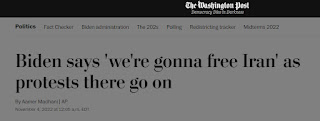
Biden: "We Will Free Iran"; Raisi: "Mr. President! Iran was liberated 43 years ago, and it’s determined to never become a milk cow."

    Friday, November 04, 2022   No comments

On Thursday, US President Joe Biden vowed to "liberate" Iran.

On Friday, a White House spokesman flet the need to clarify: President Joe Biden was expressing his solidarity with protesters in Iran by telling a crowd of his supporters, "We will liberate Iran."

White House national security spokesman John Kirby made the remarks to reporters a day after Biden made his comment at a rally in California.

On Friday, too, Iran's president said that the country had been freed by the 1979 Islamic revolution in response to a vow by US president Joe Biden to "free Iran". Ebrahim Raisi said: “Maybe he said this because of a lack of concentration...He said we aim to liberate Iran," 

“Mr. President! Iran was liberated 43 years ago, and it’s determined not to become your captive again. We will never become a milk cow.”


Submit your story (pitch an article)

Name

Email *

Message *


Trending Today...


ISR +


Frequently Used Labels and Topics

40 babies beheaded 77 + China A Week in Review Academic Integrity Adana Agreement afghanistan Africa African Union al-Azhar Algeria Aljazeera All Apartheid apostasy Arab League Arab nationalism Arab Spring Arabs in the West Armenia Arts and Cultures Arts and Entertainment Asia Assassinations Assimilation Azerbaijan Bahrain Bangladesh Belarus Belt and Road Initiative Brazil BRI BRICS Brotherhood CAF Canada Capitalism Caroline Guenez Caspian Sea cCuba censorship Central Asia Charity Chechnya Children Rights China Christianity CIA Civil society Civil War climate colonialism communication communism con·science Conflict conscience Constitutionalism Contras Corruption Coups Covid19 Crimea Crimes against humanity D-8 Dearborn Debt Democracy Despotism Diplomacy discrimination Dissent Dmitry Medvedev Earthquakes Economics Economics and Finance Economy ECOWAS Education and Communication Egypt Elections energy Enlightenment environment Epstein equity Erdogan ethics Europe Events Fatima FIFA FIFA World Cup FIFA World Cup Qatar 2020 Flour Massacre Food Football France Freedom freedom of speech G20 G7 Garden of Prosperity Gaza GCC GDP Genocide geopolitics Germany Global Security Global South Globalism globalization Greece Grozny Conference Hamas Health Hegemony Hezbollah hijab Hiroshima History and Civilizations Hormuz Human Rights Huquq Ibadiyya Ibn Khaldun ICC Ideas IGOs Immigration Imperialism In The News india Indonesia inequality inflation INSTC Instrumentalized Human Rights Intelligence Inter International Affairs International Law Iran IranDeal Iraq Iraq War ISIL Islam in America Islam in China Islam in Europe Islam in Russia Islam Today Islamic economics Islamic Jihad Islamic law Islamic Societies Islamism Islamophobia ISR MONTHLY ISR Weekly Bulletin ISR Weekly Review Bulletin Italy Japan Jordan Journalism Kenya Khamenei Kilicdaroglu Kurdistan Latin America Law and Society Lebanon Libya Majoritarianism Malaysia Mali mass killings Mauritania Media Media Bias Media Review Middle East migration Military Affairs Morocco Multipolar World Muslim Ban Muslim Women and Leadership Muslims Muslims in Europe Muslims in West Muslims Today NAM Narratives Nationalism NATO Natural Disasters Nelson Mandela NGOs Nicaragua Nicaragua Cuba Niger Nigeria Normalization North America North Korea Nuclear Deal Nuclear Technology Nuclear War Nusra October 7 Oman OPEC+ Opinion Polls Organisation of Islamic Cooperation - OIC Oslo Accords Pakistan Palestine Peace Philippines Philosophy poerty Poland police brutality Politics and Government Population Transfer Populism Poverty Prison Systems Propaganda Prophet Muhammad prosperity Protests Proxy Wars Public Health Putin Qatar Quran Rachel Corrie Racism Raisi Ramadan Ramadan War Regime Change religion and conflict Religion and Culture Religion and Politics religion and society Resistance Rights Rohingya Genocide rule of law Russia Salafism Sanctions Saudi Arabia Science and Technology SCO Sectarianism security Senegal Shahed sharia Sharia-compliant financial products Shia Silk Road Singapore Sistani Slavery Soccer socialism Southwest Asia and North Africa Sovereignty Space War Spain Sports Sports and Politics Starvation State Power State Terror Sudan Sunni Axis sunnism Supremacism SWANA Syria Ta-Nehisi Coates terrorism Thailand The Koreas Tourism Trade transportation Tunisia Turkey Turkiye U.S. Cruelty U.S. Foreign Policy UAE uk ukraine UN under the Rubble UNGA United States UNSC Uprisings Urban warfare US Foreign Policy US Veto US-Iran MoU USA Uyghur Venezuela Volga Bulgaria Wadee wahhabism War War and Peace War Crimes War on Iran Wealth and Power Wealth Building West Western Civilization Western Sahara WMDs Women women rights Work Workers World and Communities Xi Yemen Zionism

Search for old news

Find Articles by year, month hierarchy


WEEKLY AdSpace 3

_______________________________________________

Copyright © Islamic Societies Review. All rights reserved.