

We distill the noise from 340+ media outlets to deliver uncompromising, fact-based reporting on the world's most critical events.
About ISR WEEKLY: Our Editorial Approach
Islamic Societies Review Weekly is not a conventional political news outlet. We do not engage in partisan commentary, political advocacy, or reaction-driven reporting. Instead, we are committed to rigorous, fact-based journalism grounded in thorough research, careful sourcing, and reasoned analysis of events and developments in and affecting Muslim communities and societies worldwide.
Our origins and principal areas of focus are rooted in the diverse worlds of Islamic societies, but our audience is global. We write for readers across regions, cultures, and backgrounds—readers who are curious, well-informed, intellectually independent, and committed to understanding the world through evidence rather than assumption.
Our goal is to move beyond the immediate headline. We provide context, scrutinize evidence, identify underlying developments, and examine the broader social, political, economic, and intellectual implications of events and trends.
We believe that serious coverage of Muslim societies should be neither inward-looking nor defined by the assumptions of any single political, cultural, or ideological perspective. Islamic Societies Review Weekly seeks to provide an analytically rigorous and intellectually independent platform through which readers—wherever they are and whatever their background—can better understand what is happening, why it matters, how it came to be, and what it portends for the future.
Rationale: The “breaking” feature of ISR content is not reporting about an event before other outlets; rather, in its framing of the news cycle. Research has shown that Western media presents news stories filtered: editors carefully choose the words, headlines, images, and timing to achieve specific outcomes—an outcome that resonates with the political positions of the societies they serve, ignoring the true experience lived by affected communities. We Reframe the News Cycle One Story at a Time.
History: Started after the break of the 2011 protest movements, popularized as the "Arab Spring" that turned into proxy-wars for geopolitical purposes, as part of a research project, Islamic Societies Review became a trusted source of news and analyses covering key geopolitical events around the world.
Since then, Islamic Societies Review has continued to maintain the original essays site, and spun off the section (ISR Weekly) highlighting news stories and brief analysis.
With no reporters on the ground, the team monitors social media platforms and mainstream media to document some of the most significant events often ignored or buried deep in the inside pages of newspapers. The content published is always cross-referenced to ascertain, as best as the due diligence process allows, that the news story we share is not misinformation; that is why you will often see screencaptures of sources.
Today, ISR editors manually–not through algorithms and code/scripts–pick through 347 different news sources to curate the daily digest; then, out of the daily digests, the editors selects the top stories, the most consequential stories of the week, which are streamed daily on the website, ISR Weekly.
If you would like to join the team of editor, or submit a story, please reach out.
A weekly digest is emailed to subscribers only, for free.
What is media bias?
The subtle: when Muslims (or people of the Global South are killed to the action of Western governments or their allies, the news media just say that "X people were killed"; perpetrators of such violence are edited out.
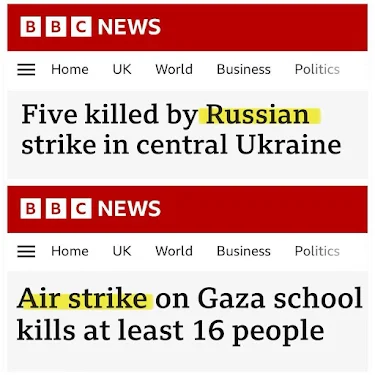
The obvious: The media outlet will shamelessly publish a story telling readers that you should be angry and move to act because this bad thing is happening to people like you, blue eyed-while men and women.

And everything in between: Leaving out stories Western media outlets do not want the public to know stories, finding “Prime Time” and "Prime Space" for running news stories, archiving them early, re-editing the headlines, "recalibrating" the language, selecting the right photo…

How can you help?
> SHARE NEWS STORIES WITH ISR WEEKLY:
If you have a news stories or an articles that meets the standard we highlighted above and you would like to share with our readers, please join in as contributor, or submit your content.
> Subscribe:
We respect your time and your privacy: you will not hear from us unless we have an update to share with you; and you will not receive more than 1 email from us per week in average. You will be able to Opt-out any time. Subscribe now
> Resources:
Using Generative AI: Disclosures and Guidelines (adopted)
As a news and analysis provider that relies on public-domain and third-party sources, Islamic Societies Review uses both human expertise and technological tools to collect, review, edit, and publish content. At every stage of the editorial process, human editors and contributors retain full responsibility for all published material.
Our guiding principles for the use of generative AI, large language models (LLMs), and related technologies are as follows:
- We believe emerging technologies can help make our content more accessible to a broader global audience. Accordingly, AI and LLM tools may be used thoughtfully and responsibly, rather than prohibited outright.
- AI and LLM tools may assist content creators, editors, and readers in various tasks; however, all work must remain under human direction, supervision, and accountability. Human editors are ultimately responsible for all published content, and every publication must undergo editorial review.
- Readers should be able to trust that the information we publish is factually accurate and consistent with our standards for transparency, editorial integrity, and ethical practice.
- Because our reporting is based on third-party and public-domain sources, we do not use AI or LLM tools to generate original news reporting. However, such tools may be used for limited editorial purposes, including language editing, synthesizing multiple reports, and creating supporting materials such as editorial cartoons, graphs, illustrations, and other analytical aids. All such materials must be reviewed and approved by human editors or content creators before publication.
- We may also recommend AI and LLM tools to readers for purposes such as translation, accessibility, or summarization of our content.




 Posts
Posts





