Showing posts with label terrorism. Show all posts

Wednesday, July 29, 2026

A Decade of Transformation: Al-Julani's Public Debut and the Geopolitical Chess Game in Syria

    Wednesday, July 29, 2026   No comments

Ten years ago today, a masked militant leader removed his veil before the world, signaling not just a rebranding but a revealing chapter in the complex theater of proxy warfare.

July 30, 2026 — On this day in 2016, Abu Mohammad al-Julani, then the emir of Jabhat al-Nusra, Al-Qaeda's Syrian affiliate, sat before an Aljazeera camera and publicly revealed his face for the first time. Flanked by two other figures, dressed in military fatigues with a white turban, he read from a statement that would reshape the Syrian conflict's trajectory: the severance of formal ties with Al-Qaeda and the birth of "Jabhat Fath al-Sham" (The Front for the Conquest of Syria).

In the carefully staged video, broadcast exclusively by Qatar's Aljazeera, al-Julani—now known as Ahmad al-Sharaa and the self-decalred leader of Syria's transitional government—thanked Al-Qaeda's leadership, including Ayman al-Zawahiri, for their "noble stance" in prioritizing "the interests of the people of Al-Sham, their Jihad, their revolution."

He quoted Osama bin Laden: "The interests of the Ummah take precedence over the interest of any state; the interests of the state take precedence over the interest of any Jama'ah (group); the interests of the Jama'ah take precedence over any individual."

Then came the announcement: "For the aforementioned reasons, we declare the complete cancellation of all operations under the name of Jabhat Al-Nusra, and the formation of a new group operating under the name 'Jabhat Fath Al-Sham,' noting that this new organisation has no affiliation to any external entity."

The statement outlined five goals:

Establishing Sharia law and justice

  • Unifying mujahideen ranks to liberate Syria from Bashar al-Assad
  • Protecting jihad in Syria
  • Serving Muslims' daily needs
  • Ensuring security and stability for the masses

The Afghan Template Revisited

This moment, a decade ago, reveals a pattern as old as the modern jihad movement itself. The theatrical severing of ties, the rebranding, the public unveiling—these were not signs of ideological moderation but of strategic adaptation within a framework that has served various geopolitical interests since the 1980s.

During the Soviet-Afghan War, the United States, through Pakistan's ISI and Saudi Arabia, funneled billions to mujahideen fighters, including those who would later form Al-Qaeda. The strategy was clear: use religiously motivated fighters as a proxy force against a geopolitical rival. When the Soviets withdrew in 1989, the infrastructure of jihad remained, as did the networks, the ideology, and the operatives.

What we witnessed in Syria, and particularly in al-Julani's 2016 announcement, was the refinement of this model. By 2016, the Syrian conflict had become the new Afghanistan—a proxy battlefield where regional and global powers could fight without direct confrontation. Russia had intervened in 2015 to prop up Assad. The United States was backing various opposition groups while simultaneously fighting ISIS. Turkey, Saudi Arabia, Qatar, and Iran were all pursuing their own agendas.

The Convenience of "Moderate" Extremism

Al-Julani's statement emphasized that the new organization would have "no affiliation to any external entity"—a claim that strained credibility given the complex web of support flowing through Turkey and other channels. Yet this rebranding served multiple masters:

For al-Julani and his fighters, it provided operational flexibility, allowing them to receive support from actors who couldn't openly back an Al-Qaeda affiliate. It enabled participation in political processes and potential negotiations.

For regional powers, particularly Turkey and Gulf states, it created a deniable proxy—a group that could fight Assad and Kurdish forces while maintaining plausible distance from Al-Qaeda's global terrorism brand.

For the United States and its allies, it fit a familiar pattern: the "good jihadist" versus "bad jihadist" dichotomy that had proven so useful in Afghanistan, Bosnia, Kosovo, and Libya. While officially designating Al-Nusra as a terrorist organization, the reality on the ground was more nuanced, with the group often fighting against ISIS and Assad—enemies shared with the West.

The Strategic Assimilation

The video's content reveals the ideological continuity beneath the organizational change. Al-Julani quoted bin Laden's hierarchical framework of interests, demonstrating that the strategic thinking remained intact even as the organizational chart changed. The goal of establishing Sharia law, unifying mujahideen, and liberating Syria remained constant.

What changed was the packaging—and that was the point. The transformation from Al-Nusra to Jabhat Fath al-Sham (and later to Hay'at Tahrir al-Sham) demonstrated how jihadist groups could evolve tactically while maintaining strategic objectives. This adaptability made them more useful to various geopolitical actors pursuing their own interests in Syria.

The fact that this announcement was broadcast on Al Jazeera, a Qatari state-funded network, was itself significant. Qatar, a U.S. ally hosting America's largest Middle East military base at Al Udeid, was providing a platform for a former Al-Qaeda leader to announce his group's rebranding—highlighting the complex, often contradictory nature of Middle East geopolitics.

A Decade Later: From Jihadist to Statesman

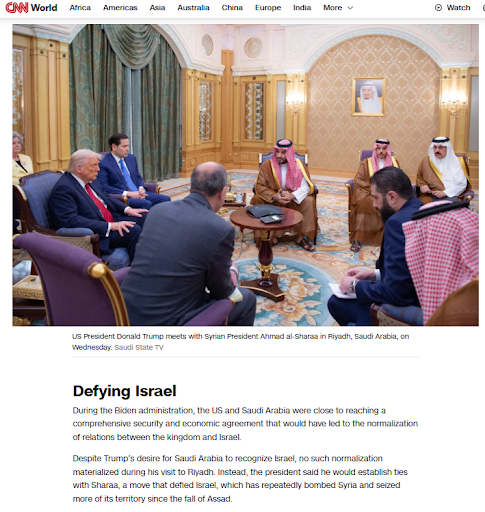
The ultimate irony of this anniversary is where al-Julani stands today. Now governing Syria as Ahmad al-Sharaa, wearing suits instead of fatigues, meeting with world leaders, and leading a transitional government, he has completed the transformation that began with that 2016 announcement.

This trajectory—from masked jihadist to public political leader—validates the strategic thinking outlined in that video. By severing the formal Al-Qaeda link, maintaining operational capability, and positioning himself as a defender of Syrian interests against both Assad and foreign powers, al-Julani navigated the conflict to emerge as Syria's de facto leader.

The Enduring Pattern

Ten years on, al-Julani's public debut reminds us that the use of jihadist groups as geopolitical tools didn't end with the Soviet withdrawal from Afghanistan. It evolved. The Syrian conflict demonstrated that even groups with global terrorist ambitions could be assimilated into regional power struggles, serving interests that extended far beyond their ideological goals.

The United States, which once armed the mujahideen against the Soviets, found itself in Syria in the uncomfortable position of tacitly benefiting from the efforts of groups it officially designated as terrorists, when those groups fought against ISIS and Assad—enemies aligned against U.S. interests.

This is not to suggest a conspiracy, but rather to acknowledge a recurring pattern: in the chaos of proxy warfare, ideological enemies can become tactical allies, and today's terrorist can become tomorrow's negotiating partner. The 2016 announcement wasn't a break from Al-Qaeda's strategy—it was the fulfillment of it, demonstrating the movement's ability to adapt, survive, and ultimately thrive within the international system it claims to reject.

As Syria attempts to rebuild under al-Sharaa's leadership, this anniversary serves as a stark reminder of the unintended consequences of proxy warfare and the long shadows cast by geopolitical expediency. The man who once quoted bin Laden now sits in presidential palaces, and the world must decide whether to engage with him—a testament to the complex, morally ambiguous reality of modern geopolitics.

Tuesday, July 28, 2026

From the Shadows of Al-Qaeda to the Halls of Washington--The Geopolitics of Forgetting

    Tuesday, July 28, 2026   No comments

 For Lindsey Snell, the past is not a foreign country; it is a high-definition video file playing on a screen. The American freelance journalist and filmmaker recently published archival footage from July 2016, capturing the chilling moments just before she was abducted in the Aleppo countryside of Syria. In the video, a masked militant stands before a black flag, articulating a vision for a strict Sharia state. Snell asserts that beneath the mask, the voice and physical mannerisms belong to Mohammad Qanatri, the man who would eventually become Syria’s current chargé d'affaires in Washington, D.C.

Snell’s harrowing two-week captivity and subsequent escape into Turkey, followed by her 67-day detention by Turkish authorities, is a matter of public record. But her recent revelation strikes at the heart of a much larger, deeply uncomfortable geopolitical paradox. Qanatri is not an anomaly; he is a single node in a vast network that has successfully rebranded itself, transitioning from the shadows of global terrorism to the polished corridors of Western diplomacy.

The trajectory of Jabhat al-Nusra, Al-Qaeda’s former Syrian affiliate, provides the context for this stunning rehabilitation. Over the past decade, the group evolved, rebranded, and eventually coalesced into Hayat Tahrir al-Sham (HTS). At the helm of this transformation is Ahmed al-Sharaa, known to the world for years by his nom de guerre, Abu Mohammad al-Jolani. Once the emir of Al-Qaeda in Syria, Sharaa has systematically remolded his image from a ruthless insurgent commander to a pragmatic statesman.

This rebranding has culminated in an unprecedented diplomatic normalization. The de facto leader of a Syria once dominated by Bashar al-Assad is now being courted by Western capitals. The most striking symbol of this shift is the reported invitation extended to Sharaa to the White House by President Trump. For a man who once commanded the very network that the United States swore to dismantle, a seat at the table in Washington represents the ultimate political vindication.

This rapid ascent of former Al-Qaeda operatives into the realm of accepted diplomacy places Western governments in a profoundly precarious and ironic position. For twenty years, the West waged a grueling, trillion-dollar Global War on Terror. Hundreds of thousands of lives were lost, and entire military doctrines were built around the singular premise that Al-Qaeda and its ideological offshoots were an existential threat that must be eradicated. Western intelligence agencies, military special operations forces, and diplomats spent two decades hunting, fighting, and killing the very individuals who now sit across the negotiating table.

Today, however, the geopolitical calculus has shifted, and the enemies of yesterday have become the indispensable partners of today. The West’s embrace of HTS and its leadership is driven by a stark strategic reality: the defeat of the Assad regime, the containment of Iranian influence in the Levant, and the marginalization of Russian and Chinese power in the region. In the eyes of Western strategists, Sharaa and his commanders are no longer terrorists to be hunted; they are the only viable mechanism to ensure a stable, post-Assad Syria that aligns with Western regional interests.

This pivot raises profound questions about the consistency of Western foreign policy. The rehabilitation of figures like Mohammad Qanatri and Ahmed al-Sharaa suggests that the ideological red lines drawn after the September 11 attacks have been quietly erased. The rhetoric of counter-terrorism, democracy promotion, and human rights—once the stated pillars of Western intervention in the Middle East—has been subordinated to cold realpolitik.

For victims like Lindsey Snell, and for the millions of Syrians who suffered under the brutal rule of various militant factions, this diplomatic pivot is a bitter pill. It highlights a cynical reality of international relations: when strategic imperatives change, principles and human rights norms are frequently the first casualties. The architects of the Global War on Terror are now shaking hands with its former foot soldiers, proving that in the grand chessboard of global power, alliances are rarely built on shared values. Ultimately, the transition from the battlefields of Aleppo to the diplomatic halls of Washington underscores a simple, enduring fact of global politics. It is rarely about principle; it is almost entirely about self interests. 

Monday, July 20, 2026

Israeli Commander’s Warning on Settler Violence Mirrors the Fatal Contradictions of White Minority Rule

    Monday, July 20, 2026   No comments

 Echoes of Apartheid

In a rare moment of candid internal critique, a senior Israeli military official has sounded the alarm on the surging violence committed by Israeli settlers in the occupied West Bank, explicitly labeling the phenomenon "Jewish terrorism." The admission, made by Central Command chief Avi Blot during a closed conference, highlights a deep fracturing within the Israeli security apparatus. Beyond the immediate tactical concerns, Blot’s warnings illuminate a grim historical parallel: the structural and ideological similarities between this unchecked settler violence and the white vigilante violence that ultimately consumed the Apartheid regime in South Africa.

According to reports from the public broadcaster KAN, Blot did not mince words, stating unequivocally that "Jewish terrorism threatens everyone’s security." He sharply criticized settler youth who reject the rule of law and disregard state institutions, noting that the establishment of illegal outposts and the broader rise in nationalist crime are placing immense strain on the military. The violence, he warned, consumes the time and resources of commanders while actively eroding Israel’s "international legitimacy."

While Blot did not oppose the broader concept of settlements—merely suggesting they be restricted to Area C—his confession underscores a reality long documented by human rights organizations: the Israeli military is increasingly bogged down not just by Palestinian resistance, but by the rogue, state-tolerated violence of its own civilian settlers.

This dynamic bears a striking resemblance to the fatal contradictions of white minority rule in South Africa during the Apartheid era.

The Parallels of State-Sanctioned Vigilantism

During the height of Apartheid, the South African state relied on a complex web of formal security forces and informal white vigilante groups to enforce racial subjugation and seize Black land. Much like the Israeli settlers in the West Bank today, white extremist groups in South Africa often operated with a profound sense of impunity. They carried out extrajudicial violence, forced removals, and intimidation against Black South Africans, frequently with the tacit approval or willful blindness of the state.

However, the Apartheid state eventually realized that this decentralized, vigilante violence was a double-edged sword. Just as Blot notes that settler violence "actively consumes the time and resources" of the Israeli military, the South African security forces found themselves stretched to the breaking point, forced to manage the chaos generated by their own ideological extremists. The white vigilantes, while sharing the state's overarching goal of territorial and racial dominance, ultimately undermined the state's monopoly on violence, creating internal instability that accelerated the regime's collapse.

The Hypocrisy of the "Rule of Law"

Blot’s criticism of settlers who "reject the rule of law" highlights a profound hypocrisy that is central to both the Israeli occupation and the Apartheid regime. In South Africa, the "rule of law" was a facade—a rigid, draconian framework used to criminalize the existence and movement of Black South Africans, while white citizens who committed violent crimes against Black people were rarely prosecuted by the white justice system.

Today, a similar dual legal system exists in the West Bank. Palestinians are subjected to military courts, administrative detention, and strict civil controls, while settler violence against them is overwhelmingly ignored by Israeli law enforcement. Blot’s frustration with settlers ignoring state authority mirrors the late-stage Apartheid dilemma: a state that builds its foundation on systemic lawlessness and oppression eventually finds that its own citizens no longer respect the law either. When the law is used merely as a tool of subjugation rather than justice, it loses all moral and practical authority.


Settlers Violence to Erase Palestinian Identity

Israeli settlers storm Sebastia archaeological site during Palestine's UNESCO bid. Israeli settlers stormed the archaeological site in the town of Sebastia, northwest of Nablus, on 20 July, raiding the grounds in several vehicles under heavy Israeli military protection, WAFA reported.

The incursion came as Muslim, Christian, and Samaritan religious leaders were gathered at the site in a show of support for Palestine's urgent request to add Sebastia to the UNESCO World Heritage List, submitted at the World Heritage Committee's 48th session underway in Busan, South Korea.

Settlers and occupation forces regularly raid Sebastia, particularly its archaeological area, in a sustained campaign to seize control of the historical site and erase its Palestinian identity.


Land Grabs, Overextension, and International Isolation


Blot highlighted the establishment of illegal outposts in areas designated under Palestinian civil or security control as a major point of friction. This mirrors the Apartheid regime’s endless attempts to redraw borders, consolidate white-controlled land, and push Black South Africans into fragmented "Bantustans." In both contexts, the relentless drive for territorial expansion requires a massive, ongoing deployment of security forces to protect the settlers, draining the military and creating endless flashpoints for violence.

The human cost of this expansion is staggering. Official Palestinian records indicate that since October 2023, the combined actions of the Israeli military and Jewish settler violence have resulted in 1,181 Palestinian deaths and nearly 13,000 injuries.

It is this exact brand of relentless, unchecked violence that led to the international isolation of Apartheid South Africa. Blot’s explicit concern that settler violence is eroding Israel’s "international legitimacy" is a direct nod to this historical trajectory. The Apartheid regime fell largely because the global community refused to tolerate the brutal, legalized violence inflicted upon Black South Africans, leading to crippling sanctions and diplomatic pariah status. Blot’s warning suggests that Israel’s military leadership recognizes they are walking the exact same path.

A System Consuming Itself


Avi Blot’s unprecedented admission is a stark acknowledgment that the occupation is mutating. The Israeli military, tasked with securing the state, is increasingly finding itself in the role of managing a rogue settler population whose "Jewish terrorism" threatens the very security and global standing of the state they claim to defend.

The parallels to Apartheid South Africa are structural and systemic. When a state empowers a privileged class of settlers to dispossess and violently subjugate an indigenous population, it unleashes forces it can eventually no longer control. The white violence against Black South Africans was the rot that hollowed out the Apartheid state from within. As Blot’s warning makes clear, the unchecked violence of Israeli settlers in the West Bank is proving to be the exact same fatal contradiction for the state of Israel.


Israeli minister Ben Gvir demands Gaza style destruction across occupied West Bank


Israel's National Security Minister Itamar Ben Gvir has publicly called for applying the catastrophic military devastation inflicted on Gaza to Palestinian towns and villages throughout the occupied West Bank.


Sunday, April 19, 2026

Media Review: Blockades Are Weapons of Policy for Some, Crimes for Others

    Sunday, April 19, 2026   No comments

In the escalating tensions surrounding the Strait of Hormuz, a familiar rhetorical pattern has emerged: actions labeled "economic terrorism" or "blackmail" when undertaken by Iran are framed as legitimate instruments of statecraft when deployed by the United States and its allies (Saudi Arabia and UAE have imposed a crushing blockade against Yemen since 2017). This selective application of moral and legal judgment reveals not merely a policy disagreement, but a deeper structural asymmetry in how international norms are invoked and enforced.

In March 2026, UAE Minister of Industry and Advanced Technology Dr. Sultan Al Jaber declared at CERAWeek that "weaponizing the Strait of Hormuz is not an act of aggression against one nation. It is economic terrorism against every nation." His statement echoed U.S. rhetoric, with President Donald Trump asserting that Iran "cannot blackmail us" with threats to close the strategic waterway.

Iran's position, articulated through official channels, frames its actions differently. Tehran has demanded compensation estimated at $270 billion for infrastructure damage sustained during recent U.S.-Israeli military operations, proposing a mechanism that could include transit fees on vessels passing through the Strait. Iranian officials argue this is not coercion but a lawful claim for reparations under international law principles governing state responsibility for wrongful acts.

The accusation of "economic terrorism" directed at Iran stands in stark contrast to the documented history of U.S. foreign policy. The United States has employed economic sanctions and blockades as primary tools of statecraft for decades. Following the 1979 Iranian Revolution, Washington imposed comprehensive economic, trade, and financial sanctions that have expanded under successive administrations.

In 2010, the U.S. introduced "secondary sanctions" compelling foreign entities to choose between access to American markets and engagement with Iran—a form of economic coercion that significantly reduced Iranian oil exports by 1.4 million barrels per day. These measures were not framed as "terrorism" but as legitimate instruments of non-military pressure.

International law scholars note that economic sanctions have become a prominent part of the American response to foreign state involvement in international terrorism, yet the legal distinction between punitive sanctions and what critics term "economic warfare" remains contested. The Geneva Centre for Security Policy defines "economic terrorism" narrowly as attempts at economic destabilization by non-state groups, a definition that does not clearly encompass state-led sanctions regimes.

Under modern international law, blockades are considered acts of war. According to established doctrine, a blockade is legal only if applied in self-defense and conducted in accordance with principles of necessity and proportionality. The United Nations Charter permits blockades under Article 42, but only as measures authorized by the Security Council to maintain or restore international peace and security.

The Strait of Hormuz presents particular legal complexity. As an international strait, it is governed by the United Nations Convention on the Law of the Sea (UNCLOS), which guarantees transit passage for all vessels. The International Maritime Organization has affirmed that "freedom of navigation is a fundamental principle of international maritime law, and it must be respected by all Parties, with no exception."

However, the application of these principles in practice reveals asymmetries. While Iran's threat to restrict passage has been widely condemned, legal analysts note that a U.S. naval blockade of Iranian ports—absent explicit Security Council authorization or clear self-defense justification—also raises significant questions under international law. As one maritime security specialist observed, such a blockade "is legal under international law but contradicts the ceasefire and has limitations."

The Compensation Question: Precedent and Principle

Iran's demand for $270 billion in compensation for infrastructure damage invokes established principles of state responsibility. Under international law, states that commit internationally wrongful acts are obligated to make full reparation for injury caused. The Iran-United States Claims Tribunal, established after the 1979 revolution, created precedent for adjudicating such claims through neutral arbitration.

The political reality complicates legal principle. Iran's proposal to fund compensation through a Hormuz transit protocol has been characterized by critics as leverage, while similar mechanisms—such as sanctions relief negotiated in the 2015 Joint Comprehensive Plan of Action—were framed as diplomatic compromise. This divergence in framing underscores the central concern: when does economic pressure constitute legitimate statecraft, and when does it cross into coercion that violates sovereign equality?

International legal scholarship has noted that economic coercion is regulated differently when undertaken collectively under UN auspices, but unilateral economic pressure occupies a gray zone in international law.

The Strait of Hormuz crisis illuminates a broader challenge in international relations: the gap between the universalist aspirations of international law and the particularist practices of powerful states. When the same action—using economic leverage to achieve political ends—is condemned as "terrorism" when undertaken by one actor but normalized as "statecraft" when deployed by another, the credibility of the rules-based order erodes.

The Gaza Blockade: A Case Study in Enduring Economic Pressure

The double standard becomes even more pronounced when examining the blockade of Gaza, imposed by Israel with sustained U.S. diplomatic and material support since 2007. For nearly two decades, restrictions on the movement of people and goods through land crossings, airspace, and territorial waters have severely constrained Gaza's economy, limited access to essential supplies, and contributed to recurring humanitarian crises. International organizations, including the United Nations and the International Committee of the Red Cross, have repeatedly warned that the blockade amounts to collective punishment, prohibited under international humanitarian law. Despite these concerns, the policy has persisted through multiple U.S. administrations. Even during periods when Washington promoted so-called "peace plans" aimed at resolving the Israeli-Palestinian conflict, the fundamental architecture of the blockade remained intact, with humanitarian exemptions often insufficient to address systemic deprivation. This continuity underscores a central contradiction: when a U.S. ally enforces a long-term blockade with profound civilian consequences, the language of "economic terrorism" is notably absent from official discourse.


Friday, January 30, 2026

The UAE's Precarious Balancing Act

    Friday, January 30, 2026   No comments

Wealth, Power, and the Cost of Ambition

The United Arab Emirates has engineered one of the most remarkable transformations in modern history—morphing from a collection of desert sheikhdoms into a glittering global hub of finance, tourism, and geopolitical influence. Yet beneath the soaring skyscrapers of Dubai and Abu Dhabi lies a more complicated reality: a nation-state where approximately 85% of residents possess no political voice, where foreign policy pivots between great powers with transactional precision, and where regional ambitions increasingly strain alliances once considered unshakable.


The UAE's economic miracle rests upon a demographic paradox. Emirati citizens—ethnic Arabs whose families trace roots to the seven emirates—comprise only 11–15% of the population. The remaining 85–89% are foreign workers, ranging from highly paid Western executives to South Asian laborers who constructed the very towers that define the UAE's skyline. This majority population lives under a kafala (sponsorship) system that legally ties workers to employers, restricts freedom of movement, and denies pathways to citizenship regardless of decades of residence.

Human Rights Watch and Amnesty International have documented systemic abuses: confiscated passports, wage theft, dangerous working conditions, and barriers to unionization. While recent labor reforms have introduced modest improvements—such as allowing job changes without employer permission—fundamental disenfranchisement remains. Migrant workers cannot vote, run for office, or meaningfully influence laws governing their lives. The state justifies this arrangement as necessary for economic management; critics call it a caste system financed by oil wealth, where prosperity for the few depends on the political silencing of the many.

Playing All Sides: A Foreign Policy of Calculated Ambiguity

The UAE has mastered what some analysts call "hedging diplomacy"—cultivating relationships with rival powers simultaneously to maximize leverage and minimize vulnerability. This approach has yielded significant returns but carries growing risks.

Abu Dhabi positions itself as a steadfast U.S. security partner: hosting American military bases, normalizing relations with Israel through the Abraham Accords, and providing counterterrorism intelligence. Yet it simultaneously deepens ties with Washington's strategic competitors. The UAE has become a favored sanctuary for sanctioned Russian oligarchs, with Dubai's luxury real estate market absorbing billions in assets fleeing Western sanctions after Moscow's 2022 invasion of Ukraine. U.S. intelligence sources have alleged Emirati officials shared identities of American intelligence officers with Russian counterparts—a breach that would constitute a profound betrayal of trust.


With China, the relationship runs deeper still. The UAE hosts Chinese surveillance technology firms, collaborates on artificial intelligence development, and welcomed Huawei's 5G infrastructure despite U.S. security warnings. When Washington conditioned a potential F-35 fighter jet sale on guarantees against Chinese espionage, Abu Dhabi responded by purchasing French Rafale jets—a pointed signal of its refusal to choose sides.

This multi-vector strategy extends to regional conflicts. While publicly aligned with Saudi Arabia in Yemen's civil war, the UAE covertly armed the Southern Transitional Council (STC), a separatist force seeking to fracture Yemen—a direct contradiction of Riyadh's objective to preserve Yemeni unity. Similar patterns emerged in Libya, where UAE-backed forces assaulted Tripoli against UN wishes, and in Sudan, where Western intelligence agencies accuse Abu Dhabi of supplying weapons to the Rapid Support Forces amid a campaign of ethnic cleansing.

The Saudi Rift and America's Reckoning

These contradictions may be reaching a breaking point. In late 2025, Saudi Arabia—long the UAE's senior Gulf partner—issued a stark ultimatum: withdraw all military forces from Yemen and cease support for separatists within 24 hours. Riyadh backed its demand with airstrikes on the port of Mukalla, targeting vessels allegedly carrying Emirati weapons. The move signaled an end to Riyadh's tolerance for Abu Dhabi's parallel agenda in Yemen, which Saudi officials now view as an existential threat to their southern border.


For Washington, the Saudi-UAE rupture presents a dilemma. The UAE remains valuable: a stable platform for U.S. forces, a counterweight to Iranian influence, and an investor in American assets. Yet its simultaneous courtship of Moscow and Beijing, its sanctuary for sanctioned oligarchs and organized crime figures like drug lord Daniel Kinahan, and its destabilizing regional interventions increasingly undermine core U.S. interests.

The Biden administration had grown wary of Emirati duplicity. The Trump administration, while embracing Gulf monarchies rhetorically, also confronted UAE-China technology ties. With geopolitical competition intensifying, American patience for "allies" who hedge against U.S. strategic priorities may be wearing thin—especially as Saudi Arabia, under Crown Prince Mohammed bin Salman, asserts itself as the undisputed Gulf leader and aligns more closely with Washington's regional framework.

An Empire of Sand?

The UAE's model—concentrating political power among a tiny citizen elite while leveraging hydrocarbon wealth to purchase global influence—has proven remarkably effective for decades. But its sustainability faces mounting pressures: Saudi assertiveness, American strategic recalibration, and the moral contradiction of a "tolerant" society built on systemic disenfranchisement.


The UAE is not an empire in the classical sense. It commands no formal colonies. Yet its strategy—using capital to shape outcomes in Sudan, Somalia, Yemen, and beyond while denying political rights at home—reflects an imperial mindset: that wealth confers the right to reorder weaker states' destinies without accountability.

Whether this model survives depends on choices Abu Dhabi now faces. It can double down on transactional opportunism, risking isolation as great powers demand clearer allegiances. Or it can undertake genuine reforms—extending labor rights, accepting constraints on destabilizing interventions, and choosing strategic clarity over perpetual hedging.

The world has long excused the UAE's contradictions because of its gleaming airports and financial hubs. But as Yemen fractures, Sudan burns, and great-power competition hardens, the luxury of ambiguity may be ending. The UAE built a nation on sand. Its next challenge is proving that sand can bear the weight of empire—or that it ever should have tried.

Tuesday, December 09, 2025

In the News: "Terrorism" as an Instrument for Power to Rewrite Morality

    Tuesday, December 09, 2025   No comments

In the echoing halls of State power, words are never just words. They are weapons—sharpened, aimed, and deployed with chilling precision. In modern times, few labels carry the weight, stigma, and lethal consequence of “terrorist.” Once uttered by an authority, it can shatter lives, dissolve rights, and justify violence that would otherwise be unthinkable. However, history—and current events—reveal a disturbing truth: the designation of “terrorism” is rarely about objective danger. More often, it is a political tool, a fluid and arbitrary label calibrated not by justice, but by convenience.


Consider this: in December 2025, Florida Governor Ron DeSantis declared the Council on American-Islamic Relations (CAIR)—one of the largest Muslim civil rights organizations in the United States—a “foreign terrorist organization.” Texas Governor Greg Abbott had done the same just weeks earlier. Neither group is listed as such by the U.S. State Department. CAIR, founded in 1994, operates 25 chapters nationwide, advocating for religious freedom, challenging discrimination, and engaging in voter outreach. Its “crime”? Being visibly Muslim in a political climate where visibility itself can be deemed subversive.

DeSantis’s executive order bars state contracts, employment, and funding from flowing to CAIR or anyone who has “provided material support” to it—a phrase so broad it could criminalize donating to a mosque that partners with CAIR on community programs. CAIR has vowed to sue, calling the move “unconstitutional” and “defamatory.” And rightly so. This isn’t counterterrorism; it’s political theater dressed in the language of national security.

But the deeper scandal lies not just in this act of domestic overreach—it’s in the glaring hypocrisy that reveals how empty the term “terrorist” has become.

Go back to Algeria in the 1950s. French colonial authorities branded the National Liberation Front (FLN)—fighters resisting decades of brutal occupation—as “terrorists.” They were hunted, tortured, imprisoned, and executed under that label. Today, the FLN is recognized as the vanguard of a legitimate anti-colonial struggle. Their “terrorism” was, in truth, resistance to systemic dehumanization. The label was never about violence per se; it was about who held the pen that wrote history—and the laws.

Fast forward to the 21st century. The United States spent trillions of dollars, launched endless wars, and dismantled civil liberties in the name of fighting al-Qaeda and its offshoots. Then, when Abu Mohammad al-Jolani—once a senior commander in al-Qaeda’s Syrian affiliate—rebranded himself as Ahmed al-Sharaa and emerged as the de facto leader of post-Assad Syria, something curious happened. The U.S. State Department quietly removed him from its terrorist watchlist. Western diplomats began treating him not as a wanted extremist, but as a pragmatic statesman who, in their telling, came to power through “the freest of elections.” Never mind that al-Sharaa’s forces committed documented atrocities. Never mind the ideological continuity between his past and present. What mattered was utility: he now aligned with geopolitical interests. The label evaporated not because the man changed—but because the politics did.

This is the arbitrariness at the heart of the terrorism designation. It is not a fixed moral category. It is a switch that powerful states flip on or off depending on whether a group serves or threatens their agenda. Liberation fighters become terrorists when they defy empire; terrorists become leaders when they serve it.

And now, at home, that same logic is being turned inward. Muslim civil society groups like CAIR—organizations that file lawsuits against discriminatory policies, defend worshippers facing hate crimes, and register voters—are recast as foreign threats. Why? Because vilifying them energizes a political base. Because associating Islam with terror—even without evidence—fuels a narrative of civilizational conflict that benefits those in power.

The result is not safety, but silencing. When “terrorist” can mean both an Algerian schoolteacher smuggling pamphlets under French rule and an American lawyer defending mosque vandalism victims in Florida, the word loses all meaning. It becomes what it has always been in practice: a cudgel for the powerful to strike down the inconvenient.

True security does not come from arbitrary labels or executive orders signed for headlines. It comes from justice, due process, and the courage to distinguish between those who threaten innocent lives and those who merely challenge the status quo. Until then, the word “terrorism” will remain not a shield for the public—but a sword for the State.


Thursday, May 15, 2025

The Political Instrumentalization of “Terrorism” and Sanctions in Contemporary Foreign Policy

    Thursday, May 15, 2025   No comments

 The recent developments surrounding former jihadist Ahmed al-Sharaa—formerly known as Abu Mohammed al-Jolani—and his transformation from a wanted terrorist leader into a sitting president welcomed by the President of the United States illustrate a deeply troubling fact in international relations: the arbitrary use of the “terrorism” label and economic sanctions as tools of political convenience rather than principled governance.

In 2013, al-Sharaa was designated by the United States as a “Specially Designated Global Terrorist” due to his leadership of the al-Qaeda affiliate in Syria, Jabhat al-Nusra, and his alleged role in orchestrating suicide bombings. At one point, the U.S. placed a $10 million bounty on his capture. Today, however, he shares tea and diplomatic smiles with President Donald Trump, without any transparent legal or procedural process to formally clear his name of terrorism charges. This dramatic pivot—absent any public renunciation of past actions, judicial review, or commitment to democratic norms like elections—exposes the malleability of the terrorism designation when it becomes inconvenient for geopolitical strategy... read more >>

Saturday, May 10, 2025

Russia's non-diplomatic response to Ukraine's threat to target world leaders attending Victory Day: our Army doesn’t engage in terrorism like yours

    Saturday, May 10, 2025   No comments

Dmitry Medvedev, the former President and Prime Minister of Russia and current Deputy Chairman of the Security Council, made a public statement in response to Ukrainian officials who reportedly said that Ukraine could not guarantee the safety of foreign leaders visiting Moscow for the Victory Day celebrations.

In his statement, Medvedev used non-diplomatic language aimed at what appears to be Ukrainian President Volodymyr Zelenskyy, referencing drug use and calling him a "typhus-carrying louse." He questioned what Zelenskyy would do if Russia stated it could no longer guarantee the safety of European leaders visiting Kyiv. Medvedev also claimed that the Russian army does not engage in terrorism, in contrast to what he described as "Banderite bastards," referring to Ukrainian nationalists. He ended the message by referencing comments made about the Victory Day parade in Moscow.


Russia's foreign PM, President, and now head of the security systems in Russia, Dmitry Medvedev:

"What would the typhus-carrying louse with a coke-dusted nose do if he were told that our country can no longer “guarantee the safety” of the European leaders who arrived in Kiev today?  Chill out, rat! Unlike the Banderite bastards, our Army doesn’t engage in terrorism. Just remember today, you degenerate, all the crap you said about the Victory Parade in Moscow."


Friday, April 25, 2025

Pakistan, Saudi Arabia, Terrorism, and the West

    Friday, April 25, 2025   No comments


Journalist prefaced her question to Pakistani official by stating that Pakistan has a lonh g history of supporting terrorism. In response, the Pakistani Minister of Defense replied:


"We have been doing this dirty work for the United States and the West — including Britain — for about three decades."

He is referencing Pakistan's role in training the "mujahideen" of Afghanistan to fight the Soviet Union, who later, under al-Qaeda leadership, one of the Mujahideen groups, attacked US on 9/11, and that started the war on terror, which Pakistan joined again, under the request of the West. 

The crisis in Kashmir has been just one element that created the alliance between Saudi Arabia, United States, and Pakistan to "radicalize", which means, to wahhabitize Muslims, to fight the "good" war against the Soviet Union, and Pakistan hoped that it can use them to control all of Kashmir, too. It turned out that using religion for political gains did not work well for all three partners in the long run.


Friday, December 20, 2024

US officials sat face to face with the person US government designated a "terrorist"

    Friday, December 20, 2024   No comments

US officials sat face to face with the person US government designated a "terrorist" and offered $10 million bounty for his arrest. Realizing the awkwardness of the moment, the administration announced later that it will cancel the reward for Jolani’s arrest.

In what must be a bizarre turn of events, US government officials set face to face with a man they allocated $10 million for information leading to determining his whereabouts, after designating him as a "terrorist" in 2017. 

State department still confirmed that the reward money is still valid, at a time when members of the State Department reportedly sat with Jolani. 

This development raises questions about the designation "terrorist", and now about what it takes for one to be removed from the list, which apparently is leading an armed rebellion that overthrows a regime.

US Assistant Secretary of State Barbara Leaf announced, following a meeting with representatives of Hay'at Tahrir al-Sham, that Ahmed al-Sharaa (al-Jolani) is committed to not allowing terrorist groups to operate in Syria in a way that threatens the United States and neighboring countries.

According to news reports, US State Department delegation discussed with the commander-in-chief of the new administration in Syria, Ahmed al-Sharaa, on Friday, lifting sanctions on the Syrian people. The two sides also discussed removing Hay’at Tahrir al-Sham from the terrorist lists.


Tuesday, September 17, 2024

Media review: World reacts to the unprecedented terrorist attack using pagers that took place today in Lebanon

    Tuesday, September 17, 2024   No comments

If a state actor is behind this attack, it represents an unprecedented indiscriminate attack that killed people as they shopped, played with their children, sat in classrooms, or interact with any other person while carrying a pager. The Lebanese government and other governments from around the world are now reacting to this terrorist attack. Here is an update based on news reports from around the world.

Lebanese Health Minister on Pager Blow-up: What Happened Was a "Real Massacre" (Press Conference)

Lebanese Parliament Speaker: What Israel did (blowing up pager communication devices) is a "war crime and its continuation of this crime will drag the region towards widespread evil" (statement)

Jordanian Foreign Minister confirms in phone call with Mikati the Kingdom’s support for Lebanon’s security, sovereignty and stability, and expresses its condemnation and rejection of any action that threatens the safety of the Lebanese (statement)


After a cyber attack that left 9 dead and thousands injured, the King of Jordan directs to provide any assistance needed by the Lebanese medical sector (statement by the Jordanian Foreign Ministry)

The sabotage of communication systems in Lebanon points to Israel's intent to escalate military operations in the Middle East, according to a statement from the Syrian Foreign Ministry.

U.S. State Department spokesperson Matthew Miller: The U.S. is not involved in the pager explosions in Lebanon and was not aware of the incident beforehand.

"I can tell you that the U.S. was not involved in it, the U.S. was not aware of this incident in advance and, at this point, we're gathering information," State Department spokesman Matthew Miller told reporters at a press briefing Wednesday.

Miller did however go on to say the U.S. supported the action to carry out Tuesday's attacks.

"Going back to Lebanon, you said that you consider targeting terrorists as a legitimate act. Then Hezbollah is a terrorist organization by the U.S. Does that mean that you support such operation that happened today and that targeted Hezbollah?" he was asked at a news briefing on Tuesday.

"So again, when I gave that answer, I said I want to be very clear that I'm not answering with specific, with any specificity regarding this incident, because we're continuing to gather facts on it," Miller replied. "But in general, yes, of course we support operations to target Hezbollah militants, who continue to launch terrorist attacks against civilians. Israel has a right to defend itself against terrorism and a right to carry out legitimate attacks against terrorists, not civilians, but terrorists. So as a general proposition, yes, of course," the U.S. State Department spokesman said.

Miller added: "We would urge Iran not to take advantage of any incident, any instability, to further increase tensions in the region."

Others in the US seem to support the attack. Pennsylvania Democratic Senator John Fetterman tweeted on Twitter celebrating the bombings, saying, “I fully support efforts to target and neutralize any existential threat like Hezbollah.” AIPAC, the largest pro-Israel lobby in the United States, retweeted the tweet, thanking the senator for his support for Israel.

The organization reminded its audience that Hezbollah is “a terrorist organization and proxy of Iran,” and noted its role in supporting the Islamic Resistance Movement (Hamas) after October 7 of last year, arguing that “Israel is fully entitled under international law, including but not limited to Article 51 of the United Nations Charter, to exercise its right to self-defense.”


The Wall Street Journal editorial also celebrated the Israeli operation, saying that “the explosion of pagers carried by Hezbollah members across Lebanon and Syria on Tuesday was a ‘daring display of modern technological warfare. ’ It also considered it a ‘warning to Iran’s proxy Shiite militia of the human price it will pay if it continues to bombard northern Israel. ’” The conservative newspaper, known for its closeness to Israeli positions, added that “at best, this pager operation will convince Hezbollah leaders that their lives are at grave risk if a wider war breaks out, and they cannot say they did not receive a message to that effect.”

...

In his interview on CBS News Sunday Morning (9/22), Former CIA director Leon Panetta  said that Israel’s actions are “a form of terrorism”. He also warned that these actions could lead to more deadly operations as the conflict continues.

“The ability to be able to place an explosive in technology that is very prevalent these days. And turn it into a war of terror. Really, a war of terror. This is something new,” said Panetta.

“I don’t think there’s any question that it’s a form of terrorism…This is going right into the supply chain, right into the supply chain. And when you have terror going into the supply chain, it makes people ask the question, what the hell is next?” added Panetta.

...

The widespread, and seemingly indiscriminate attack was triggered simultaneously when hundreds or thousands of pagers, mostly across Lebanon, but also in Syria, exploded. If the instigator was not believed to have been Israel, it would have been uniformly described as a mass series of terrorist attacks.


Other world governments condemned the attack, and some called it an act of terrorism.

Belgium has designated the mass explosion of pagers across Lebanon and Syria as a terror attack.

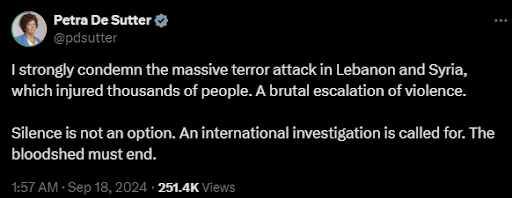
"I strongly condemn the massive terror attack in Lebanon and Syria, which injured thousands of people. A brutal escalation of violence," Belgium's Deputy Prime Minister Petra De Sutter posted on X on Wednesday.

"Silence is not an option. An international investigation is called for. The bloodshed must end," she added.


"We consider this incident to be another act of hybrid warfare against Lebanon, which has affected thousands of innocent people," Russian Foreign Ministry spokeswoman Maria Zakharova said in a statement.

"We strongly condemn the unprecedented attack on friendly Lebanon and its citizens, which is a gross violation of its sovereignty and a serious challenge to international law using unconventional weapons," she added.


Turkish President Recep Tayyip Erdogan expresses sorrow over pager explosions in Lebanon, saying Israel's attempts to spread conflicts in the region are extremely dangerous 


EU's Borell: pager detonations had 'heavy, indiscriminate collateral damages among civilians'

The EU’s top diplomat has described the pager detonations in Lebanon as “extremely worrying”, and said they had caused “heavy, indiscriminate collateral damages among civilians.”


In a statement, Josep Borrell said:


Following yesterday’s series of explosions in Lebanon, I called the Lebanese foreign minister Abdallah Bou Habib. He briefed me on the explosion of a high number of electronic devices in many areas across the country. Thousands of people were injured – hundreds in critical condition – hospitals are collapsing.

Even if the attacks seem to have been targeted, they had heavy, indiscriminate collateral damages among civilians: several children are among the victims

I consider this situation extremely worrying. I can only condemn these attacks that endanger the security and stability of Lebanon, and increase the risk of escalation in the region.

The European Union calls on all stakeholders to avert an all-out war, which would have heavy consequences for the entire region and beyond.

UN high commissioner for human rights demands accountability for Lebanon pager blasts

The United Nations High Commissioner for Human Rights, Volker Türk, said on Wednesday that those responsible for the bombing of Hezbollah’s communications devices “must be held accountable.”

“The simultaneous targeting of thousands of people, whether civilians or members of armed groups, without knowing who was in possession of the targeted devices, where they were located, and the environment in which they were located at the time of the attack, constitutes a violation of international human rights law and international humanitarian law,” he said in a statement.

Türk called for an “independent, serious and transparent investigation” into these events to find those who ordered and carried out the attacks.

He said that the bombings of the communications devices, “which killed 12 people, including two children, and injured thousands, are shocking and their effects on civilians are unacceptable, and the fear and horror they cause are profound.”

“In this volatile period, I call on all influential states in the region and beyond to take immediate action to avoid further escalation of the current conflicts,” he added, stressing that “it is time for leaders to act to save the right of everyone to live in peace and security.”

Those responsible for a deadly wave of explosions across Lebanon targeting paging devices used by members of the Hezbollah militant group “must be held to account”, the UN high commissioner for human rights said on Wednesday.

...

Irish foreign minister Micheál Martin: pager detonation showed 'wanton disregard' for civilian lives in Lebanon
Irish foreign minister Micheál Martin has said that the pager detonations in Lebanon showed a “wanton disregard” for the lives of civilians, and said it was a “logical conclusion” that Israeli forces were behind the incident. Israel has not claimed responsiblity for the attack, which injured nearly 3,000 people and killed at least 12 people, including two children.

The tánaiste said “The nature of the attack illustrates a wanton disregard for the lives of people because these pagers with explosives put into them went off in public areas and supermarkets and around people going out about their daily lives. It meant that many innocent civilians – men, women and children – were caught up in this.”

PA Media reports that asked if he considered it to be a breach of Geneva conventions rules on indiscriminate attacks, Martin replied: “In my view, yes, absolutely.”

Martin continued:

I would appeal to the Israeli Government to desist and not to engage in war in Lebanon and likewise to Hezbollah to desist and not to do anything to further escalate the situation. That kind of warfare and the creation of that terror in the midst of communities, commercial areas and normal human behaviour is unacceptable.

Tuesday, August 20, 2024

Richard Medhurst: I was arrested at Heathrow Airport as a “Terrorist” for My Journalism

    Tuesday, August 20, 2024   No comments

The British journalist revealed on X his treatment by the authorities after being arrested under Section 12 of the U.K.’s Terrorism Act.

The arrest on Aug. 15, came eight days after the F.B.I. raided the home of journalist and CN columnist Scott Ritter in the United States. 

Section 12 of the British Terrorism Act criminalizes holding certain opinions or beliefs. It reads: 

“12 Support.

(1) A person commits an offence if—

(a) he invites support for a proscribed organisation, and

(b) the support is not, or is not restricted to, the provision of money or other property (within the meaning of section 15).

[F1(1A) A person commits an offence if the person—

(a) expresses an opinion or belief that is supportive of a proscribed organisation, and

(b ) in doing so is reckless as to whether a person to whom the expression is directed will be encouraged to support a proscribed organisation.]”

Wednesday, November 22, 2023

Al-Azhar Observatory: The Zionist entity and ISIS are two sides of the same coin

    Wednesday, November 22, 2023   No comments

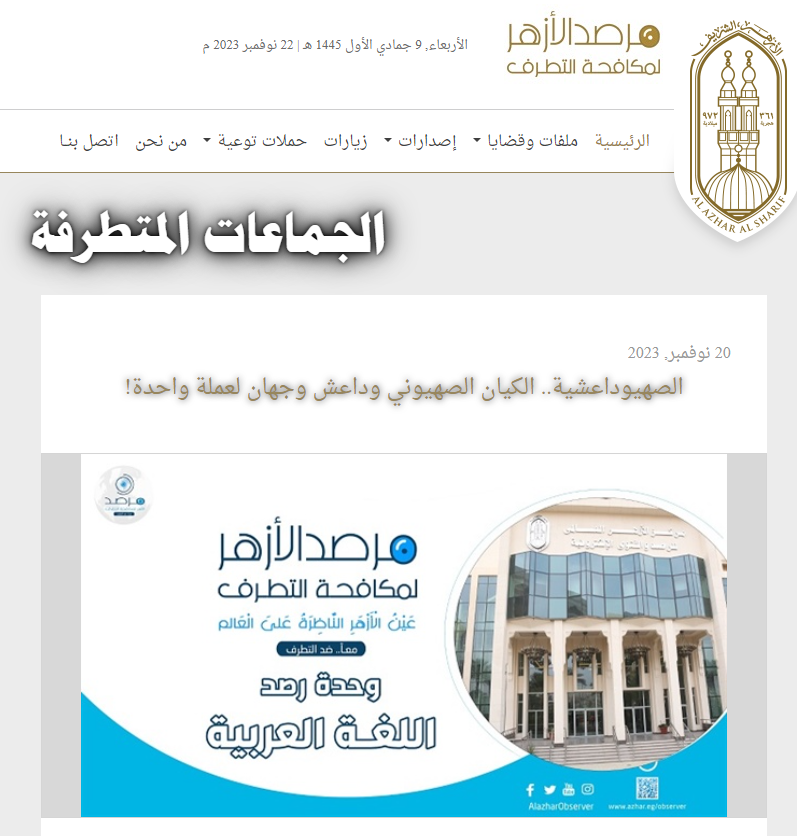
The Al-Azhar Observatory for Combating Extremism released a note stating that the Zionist entity and the terrorist organization ISIS are “two sides of the same coin.” The Observatory reached this conclusion by comparing the Israeli occupation’s aggression against the Gaza Strip and the terrorist actions of ISIS, as a great similarity between them emerged.

The Sunni religious organization added that the occupation added "a mixture of fascism and Nazism, and produced something uglier than all the terrorist organizations combined, regardless of their names and ideologies."

Al-Azhar Observatory summarized the similarities between the Israeli occupation and the terrorist organization ISIS in the following points:


1- Using religion to achieve political gains: In this context, the Observatory noted that the head of the occupation government, Benjamin Netanyahu, cited biblical texts more than once in justifying the Israeli massacres against innocent men, women and children in the Gaza Strip.


2- Achieving the dream of empire and imperial expansion: Here, Al-Azhar Observatory explained that the ambition of the terrorist organization “ISIS” to build a theocratic state, under the name of reviving the caliphate, is the same dream of the extremist Zionists, regarding establishing the “Greater Kingdom of Israel” or the “Kingdom of David” on the land of occupied Palestine. Egypt, Jordan, Syria and Lebanon, in addition to part of Iraq and Saudi Arabia.


3- Racism, arrogance, and expanding the circle of racist conflict: In this regard, the Observatory pointed out that racism and the claim of superiority and the possession of rights are among the common features in the literature of ISIS and the occupation, in justifying acts of violence, killing, and assault on others, which distances itself from using methods Similar in resistance and self-defense. He added that the speeches of ISIS and the occupation perpetuate violence and terrorism in the name of religions.


4- Ethnic cleansing and genocide: Al-Azhar Observatory confirmed that there is a strong similarity between the genocidal operations carried out by ISIS members against the Yazidi nationality in Iraq, and the crimes of the occupation in the Gaza Strip, and Palestine in general. According to him, the international handling of the two cases revealed Western double standards.


5- Excessive violence and the use of brutality: With regard to this matter, the Observatory pointed out that the world has not forgotten that ISIS burned the Jordanian pilot Moaz Al-Kasasbeh alive, nor cut off the heads of members, nor blew up people’s heads with firearms and explosive devices.


According to what he continued, the starting point for these actions by ISIS is the book “Managing Savagery,” by “theorist” Abu Bakr Naji, and how to exploit brutality to “terrorize” the organization’s enemies.


The Al-Azhar Observatory stated that this is embodied in our reality with the Zionist entity, which is following the example of ISIS in “management of brutality,” in an even uglier way and with greater firepower, as we see the remains of children in Gaza every day, bodies without heads and organs without bodies, and the remains of entire families. It collects in a handful, or two handfuls, or a bag, or two bags, as well as destroying thousands of homes.


6- The scorched earth strategy: With regard to this point, the Observatory reported that the displacement policy that the Israeli occupation insists on is preceded by the scorched earth strategy.


ISIS used this same policy in Iraq and Syria, as the Al-Azhar Observatory added. He also pointed out that Jaafar Al-Ibrahimi, the Iraqi government’s advisor for infrastructure, told Reuters that “ISIS has caused losses estimated at about $30 billion in Iraqi infrastructure since 2014.”


Al-Ibrahimi continued: “ISIS used a policy of comprehensive destruction of facilities, factories, and buildings, with the intention of causing the greatest economic damage to Iraq.”


7- Disavowing international laws and conventions: According to the Observatory, ISIS continues to repeat that it does not respect international resolutions and does not respect international conventions.


Likewise, the Israeli occupation did not implement United Nations resolutions, did not respond to the calls of the world order, and did not abide by the texts of international laws and conventions. He does not see, hear, or implement all of them, to the point that many writers see him as above international law and UN resolutions, according to the Al-Azhar Observatory.

The subdivision of al-Azhar, the observatory outlines its mission as follow:

Al-Azhar Observatory for Combating Extremism seeks to consolidate the teachings of the true Islamic religion, and to maximize its message based on moderation, moderation, tolerance, and human brotherhood by providing moderate and purposeful content in various languages, emphasizing the universality of Al-Azhar Al-Sharif, and enhancing Egypt’s global position in the field of combating extremism and building societal peace.


Friday, October 06, 2023

Media reports: Ukraine's allies proposed striking “Iranian drone production factories in Iran, Syria and Russia”

    Friday, October 06, 2023   No comments

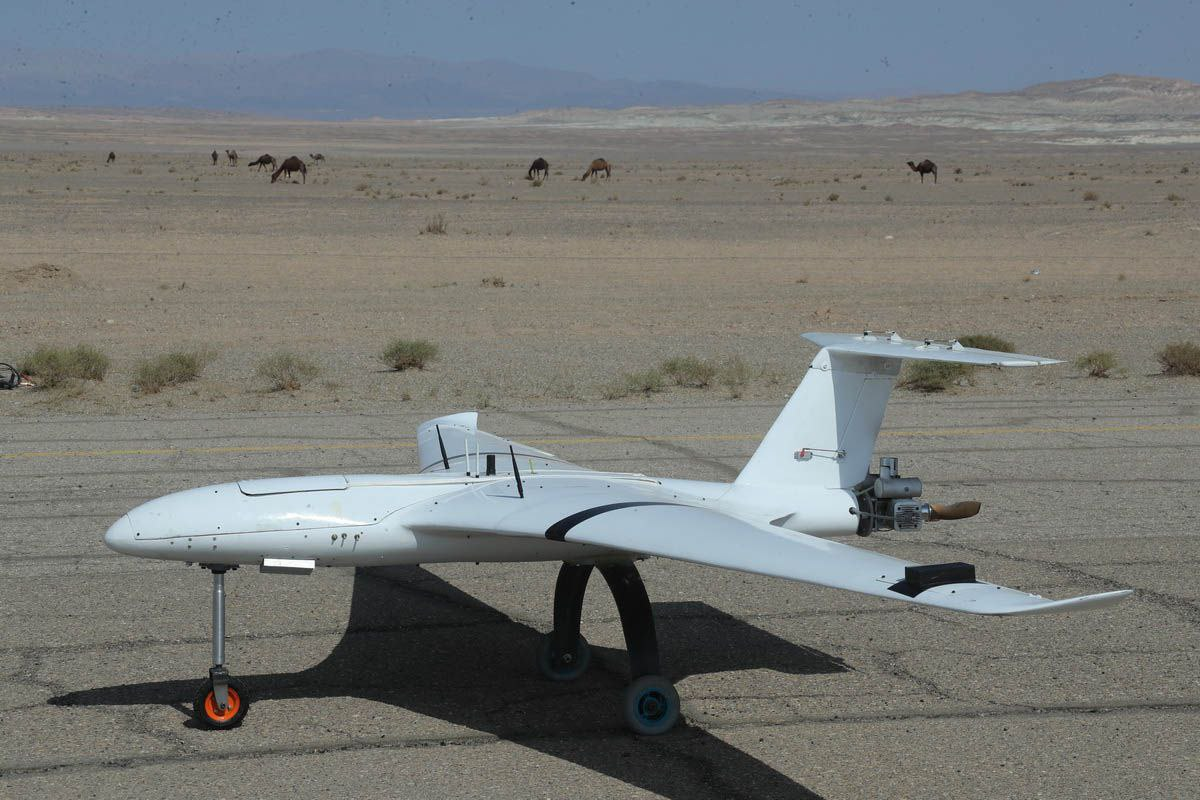
Days after the British newspaper published in a report, details obtained from a secret document submitted by Ukraine to its Western allies in the Group of Seven, which included a proposal to target "Iranian drone production factories in Iran, Syria and Russia", a drone attack hit Syria killed more than 80 people and injured hundreds more.

The British newspaper "The Guardian" revealed a secret document that indicated that Ukraine's Western allies had proposed launching missile strikes on drone production factories in Iran, Syria, and Russia.

In the context of a newspaper report on “European components in Iranian drones,” The Guardian revealed a 47-page document that the Ukrainian government submitted to the G7 governments last August.

As part of the discussion to take measures against Iranian drones, the newspaper revealed, citing the document, that among the proposals presented by Ukraine’s Western allies “launch missile strikes on the production factories of these drones in Iran and Syria, as well as on a potential production site located on the territory of the Russian Federation.” ".

The newspaper indicated in its report that such a measure “is likely to be refrained from by Western powers,” quoting from the document that “the Ukrainian Defense Forces can implement what was mentioned above, if the partners provide the necessary means of destruction.”

According to the secret document that Kiev sent to its Western allies, it called for “the use of long-range missiles to attack production sites in Iran, Syria, and Russia.”

It is noteworthy that, in mid-February, “The Guardian” had quoted American officials as saying that Iran had become a “global superpower in the field of drones.”


Analysts at the US Intelligence Agency also said that Iran “has emerged as a global leader in producing effective drones at an affordable price.”


Dozens dead in a drone attack on a military college in Homs

The Syrian Minister of Health, Hassan Al-Ghobash, announced Thursday that the initial toll was not final, amounting to 80 martyrs, including 6 women and 6 children, and about 240 injuries as a result of the terrorist attack on the Military College in Homs.

On Friday morning, Syrian official media counted the deaths of 89 people and the wounding of 277 others.

The Syrian Observatory for Human Rights, an anti-government organization, reported on Friday that the death toll had risen to 123, including 54 civilians, including 39 children and a woman related to officers. It was also estimated that 150 others were injured.

After the incident, the Syrian Foreign Ministry announced its condemnation of the "heinous crime" committed by "terrorist organizations." It stressed that it expresses the perpetrators’ persistence in their “brutal terrorist approach,” due to which the Syrian people have suffered over the past years.


It added, in her statement, that this attack “will not deter” Syria from moving forward in its effort to “eradicate the scourge of terrorism and its sponsors.”


The Syrian government declared three days of official mourning for the souls of the martyrs of the terrorist attack.


Media reports: the technology used in the attack originated in France; and Syria's army responds


The Syrian army launched artillery and missile bombardment, mainly targeting the headquarters of the Turkestan Party and the Migrant Brigade, in Jericho, Jisr al-Shughur, Idlib, Binnish, and Sarmin, in response to the terrorist attack that targeted the Military College in Homs.


According to media reports, the Turkestan Party and the Muhajireen Brigade "are the two factions that possess drone technology."


The information also indicated that parts of advanced drones “were transferred to the two factions three months ago, and France was the one that provided them with this technology.”


According to media sources, the information confirmed that a drone had been launched from areas under the control of the Turkestan Party, prior to targeting the Military College in Homs.

Early Warning

It hsould be noted that on October 4, Deputy Head of the Russian Reconciliation Center in Syria, Admiral Vadim Collet, reported that “terrorist groups are preparing to launch attacks on military sites belonging to both Moscow and Damascus.”

According to Collet, these groups are active in the provinces of Idlib, Aleppo, and Latakia.

Collet explained that the data the center received from Syrian intelligence agencies showed that the groups “Turkistan Islamic Party” and “Ansar al-Tawhid” were preparing to carry out “attacks on Russian and Syrian military bases using locally made drones.”

The two groups will use "long-range multiple missile launch systems," according to Collett.

The Deputy Head of the Russian Reconciliation Center added that the leadership of the Russian group and the Syrian Armed Forces "will take the necessary proactive measures in order to prevent armed provocations by terrorists."

The center's announcement comes after statements made by the head of Russian Foreign Intelligence, Sergei Naryshkin, to the effect that the United States of America is "preparing to assist militants to carry out terrorist attacks in Syria."

According to Naryshkin, these attacks affect "crowded public places and Syrian government institutions."


Over time, the conenctions among many of the otherwise seemingly isolated armed conflicts or coups, in Ukraine, Yemen, Sudan, Syria, Niger, Mali, and other places,  become more evident.

For instance, it has been reported that Ukrainian special forces have been conducting operations outside Ukraine, including in Africa.

Since the start of the armed conflict in that country, Ukraine used drones very well, first to stop Russian troops advances toward Kyiv, using Turkish made drone, and there after using drone for attacks beyond the frontline, including attacks on Moscow. Ukrainian drone in Sudan last month reveals that Ukraine is now operating beyond its borders.


Submit your story (pitch an article)

Name

Email *

Message *


Trending Today...


ISR +


Frequently Used Labels and Topics

40 babies beheaded 77 + China A Week in Review Academic Integrity Adana Agreement afghanistan Africa African Union al-Azhar Algeria Aljazeera All Apartheid apostasy Arab League Arab nationalism Arab Spring Arabs in the West Armenia Arts and Cultures Arts and Entertainment Asia Assassinations Assimilation Azerbaijan Bahrain Bangladesh Belarus Belt and Road Initiative Brazil BRI BRICS Brotherhood CAF Canada Capitalism Caroline Guenez Caspian Sea cCuba censorship Central Asia Charity Chechnya Children Rights China Christianity CIA Civil society Civil War climate colonialism communication communism con·science Conflict conscience Constitutionalism Contras Corruption Coups Covid19 Crimea Crimes against humanity D-8 Dearborn Debt Democracy Despotism Diplomacy discrimination Dissent Dmitry Medvedev Earthquakes Economics Economics and Finance Economy ECOWAS Education and Communication Egypt Elections energy Enlightenment environment Epstein equity Erdogan ethics Europe Events Fatima FIFA FIFA World Cup FIFA World Cup Qatar 2020 Flour Massacre Food Football France Freedom freedom of speech G20 G7 Garden of Prosperity Gaza GCC GDP Genocide geopolitics Germany Global Security Global South Globalism globalization Greece Grozny Conference Hamas Health Hegemony Hezbollah hijab Hiroshima History and Civilizations Hormuz Human Rights Huquq Ibadiyya Ibn Khaldun ICC Ideas IGOs Immigration Imperialism In The News india Indonesia inequality inflation INSTC Instrumentalized Human Rights Intelligence Inter International Affairs International Law Iran IranDeal Iraq Iraq War ISIL Islam in America Islam in China Islam in Europe Islam in Russia Islam Today Islamic economics Islamic Jihad Islamic law Islamic Societies Islamism Islamophobia ISR MONTHLY ISR Weekly Bulletin ISR Weekly Review Bulletin Italy Japan Jordan Journalism Kenya Khamenei Kilicdaroglu Kurdistan Latin America Law and Society Lebanon Libya Majoritarianism Malaysia Mali mass killings Mauritania Media Media Bias Media Review Middle East migration Military Affairs Morocco Multipolar World Muslim Ban Muslim Women and Leadership Muslims Muslims in Europe Muslims in West Muslims Today NAM Narratives Nationalism NATO Natural Disasters Nelson Mandela NGOs Nicaragua Nicaragua Cuba Niger Nigeria Normalization North America North Korea Nuclear Deal Nuclear Technology Nuclear War Nusra October 7 Oman OPEC+ Opinion Polls Organisation of Islamic Cooperation - OIC Oslo Accords Pakistan Palestine Peace Philippines Philosophy poerty Poland police brutality Politics and Government Population Transfer Populism Poverty Prison Systems Propaganda Prophet Muhammad prosperity Protests Proxy Wars Public Health Putin Qatar Quran Rachel Corrie Racism Raisi Ramadan Ramadan War Regime Change religion and conflict Religion and Culture Religion and Politics religion and society Resistance Rights Rohingya Genocide rule of law Russia Salafism Sanctions Saudi Arabia Science and Technology SCO Sectarianism security Senegal Shahed sharia Sharia-compliant financial products Shia Silk Road Singapore Sistani Slavery Soccer socialism Southwest Asia and North Africa Sovereignty Space War Spain Sports Sports and Politics Starvation State Power State Terror Sudan Sunni Axis sunnism Supremacism SWANA Syria Ta-Nehisi Coates terrorism Thailand The Koreas Tourism Trade transportation Tunisia Turkey Turkiye U.S. Cruelty U.S. Foreign Policy UAE uk ukraine UN under the Rubble UNGA United States UNSC Uprisings Urban warfare US Foreign Policy US Veto US-Iran MoU USA Uyghur Venezuela Volga Bulgaria Wadee wahhabism War War and Peace War Crimes War on Iran Wealth and Power Wealth Building West Western Civilization Western Sahara WMDs Women women rights Work Workers World and Communities Xi Yemen Zionism

Search for old news

Find Articles by year, month hierarchy


WEEKLY AdSpace 3

_______________________________________________

Copyright © Islamic Societies Review. All rights reserved.