Showing posts with label Venezuela. Show all posts

Monday, January 05, 2026

Erdogan Vows to Eradicate Terrorism, Condemns Foreign Interference in Venezuela

    Monday, January 05, 2026   No comments

Ankara, January 6, 2026 — Turkish President Recep Tayyip Erdoğan reaffirmed his government’s unwavering commitment to eliminating terrorism and upholding international law during a speech following a cabinet meeting in Ankara on Tuesday. Declaring that Turkey will not allow any actor to undermine its vision of a “Turkey free from terrorism,” Erdoğan framed the fight against terror as both a national imperative and a moral obligation.


“For forty years, terrorism has drained our nation’s energy and resources,” Erdoğan stated. “With our clear vision of a Turkey without terrorism, we will finally put an end to this scourge.”

The president identified several groups—including ISIS, the Gülen movement (FETÖ), and the Kurdistan Workers’ Party (PKK)—as instruments of what he described as “imperialist shackles” designed to weaken Turkey. He accused external forces of using these organizations to destabilize the country and obstruct its sovereignty.

Beyond its domestic security agenda, Erdoğan emphasized Turkey’s role as a global advocate for justice, legality, and international norms. “Turkey stands at the forefront of nations defending justice, legitimacy, and international law across the world,” he said, citing Ankara’s consistent positions in conflict zones from Gaza to Syria. “Wherever injustice or violations of international law occur, we have made our stance unmistakably clear.”

Turning to Latin America, Erdoğan expressed deep concern over recent developments in Venezuela, a country he described as a “close friend” of Turkey. He referred to ongoing political and social unrest in the South American nation as “regrettable events” and warned against foreign interference that could exacerbate the crisis.

During a recent conversation with former U.S. President Donald Trump, Erdoğan said he stressed the importance of avoiding actions that might plunge Venezuela into further instability. “We do not accept any violation of international law,” he asserted. “Our goal is to support what is best not only for Turkey but also for our friendly Venezuelan people.”

The Turkish leader pledged his country’s continued solidarity with the Venezuelan population in their pursuit of “prosperity, stability, and development.” He cautioned that breaches of national sovereignty and violations of international legal norms are “risky steps” that could trigger serious global repercussions.

Erdoğan’s remarks come amid heightened geopolitical tensions and underscore Turkey’s ambition to position itself as a principled actor on the world stage—one that champions anti-imperialism, respects state sovereignty, and combats terrorism in all its forms.

China, other countries Slam U.S. Coup in Venezuela at UN Security Council

    Monday, January 05, 2026   No comments

United Nations, New York – January 6, 2026

In a forceful intervention at the United Nations Security Council today, China issued a scathing condemnation of what it described as a U.S.-led military operation that resulted in the capture of Venezuelan President Nicolás Maduro and his wife, followed by Washington’s declaration of intent to “run Venezuela.” The statement, delivered by China’s Permanent Representative to the UN, underscored Beijing’s rejection of unilateral interventions and reaffirmed its commitment to the principles of sovereignty, non-interference, and international law.

China’s ambassador opened the statement with an unequivocal denunciation: “The United States has flagrantly violated Venezuela’s sovereignty and territorial integrity, and grossly breached the foundational principles of the UN Charter.” He emphasized that no nation, regardless of its power, has the right to unilaterally impose regime change or dictate the internal affairs of another sovereign state.

“The actions taken by the United States constitute a textbook coup d’état—executed not by domestic actors, but by foreign military force,” he declared.

Central to China’s position was a demand for the immediate and unconditional release of President Maduro and his spouse. “President Maduro is the democratically elected head of a UN member state. His detention by foreign forces is not only illegal under international law but also sets a dangerous precedent for global order,” the ambassador stated.

He warned that holding a sitting head of state captive would “destabilize the entire Western Hemisphere” and potentially trigger a regional crisis.

China urged the Security Council to convene emergency consultations and adopt a resolution condemning the U.S. intervention, calling on all member states to refrain from recognizing any authority imposed by force. “The Council must act—not to enforce the will of the powerful, but to uphold international legality and prevent further bloodshed,” the statement read.

The Chinese representative stressed that Venezuela’s future must be determined solely by its people through peaceful and democratic means, free from external coercion.

One of the most resonant lines from the speech came in response to what China described as Washington’s historical pattern of interventionism in Latin America: “Latin America is not a U.S. colony. It is a zone of peace—a region with its own sovereignty, dignity, and right to self-determination.”

Invoking the legacy of past U.S. military interventions, the ambassador drew stark parallels to Iraq, Libya, and Iran: “We have seen this script before—fabricated justifications, military strikes, regime change, and then chaos. Millions displaced. Infrastructure destroyed. Civilian lives shattered. The world cannot afford another repeat.”

In closing, China issued a broader warning against hegemonism in international relations: “No country can act as the world’s police, nor presume to be the international judge. The era of gunboat diplomacy is over. Multilateralism, not unilateral force, must guide our collective security.”

The statement marks the latest escalation in tensions between Beijing and Washington over Venezuela, a nation that has long been a point of geopolitical contention. While the U.S. has yet to formally address the allegations of a military strike and detention of Maduro, China’s intervention at the Security Council signals its readiness to challenge what it perceives as American overreach on the global stage.

As the international community grapples with this unfolding crisis, China’s message is clear: sovereignty is non-negotiable, and the UN Charter must remain the bedrock of global peace—not a relic to be overridden by power.


Saturday, January 03, 2026

Media review: The Illegality of U.S. abduction of the president of Venezuela and the Precedent it will regret setting

    Saturday, January 03, 2026   No comments

In a move that has shocked the international community and drawn swift condemnation from global capitals, U.S. President Donald Trump announced on January 3, 2026, that a covert military operation had successfully “ousted” Venezuelan President Nicolás Maduro and “extradited” him—along with his wife—from their home in Caracas to face trial in New York on drug and weapons charges. Simultaneously, Trump declared that the United States would “run” Venezuela “properly” and “professionally” until a transition of power could be arranged.

This extraordinary assertion of unilateral authority—framed in triumphalist rhetoric rather than legal or moral reasoning—raises profound questions under both international law and ethical governance. Worse still, it comes just days after Trump hosted Israeli Prime Minister Benjamin Netanyahu at his Mar-a-Lago estate, a leader indicted by the International Criminal Court (ICC) for war crimes and crimes against humanity in Gaza.

The juxtaposition is jarring and revealing: while the U.S. president embraces an accused perpetrator of mass civilian atrocities, he orchestrates a military-style raid to depose and abduct the head of state of a sovereign nation—all under the thin veneer of enforcing “justice.”

A Clear Violation of International Law

The United Nations Charter, the bedrock of modern international law, enshrines two core principles: the prohibition on the use of force (Article 2(4)) and the right of states to sovereignty and territorial integrity. The U.S. operation in Venezuela—described by French Foreign Minister Jean-Noël Barrot as an act that “infringes the principle of the non-use of force that underpins international law”—constitutes a textbook violation of both.

Even if one accepts U.S. allegations that Maduro’s government is corrupt or authoritarian (a view held by many human rights groups and Western governments), that does not grant any state the legal authority to invade another, kidnap its sitting president, or impose a transitional administration. There is no UN Security Council resolution authorizing such action. There is no invitation from Venezuela’s legitimate government—only a furious denunciation from Vice President Delcy Rodríguez, who was swiftly sworn in as interim leader and demanded Maduro’s immediate return.

Moreover, the notion that the U.S. will “run” Venezuela echoes colonial-era paternalism. As Trump boasted: “We’ll have the greatest oil companies in the world going in, invest billions and billions of dollars.” The implicit promise—that Venezuelans will benefit—is undercut by the fact that the U.S. is acting without their consent, installing no democratically legitimate authority, and asserting control over one of the world’s largest oil reserves.

The Hypocrisy of Selective Justice

The ethical bankruptcy of this intervention becomes even starker when viewed alongside U.S. foreign policy toward Israel. Just days before the Venezuela raid, Trump hosted Netanyahu—a man now subject to an ICC arrest warrant for alleged war crimes, including the intentional starvation of civilians and indiscriminate bombing of residential areas in Gaza. The ICC’s charges also cite Netanyahu’s role in a policy that may amount to crimes against humanity.

Yet instead of distancing himself from an indicted ally, Trump rolled out the red carpet. No military raids. No extradition demands. No declarations that Israel must be “run properly” until new leadership emerges.

This double standard exposes a deeply entrenched pattern: international law applies only to adversaries, never to allies—or to the United States itself. When the U.S. acts unilaterally, it calls it “strength.” When others do the same, it’s “aggression.” This selective enforcement erodes the very foundations of a rules-based order and fuels global cynicism about Western claims to moral leadership.

The Dangerous Precedent of Legitimacy as a Weapon

The Trump administration justifies its actions by claiming Maduro’s 2024 re-election was “illegitimate.” But if contested elections become grounds for foreign military intervention and the kidnapping of heads of state, then no leader is safe—not even American presidents.

Consider this: Trump’s own 2016 election was widely scrutinized for foreign interference (as confirmed by U.S. intelligence agencies), voter suppression, and unprecedented foreign meddling. If Canada, Germany, or France adopted Trump’s logic, they could theoretically declare him “illegitimate” and, in the name of democracy, dispatch special forces to Mar-a-Lago to “extradite” him to The Hague.

Of course, no democratic nation would do such a thing—because they respect sovereignty, due process, and legal norms. The absurdity of the hypothetical underscores the recklessness of Trump’s Venezuela gambit. It is not a defense of Maduro to point out that regime change by abduction is lawless. It is a defense of international order.

Supremacism Masquerading as Strategy

At its core, this operation reflects what can only be described as imperial supremacism: the belief that the United States, by virtue of its military and economic power, is exempt from the rules that bind others. Trump’s declaration—“This was one of the most stunning, effective and powerful displays of American military might in American history”—is not a statement of policy but of domination.

Such actions are not only illegal; they are strategically foolish. They alienate allies (the European Union expressed “great concern”), embolden adversaries like Russia and China (both of whom condemned the raid as “armed aggression”), and invite reciprocal logic in other regions. If the U.S. can remove Maduro, why can’t China “liberate” Taiwan? Why can’t Russia “stabilize” the Baltics? The erosion of legal norms is contagious.

A Reckless Abandonment of Principle

The United States once positioned itself as a champion of sovereignty, self-determination, and the rule of law—even if imperfectly. Trump’s Venezuela intervention represents a full-throated rejection of those ideals in favor of raw power politics. By hosting an ICC-indicted leader while simultaneously abducting another on disputed legal grounds, the administration has revealed its moral compass to be calibrated not by justice, but by allegiance.

Friday, June 16, 2023

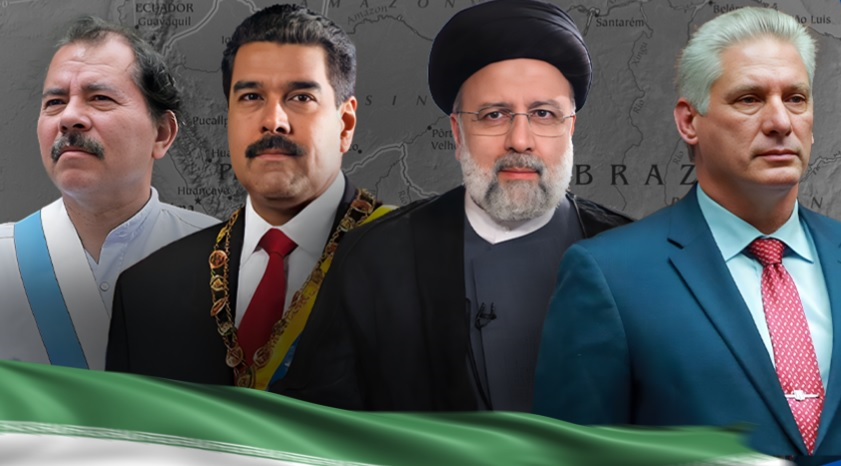
The Four Amigos: How the close alliance grew between the far Global South Flanks

    Friday, June 16, 2023   No comments

There is no doubt that Iranian President Ibrahim Raisi's current visit to South American countries, Venezuela, Nicaragua and Cuba, constitutes a strengthening of Iran's course of cooperation with Latin American countries and the confrontation of unilateral US sanctions.

This path has brought the far one closer geographically, and has developed rapidly since the beginning of the new millennium, with the emergence of a new generation of Bolivarian leaders.

And with the presence of leaders such as the late Hugo Chavez, Evo Morales, Rafael Correa and Lula da Silva, some of these relations began to enter the stage of strategic alliances, especially during the years 2005-2013, as Iran became an observer member of the Bolivarian Alliance for the Peoples of Latin America, ALBA, in 2008, in one of the manifestations of these Alliances.

As a continuation of this rapprochement, Iran and Venezuela signed more than 270 agreements between 2005 and 2012, which included automobile manufacturing projects, energy programs, and others.

In 2019, following the coup of Venezuelan Parliament Speaker Juan Guaido against elected President Nicolas Maduro and the United States announcing his recognition, America froze the Venezuelan government's assets abroad, and exacerbated the suffering of Venezuelans, in conjunction with a humanitarian crisis that struck the world as a result of the spread of the Corona virus and the subsequent economic recession.

Iran sent 5 tankers of oil derivatives to Caracas to alleviate the unprecedented fuel crisis, and helped repair a number of Venezuelan oil refineries that were damaged by US sanctions, in a message confirming the strength of this alliance, and a challenge to the hegemony of the United States whose patrols in the Caribbean did not dare to intercept the fleet yet. Iranian warnings.

The first year of Iranian President Ebrahim Raisi's term did not pass, until he signed with his Venezuelan counterpart in Tehran a map of bilateral cooperation between the two countries in June 2022. Subsequently, Raisi handed over, in a ceremony via video technology, the second Iranian-made Venezuelan oil tanker, and committed Renovation of the largest oil refinery complex in Venezuela.

For his part, the Iranian president stressed, in a joint press conference with his Venezuelan counterpart, that "relations between Tehran and Caracas are not ordinary diplomatic relations, but rather strategic relations," noting that the two countries have "common opponents, common interests and common views in the areas of seeking independence, freedom and justice." 

The Iranian president participated in the ceremony of resuming the production line of two Iranian companies for cars and tractors in Venezuela, and said during the visit: "The volume of trade exchange can be increased to 10 billion dollars in a first step, and to 20 billion dollars in a second step," after the exchanges increased from 600 million dollars in 2008. 2021 to more than $3 billion.


During his meeting with Iranian and Venezuelan businessmen, he stressed that there is a great untapped potential to increase economic exchanges between Iran and Venezuela, and stated that the way to achieve the $20 billion agreements is serious activity and investment between the two countries.


The memorandums of cooperation included the sectors of communications and information technology, energy, insurance, maritime transport, higher education, agriculture, medicine and medicine, culture, and the mining sector, in addition to Iran’s decision to transfer micro and nanotechnology through government and private institutions, in order to build a model of Iranian-Venezuelan partnership and integration. It can circulate in a lot of countries that want an equal relationship.


These agreements provide opportunities for mutual investment in the field of agriculture, facing food security problems and exchanging commodities.


Commenting on the economic sanctions imposed by the United States on Venezuela, Roy Warran tells Al-Mayadeen Net: "Iran has a clear position against sanctions, and it rejects them completely, whether sanctions against Iran or any other country." He adds, "Our position is principled against sanctions. Therefore, Iran sent tankers carrying oil production requirements to Venezuela, in a practical step to refuse, whatever the price."


In the same context, since February 2023, two ships carrying Iranian products have arrived at Venezuelan ports, after the Iranian-Venezuelan shipping line was recently launched, as the Iranian-Venezuelan cooperation map stipulates that a ship sails from Iranian shores heading to Venezuela every 3 months.


"A large part of Venezuela's refining sector, which was neglected due to sanctions, has been put into operation with the help of Iranian experts," said Iranian Oil Minister Javad Auchi.


Iran will provide technical and engineering support, as well as equipment, to help modernize petrochemical complexes, loading docks and oil terminals in Venezuela.

After the Venezuelan president's visit to Tehran in 2022, the state oil company "Petroleos de Venezuela" and the state-owned National Iranian Oil Refining and Distribution Company worked to renovate the "Paraguana" refining center, the largest refining complex in Venezuela, in a move to end Venezuela's dependence on American refinery technology. .

A unit of the National Iranian Oil Refining and Distribution Company had earlier signed a contract worth 110 million euros with Petroleos de Venezuela last May to repair the El Palito oil refinery, which has a capacity of 146,000 barrels per day.


Since December 2022, Iranian commercial ships have been moving along the road leading to Venezuela to transport petrochemical products, primarily naphtha, which Venezuela needs in the production of Venezuelan oil.


Wednesday, June 14, 2023

Raisi visit Venezuela, Nicaragua, as part of his Latin American tour

    Wednesday, June 14, 2023   No comments

The Iranian President, Ebrahim Raisi, left the Venezuelan capital, Caracas, heading to Managua, the capital of Nicaragua, after the end of his two-day official visit, at the head of two political and economic delegations, as part of a tour to several countries in Latin America.

During his visit to Caracas, my president met with Venezuelan President Nicolas Maduro, and high-level delegations of the two countries signed 25 agreements.

Raisi also met with the Speaker of Parliament and a group of chairmen of the Venezuelan National Assembly committees, visited the science and technology exhibition of Iranian achievements, sponsored the revival of the production line of two Iranian car companies, and met with Venezuelan youth groups and elites.

Earlier today, Tuesday, Iran and Venezuela signed a number of agreements in the presence of Iranian President Ibrahim Raisi and Venezuelan President Nicolas Maduro in the capital, Caracas, including agreements related to oil, trade, health and technology.

In a joint press conference with his Venezuelan counterpart, the Iranian president stressed that "relations between Tehran and Caracas are not ordinary diplomatic relations, but rather strategic relations," noting that the two countries have "common opponents" and "common interests and common views in the areas of seeking independence and freedom." and justice.”

Referring to an increase in the volume of trade between the two countries from $600 million in 2021 to more than $3 billion, Raisi said, "The volume of trade exchange can be increased to $10 billion in a first step, and to $20 billion in a second step."

In turn, the Venezuelan president said, "Raisi's visit marks a new milestone in the relationship with Iran, which plays an excellent role as one of the most important emerging powers in the new world."


"We signed 25 agreements during this historic visit by President Raisi, and new agreements are still under negotiation," he said, explaining that "the goal of the sanctions is to make Venezuelan society collapse so that the United States can control its oil."

Monday, Raisi began his tour to Latin America, which includes Venezuela, Cuba and Nicaragua, with the aim of "continuing the policy of strengthening relations with friendly countries and promoting cooperation, economically, politically and scientifically."


This visit will last for 5 days, at the official invitation of Raisi's counterparts in the three countries.

A year ago, on such days, Tehran hosted the Venezuelan president, and the two sides signed a 20-year cooperation agreement.


Iran and Venezuela are two major oil producers and members of the Organization of the Petroleum Exporting Countries (OPEC), which makes them the focus of international discussions on the energy crisis resulting from the war in Ukraine.


Iran is strengthening its orientation towards Latin American countries, within the framework of its policy aimed at "diversifying foreign relations", which coincides with its efforts to strengthen and improve relations with the countries of the region, under the title of "neighborhood policy".

In the face of sanctions.. Raisi from Nicaragua calls for pluralism

Iranian President Ebrahim Raisi affirmed his country's readiness to expand and strengthen bilateral cooperation with Nicaragua, stressing that the relations between the two countries are strategic.

Raisi added during his meeting with Nicaraguan President Daniel Ortega: "We want to increase and deepen our relations in the political, economic and cultural fields, and in all other fields, especially in the field of science and technology."


He thanked the government for the warm reception and hospitality he received and the delegation accompanying him on his first visit, which began yesterday evening to the Central American country.


In turn, Ortega stressed that Nicaragua and Iran are twin revolutions that have deep roots in defending the identity and well-being of peoples.


When welcoming his Iranian counterpart, Ortega highlighted the perpetual struggle of both countries against empires that throughout history have tried to seize various lands to control the world.


The Head of State reviewed some of the battles waged by the first Nicaraguan anti-colonialists, while he told his Iranian counterpart the different stages of Nicaragua's struggle in defense of freedom and national sovereignty.


"Over the years, the United States has been extremely brutal with Nicaragua in its search for hegemony to build an inter-oceanic canal here, because this route was so coveted by North American businessmen," Ortega said.


Ortega received his Iranian counterpart at the head of a high-level political and economic delegation in Freedom Square in the capital, Managua, during an official reception ceremony.

Meanwhile, the Iranian president called for an end to unilateral sanctions that aim to subjugate people, calling on Latin American countries to bet on pluralism.


In an interview with Telesur, Raisi said, "We have to put an end to this unilateralism, create a multipolar world, and put an end to this oppression against human beings."


According to Raisi, "Sanctions are a declared war against states, and the tool was military. Now, sanctions are used to subjugate people."

He pointed out that "the Americans are looking for their interests in that region and all over the world, and they are looking for their hegemony. And what Trump said is the reality of the United States; that fact is that they are looking to usurp the reserves and plunder them."

Likewise, the Iranian president believed that the United States wanted to punish countries that did not submit to its policy.


He stressed that "Iran will not oppress anyone, and therefore will never accept being subjected to oppression," adding, "They do not want us to be independent and self-sufficient."


Raisi referred to "the various damages caused by the northern force in several countries such as Iraq and Afghanistan," stressing "the need to respect the internal decisions of each country."


It is noteworthy that the Iranian president had arrived yesterday in Managua, the capital of Nicaragua, at the end of his visit to Venezuela, as part of a tour in Latin America that also includes Cuba, which he started last Monday.


The Iranian President's visit to Nicaragua comes at the official invitation of his counterpart, President Ortega.


Prior to his Latin tour, Raisi said that the position of Iran and the countries he will visit is to "stand up to the hegemonic regime," stressing that relations with independent Latin countries are strategic.


Iran is strengthening its orientation towards Latin American countries within the framework of its policy aimed at "diversifying foreign relations", which coincides with its efforts to strengthen relations with countries in the region under the title of "neighborhood policy".


Monday, June 05, 2023

Days before Blinken visit to the kingdom, Saudi Arabia welcomes Venezuelan President

    Monday, June 05, 2023   No comments

Maduro's visit comes as the kingdom has restored ties with both Iran and Syria, two nations that are also target of the US 'maximum pressure' sanctions campaign.

Previously, Prince Faisal bin Farhan bin Abdullah, the Saudi Minister of Foreign Affairs, reviewed with his Venezuelan counterpart Eban Eduardo Gil Pinto, on Monday, aspects of cooperation between the two countries, and ways to enhance and develop them in various fields.


This came during their meeting in Jeddah, where they discussed intensifying joint coordination on many regional and international issues of concern to the two countries, and their efforts to establish international peace and security, and contribute to achieving global sustainable development goals.


Sunday, April 09, 2023

Venezuela aiming to insolate its economy from western sanctions builds new ties with Iran and Russia

    Sunday, April 09, 2023   No comments

A year after the inking of the cooperation agreement between the CEO of Iran’s SAIPA Automotive Group Mohammad Ali Teimouri and Venezuelan Minister of Transportation Ramón Velásquez at the venue of SAIPA Company in Tehran in order to produce Iranian cars in this country as joint venture (JV), Russia signs a transport deal with Venezuela.

Russia and Venezuela intend to create a shipping company to strengthen ties between Latin America and Russia. As part of the initiative, Moscow and Caracas plan to establish two transportation hubs to increase cooperation and establish a logistics chain. An intergovernmental commission has already decided to create such a company, which will be financed from public and private sources. The company could be registered in Sevastopol, St. Petersburg or Novorossiysk, and joint construction of ships is also planned.

New trade routes will greatly facilitate Russian exports to Latin America, since the region is actively interested in grain, sunflower oil and agricultural machinery from Russia. In turn, Russia will be able to import seafood and fruit at bargain prices. Venezuela will play the role of an operational center.


Followers


Most popular articles


ISR +


Frequently Used Labels and Topics

40 babies beheaded 77 + China A Week in Review Academic Integrity Adana Agreement afghanistan Africa African Union al-Azhar Algeria Aljazeera All Apartheid apostasy Arab League Arab nationalism Arab Spring Arabs in the West Armenia Arts and Cultures Arts and Entertainment Asia Assassinations Assimilation Azerbaijan Bangladesh Belarus Belt and Road Initiative Brazil BRI BRICS Brotherhood CAF Canada Capitalism Caroline Guenez Caspian Sea cCuba censorship Central Asia Charity Chechnya Children Rights China Christianity CIA Civil society Civil War climate colonialism communication communism con·science Conflict conscience Constitutionalism Contras Corruption Coups Covid19 Crimea Crimes against humanity D-8 Dearborn Debt Democracy Despotism Diplomacy discrimination Dissent Dmitry Medvedev Earthquakes Economics Economics and Finance Economy ECOWAS Education and Communication Egypt Elections energy Enlightenment environment equity Erdogan Europe Events Fatima FIFA FIFA World Cup FIFA World Cup Qatar 2020 Flour Massacre Food Football France Freedom freedom of speech G20 G7 Garden of Prosperity Gaza GCC GDP Genocide geopolitics Germany Global Security Global South Globalism globalization Greece Grozny Conference Hamas Health Hegemony Hezbollah hijab Hiroshima History and Civilizations Human Rights Huquq Ibadiyya Ibn Khaldun ICC Ideas IGOs Immigration Imperialism In The News india Indonesia inequality inflation INSTC Instrumentalized Human Rights Intelligence Inter International Affairs International Law Iran IranDeal Iraq Iraq War ISIL Islam in America Islam in China Islam in Europe Islam in Russia Islam Today Islamic economics Islamic Jihad Islamic law Islamic Societies Islamism Islamophobia ISR MONTHLY ISR Weekly Bulletin ISR Weekly Review Bulletin Italy Japan Jordan Journalism Kenya Khamenei Kilicdaroglu Kurdistan Latin America Law and Society Lebanon Libya Majoritarianism Malaysia Mali mass killings Mauritania Media Media Bias Media Review Middle East migration Military Affairs Morocco Multipolar World Muslim Ban Muslim Women and Leadership Muslims Muslims in Europe Muslims in West Muslims Today NAM Narratives Nationalism NATO Natural Disasters Nelson Mandela NGOs Nicaragua Nicaragua Cuba Niger Nigeria Normalization North America North Korea Nuclear Deal Nuclear Technology Nuclear War Nusra October 7 Oman OPEC+ Opinion Polls Organisation of Islamic Cooperation - OIC Oslo Accords Pakistan Palestine Peace Philippines Philosophy poerty Poland police brutality Politics and Government Population Transfer Populism Poverty Prison Systems Propaganda Prophet Muhammad prosperity Protests Proxy Wars Public Health Putin Qatar Quran Rachel Corrie Racism Raisi Ramadan Regime Change religion and conflict Religion and Culture Religion and Politics religion and society Resistance Rights Rohingya Genocide Russia Salafism Sanctions Saudi Arabia Science and Technology SCO Sectarianism security Senegal Shahed sharia Sharia-compliant financial products Shia Silk Road Singapore Slavery Soccer socialism Southwest Asia and North Africa Sovereignty Space War Spain Sports Sports and Politics Starvation State Power State Terror Sudan sunnism Supremacism SWANA Syria Ta-Nehisi Coates terrorism Thailand The Koreas Tourism Trade transportation Tunisia Turkey Turkiye U.S. Cruelty U.S. Foreign Policy UAE uk ukraine UN under the Rubble UNGA United States UNSC Uprisings Urban warfare US Foreign Policy US Veto USA Uyghur Venezuela Volga Bulgaria Wadee wahhabism War War and Peace War Crimes Wealth and Power Wealth Building West Western Civilization Western Sahara WMDs Women women rights Work Workers World and Communities Xi Yemen Zionism

Search for old news

Find Articles by year, month hierarchy


AdSpace

_______________________________________________

Copyright © Islamic Societies Review. All rights reserved.