Showing posts with label Europe. Show all posts

Monday, August 03, 2026

Morocco’s Sahara Obsession and Migrant Weaponization Are Backfiring

    Monday, August 03, 2026   No comments

Moroccan security forces preventing migrants from returning
The recent mass migrant breach into the Spanish enclave of Ceuta was not a spontaneous humanitarian crisis; it was a calculated geopolitical weapon. As tens of thousands of desperate people surged across the border—resulting in a tragic death toll of up to 88 souls and prompting emergency border militarization across Europe—the underlying mechanics of the crisis revealed a darker reality. It laid bare the grand strategy of the Moroccan monarchy: a regime that operates much like a colonial power, prioritizing its own self-preservation and territorial ambitions over human life, regional stability, and the genuine will of its own people.

Morocco’s current foreign policy is built on a fragile foundation of transactional blackmail. But as the kingdom’s domestic demographics shift and its alliances alienate the broader public, this strategy is rapidly becoming a flawed trap that will keep the nation in a diplomatic and social tight spot for the long run.

The Domestic Disconnect: A Monarch Out of Touch

King Mohammed VI has long relied on his constitutional and religious title as the "Commander of the Faithful" to legitimize his absolute rule. Historically, this religious narrative provided a unifying canopy that demanded total submission from the populace. However, this same narrative is failing the King on both the global stage and the domestic front.

In light of the ongoing devastation in the Middle East and the broader Arab peoples’s solidarity with Gaza, the Moroccan regime’s quiet alignment with Western and Israeli preferences has created a deep cognitive dissonance. The King's foreign alliances simply do not resonate with the larger segment of the Moroccan population.


Furthermore, the ruler is a self-serving figure demanding submission from a population that is fundamentally changing. Today’s Moroccan youth are younger, vastly more educated, and deeply informed thanks to new technology. The state can no longer control the flow of information as it did in the analog past. Moroccans watch in real-time as their government bends over backward to please Washington and Tel Aviv, while domestic economic struggles go unaddressed. The regime’s attempt to project power abroad is increasingly viewed at home as a distraction from its failures within.

The Sahara Trap: A Flawed Diplomatic Doctrine


For years, Rabat has based its entire foreign relations apparatus on a single, rigid metric: how a nation speaks about Morocco’s occupation of Western Sahara. This hyper-fixation has reduced Moroccan diplomacy to a series of transactional shakedowns.

The most glaring example of this subservience was the renaming of the 1,055-kilometer Tiznit–Dakhla road to the "President Donald J. Trump Highway"—a sycophantic monument built to reward a former US president for his unilateral recognition of Morocco's claims to the Sahara.

Basing national security and foreign policy on the whims of foreign leaders regarding the Sahara is a deeply flawed, short-term strategy. It strips Morocco of its strategic autonomy, turning the kingdom into a client state that must constantly offer concessions—whether in normalization deals or border security—to maintain its "alliances." It keeps the nation in a perpetual tight spot, forever vulnerable to the shifting winds of Washington, Paris, and Madrid.


Weaponizing Desperation: The Anatomy of the Ceuta Breach


When diplomacy fails to yield the desired concessions, the Moroccan royal family has shown a willingness to weaponize human misery--leading to human rights abuses. The recent crisis in Ceuta was a state-directed operation. Reports confirmed that migrants were literally trucked to the border to incite an organized, massive crossing into Spanish-controlled territory.

The goals of this manufactured crisis were twofold:

  • Punish Spain for its stance on Gaza: Spain has recently defied US and Israeli preferences by recognizing Palestine, confronting Israel over the war in Gaza, and restricting arms transit.
  • Punish Spain for the Sahara: Madrid has hesitated to fully endorse Morocco's continued occupation of Western Sahara and its claims over Spanish territories.

The operation was executed with chilling precision. Moroccan intelligence agents were documented by the Guardia Civil embedded among the migrants, using the chaos to conduct reconnaissance on Ceuta’s defenses. Meanwhile, in a display of sheer cruelty, images emerged of Moroccan security forces physically blocking migrants from returning to Morocco once the political point had been made, trapping them in the Spanish enclave.

Morocco covets the territories controlled by Spain (Ceuta and Melilla) and the UK (such as the Peñón de Vélez de la Gomera). The monarchy hopes to claim these territories not through war or traditional diplomatic challenge, but by making the cost of holding them so unbearably high that Europe simply hands them over.

Proxy Warfare: Washington’s $40 Million Slap at Madrid


The Ceuta crisis also exposed a cynical alignment between Rabat and elements within the US government to punish Madrid. While US Republicans performed public outrage over the migrant invasion, Representative Thomas Massie pointed to the fine print of a recent GOP-backed bill.

Just two weeks before tens of thousands of migrants poured into Ceuta, the US House passed H.R. 8595, which included a $40 million payout to Morocco. More damning was the accompanying House Appropriations Committee report, which explicitly stated that the "Spanish-administered cities of Ceuta and Melilla are located in Moroccan territory."

This was a direct diplomatic slap in the face to Spain. The US did not just acknowledge Morocco’s claim; it validated it on American legislative paper. The message was clear: Washington was willing to let Morocco do its dirty work, using a $40 million incentive to facilitate a migrant surge against a NATO ally that had dared to step out of line on Middle Eastern policy.

The European Blowback and the Double Standard


The immediate fallout of Morocco’s gamble has been chaotic. Spain was overwhelmed, leading to anarchy in Ceuta and the tragic deaths of dozens, including teenagers and women, who drowned or were crushed at the Tarajal breakwater. In response, Spain deployed a 500-meter floating sea barrier to allow for legal "hot returns" and expedited the deportation of 48,000 migrants.

The crisis has fractured European unity. Right-wing leaders like Spain's Santiago Abascal (Vox) have demanded a "military act" against Morocco, the freezing of EU agreements, and the total militarization of the border. Italy took the drastic step of unilaterally suspending the EU’s Schengen free-travel pact with Spain, while Portugal has heavily reinforced its southern borders.

Yet, a glaring double standard remains. When Belarus used similar tactics to funnel migrants into Poland and Lithuania, it was hit with sweeping EU sanctions and total diplomatic isolation for "weaponizing migration." Morocco, despite staging a state-directed surge complete with intelligence infiltration, faces no such consequences because it is shielded by its status as a US and Israeli partner.

A Tight Spot in the Long Run

The Moroccan monarchy operates under the illusion that it is playing a masterful game of geopolitical chess. In reality, it is eroding its own moral standing and destabilizing its neighborhood.

Basing foreign policy on the Sahara issue and weaponizing migrants may force temporary concessions from Madrid or Washington, but it is a fundamentally flawed strategy. It breeds intense resentment among European neighbors, invites the militarization of the Mediterranean, and exposes the regime's colonial, self-serving nature to the world.

Most importantly, it alienates a young, tech-savvy Moroccan population who can no longer be blinded by state-sponsored narratives. As the flow of information continues to bypass royal censors, the Moroccan people are increasingly recognizing that their King’s alliances serve the preservation of the palace (makhzen), not the prosperity of the populace. In the long run, no amount of highways named after foreign presidents or weaponized border crises can secure a regime that has lost the genuine consent of its own people.

Updates:

Chinese intelligence reportedly believes Ceuta crisis orchestrated by Mossad


Chinese intelligence and academic circles have reportedly raised suspicions that Israel was behind the recent surge of migrants into Spain’s North African enclave of Ceuta.


According to El Mundo, reports circulating in Beijing claim the border crisis was a deliberate hybrid warfare operation allegedly coordinated by Mossad and enabled by Morocco, with the aim of destabilizing the Spanish government.


The assessment reportedly connects the incident to worsening relations between Madrid and Tel Aviv, particularly after Spain’s criticism of Israel’s war on Gaza and its recognition of a Palestinian state.

Nadia Helmy, an Egyptian political scientist specializing in Sino-Israeli relations, said Chinese security analysts view the Ceuta events as a potential pressure operation targeting Prime Minister Pedro Sanchez’s government.

"Chinese intelligence analysis centers have examined the escalation of diplomatic and political tensions between Spain and Israel," Helmy stated. "From that perspective, the deterioration of bilateral relations could have motivated Mossad to get involved in the migration crisis between Morocco and Spain, exacerbating the situation and infiltrating agents to foment discontent and chaos among the Moroccan population."

Saturday, May 30, 2026

UK parliament to debate probe into Israeli lobbying grip on British politics

    Saturday, May 30, 2026   No comments

Over 116,000 people have signed a petition demanding an inquiry into how pro-Israel organizations shape UK government decisions, party policy, and public debate.

British lawmakers are set to debate on 22 June whether to launch a formal inquiry into Israeli lobbying influence over UK political decision-making. 

The petition demands accountability for what they describe as a systematic Israeli effort to control Britain's political agenda.


“We feel that the horrific devastation in Gaza, the ongoing suppression of Palestinians in the West Bank, and the UK’s political response underline the urgent need to scrutinize how pro-Israel organizations, networks, and lobbying efforts may shape government decisions, party policy, and public debate,” the petition read.


Thursday, January 08, 2026

In the News: France and Germany Condemn U.S. Foreign Policy as “New Colonialism” and “Robber’s Den”

    Thursday, January 08, 2026   No comments

January 9, 2026 — Paris and Berlin

In a rare and forceful rebuke of U.S. foreign policy, the presidents of France and Germany have issued sharp criticisms of Washington’s recent actions under President Donald Trump, warning that America’s shift away from multilateralism and international norms threatens to unravel the postwar global order.

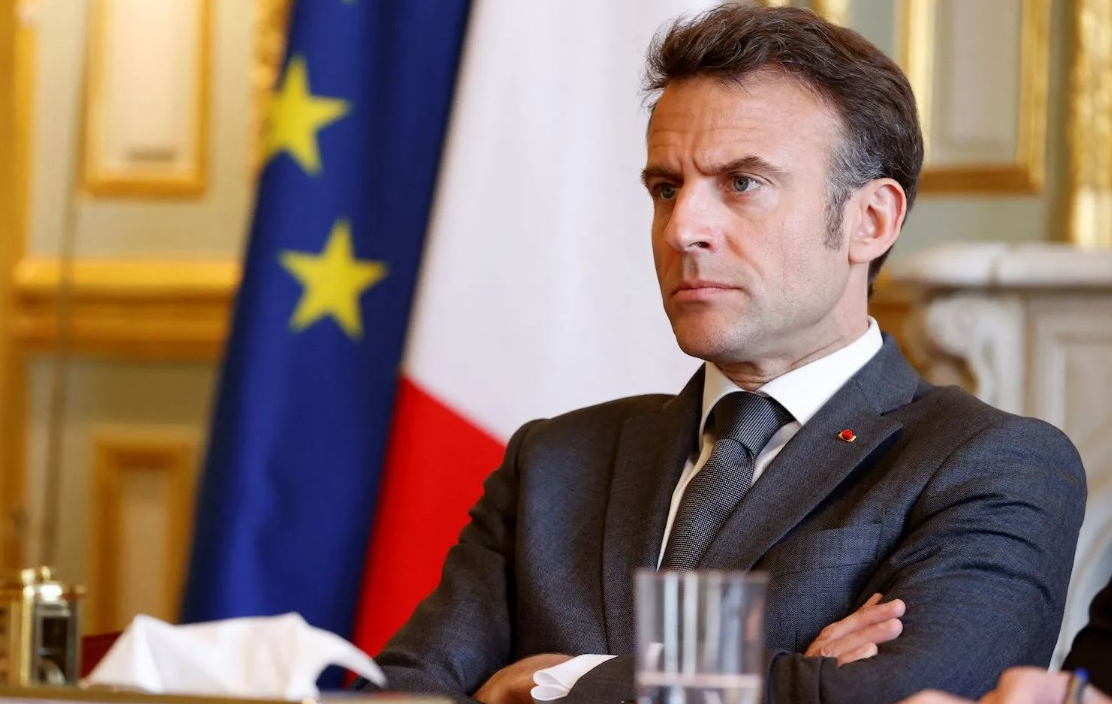
Speaking before France’s diplomatic corps at the Élysée Palace on Thursday, President Emmanuel Macron lamented what he described as a “gradual turning away” by the United States from its traditional allies and the very international rules it once championed. Macron characterized the current trajectory of U.S. diplomacy as exhibiting “a new colonial aggressiveness,” asserting that the world is increasingly dominated by great powers tempted to carve it up among themselves.

“The U.S. is an established power, but one that is gradually turning away from some of its allies and breaking free from the very international rules that it was until recently promoting,” Macron said. He added that multilateral institutions are “functioning less and less effectively,” and urged reform of the United Nations—calling on the G7 and major emerging powers to help reshape a faltering international system.

Macron’s remarks come amid growing European unease over a series of unilateral U.S. moves, including last weekend’s dramatic raid in Caracas that led to the capture of Venezuelan President Nicolás Maduro, and President Trump’s long-stated ambition to acquire Greenland—an autonomous territory of Denmark. Though Macron did not explicitly name these incidents, diplomats and analysts widely interpreted his comments as a direct response.

Across the Rhine, German President Frank-Walter Steinmeier, himself a former foreign minister, delivered an equally stark warning Wednesday evening during a public forum. Steinmeier said the international order is suffering a “second historic rupture”—the first being Russia’s annexation of Crimea and full-scale invasion of Ukraine. The second, he argued, stems from the erosion of democratic values by none other than America, “our most important partner,” which helped construct the very system now under threat.

“The world must not be allowed to descend into a robber’s den,” Steinmeier declared, “where the most unscrupulous take whatever they want, and entire regions or nations are treated as the private property of a few great powers.”

Both leaders emphasized the urgency of defending a rules-based international order while navigating the delicate balance of maintaining the transatlantic alliance. Europe, caught between upholding international law and preserving its strategic and economic ties with the U.S.—especially in the context of the ongoing war in Ukraine—has struggled to formulate a unified response to Washington’s increasingly assertive and unilateral foreign policy.

Macron underscored France’s push for “greater strategic autonomy” and reduced dependence on both the U.S. and China—a vision increasingly shared across European capitals. “We reject new colonialism and new imperialism,” he said, “but also vassalage and defeatism.”

The simultaneous but apparently uncoordinated condemnations from Europe’s two most influential powers mark a significant escalation in transatlantic tensions. As the Biden-era emphasis on alliances and multilateralism appears to give way to a more transactional and expansionist approach under Trump’s regime, European leaders are signaling they may no longer accept U.S. leadership uncritically—and may act independently to safeguard global norms.

Friday, November 21, 2025

Witkoff's Peace Proposal Aimed at Ending the War in Ukraine

    Friday, November 21, 2025   No comments

In a dramatic and highly controversial initiative that has reignited global debate over the future of Ukraine and European security, real estate magnate and Trump adviser Steven Witkoff has unveiled a comprehensive peace proposal aimed at ending the war in Ukraine. First reported by The Wall Street Journal, Bloomberg, and The New York Times in late November 2025, the 28-point plan — dubbed “Witkoff’s Peace Proposal” — presents a sweeping, U.S.-mediated framework that would require profound concessions from both Ukraine and the West, while offering Russia significant strategic and economic rewards.

At its heart, Witkoff’s proposal seeks to freeze the conflict on terms that would effectively legitimize Russia’s territorial gains while embedding Ukraine into a new, constrained security architecture.

The plan begins with a rhetorical affirmation of Ukraine’s sovereignty — a necessary fig leaf for Western audiences — but quickly pivots to concrete measures that would permanently alter Ukraine’s geopolitical trajectory. Most notably, Ukraine would be constitutionally barred from joining NATO, and NATO would formally pledge never to extend membership to Kyiv. In return, NATO would agree not to station troops or military infrastructure on Ukrainian soil — a direct reversal of current Western policy.

To ensure compliance, the proposal calls for a U.S.-mediated Russia–NATO security dialogue, a U.S.–Russia working group to monitor adherence, and the legal codification of Russian non-aggression pledges toward Ukraine and Europe. Simultaneously, Ukraine’s armed forces would be capped at 600,000 troops — a significant reduction from its current mobilized strength — and it would remain a non-nuclear state, reinforcing its dependence on Western security guarantees rather than self-reliance.

Territorial Concessions: The De Facto Recognition of Annexation

The most contentious element of the proposal lies in its territorial provisions. Ukrainian forces would withdraw from remaining Kyiv-held areas of Donetsk, creating a demilitarized buffer zone that would be “recognized as Russian territory.” While the proposal claims both sides will “not change territorial arrangements by force,” critics argue this is a de facto international recognition of Russia’s illegal annexations of Donetsk, Luhansk, Zaporizhzhia, and Kherson — territories seized since 2014 and fully occupied since 2022.

This concession, if implemented, would mark the largest territorial realignment in Europe since the end of World War II — and would fundamentally undermine the post-Cold War order built on the principle that borders cannot be changed by force.

Economic Engine: Frozen Assets as Reconstruction Fuel

Witkoff’s economic plan is equally ambitious. It proposes using $100 billion of frozen Russian assets — held primarily in Western banks — to fund Ukraine’s reconstruction, with the U.S. receiving 50% of the profits generated from those assets. Europe would contribute an additional $100 billion. The remainder of frozen Russian funds would be redirected to joint U.S.–Russia investment projects, signaling a dramatic thaw in economic relations.

The proposal further calls for Russia’s phased reintegration into the global economy, including an invitation to rejoin the G8 — a move that would reverse the Western diplomatic isolation imposed after the 2014 annexation of Crimea. Russia would also guarantee Ukraine’s free commercial use of the Dnieper River and establish agreements on Black Sea grain exports — critical for global food security.


Humanitarian and Political Measures: Elections and Amnesty

On the humanitarian front, the proposal includes a humanitarian committee to oversee prisoner exchanges, repatriation of civilians, and family reunifications — widely welcomed by international NGOs. It also mandates that Ukraine hold elections within 100 days of signing the agreement and grants full wartime amnesty to all parties, including Russian soldiers and Ukrainian collaborators — a provision that has drawn sharp criticism from human rights advocates.


Enforcement: Trump at the Helm

Perhaps the most politically explosive feature is the proposal’s enforcement mechanism: a “Peace Council” chaired by former President Donald Trump, empowered to impose sanctions or penalties for violations. This unprecedented role for a private citizen — and a former U.S. president with known pro-Russia leanings — has drawn bipartisan alarm in Washington. Critics warn it would undermine international law and institutional legitimacy, turning diplomacy into a personal project.


Reactions: Polarization Across the Globe

Reactions have been sharply divided. In Kyiv: Ukrainian officials have called the plan “a surrender disguised as peace,” warning it would cement Russian occupation and betray Ukraine’s sacrifices. President Zelenskyy’s office stated, “No peace that requires Ukraine to abandon its sovereignty or future in Europe can be legitimate.”


In Moscow: Russian state media hailed the proposal as “a realistic and dignified path forward,” with Foreign Ministry spokesperson Maria Zakharova calling it “the first serious Western acknowledgment of Russia’s security needs.”

In Brussels and Washington: NATO allies expressed deep skepticism. German Chancellor Olaf Scholz said the plan “violates the spirit of the UN Charter,” while U.S. Senator Bob Menendez called it “a dangerous appeasement that would embolden authoritarianism.” However, some conservative voices in the U.S., including former Trump officials, have praised it as “pragmatic statecraft.”

In Global South: Many non-aligned nations welcomed the economic reintegration of Russia, seeing it as a step toward multipolarity — but questioned why Ukraine bore the full cost of peace.

Witkoff’s proposal is not a negotiation — it is a blueprint for a new European order, one in which military conquest is rewarded with economic rehabilitation and strategic legitimacy. It offers Ukraine security guarantees but at the cost of its sovereignty, neutrality, and future aspirations.

While it may offer a path to an immediate ceasefire — and relief for millions of war-weary civilians — it does so by codifying the results of aggression. As one European diplomat told Reuters: “This isn’t peace. It’s the institutionalization of defeat.”

Whether the proposal gains traction — particularly with Trump’s potential return to the White House in 2025 — remains uncertain. But one thing is clear: Witkoff has forced the world to confront an uncomfortable question: At what price do we end a war — and what kind of world do we create when we do?

Source: The Wall Street Journal, Bloomberg, The New York Times, Reuters, and BBC as of November 20–21, 2025.


Friday, April 11, 2025

France will recognize Palestine Soon

    Friday, April 11, 2025   No comments

The West is behind in recognizing the rights of the Palestinians to self-determination. But it is better late then never.

West's refusal to recognize Palestine as an independent state could have prevented the October attacks and the cycle of wars in Gaza. Now some Western countries, including France, are coming to accept that potential.

France's president just announced that France will recognize Palestine in months.  France’s potential recognition of Palestine as a sovereign state is quite important, despite the fact that 147 out of 193 UN member states have already done so. Here's why France’s stance carries significant weight:

1. France's Influence in the West

France is a major Western power—a permanent member of the UN Security Council, a founding member of the European Union, and part of the G7. Most of the countries that haven’t recognized Palestine are Western or aligned with the U.S. position, including the U.S., UK, Germany, and others. So, a shift in France’s stance could:

  • Encourage other Western countries to reconsider their position.
  • Break the perception of a unified Western front against recognition.

2. European Policy Shift

Macron's statement might signal a broader shift in EU policy, especially since he hinted this move could happen in coordination with other states or at a UN summit in June. This could:

  • Build momentum for a multilateral recognition initiative.
  • Put pressure on other EU members to align or clarify their positions.

3. Symbolic & Diplomatic Impact

  • Recognition from a country like France is more than symbolic:
  • It could increase diplomatic legitimacy for Palestine on the global stage.
  • It might influence international forums, aid flows, and negotiations.
  • It adds pressure on Israel by elevating the statehood issue beyond bilateral talks.

4. Tactical Timing

France possibly tying this recognition to a UN event in June also gives it diplomatic weight—it suggests recognition could become part of a broader international initiative, maybe even linked to Arab normalization with Israel.

Saturday, May 25, 2024

Spanish Defense Minister: What is happening in Gaza is a real genocide... something that cannot be ignored

    Saturday, May 25, 2024   No comments

Spanish Defense Minister Margarita Robles confirmed today, Saturday, that the war on the Gaza Strip is a “true genocide,” in light of the deterioration of relations between “Israel” and Spain, after Madrid’s decision to recognize the Palestinian state.

“We cannot ignore what is happening in Gaza, which is a true genocide,” Robles said during an interview with the official TVE television, pointing out that Madrid’s recognition of a Palestinian state aims to help “end the violence in Gaza.”

Robles' statements came after similar statements from Yolanda Diaz, Spanish Deputy Prime Minister yesterday, who also confirmed that the war on Gaza is genocide.

Diaz pledged to continue pressing, from her position in the government, to defend human rights and put an end to the genocide committed against the Palestinian people.

Diaz's pledge came in a video clip circulated by activists on social media, in which she expressed her welcome of Spain's recognition of the State of Palestine, and stressed that her country's move towards recognizing the Palestinian state, on May 28, is "just the beginning, and we cannot stop at this point."

“We are living in a moment where doing the bare minimum is heroic, but it is not enough at the same time,” added Díaz, who also serves as Minister of Labor and Economy.

She said, "Palestine will be liberated from the river to the sea," referring to the Jordan River and the Mediterranean Sea, between which Palestine lies.

In a related context, the Spanish Minister of Foreign Affairs, José Manuel Albarez, said in a post on the “X” platform that “the precautionary measures taken by the International Court of Justice, which included the decision to stop the Israeli attack in Rafah, are mandatory,” calling for their implementation. The ICC, too, has moved to issue arrest warrants against Israeli leaders accusing them of crimes against humanity and other war crimes.

Yesterday, the International Court of Justice ordered the Israeli occupation to stop the military attack on Rafah, stressing that any additional military action will lead to partial or total destruction in the region, in accordance with the Genocide Convention, without urging a comprehensive ceasefire in the Strip.

It is noteworthy that Spain, Norway, and Ireland announced, two days ago, officially recognizing the State of Palestine as of May 28, amid Arab welcome and Israeli anger.

Spanish Prime Minister Pedro Sanchez said on Wednesday, "If more countries recognize the Palestinian state, this will increase international pressure for a ceasefire in the Gaza Strip."

Before this development, European Union member countries had previously recognized the State of Palestine, including Bulgaria, Poland, the Czech Republic, Romania, Slovakia, Hungary and Sweden.


Wednesday, December 27, 2023

Le Monde: Western donors punish human rights organizations because of their support for Gaza

    Wednesday, December 27, 2023   No comments

The French newspaper Le Monde said that civil society organizations in many Middle Eastern countries are extremely angry because of their loss of European funding, after they condemned the Israeli attack on Gaza.

The newspaper - in a report by its correspondents Laure Stephane in Beirut and Clotilde Mravco in Jerusalem - reviewed the story of the Egyptian lawyer Azza Soliman, who had been relying on German support for about 10 years, and learned that Germany would withdraw the funds allocated from her for a project to support women victims of human trafficking.

This came after it signed - with more than 200 Arab organizations - a text condemning “genocide against the Palestinian population in the Gaza Strip” and calling for sanctions to be imposed on Israel, “the occupying and apartheid state.”

The punishment sparked intense anger within Egyptian civil society, which denounced this censorship. The lawyer said, “Do the German authorities want to discipline us? Teach us what we have the right to say? It is a scandal.” However, the German Foreign Ministry said that it acted because of “the public statements of the Seola organization and its founder, Azza Soliman.” , which contradicts “the Berlin line, including the call for an economic boycott of Israel.”


This decision comes within a broader framework - according to the newspaper - since the attack by Hamas on Israel on October 7, during which Germany reviewed the projects funded “in the region,” which “includes a re-evaluation of the political positions and announcements of our partners, with regard to these issues.” 

The newspaper saw that Arab human rights defenders risk losing their funding if they do not adhere to the political line of this donor regarding the Israeli-Palestinian conflict, at a time when the unconditional support provided by Washington and the majority of European leaders for Israel arouses discontent in the Arab world, in light of the massacre committed by Israel. against civilians in Gaza.

Other European governments want to reconsider their partnerships with civil society organizations in the Middle East, especially Palestinian NGOs, after the European Union generalized the “combat incitement” to hatred and violence clause to all new contracts signed with Palestinian actors, including vague language, which is likely To be used to force beneficiaries to silence their work denouncing the Israeli occupation.

For its part, Sweden intends to ask its Palestinian partners to condemn Hamas. Switzerland also announced the end of its cooperation with 3 Palestinian non-governmental organizations, considering that its statements after the Hamas attack are not consistent with its rules of conduct. The director of the Palestinian Center for Human Rights, lawyer Raji Sourani, says, “It is an issue that returns.” "For political motives."

At the end of November, Amnesty International and about 100 organizations denounced this pressure, which is seen in the Middle East as a reflection of right-wing policies in Europe, and considered it an obstacle to freedom of expression and opinion.

Le Monde believed that the conditions imposed on non-governmental organizations threaten to weaken civil societies that rely heavily on Western funds, at a time when their silence in the face of the ongoing massacre in Gaza means losing their credibility in the region.


Tuesday, December 12, 2023

European Union foreign policy chief Josep Borrell: The destruction in Gaza is worse than what Germany witnessed during World War II

    Tuesday, December 12, 2023   No comments

Borrell: The situation is catastrophic and horrific, and the human suffering in the Strip constitutes an unprecedented challenge to the international community

European Union foreign policy chief Josep Borrell on Monday described the situation in Gaza as “catastrophic and horrific,” with relatively “greater” destruction than what Germany witnessed during World War II.

After chairing a meeting of European Union foreign ministers, Borrell said that the Israeli army's response to the attacks launched by Hamas on October 7 led to an "incredible number of civilian casualties."

Borrell did not refer to the fact that Israel's war on Gaza has killed more children than any other conflict, with more than 70% of confirmed deaths being women and children.

Borrell also expressed the European Union's "concern" about the violence of extremist settlers in the West Bank, who are represented in the Israeli government by supremacists who suggested Israel drops a nuclear bomb on Gaza

Borrell also condemned the Israeli government's approval of the construction of 1,700 new housing units in Jerusalem, which Brussels considers a violation of international law.

Borrell said, “The destruction caused to buildings in Gaza...is somewhat greater than the destruction inflicted on German cities during World War II.”

He said that he presented to the foreign ministers of European Union countries a discussion paper to consider “imposing sanctions against extremist settlers in the West Bank” whose attacks against Palestinian residents have increased in intensity.

He indicated that he would soon turn the paper into an official proposal, based on an initiative taken by the United States, which announced last week that it would refuse to grant visas to extremist Israeli settlers.

But he acknowledged that there is no consensus yet on the issue among the governments of European Union countries.


Sunday, November 19, 2023

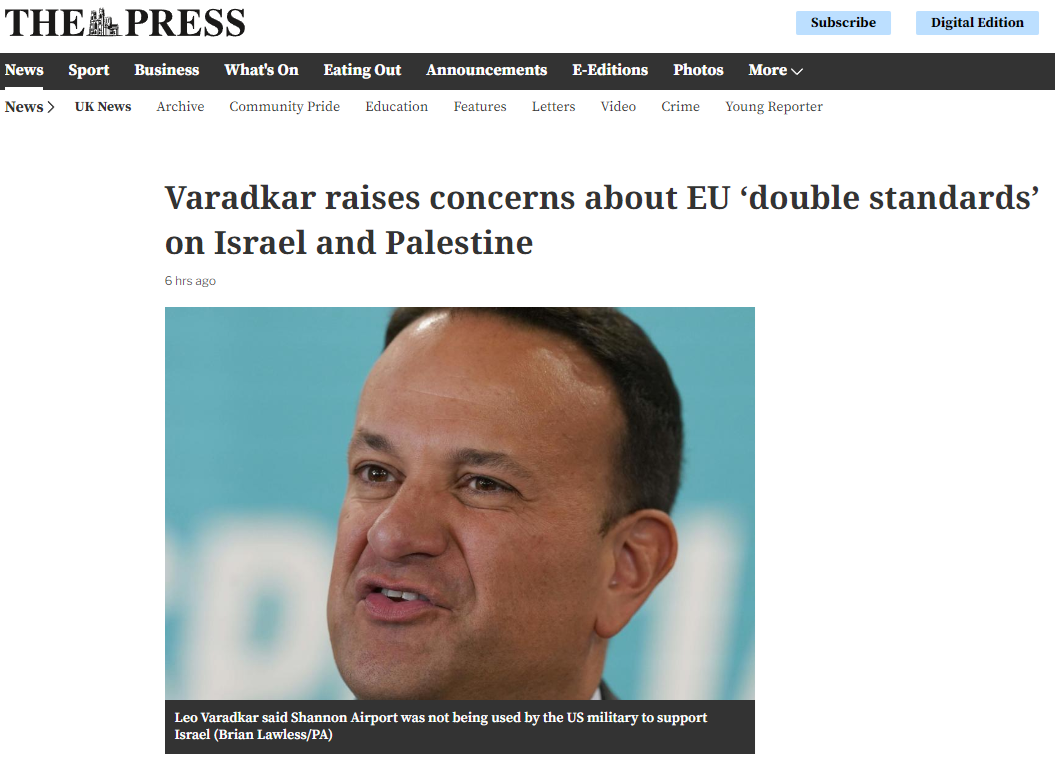
Irish Prime Minister Leo Varadkar accuses other countries in the European Union, and the West in general, of double standards against the backdrop of the conflict in the Middle East

    Sunday, November 19, 2023   No comments

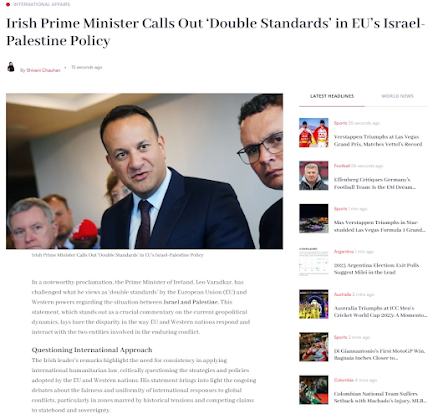
Irish Prime Minister Calls Out ‘Double Standards’ in EU’s Israel-Palestine Policy

In an interview with the Irish radio station RTE, Varadkar accused the European Union and other Western countries, saying that “failing to take a reaction similar to the absolute rejection of what Russian President Vladimir Putin did in Ukraine, with regard to Israel, is seen as duplicity in Standards".


The Irish government warned, shortly after the Al-Aqsa Flood operation launched by the Palestinian resistance against Israel on October 7, that Israel should not exaggerate its reaction in the Gaza Strip, otherwise it would risk losing the support of other countries.


According to the German News Agency, Varadkar seeks to reach a ceasefire in Gaza, and said that his country early adopted a clear position that Israel has the right to...

To defend itself, but it has no right to violate humanitarian law.


Varadkar expressed concern that double standards on the part of some countries would undermine Ukraine's struggle, and stated that he and European leaders were working hard to gain support from the Global South for Ukraine.


Saturday, October 28, 2023

Keypoints from the President of Turkey, Erdogan, before a crowd organized in support of Gaza

    Saturday, October 28, 2023   No comments

Erdogan is the most successful opportunistic politician who will use every popular issue to plug in his relevance. After weeks of silence, he came to join a large crowd of people waving Turkish flags, invoking Gaza crisis but saying nothing of substance. He seemed more concerned with the optics than with the human cost accrued by people dying. Here are some of the ultimate showman’s statements.


* Unfortunately, in Turkey, there are politicians who claim that just as Netanyahu is a terrorist, so is HAMAS. They don't know what HAMAS is.

* Today, some in Turkey see Gaza as distant from us, and they don't care about what happens there. Gaza was an Ottoman city nearly 100 years ago. For us, it was one of our cities, like Adana and Mardin are today.

* Unfortunately, we were divided and separated by borders, and today they are trying to divide us with various temptations and games.

* Look closely at the statements of Israeli officials, and you will find plans of insult and betrayal, directed at our lands as well.

* I confirm that HAMAS is not a terrorist movement, and we will not be satisfied with the condemnation of what is happening in the Gaza Strip.

* Those who cried about injustice in Ukraine yesterday are today supporting Israel with blood on their hands.

* Israel won't last even three days without the support of Western countries.

* Turkey is preparing to declare Israel a war criminal to the entire world.

* Western officials have become deaf and cannot hear the cries of the casualties in Gaza or the appeals of the UN Secretary-General.

* Israel is committing a massacre in Gaza in the darkness, thinking that the world will not find out.


Sunday, September 24, 2023

News media review: Zelensky visited Poland during his return from Washington, but no official in the country received him

    Sunday, September 24, 2023   No comments

A report in the Singaporean newspaper “The Straits Times” said on Sunday that Ukrainian President Volodymyr Zelensky, returning from the United States, stopped in Poland, but no officials met with him.

The report added: “Zelensky gave Polish volunteers government awards during his stop in Poland yesterday, Saturday, but he did not meet any official, as relations between the two countries became tense due to grain supplies.”

Marcin Brzydak, head of the Polish Presidency's International Policy Office, said in an article in the Singaporean newspaper, The Straits Times, that "his office did not receive any official request to hold a meeting during Zelensky's stay in Poland."

Polish Prime Minister Mateusz Morawiecki had previously warned President Zelenskiy of “new insults to Warsaw.”


Saturday, September 16, 2023

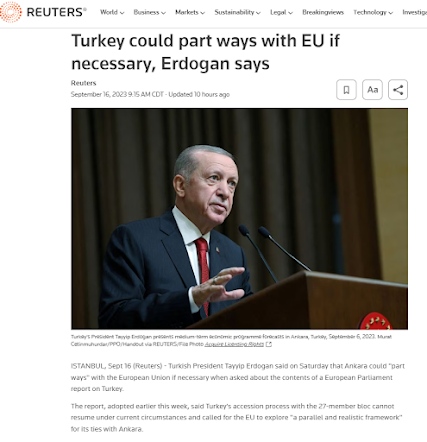
After waiting longer than any applicant, Erdogan now says Turkiye could 'part ways' with EU

    Saturday, September 16, 2023   No comments

After waiting far longer than any other country that applied and joined the Bloc, Turkiye is not frustrated with the process, but not giving up yet. 

Turkish President Recep Tayyip Erdogan said on 16 September that Ankara could “part ways” with the EU if necessary, following the release of a European Parliament report rejecting the possibility of Turkiye joining the EU soon.

The report instead suggested the EU explore “a parallel and realistic framework,” such as a customs union, to determine its ties with Ankara.

“The EU is trying to break away from Turkiye,” Erdogan told reporters. “We will make our evaluations against these developments and if necessary, we can part ways with the EU.”


Turkey’s Foreign Ministry said the European Parliament report contained unfounded allegations and prejudices and took “a shallow and non-visionary” approach to the country’s ties with the EU.


Visa liberalization, which would give Turkish citizens visa-free travel to the bloc for long periods, is a significant reason Turkiye wishes to join the EU. Many Turkish citizens work in EU states, most notably Germany, and EU membership for Turkiye would free them of the difficult bureaucratic process needed to obtain visas.


The European Parliament report follows renewed Turkish efforts to join the EU. Earlier this summer, President Erdogan sought to link Turkiye’s EU accession to approving Sweden’s bid to join NATO.


However, EU officials balked at linking the two issues, citing human rights abuses and the deterioration of the rule of law in Turkiye under Erdogan.


“We have recently seen a renewed interest from the Turkish government in reviving the EU accession process,” said the lead lawmaker on the file, Spanish Socialist Nacho Sánchez Amor, upon adopting the report on Wednesday.


“This will not happen because of geopolitical bargaining, but only when the Turkish authorities show real interest in stopping the continuing backsliding in fundamental freedoms and rule of law in the country,” Sánchez Amor said.


EU officials accuse Erdogan of stifling the media and imprisoning dissidents, including during a crackdown after a failed coup in 2016, which Erdogan blamed on the Gulen Movement. Turkiye’s occupation of parts of EU-member Cyprus has also led EU officials to criticize Erdogan.


In 2018, the European Council said in a statement that negotiations for Turkiye to join the EU “have come to a standstill.”


Wednesday, September 13, 2023

While Western governments are crying foul over Russia’s termination of the “gain deal”, European governments are banning the import of grain from Ukraine

    Wednesday, September 13, 2023   No comments

Hungary, Slovakia and Bulgaria will introduce restrictions on the import of grain from Ukraine. 

This was stated by Hungarian Agriculture Minister Istvan Nagy after negotiations with colleagues.

 Countries want to introduce restrictions on the import of Ukrainian grain at the national level until the end of 2023, if the EC does not extend them at the pan-European level.


Poland has already announced a unilateral ban on grain imports, and Romanian farmers are threatening to block ports and customs if the import ban is not extended.


Related to the grain deal, and after a meeting between Erdogan and Putin in Sochi, Russia, Turkeye, and Qatar agreed to form an alternative structure that would supply African countries with grain and fertalizer. Russia has offered to provide free grain to Africa.

The grain will be provided by Russia, the logistics will be financed by Qatar, and the operation will be managed from Trukeye, which is also asiring to become a natural gas hub for the world.

Saturday, September 02, 2023

The statements of a Belgian minister about the occupation's violations against the Palestinians and the killing of children raise a diplomatic crisis with Israel.. and Guinness confirms that she does not regret her statements

    Saturday, September 02, 2023   No comments

The statements of the Belgian Minister of Cooperation and Development, Caroline Guenez, about Israel's violations against the Palestinians, sparked a diplomatic crisis with Tel Aviv, according to Belgian media, while it was welcomed by the Palestinians.

In an interview with the local newspaper "De Morgen", published on Friday, Gennes spoke about the killing of Palestinian children, wiping entire villages off the map, and destroying schools and neighborhoods funded by the European Union.

And according to the website of the Belgian newspaper “HLN”, “Minister Guenez stuck to her words, which caused a diplomatic problem between her country and Israel.”

The newspaper quoted a spokesman for the minister as telling the Belgian media that Guenez "does not regret her statements in the interview."

She added that the minister also referred to "Belgium's support for the two-state solution in the Israeli-Palestinian issue, and if democracy and human rights come under pressure anywhere in the world, we will oppose that," according to the same source.

“Unfortunately, 2023 is the bloodiest year in the Israeli-Palestinian conflict for a long time, as 218 Palestinians, including 34 children, and 28 Israelis, were martyred,” Guenez said in her statements, which she re-published in several languages on her account on the X platform.

She added, “We have also witnessed the systematic destruction of infrastructure on the Palestinian side in recent months, and this is pushing entire communities out of their villages, and the costs of this infrastructure have often been jointly financed through international support.”


And the Belgian minister added, “I still condemn this out of respect for the efforts of the international community, and a serious conversation is also scheduled with the Israeli ambassador on this issue on September 7.”

For its part, the Palestinian Ministry of Foreign Affairs and Expatriates welcomed, in a statement, the Belgian Minister's statements.

And she considered that these statements are “fully consistent with international law and international legitimacy decisions and support the two-state solution and the principles of human rights, as indicated by the (Belgian Minister).”

The ministry condemned "the heinous and unjustified Israeli attack by the Israeli government against the minister and her statements."

And it considered that the Israeli attack falls “within the framework of misleading propaganda and intimidation of parties that criticize the occupying state and attempts to obscure the reality of the historical injustice that the Palestinian people are subjected to, repression, abuse, persecution and racial discrimination that many credible human rights and humanitarian organizations, including Israeli, American and European ones, have talked about.”

In turn, the Palestinian “Hamas” movement welcomed, on Saturday, the statements of the Belgian Minister of Cooperation and Development about Israel’s “crimes” against the Palestinians, especially children.

The leader of the movement, Bassem Naim, said in a statement: "The Belgian minister's statements are completely consistent with the facts on the ground, which were confirmed by several UN reports, especially in light of the current far-right government."

Naim added, "The occupation's reaction to the statements reflects the entity's fear of exposing its myths that it has promoted for decades, and its keenness to keep its crimes away from public opinion and the international media."

Yesterday, Friday, Tel Aviv summoned Belgium's ambassador to France, Jean-Luc Bodson, to express "strong condemnation" after Belgian Minister Guenez's statement about Israel's violations against the Palestinians, according to the "Times of Israel" newspaper.

The Israeli ambassador to Brussels, Edith Rosenzweig-Abu, also said, through her account on the “X” platform, that the Ministry of Foreign Affairs protested to the Belgian ambassador, and asked for clarifications regarding Minister Guenez’s statements.


Monday, August 28, 2023

Macron admits the Western dominated global order is being challenged, calls for revised strategies

    Monday, August 28, 2023   No comments

In his annual address to French ambassadors, French President Emmanuel Macron admits the Western dominated global order is being challenged, calls for strengthening of France's diplomatic on Monday.

Macron stated that: "The situation in the international arena is becoming more complicated, which threatens the risk of weakening the West and, in particular, Europe. We need to take a sober approach to this, without falling into excessive pessimism ... There is a revision of the world order, its principles, various forms of its organization, where the West has occupied and occupies a dominant position.”

France needs to consolidate its diplomatic strategies as the international context has become more “complex”, Macron told French ambassadors at a meeting in Paris on Monday.

“Our international order is being challenged,” said Macron. “War has returned to European soil, anti-French sentiment is rife, fueled by anti-colonialism or a perceived anti-colonialism that a double standard is being employed,” he said.

“We need to be clear, without being excessively pessimistic,” he said, citing the rise of “new forms of protectionism” and democratic backsliding due to a rise in illiberal powers.

Faced with these risks, Macron said France’s diplomatic efforts should focus on security policy in the context of the war in Ukraine and in bolstering European independence and strategic interests.

The French president also stressed the need to “avoid partitioning the world” over the Ukraine war, at a time when many countries from the Global South have refused to condemn Russian aggression. We must “avoid a narrative that claims, ‘this is Europe’s war, it doesn't concern us’”, he said.

France also seeks to be a “trusted partner” on the geopolitical front, “our diplomatic efforts should keep it simple. We should protect our interests. We should also stand for our principles and our values, which are universal,” said Macron.


Keeping our readers informed about the most consequential events in this fast changing worldManage your Subscription; invite a friend to subscribe to ISR’s Weekly Review Bulletin

Saturday, May 27, 2023

Personalities and ideologies that drive the conflict between NATO and Russia and their semi-proxy war in Ukraine

    Saturday, May 27, 2023   No comments

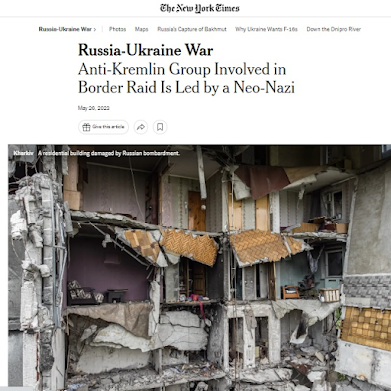
Yesterday, the New York Times revealed that the “Anti-Kremlin Group Involved in Border Raid Is Led by a Neo-Nazi”. The paper reported that the leader of the Russian Volunteer Corps, one of the two insurgent groups responsible for an armed incursion into Russia this week, is a far-right extremist, German officials and humanitarian groups say.


Russia has stated since the start of the conflict in Ukraine in 2014 that neo-Nazis are behind the campaign to kill and displace ethnic Russians in eastern Ukraine; Russian leaders have stated that denazification is a goal of its military operation in Ukraine.

On the same day, the German DER SPIEGEL reported that the “evidence confirms Ukraine's involvement in the Nord Stream bombing.” The newspaper confirmed, Friday, that there is new evidence in the investigation indicating Ukraine's involvement in sabotage operations targeting the "Nord Stream" gas pipelines.

And the newspaper reported that the metadata of e-mail messages, which were sent during the charter of the boat, indicate the involvement of Ukraine, pointing to the finding in the yacht of traces of the explosive “HMX” substance, which is very widespread in the west as in the previous block in the east.

"Der Spiegel" stated that all the evidence "consistent with the assessments of several intelligence services, according to which the perpetrators will be searched for in Ukraine."

And the German newspaper continued: "We now wonder whether what happened could have been carried out by unsupervised commandos, or the Ukrainian intelligence services, and to what extent certain elements of the Ukrainian government apparatus were aware of this."

This comes at a time when police investigations are focusing, in particular, on the "Andromeda" yacht, which is likely to be used to transport explosives, which led to the detonation of the pipelines in September 2022, in the Baltic Sea, according to what was reported by "Agence France Presse".

It is likely that the yacht set off from the port of Rostock, in northern Germany, on September 6, with 6 people on board, including divers and a doctor.

It turned out that one of the passengers on the boat holds a Romanian passport, and he is also a "Ukrainian citizen who previously served in an infantry unit."

And at the beginning of this week, other German media traced the file of the boat rental by a Polish company owned, in fact, by Ukrainians.

Investigators are looking into the evidence of "Ukrainian military services," according to Sudeutsche, RND and VDR TV.

Meanwhile, a German analyst suggested that the transferring the Ukrainian war to Russia is a strategic mistake for which the world will pay.

During the past few days, the Russian-Ukrainian war witnessed a remarkable development when Russia revealed that armed elements had entered its territory through the Ukrainian borders, which means that Ukraine may have begun to transfer the war into Russia.


And whether you do or plan to do so, the question posed by German writer and analyst Andreas Kluth in an analysis published by Bloomberg News is: Will this development be a good thing?


Russia said that "Ukrainian terrorists" and "fascists" attacked Russian territory. Of course, according to the German analyst, such statements and everything issued by the Russian government can be ignored. It has been said that the armed groups that claimed responsibility for the attacks inside Russian territory consist of Russians who defected from President Vladimir Putin's army and are fighting against him for Ukraine now.


One of these groups calls itself the "Russian Freedom Corps", and the other is called the "Russian Volunteer Corps", and includes elements of ultra-nationalists.


According to Cloth, there is limited information available about these anti-Putin paramilitary forces, especially as to whether they take orders from Ukraine or operate independently.


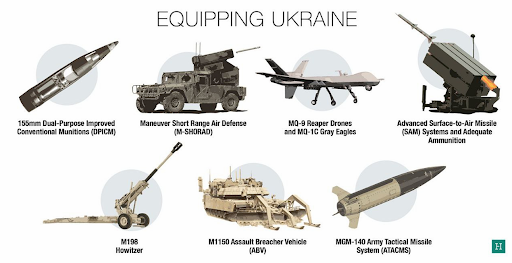
In the context of the conflict with Russia, the Ukrainian Ministry of Defense said - in a statement - that the Ukrainian army needs about 48 F-16 combat aircraft to liberate the territories occupied by Russia, according to the ministry's statement.


On the other hand, the ministry announced that Canada will complete in the coming weeks the delivery of thousands of small arms and live ammunition that it donated to Ukraine.


The Ukrainian National News Agency quoted the Ministry of Defense as saying that the delivery of small arms and ammunition had already begun last April, including machine guns and assault rifles.


The ministry stated that in the coming weeks, one million bullets and about 5,000 assault rifles will be delivered.


Meanwhile, a spokeswoman for the German Defense Ministry said that the ministry had received a request from Ukraine in the past few days to hand over Taurus cruise missiles. The spokeswoman did not give any other details about the letter, such as the number of missiles that Kiev is requesting.

All these developments suggest that if Ukraine accumulates enough weapons, it will be able to use them anyway it sees fit without any consideration of the limits demanded by the Western nations that donated the weapons. This would take things out of control and can result in catastrophic events unless the conflict is recalibrated. Sensing the urgency to act now before it is late, and the to build on the Chines, Brazilian, and African initiatives to settle the conflict, German leaders decided to reopen a direct line of communication with Russia. Schultz intends to reconnect with Putin at the appropriate time

German Chancellor Olaf Schultz announced today, Friday, that he is ready to return to contact with Russian President Vladimir Putin "at the appropriate time," in light of the interruption of talks between them since last December.


Schultz said in an interview published by the newspaper "Kölner Stadt-Anzeiger" on Friday that his last phone call with Putin was a long time ago, but he intends to talk to him again at the appropriate time.


Regarding his vision for resolving the conflict, Schultz said that Russia "must understand that the war cannot end with some kind of cold peace that would turn the current front line into a new border between Russia and Ukraine, that would only serve to legitimize Putin's campaign."


On the contrary, he added, a just peace must be achieved through the withdrawal of Russian forces from Ukraine.


But Schultz refused to say whether this withdrawal should also include Crimea, occupied since 2014, and the German chancellor believed that it was up to Ukraine to determine what it wanted.

Commenting on all these developments, and speaking on behalf of Putin, Dmitry Peskov said that “the degree of involvement of the West in the conflict in Ukraine is growing every day.”

 Peskov noted that the involvement of the West can stretch the conflict in time, but will not change the situation radically. "Russia will continue the special operation and one way or another will ensure its interests," the press secretary of the President of the Russian Federation stated.
Thursday, April 20, 2023

Media review: is France's Macron rebelling against the Western world order?

    Thursday, April 20, 2023   No comments

The Economist thinks so.

The prestigious British newspaper The Economist launched, in its latest issue, a fierce attack on President Macron because of his statements that he made to a very limited number of journalists who accompanied him during his recent visit to China, describing them as very dangerous and at the wrong time.


What angered the well-established magazine, which represents the Western liberal capitalist world in one way or another, and was reflected in its editorial, which is followed by most of the leaders of the Western world in particular, and topped its latest issue, the saying of the French president, whom she described as one of the most experienced European leaders, “It is not the business of the European continent to fall into crises.” It is not our business, and in the name of strategic autonomy, and we should not be in Europe following America in a crisis like the Taiwan crisis.”

Macron, from the magazine's point of view, made two fatal mistakes:

The first: strengthening the ambition of China and its president to divide the European continent and separate the Europeans from America.

The second: undermining the allies' support for Taiwan, because diplomacy alone will not reduce the risks of war, and the West needs to strengthen military deterrence, which requires strengthening the US-European Western alliance in the face of tyranny.

What is certain and indisputable is that Emmanuel Macron is not Charles de Gaulle, the historical leader of France, and it is not possible to compare the two for many reasons that are long to explain, but his recent positions, that is, Macron, are trying to emulate de Gaulle's strategic positions, the most prominent of which is preventing Britain from entering the European market The joint (European Union later) because it does not trust it, and not to join the “NATO” alliance led by America.

Submit your story (pitch an article)

Name

Email *

Message *


Trending Today...


ISR +


Frequently Used Labels and Topics

40 babies beheaded 77 + China A Week in Review Academic Integrity Adana Agreement afghanistan Africa African Union al-Azhar Algeria Aljazeera All Apartheid apostasy Arab League Arab nationalism Arab Spring Arabs in the West Armenia Arts and Cultures Arts and Entertainment Asia Assassinations Assimilation Azerbaijan Bahrain Bangladesh Belarus Belt and Road Initiative Brazil BRI BRICS Brotherhood CAF Canada Capitalism Caroline Guenez Caspian Sea cCuba censorship Central Asia Charity Chechnya Children Rights China Christianity CIA Civil society Civil War climate colonialism communication communism con·science Conflict conscience Constitutionalism Contras Corruption Coups Covid19 Crimea Crimes against humanity D-8 Dearborn Debt Democracy Despotism Diplomacy discrimination Dissent Dmitry Medvedev Earthquakes Economics Economics and Finance Economy ECOWAS Education and Communication Egypt Elections energy Enlightenment environment Epstein equity Erdogan ethics Europe Events Fatima FIFA FIFA World Cup FIFA World Cup Qatar 2020 Flour Massacre Food Football France Freedom freedom of speech G20 G7 Garden of Prosperity Gaza GCC GDP Genocide geopolitics Germany Global Security Global South Globalism globalization Greece Grozny Conference Hamas Health Hegemony Hezbollah hijab Hiroshima History and Civilizations Hormuz Human Rights Huquq Ibadiyya Ibn Khaldun ICC Ideas IGOs Immigration Imperialism In The News india Indonesia inequality inflation INSTC Instrumentalized Human Rights Intelligence Inter International Affairs International Law Iran IranDeal Iraq Iraq War ISIL Islam in America Islam in China Islam in Europe Islam in Russia Islam Today Islamic economics Islamic Jihad Islamic law Islamic Societies Islamism Islamophobia ISR MONTHLY ISR Weekly Bulletin ISR Weekly Review Bulletin Italy Japan Jordan Journalism Kenya Khamenei Kilicdaroglu Kurdistan Latin America Law and Society Lebanon Libya Majoritarianism Malaysia Mali mass killings Mauritania Media Media Bias Media Review Middle East migration Military Affairs Morocco Multipolar World Muslim Ban Muslim Women and Leadership Muslims Muslims in Europe Muslims in West Muslims Today NAM Narratives Nationalism NATO Natural Disasters Nelson Mandela NGOs Nicaragua Nicaragua Cuba Niger Nigeria Normalization North America North Korea Nuclear Deal Nuclear Technology Nuclear War Nusra October 7 Oman OPEC+ Opinion Polls Organisation of Islamic Cooperation - OIC Oslo Accords Pakistan Palestine Peace Philippines Philosophy poerty Poland police brutality Politics and Government Population Transfer Populism Poverty Prison Systems Propaganda Prophet Muhammad prosperity Protests Proxy Wars Public Health Putin Qatar Quran Rachel Corrie Racism Raisi Ramadan Ramadan War Regime Change religion and conflict Religion and Culture Religion and Politics religion and society Resistance Rights Rohingya Genocide rule of law Russia Salafism Sanctions Saudi Arabia Science and Technology SCO Sectarianism security Senegal Shahed sharia Sharia-compliant financial products Shia Silk Road Singapore Sistani Slavery Soccer socialism Southwest Asia and North Africa Sovereignty Space War Spain Sports Sports and Politics Starvation State Power State Terror Sudan Sunni Axis sunnism Supremacism SWANA Syria Ta-Nehisi Coates terrorism Thailand The Koreas Tourism Trade transportation Tunisia Turkey Turkiye U.S. Cruelty U.S. Foreign Policy UAE uk ukraine UN under the Rubble UNGA United States UNSC Uprisings Urban warfare US Foreign Policy US Veto US-Iran MoU USA Uyghur Venezuela Volga Bulgaria Wadee wahhabism War War and Peace War Crimes War on Iran Wealth and Power Wealth Building West Western Civilization Western Sahara WMDs Women women rights Work Workers World and Communities Xi Yemen Zionism

Search for old news

Find Articles by year, month hierarchy


WEEKLY AdSpace 3

_______________________________________________

Copyright © Islamic Societies Review. All rights reserved.