Wednesday, April 15, 2026
Tuesday, November 25, 2025
Media Review: Trump’s Forced Smiles Conceal Deep Anxiety as Rising Star Mamdani Threatens Political Narrative
In an apparent display of civility, former U.S. President Donald Trump met newly elected New York City Mayor Zohran Mamdani in the Oval Office on November 21, 2025—two figures who, despite having branded each other in incendiary terms, posed for cameras with practiced composure. Yet beneath the handshakes and shared jokes, British journalist Michael Day argues in The Independent, lies a far more revealing story: Trump’s calm demeanor and wide, artificial smiles mask a profound unease—an anxiety rooted not just in personal pride, but in the existential threat Mamdani represents to the Republican Party’s political narrative.
Just weeks before the meeting, Trump had dismissed Mamdani as a “100% insane communist,” while Mamdani, an unapologetic democratic socialist, had once labeled Trump a “fascist.” Their ideological chasm could hardly be wider. Yet in Washington, the two avoided direct confrontation, instead exchanging platitudes about their mutual love for New York City and pledges to support its growth. To Day, this surface-level harmony is a carefully constructed illusion—“a mask worn for the cameras”—hiding a deeper tension.
At 34, Mamdani—a Muslim of Indian-Ugandan heritage—has achieved what many deemed improbable: defeating the politically entrenched Cuomo dynasty and capturing City Hall on a platform of bold progressive reform, including rent freezes, universal public services, and aggressive wealth redistribution. For Trump, a man who prides himself on winning and venerates winners, Mamdani’s meteoric rise is not merely impressive—it is unsettling. As Day notes, Trump himself acknowledged Mamdani had waged “an incredible race against very smart people,” a rare admission of respect tinged unmistakably with apprehension.
Why the anxiety? Mamdani’s success signals a new, viable path for the American left: a charismatic, digitally savvy, grassroots-driven socialism that resonates powerfully with younger, multiracial, and working-class voters—exactly the coalition the GOP has struggled to neutralize. His campaign, built around a laser-focused message of lowering the cost of living and leveraging innovative digital outreach, mobilized a broad coalition that defied traditional political expectations. To Trump, whose political dominance has long depended on framing Democrats as elitist, out-of-touch, or extremist, Mamdani’s authenticity and electoral potency disrupt that script. He is not a caricature Trump can easily ridicule—he is a winner, and that makes him dangerous.
Compounding Trump’s unease is a week of personal and political turbulence: although he recently secured massive Saudi investments, he was forced—amid renewed scrutiny of the Epstein case—to release previously withheld documents, a development that reportedly angered and unnerved him. In this fragile moment, Day suggests, Trump could not afford to appear weakened or reactive in front of Mamdani. Instead, he defaulted to deflection and dark humor. When a journalist asked whether he minded Mamdani calling him a fascist, Trump quipped, “I’ve been called worse than fascist”—a line that drew laughter but betrayed strategic evasion.
Yet the stakes extend far beyond Trump’s ego. Day warns that Mamdani’s ascent risks triggering a crisis of identity within the Democratic Party itself. While the progressive left celebrates his victory as vindication, the party’s moderate wing grows increasingly wary of his socialist agenda—fearing a backlash in swing districts and national elections. This internal rift was starkly illustrated the day before the White House meeting, when 86 House Democrats joined Republicans in passing a resolution condemning “the terror of socialism.” To Day, this was a profound misstep: targeting Mamdani-style progressivism, he argues, while ignoring the very real threat of a second Trump term, reveals a party at odds with its own future.
Ultimately, Day concludes, the cordial photo-op between Trump and Mamdani obscures a seismic political shift. Mamdani embodies a new generational energy—one that challenges both Republican hegemony and Democratic orthodoxy. His rise signals the emergence of a new political archetype: pragmatic yet radical, local yet nationally resonant, deeply ideological yet electorally effective.
As Trump watches this young mayor assume power in America’s largest city, he does so not just as a former president—but as a seasoned political predator keenly aware that the rules of the game may be changing. And for the first time in years, it’s not Trump setting the pace.
Wednesday, September 24, 2025
Arab and Muslim Leaders, who met with Trump, Call for Immediate Gaza Ceasefire as First Step Toward Lasting Peace
In a significant diplomatic move on the sidelines of the United Nations General Assembly in New York, leaders from eight Arab and Muslim-majority nations joined U.S. President Donald Trump in a high-level summit focused on ending the war in Gaza. Following the meeting on Tuesday, the group issued a joint statement on Wednesday emphasizing that an immediate cessation of hostilities is “the first step toward a just and lasting peace.”
The leaders described the situation in Gaza as “an unbearable and tragic humanitarian catastrophe,” citing massive civilian casualties, widespread destruction, and the dire consequences for regional stability and the broader Muslim world. They reaffirmed their collective rejection of forced displacement and stressed the necessity of allowing displaced Palestinians to return to their homes.
Central to the joint declaration was a call for an immediate and permanent ceasefire that would facilitate the release of all hostages and guarantee the unimpeded delivery of sufficient humanitarian aid into Gaza. “Ending the war and achieving an immediate ceasefire—ensuring the release of hostages and the entry of adequate humanitarian assistance—is the essential first step toward a just and lasting peace,” the statement read.
The leaders also underscored the urgent need for a comprehensive reconstruction plan for Gaza, built upon proposals previously advanced by the Arab League and the Organization of Islamic Cooperation (OIC). This plan, they said, must include robust security arrangements and international support for Palestinian leadership to ensure long-term stability and recovery.
Trump’s 21-Point Peace Plan Unveiled
Adding further context to the summit, U.S. Middle East envoy Steve Witkoff revealed on Wednesday that a detailed 21-point peace proposal crafted by the Trump administration had been presented to the assembled leaders. According to the American news outlet Axios, the plan outlines a phased approach to de-escalation and post-conflict governance.
Key elements of the proposal include:
The full release of all hostages and prisoners;
A permanent ceasefire;
A gradual Israeli military withdrawal from Gaza;
A “day-after” governance framework that explicitly excludes Hamas from any role in administering the territory;
The deployment of an international security force in Gaza, including Arab troops, to maintain order and support reconstruction efforts.
Witkoff expressed optimism about the prospects for a breakthrough, stating, “I hope—or maybe I’m even confident—that we will soon announce some form of breakthrough regarding Gaza.” He described the plan as a realistic and actionable roadmap designed to address both immediate humanitarian needs and long-term political stability.
In a related development, Witkoff also signaled the administration’s openness to diplomacy with Iran. When asked about potential negotiations, he confirmed, “We are talking to them, and we have a desire to negotiate,” suggesting a broader regional strategy that could link Gaza’s stabilization to wider Middle East diplomacy.
Trump reportedly urged Arab and Muslim leaders to send troops to Gaza to ‘facilitate Israel's withdrawal’ and finance reconstruction.
A Unified Regional Stance
The summit marked a rare moment of alignment between the Trump administration and key Arab and Muslim leaders on the Gaza crisis. By jointly endorsing a ceasefire as the cornerstone of any peace process—and backing a reconstruction plan that sidelines Hamas while empowering Palestinian institutions—the group signaled a shared vision for Gaza’s future.
While challenges remain, particularly in securing buy-in from all conflict parties and ensuring the plan’s implementation, the New York summit has injected renewed momentum into efforts to end one of the region’s most devastating recent conflicts. As Witkoff put it, the goal is not just to stop the fighting, but to “rebuild Palestinian lives in Gaza” with dignity, security, and hope.
Politico: 'Trump promises Arab, Muslim leaders he won’t let Israel annex the West Bank'
At a closed-door meeting on 23 September at the United Nations, President Donald Trump assured Arab and Muslim leaders that he would not allow Israeli Prime Minister Benjamin Netanyahu to annex the occupied West Bank, according to six sources familiar with the discussions, reports Axios.
Trump was described as “firm” on the issue, telling participants that Israel would not be permitted to absorb the territory, which is under Palestinian Authority governance. His administration also circulated a white paper detailing its postwar plan, including governance and security arrangements.
Despite Trump’s assurances, participants noted that a ceasefire to end Israel’s nearly two-year war on Gaza remains distant. Turkish President Recep Tayyip Erdogan called the meeting “fruitful,” while Arab leaders privately emphasized that West Bank annexation would collapse the Abraham Accords — Trump’s signature regional achievement — and halt Israel’s integration into the region.
The White House has yet to release an official readout.
Friday, September 05, 2025
Chechnya Launches Major Humanitarian Mission for Gaza, Citing Muslim Duty
Amid the profound humanitarian crisis in Gaza, a significant aid mission has been launched from the Chechen Republic, a federal subject of Russia. This effort, described as one of the largest in the history of the Regional Public Foundation named after Hero of Russia Akhmat-Hadji Kadyrov, aims to deliver critical supplies to approximately one million Palestinians. The first shipments, containing colossal quantities of food and water, have already begun to reach residents, marking a substantial intervention from this predominantly Muslim region in the North Caucasus.
The driving force behind this initiative is portrayed as a deeply personal and religious endeavor led by the republic's leadership. The President of the Foundation, Aymani Nesievna Kadyrova, is publicly honored for her "sincere care for Muslims in distress," with the delivery of aid attributed directly to her "mercy and support." The supplies reported are vast, including tens of thousands of ready-made meals and hundreds of tons of essential staples like rice, flour, sugar, pasta, and drinking water.The operational coordination of the mission is being carried out under the instruction of her son, Ramzan Kadyrov, the Head of the Chechen Republic. He has publicly tasked high-ranking officials, referred to as his "dear brothers," with managing the logistics. These officials include the republic's minister for national policy and a prominent police commander, both decorated figures within the local power structure. Overseeing the entire program as its main curator is Adam Kadyrov, the Assistant to the Head of the Republic and Secretary of the Security Council, whose daily supervision is said to ensure the mission's reliable implementation.
This very public display of support for Palestine is consistent with long-standing political and rhetorical positions emanating from Grozny. The action is framed not merely as humanitarian but as a sacred duty, a reflection of Islamic solidarity with fellow Muslims facing "constant suffering and deprivation." For the Chechen leadership, providing this aid fulfills a religious obligation and projects an image of Chechnya as a significant, autonomous actor on the global Muslim stage. Furthermore, it aligns seamlessly with the broader foreign policy objectives of the Russian government, which has historically supported the Palestinian cause as a counterbalance to Western and Israeli influence in the region. Thus, while the aid itself addresses a critical material need, its announcement and narrative also serve to bolster domestic legitimacy and demonstrate loyalty to the Kremlin's geopolitical strategy. The effort concludes with a public invocation for divine reward for all participants and a prayer for "peace and freedom" for the people of Palestine.
Statement from the leader of the Chechen Republic about Aid to Gaza
My dear MOTHER, the President of the Foundation, Aymani Nesievna Kadyrova, has, as always, shown sincere care for Muslims in distress. Thanks to her mercy and support, colossal amounts of food have been delivered to Gaza: 50,000 ready-made meals, 250 tons of rice, 200 tons of flour, 168 tons of sugar, 243 tons of pasta, and 500 tons of drinking water.
At my instruction, the coordination of this work is being carried out by my dear BROTHERS — the Minister of the Chechen Republic for National Policy, External Relations, Press, and Information, Akhmed Dudayev, and Hero of Russia, Commander of the A.A. Kadyrov Special Police Regiment, Zamid Chalayev.
The main curator of the program to support the Palestinian people is the Assistant to the Head of the Chechen Republic, Secretary of the Security Council of the Chechen Republic, Adam Kadyrov. His daily supervision and attention to every stage ensure the reliable and effective implementation of the mission.
Today, the Palestinian people are enduring the most severe trials, facing constant suffering and deprivation. In such a moment, helping them is the sacred duty of every Muslim. I express my deep gratitude to my dear MOTHER Aymani Nesievna and to everyone who is helping in this campaign with a sincere heart. May Almighty Allah reward everyone who is participating in this noble mission and grant our brothers and sisters in Palestine peace and freedom
Monday, May 20, 2024

On this Day in History, May 19, Malcolm X, an icon for resisting injustice by “any means necessary”, was born
On May 19 of every year, many Americans celebrate “Malcolm Day,” the anniversary of his birth, to honor one of the most prominent defenders of black rights in the United States during the civil rights movement in the 1960s. This day is not a federal holiday, although some are. American states and cities have made it a holiday, so who is Malcolm X?
Malcolm was born on May 19, 1925 as Malcolm Stuart Little, the fourth of eight children, in Omaha, Nebraska, and died on February 21, 1965, in New York. He was a prominent figure in the Nation of Islam. After his assassination, his life story spread widely and he became a hero among black youth.
After his birth in Nebraska, baby Malcolm moved with his family to Lansing, Michigan. During his early childhood, he and his family were exposed to racist abuse from the Ku Klux Klan, and they had to move frequently to avoid harm from this violent racist group.When Malcolm was six, his father, Reverend Earl Little, a supporter of black leader Marcus Garvey, died after being hit by a streetcar, sparking speculation that he had been the victim of white murder.
The family was so poor that Malcolm's mother, Louise Little, resorted to cooking dandelion greens from the street to feed her children. After being admitted to a mental institution in 1939, Malcolm and his siblings were sent to foster homes or to live with family members.
Malcolm excelled in school, but after one of his teachers told him in eighth grade that he should become a carpenter instead of a lawyer, he lost interest and soon finished his formal education.
Malcolm moved from a foster home in Michigan to live with his half-sister, Ella, in Boston. There he became involved in petty criminal activities in his teenage years, becoming a street hustler, drug dealer, and leader of a gang of thieves in Roxbury and Harlem (in New York City).
While in prison for robbery from 1946 to 1952, he underwent a conversion that eventually led him to join the Nation of Islam. His decision to join the Nation was also influenced by discussions with his brother Reginald, who had become a member and who was imprisoned with Malcolm in the Norfolk Colony. In Massachusetts in 1948.
Malcolm quit smoking, gambling, and eating pork in 1948. In order to educate himself, he spent long hours reading books in the prison library. In accordance with Nation of Islam tradition, he replaced his surname "Little" with an "X", a custom among Nation of Islam followers who considered their family names to have originated from slave-owning whites.
In the early twentieth century, some Muslim religious leaders in the United States asserted that Islam was the natural religion of blacks, relying largely on accounts of African Muslims being kidnapped centuries ago and sold into slavery in the Americas.
The Nation of Islam, a movement and organization of black Americans, was founded in 1930 by Elijah Muhammad and is famous for its teachings that combine elements of traditional Islam with black nationalist ideas.
The Nation of Islam also combines religious ideas with those that denounce the suffering suffered by blacks at the hands of whites.
Malcolm rose so quickly through the ranks of the Nation of Islam that Elijah Muhammad, who had a special affection for Malcolm, appointed him spokesman for the group, second only to Muhammad himself. Under Malcolm's leadership, the Nation of Islam claimed half a million members.
Malcolm was an articulate public speaker and charismatic figure who expressed the pent-up anger, frustration and bitterness of African Americans during the civil rights movement from 1955 to 1965.
He delivered speeches in the streets of Harlem and spoke at major universities such as Harvard and Oxford. His penetrating wit and passionate radicalism made him a formidable critic of American society. He also criticized prevailing civil rights movement concepts, challenging Martin Luther King's views on coexistence and nonviolence.
Malcolm argued that issues of black identity, integrity, and independence for black people were more important than the civil right to sit in a restaurant or even to vote. In contrast to King's strategy of nonviolence and civil disobedience, Malcolm urged his followers to defend themselves "by any means necessary."
He also disagreed with Martin Luther King's ambition for America to be a place where blacks and whites lived together, as Malcolm did not believe in this vision and wanted a separate nation for blacks only.
...
Racial segregation ended throughout the United States thanks to the efforts of the civil rights movement in the 1950s and 1960s, of which Malcolm
Civil rights include the right to liberty, the right to education, the adult right to vote, and the right to a fair trial.
For a long time in the United States, African Americans were denied their civil rights.
Black Americans suffered from slavery and were bought and sold for money. Their life as a slave was very difficult and difficult to imagine now. Most of them were treated horribly by their white owners and had no rights at all. Many of them were forced to change their names, sometimes to the name of their owner.
Although slavery was abolished in England in 1833, and in America in 1865, blacks were still treated fairly due to segregation laws - or rules - that separated blacks from whites.
Racial segregation in the United States meant that, by law, non-white people were kept physically separated and treated poorly compared to white people.
Things like housing, hospitals, schools, transportation, and workplaces were segregated, based on the color of a person's skin.
For example, black children were not allowed to go to the same schools as white children, blacks had to sit separately on buses, and were not allowed in whites-only areas.
Saturday, April 20, 2024

Berkeley law school professors claim privacy of their home to limit free-speech after hosting a University event in the home
Media coverage depicts Palestinian students' attending and protesting a university event as an attack on professor's private residence.
During a dinner for students that the dean of the University of California, Berkeley law school held in his house’s backyard earlier this month, a woman wearing a hijab and checkered Palestinian scarf suddenly stood up with a microphone and amplifier. What followed lasted only a couple of minutes, but has led to a fierce debate about the limits of free speech, drawn death threats for those involved, and created a “media firestorm”, as the dean, Erwin Chemerinsky, has put it.
Some short and chaotic viral videos illustrate part of what happened. One of them shows the woman, Malak Afaneh, as she gives a Ramadan greeting; she is accompanied by a small group of other student protesters. As Afaneh begins reading a speech about the Israel-Gaza war, Chemerinsky and his wife, the law professor Catherine Fisk, quickly cut her off.
“This is not your house,” Fisk says, putting her arm around Afaneh’s shoulder and trying to grab the microphone. “This is my house.”
For a pair of law professors, and from the point of view of
conducting university business from one's home, for the duration of the event,
the home is no longer private home. The rules of the University apply to the
event that is part of the university events.
The known facts are as follows: the pair of law professors used their home for a University event. For them to claim privacy after they invited
the students home, and then telling them what to do and what not to do or say during such a university event amounts to discrimination.
If the dean and his wife, also a law professor, did not want students protesting in their home
they should not, freely and willingly, make their home an extension of the
University of California.
Wednesday, November 29, 2023
Israeli PM: “Islam in the Arab countries needs radical change”
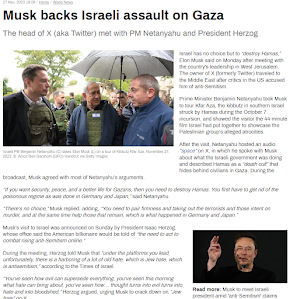
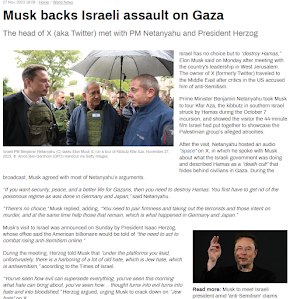
The war in Gaza may not be a war against Hamas after all, it is a war on the ideology and beliefs of Hamas. Echoing France’ President who called for an “Enlightened Islam”, Israeli Prime Minister Benjamin Netanyahu said during his meeting with American businessman Elon Musk, who visited the Gaza Strip settlements, that “Islam in the Arab countries needs a radical change.”
Israel will purge Gaza’s mosques and schools of their “poisonous” ideology once its war with Hamas concludes, Israeli Prime Minister Benjamin Netanyahu told X (aka Twitter) owner Elon Musk in an interview on Monday.
The Israeli premier pointed to the wealthy Gulf states as
examples of Muslim countries that had been “de-radicalized.”
Speaking to Musk in an interview live-streamed on X,
Netanyahu said that the destruction of Hamas would be a “precursor” to more
systemic changes in Gaza.
Expanding on his vision of a “de-radicalized” Gaza,
Netanyahu told Musk that “you first have to get rid of the poisonous regime, as
you did in Germany, as you did in Japan in World War II.”
Netanyahu pointed to the United Arab Emirates and Bahrain as
examples of Arab states that had undergone this process, likely referring to
their recognition of Israel in 2020. With Riyadh on the cusp of a US-brokered
recognition deal before the current war began, Netanyahu added that the “same
thing is happening to a considerable extent in Saudi Arabia.”
The Israeli leader suggested that his country’s “Arab
friends” could help rebuild Gaza, where the UN estimates that around half of
all homes have been destroyed since the war began. Earlier this month,
Jordanian Foreign Minister Ayman Safadi said that the Arab nations would not
take part in any potential post-conflict peacekeeping in Gaza, nor would they
“clean the mess” left behind by the Israeli military.
Wednesday, November 22, 2023

Former US official: Killing 4,000 Palestinian children is “not enough”
To understand why US foreign policy in the Middle East was a complete failure, listen to this former US official, talk to a NYC food cart operator and tell him how he really feels about Muhammad, Quran, Muslims, Egypt, and the war in Gaza.
Some excerpts:
Tuesday, November 21, 2023
Chinese Foreign Ministry: We are good friends of the Arab and Islamic countries
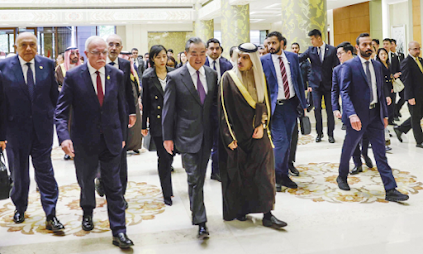
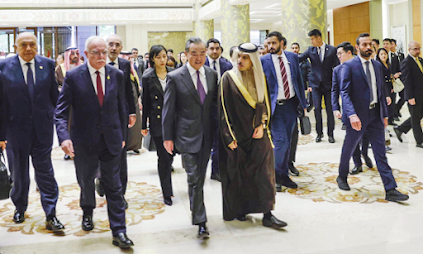
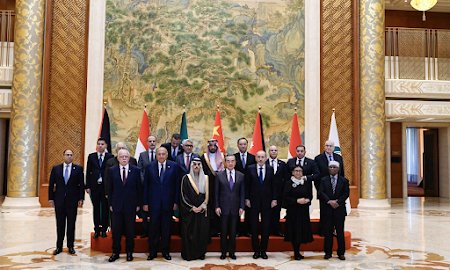
Chinese Foreign Minister Wang Yi announced on Monday before a delegation including Arab foreign ministers that the international community must take urgent measures to stop the “humanitarian catastrophe” unfolding in Gaza.
"Let us work together to quickly calm the situation in Gaza and restore peace in the Middle East as soon as possible," Wang said in his opening speech in Beijing.
Wang added to the diplomats that “there is a humanitarian catastrophe unfolding in Gaza,” noting that “the situation in Gaza affects all countries around the world and reconsiders the principle of good and evil and the basic principles of humanity.”
He stressed that "the international community must act urgently and take effective measures to prevent the spread of this tragedy."
Wang said, "China is a good friend and brother of the Arab and Islamic countries," adding that it "firmly defended the legitimate rights and interests of the Arab and Islamic countries, and strongly supported the efforts of the Palestinian people to restore their legitimate national rights and interests."
Earlier, the Chinese Foreign Minister expressed "China's strong sympathy for the Palestinians, especially in the Gaza Strip," adding that "what the people of Gaza need most is security, food and medicine, not war, weapons and ammunition."
Wang Yi stressed that "the historical injustice against Palestine cannot continue," and that "China is currently working closely with all parties to strengthen the ceasefire and end the war."
The Arab delegation includes the foreign ministers of Saudi Arabia, Egypt, Jordan and Palestine, and the Secretary-General of the Council of Islamic Cooperation.
The visit of the Arab ministerial delegation comes as part of a tour to the capitals of a number of countries that are permanent members of the Security Council, with the participation of the foreign ministers of the committee formed from the recent Arab-Islamic summit, with the aim of advancing the process of stopping the war on Gaza, and dealing with the deteriorating humanitarian conditions in the Strip.
China backs an international peace conference to push the Palestinian issue back to the track of two-state solution: top diplomat
Wang, also a member of the Political Bureau of the Communist Party of China Central Committee, noted that the current situation in Gaza continues to deteriorate, with an increasing number of casualties among the civilians. Any country with a conscience and a sense of responsibility can't allow such a tragedy to continue. The recent emergency special session of the UN General Assembly passed a resolution calling for an immediate humanitarian truce, reflecting the strong call from the international community, Wang said.
Sunday, November 05, 2023
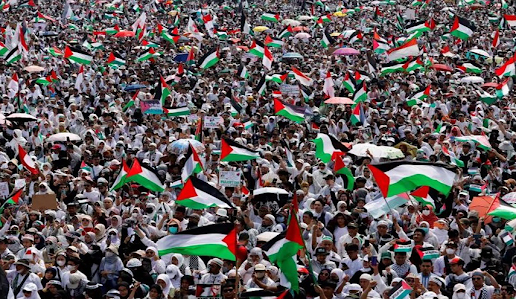
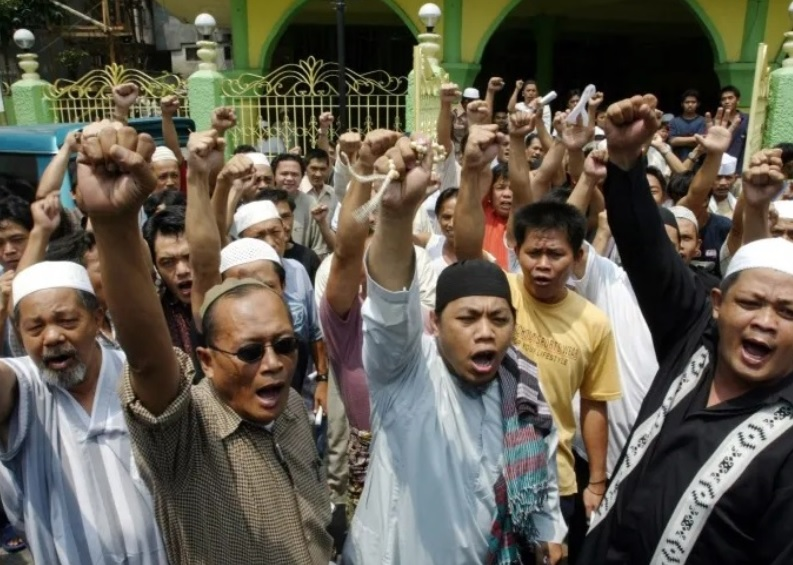
A Million people march in Indonesia in support of Gaza
The Indonesian capital, Jakarta, witnessed massive demonstrations denouncing the Israeli war on the Gaza Strip and demanding a ceasefire.
Participants in the demonstration called by the Indonesian People's Alliance to Support Palestine raised slogans demanding the lifting of the siege on the Gaza Strip, the entry of humanitarian aid and an end to the war.
Monday, October 16, 2023

Timeline and connections between the fake news story of “40 babies beheaded” and the stabbing to death of Muslim-American child
As we have learned from the last 4 years, words of persons
in positions of power have consequences. A Congressional committee condemned
former president Trump for saying to his supporters to “fight like hell”. It was argued that his words incited the violent attack on the Capitol on Jan. 6, 2021.
The words of the president of the United States and the
media do shape the national discourse, and evidently, the discourse created an
atmosphere in which the cruel stabbing of a six-year-old American was made real,
and possibly more Muslim-Americans will face more violence because of this irresponsible
behavior.
Words matter, and those in power must pay
attention to their words. This is just an example of how media outlets and
political leaders fail to undertake due diligence check for a story before
amplifying it, and the deadly consequences of such negligence.
Friday, September 01, 2023
Presidential elections in Singapore.. Tharman is the likely successor to Halima Yaqoub
Singapore is a country of many races, ethnicities and religions, 3 quarters of its citizens are of the Chinese race, while the rest of the population belongs to the Malay race or mixed Indian or Eurasian race. As many ethnicities as there are many religions in Singapore as well and include Buddhism, Islam, Taoism, Hinduism and Christianity.
All three prime ministers that Singapore has known came from ethnic Chinese - the largest of Singapore's ethnicities - and from one party, the People's Action Party (PAP), which has governed Singapore continuously since 1959.
And while the presidency of the government remained confined to the Chinese ethnicity, the ethnicities of those who assumed the position of head of state, which is an honorary position, varied, as they include, in addition to the Chinese ethnicity, the Malay and Indian ethnicities, and others of mixed ethnicities as well.
The religions of these presidents also varied between Buddhism, Hinduism and Islam. The first president of the state was Youssef bin Ishaq, whose image is placed on the country’s banknotes. He is a Malay Muslim who held the position for 3 consecutive terms from the founding of the state until his death in 1970. While it was Executive power is in the hands of Lee Kuan Yew, the founder and builder of Singapore and its first prime minister, who has been in office for 3 continuous decades.
In contrast to the position of prime minister, which the parties compete for in general legislative elections; The position of the president is non-partisan under the constitution, and the parliament remained the one who elects the president, until the constitution was amended in 1991, allowing him to be elected through presidential elections. Today's elections, Friday, are only the third since the constitutional amendment that transformed this position into a position elected by the public and gave the public the right to choose.
What is unique to Singapore in the requirements for a candidate for the presidency is that he has worked either as a senior government employee or CEO of a company whose shareholders have a value of at least 500 million Singapore dollars (370 million US dollars).
Although the role of the president in Singapore is largely ceremonial, there are strict requirements for the position, which formally oversees the country's accumulated financial reserves that can only be relied upon in exceptional circumstances, such as the Covid-19 pandemic and the 2009 global financial crisis. With the power to veto certain actions and to approve anti-corruption investigations.
Three candidates who meet the conditions are competing in the elections taking place today, namely the Deputy Prime Minister and former Finance Minister Tharman Shanmugaratnam, who is the youngest of the three candidates (65) and the most fortunate, compared to his competitors; They are Ing Kok Song, 75, and Tan Kin Lien, 75.
Economic backgrounds and a major public position appear to be the common denominator among the three contenders, who the election administration announced that they met the strict criteria for competition among the applicants for candidacy.
The announcement of their official acceptance of the candidacy came less than two weeks before the elections were held today, which is a very short period compared to the rest of the world, and was the object of the complaint of the candidate, Tan Kin Lien, who saw it as an insufficient period for the electoral campaign that ended last Wednesday before the election day of silence yesterday, Thursday.
The nominee, Ing Kok Song, is a former chief investment officer at the Singaporean sovereign wealth fund that manages the country's foreign reserves, and spent more than 4 decades working in public service until his retirement in 2013. Ing is currently Chairman of the Board of Directors of Avanda Management Corporation. Investments worth billions of dollars.
Having spent years working closely with Prime Minister Lee Hsien Loong, Eng admitted he might be seen as "part of the establishment". However, he believes that the lack of direct political affiliation makes him an independent candidate. He never joined the Popular Action Party, which has ruled the country since its independence six decades ago. He believes that his long experience in the financial sector puts him in a good position to protect the national reserves.
As for Tan Kin Lien, a former presidential candidate in Singapore, this is his second attempt to win the position. Having come last out of 4 candidates in the 2011 presidential election, he is a former chairman of one of Singapore's leading insurance companies and has the support of several opposition leaders.
Layan presided over the International Federation of Cooperative and Mutual Insurance from 1992 to 1997, and the federation was an international organization that at that time represented 123 insurance groups in 65 countries, and employed 260,000 people. The total assets of the members of this international association amounted to 1.5 trillion US dollars in 1997.
Before resigning his government positions to contest this election, Tharman spent more than two decades in office with the People's Action Party, rising to the position of Deputy Prime Minister.
He was first elected to Parliament in 2001 and was Chairman of the Monetary Authority of Singapore. He also served as the Coordinating Minister for Social Policy, and provided economic advice to Prime Minister Lee.
He said that if given the opportunity to lead, he would be "total and impartial in the discharge of the constitutional duties of office in respect of the prudent use of the country's reserves".
While his rivals seemed preoccupied with their party independence, Tharman urged voters to judge candidates on their record, rather than their past affiliations.
"If I am lucky enough to be elected president, I will represent the unity of Singaporeans, of all races, religions, social backgrounds and political leanings, at a time when views among the population are becoming more diverse," he said.
Since Tharman entered Singaporean politics just over two decades ago, he has avoided constant calls from the public that he should become the next prime minister of the Southeast Asian country.
Tharman - who is very popular and has risen in the ranks of the ruling People's Action Party, and is very popular among members of the opposition - insists that he is not suitable for the position of prime minister. He even likened his refereeing skills to those of a soccer goal-maker, saying that he is better as a team player who can provide assists than a superstar who scores goals. "I enjoy making long passes," he said. "But I'm not the striker."
His candidacy is thus a far cry from the quest for the premiership currently held by Lee Hsien Loong, the son of Singapore's founding prime minister. He is expected to retire and choose his successor before the country's next general election in 2025.
But it is a step that helps avoid the looming question of whether the Chinese-majority country (or the ruling party) that promotes its multi-ethnic and pluralistic society is ready or reluctant to elevate someone from an ethnic minority to the position of prime minister.
Also unique to Singapore is voting, which is compulsory for more than 2.7 million eligible citizens of Singapore. Those who do not vote without valid reason are subject to being removed from the voter list.
He also notes the absence of long, orderly lines at polling stations, as well as the raucous atmosphere that can accompany elections in other countries, with supporters cheering or handing out flyers to push for last-minute votes. And "presidential elections are increasingly being treated as a general election."
Today's presidential elections are being watched closely as an indication of support for the ruling Popular Action Party after a rare series of political scandals that rocked the party recently, which is rare in a country that has benefited from the reputation of its clean government, and has become an international center for a group of industries such as finance and aviation, especially since the party has suffered from its worst electoral performance ever in 2020; However, he maintained his majority of more than two-thirds.
Observers said the vote could indicate the level of support for the PAP ahead of general elections scheduled for 2025 or discontent after recent scandals that include a corruption investigation into the transport minister and the resignation of two PAP lawmakers over an affair.
Keeping our readers informed about the most consequential events in this fast changing world. Manage your Subscription; invite a friend to subscribe to ISR’s Weekly Review Bulletin
Thursday, August 31, 2023
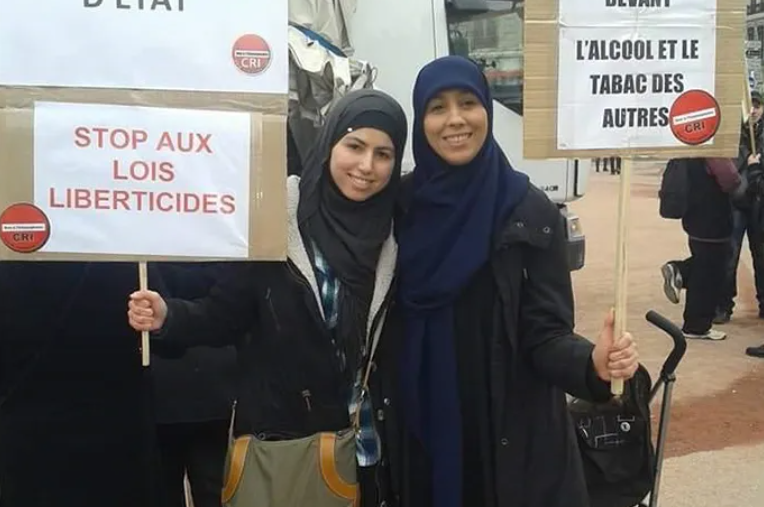
Media review: Islamic dress front and center in France again... He who wears a cape or a shirt will not enter his classroom on Mondays
On Sunday, French Education Minister Gabriel Atal announced that he would ban the wearing of the "cloak" in French schools, indicating that wearing this Islamic dress is a violation of the strict secular laws applied in the field of education in the country.
"Wearing the abaya in school will no longer be possible," Atal said during an interview with French TV TF1. And he stressed his endeavor to set "clear rules at the national level" to be followed by school principals before the start of the new academic year in all parts of France, starting from September 4 next.
Clearly, the universal values that Macron instructed his diplomats to promote exclude Muslims' rights to dress.
Here are some of what the French media outlets have said about these issues and the topics they covered.
The French newspaper Le Figaro revealed that the Minister of Education, Gabriel Atal, confirmed today that students who wear the “abaya” for females and the “shirt” for males will not enter their classrooms with the start of the school season on Monday.
The newspaper pointed out that the minister made it clear - in an interview with Radio France International today - that these students will be allowed to enter only the schools that accept their reception and bear the responsibility of clarifying the goals of this government decision to them.
"Behind the cloak and the shirt, there are young girls and boys and families, people with whom we must dialogue through a clear pedagogical method," the minister said.
The French minister was keen to stress that French secularism is one of the main values for the French school, adding that his delay in announcing the details of the implementation of this decision is due to the fact that he entered into discussions and dialogues with directors of educational institutions who were waiting for a clear detail from the government on how to implement it.
The French newspaper stated that some schools include a number of students concerned with this decision, and therefore school officials were in need to clarify the government's position, to provide them with all guarantees for the implementation of the decision.
Le Figaro added that Minister Gabriel Atal confirmed that his ministry will send explanatory notes and a guide to all schools explaining how to implement the decision, along with messages that are supposed to be sent to families.
According to the French newspaper, the new decision to ban gowns and shirts is a continuation of the implementation of the March 15, 2004 law banning the wearing of clothes or symbols that show religious affiliation in French educational institutions.
Prominent French left-wing politician Jean-Luc Melenchon strongly criticized the decision, and called on officials to avoid provoking conflicts of a religious nature.
Le Figaro also quoted Manuel Bombard, coordinator of the France Fatherland Party - which is led by Melenchon - as saying that he would propose to the party's parliamentary group to reject this decision, which he described as dangerous and harsh, and to put it up for review before the Council of State with the aim of proving that it is a decision contrary to the constitution.
And in July of last year, Le Figaro published an investigation that revealed that despite the application of the 2004 law, there is a significant increase in the abayas worn by girls and shirts worn by males, so that they doubled in secondary schools, especially when Ramadan comes, so that some principals They expressed their dissatisfaction and began to wonder why such clothes were so popular.
An official French book defending French secularism had previously spoken of gowns and shirts, and said that the ban was not only related to “symbols or clothing that by nature show religious affiliation,” such as the veil, the Jewish skullcap, and the large cross, but rather related to all symbols or clothing that “do not indicate religious affiliation.” directly to religion, but wearing it is to clearly show religious affiliation.
And the French newspaper Le Point considered - two days ago - that the decision of the Minister of Education, Gabriel Atal, is not an easy decision from a legal point of view, and wondered on what legal basis this ban would be built and what risks could be taken in the event of an appeal before the administrative court.
The anthropologist of religions, Anne-Laure Zwilling, believed that the cloak is not associated with Muslim worship, but rather with "culture", while university professor Claire Geville denounced President Emmanuel Macron's vision regarding education, and saw that "the measure against the cloak may cause more conflict than it will solve a problem," and he said, " From my point of view, this issue, which comes to the fore and dominates everything else, is more a matter of a political agenda than a real educational issue.
For his part, Abdullah Zakry, Vice President of the French Islamic Council, expressed his surprise at the decision to ban the wearing of the abaya in French schools, and called on the French Ministry of Education to issue a statement explaining the reasons that prompted the decision to ban the abaya in schools, and denied that this dress is a religious symbol.
Abdullah Zakry said that the abaya is a form of "fashion" and not a religious garment, expressing his hope that the French Minister of Education had consulted religious authorities before making a decision to ban it.
Wednesday, August 30, 2023
Philippines: Muslims affirm that the first dictionary of Islamic law will be issued bearing the slogan of justice and mercy
With the Philippines achieving the achievement of publishing the first dictionary of Islamic law, Muslims expressed their happiness that the aforementioned book promotes neutrality and moves for it and benevolence.
Attorney Maysara Dandamoon Latif, a former Member of Parliament who is now the head of a local council, emphasized that the newly released dictionary enhances appreciation between different cultures.
He added, “The dictionary embraces the spirit of inclusiveness that welcomes individuals of different religions and ethnicities to enrich their understanding of Islamic concepts.
Latif emphasized that Sharia guides have never had dictionaries, and that the newly launched Islamic Sharia Dictionary is the first of its kind.
The responsible authorities stressed that the reader will understand that Sharia promotes justice and mercy instead of hatred and that it enhances understanding because Islamic Sharia teaches mercy, kindness and humanity.
Former Muslim Senator Sameera Gutuk said that the Dictionary of Islamic Law is a wonderful contribution to literature.
And she stressed, "Those who stand behind the completion of this book were not just authors and writers, but rather advocates who gathered together as one community."
Tuesday, May 23, 2023
Saturday, April 22, 2023

Eid Mubarak: Muslims around the world celebrate the end of the month of Ramadan
After a month of fasting, reflection, and prayers, Muslims around the world mark the end of the month of fasting, Ramadan, with prayers, visits to family and neighbors to ask forgiveness, and recommit to a more balanced life.
These are some images of Muslims celebrating Eid 2023.
Saturday, February 04, 2023

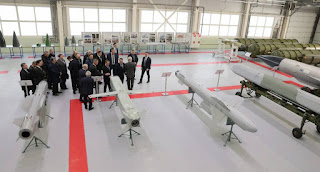
In the strongest threat.. Medvedev: If “Crimea” is targeted, the rest of the Ukrainian lands that are still under Kyiv’s control will turn to ashes, and there will be no restrictions, and our response will be with all kinds of weapons
The Deputy Chairman of the Russian Security Council, Dmitry Medvedev, announced that his country has not set restrictions for itself when responding to any attacks against its territory from Kyiv, and there will be a willingness to use all kinds of weapons to respond to that.
Medvedev added, during press statements, by saying: “Our response can be anything, and the Russian president confirmed that. We do not set ourselves any restrictions and, depending on the nature of the threats, are ready to use all kinds of weapons.”
"If Ukraine launches any attack on Crimea, there will be counter-attacks, and the rest of the Ukrainian lands that are still under Kyiv's control will turn to ashes," the deputy head of the Russian Security Council stressed.
In a related context, the adviser to the President of the Russian Republic of Crimea for media policy, Oleg Kryuchkov, described the threat of the Kyiv authorities to launch a missile attack on the peninsula as “barking” from under the sofa, according to “Sputnik”.
Earlier, the adviser to Vladimir Zelensky's office, Mikhail Podolyak, said that after agreeing with the West on the supply of tanks, Kyiv is negotiating the supply of long-range missiles and aircraft to launch strikes in Crimea.
Fighting in Crimea could impact Tatar Muslims there. Tatars are indigenous inhabitants of Crimea, Eastern European Turkic people historically formed in the Crimean Peninsula, which is on the northern coast of the Black Sea. It is estimated that 500,000 Tatar Muslims inhabied the region. Crimean Tatars are, genrally, Sunni Muslims, and they make up 15% of the Crimea population. The majority of the Crimean population adheres to the Russian Orthodox Church.
Crimean Tatars are ethnically connected to the people who live in the Republic of Tatarstan. Founded in 1005 on the banks of the Volga River, about 500 miles east of Moscow, Kazan, the capital of the republic, was a main stop along the Silk Road, the historic trade route for the exchange of not only of goods and services, but also of habits and cultures. Today, about 53% of Tatarstan's population are Muslims, the rest are mostly Russian Orthodox Christians.
Based on previous actions, and based on the use of the Chechen armed forces in conflict zones, Russian fedeation leadership is likely to rely on Chechen Republic armed forces to manage the conflict in Crimea, to make sure that contact between the Russian armed forces with local Muslims is done through other Russian Muslim officials.
Followers
Trending now...
-
In a development that could reshape Iraq’s political trajectory and ease mounting regional tensions, the Coordination Framework, Iraq’s do...
-
In recent weeks, heightened rhetoric around Iran's nuclear program has dominated headlines. US Special Envoy Steve Witkoff stated on Fox...
-
China's representative to the United Nations stated that the closure of the Strait of Hormuz stems from illegal military operations la...
-
A deepening confrontation between the United States and Iran has evolved into one of the most perilous flashpoints of our era, with ramifica...
-
When the stock market hits a new high, financial networks celebrate. But walk into any gas station in America, and you'll find a differe...
-
Diplomacy between Iran and the United States has traditionally been channeled through civilian foreign ministries, backchannel envoys, and m...
-
The announcement of a ceasefire typically signals a de-escalation of hostilities, a diplomatic reprieve, and the beginning of military drawd...
-
Your concise roundup of today's key developments from international media Strait of Hormuz: Cautious Opening Amid Uncertainty Iran...
-
In the escalating tensions surrounding the Strait of Hormuz, a familiar rhetorical pattern has emerged: actions labeled "economic terro...
-
A Sacrifice of Conscience On February 25, 2024, a Sunday afternoon in Washington, D.C., the ongoing global discourse regarding the war in Ga...
ISR +
Frequently Used Labels and Topics
Search for old news
Find Articles by year, month hierarchy
Copyright © Islamic Societies Review. All rights reserved.
Read this in your preferred language
Search
Users-Generated News & Updates
Readers pick...
Most read... Monthly
-
This weeks media review focus on a conversation with the French intellectual and Middle East Studies expert, François Borga. In this summary...
-
Aljazeera reported that the Pentagon confirmed on Monday the death of a US Navy pilot who burned himself in front of the Israeli Embassy in...
-
It may escape many, but the connection between Iran’s strike on Israel in retaliation for the latter’s attack on its diplomatic building in ...
-
Dominique de Villepin, former Prime Minister of France, on Gaza: "No longer has a voice on the international scene", because (amo...
-
The US Republicans, who would otherwise support freedom of speech to continue to spew hate and racism, found the limits of freedom of speech...
-
France's Macron to Israel: stop killing babies If these are the images and characterization of what Israeli "self-defense" lo...
-
Journalism (mass communication) is the fourth branch of government. As to how much power this fourth branch of government has, that depends ...
-
Given that 147 out of the 193 UN member states already recognize Palestine, European governments should not receive praise simply for now c...
-
Since the 1990 US intervention in Iraq and the UNSC action after Iraq’s invasion of Kuwait, Iraq lost control of its economy and that has n...
-
New Zealand journalist Shaneel Lal delivers a powerful speech in support of Gaza and Palestinian journalists killed by the Israeli occupatio...