Showing posts with label Media Bias. Show all posts

Wednesday, October 29, 2025

media review: Hundreds of writers boycott New York Times over Gaza coverage

    Wednesday, October 29, 2025   No comments

As of yesterday Oct. 28, over 150 contributors, and the list is growing, to the New York Times have declared a boycott of its opinion section, accusing the paper of “biased coverage” of Israel’s war on Gaza.

In a joint letter cited by Middle East Eye, the writers said the Times “launders the US and Israel’s lies,” and called for an internal review of anti-Palestinian bias and a US arms embargo on Israel.

“Until the New York Times takes accountability for its biased coverage and commits to truthfully and ethically reporting on the US-Israeli war on Gaza, any putative ‘challenge’… is, in effect, permission to continue this malpractice,” the letter read.

Signatories include Rashida Tlaib, Greta Thunberg, Chelsea Manning, Sally Rooney, Rima Hassan, Elia Suleiman, Viet Thanh Nguyen, and Dave Zirin.


Saturday, August 30, 2025

Media Review: The Unseen Legs, The Unheard Cries--Gaza's Children and the Machinery of Denial

    Saturday, August 30, 2025   No comments

In the stark calculus of war, the most devastating number is the smallest: the number of meals a child has missed. In Gaza, that number has long since run out. A famine, human-made and entirely preventable, is now stalking the streets and rubble-strewn landscapes. Its primary victims are children. And as they wither away, the state responsible is not just continuing its assault but perfecting a second, insidious attack: a campaign of outright denial so brazen it seeks to gaslight the world.

This reality became impossible to ignore from an unlikely podium. When a figure as staunchly pro-Israel as Donald Trump recently stated that “starvation is happening in Gaza,” it should have been a watershed. Instead, it revealed the intransigence of the Israeli government. Prime Minister Benjamin Netanyahu’s administration did not pivot. It did not concede. It doubled down on a fantasy, amplifying debunked claims that emaciated children suffering from acute malnutrition were actually battling pre-existing “medical conditions”—as if a population of infants suddenly developed a collective syndrome that just happens to mimic starvation under a total siege.

This is not a simple disagreement over facts. It is a deliberate strategy. Israeli leaders, grasping for straws to justify the unjustifiable, have outsourced their propaganda to a network of online influencers. Their task is not to report truth, but to manufacture enough doubt to cloud the overwhelming evidence. They scurry through social media, not to witness the horror, but to find snippets they can misrepresent, creating a parallel universe where a famine verified by the entire international community—the UN, the WHO, UNICEF, and every major human rights organization—simply does not exist.

The most chilling example of this moral bankruptcy emerged recently. A heart-shattering image circulated of children on a Gaza beach, their lower bodies horrifically absent. The message was clear: these are the victims of a war machine that, by its own admission, sees “human animals” and does not distinguish between combatant and child.

The Israeli response was not remorse. It was not investigation. It was a sneering, cynical denial. Official channels and their digital foot soldiers claimed the image was fake. They insisted, with a breathtaking lack of humanity, that these children were simply playing, their legs buried happily in the sand—not blown off by a Israeli bomb, drone, or shell.

Let that sink in. Faced with the undeniable visual evidence of a child maimed, the response is to claim they are actually whole, just playing in the surf. It is a metaphor for the entire Israeli approach: if we cannot see their legs, then they were never lost. If we cannot hear their cries, they were never made. If we can cast doubt on their empty stomachs, then they are not hungry.

This level of denial is not just callous—it is dehumanizing. To dismiss starved children as “sick children” and to erase maimed children by claiming their amputations are an illusion demonstrates a chilling absence of humanity. It reveals the desperation of Israeli leaders and their supporters to maintain the fiction that Gaza’s suffering is somehow exaggerated, staged, or self-inflicted.


But the children of Gaza are not invisible. Their skeletal frames are documented by doctors. Their silent cries are recorded by aid workers struggling without supplies. Their deaths from starvation and dehydration are meticulously logged by health officials, even as the infrastructure to do so collapses around them.

This denial is not a passive act. It is a active weapon. By creating a fog of misinformation, Israel seeks to numb the world’s conscience and slow the pressure for a ceasefire and the urgent flood of aid needed. It is a policy of starvation by design, followed by a cover-up by dissemination.

To deny a child food is a profound act of cruelty. To then deny that the starving child exists is a profound act of evil. It shows a total detachment from humanity, a moral vacuum where political survival and ideological rigidity matter more than infant lives.

What is most horrifying is that children—those least responsible for any political conflict—are the first to pay the price. Malnutrition strips them of their strength, their childhood, and too often their lives. Bombings rob them of their limbs, their parents, and their futures. And yet, while human rights organizations sound the alarm, Israel insists on seeing only conspiracies and fabrications.

This denial is not harmless rhetoric. It enables the continuation of policies that inflict unimaginable suffering. It grants cover to those who choose silence or complicity. It numbs the conscience of those who would rather not look too closely at the emaciated faces of Gaza’s children.

The world must not look away. We must not be confused by the digital smokescreen. The facts are clear, and they are spoken in the fragile breaths of starving children and the silent grief of parents burying them. The famine is real. It is killing people. And it is being executed and then denied by a state that has chosen, repeatedly, to sacrifice its humanity on the altar of its own denial. The legs of Gaza's children are not buried in the sand. They are buried under the rubble of their homes, and the even heavier rubble of Israel’s lies.


Wednesday, August 13, 2025

Media Review: Nationalism, Distrust, and the Specter of Regime Change

    Wednesday, August 13, 2025   No comments


1. Netanyahu’s Overt Call: “Iran for Iranians”

On August 12, 2025, Israeli Prime Minister Benjamin Netanyahu released a striking video address aimed directly at the Iranian people. He urged them to “take to the streets”, “demand justice”, and resist “ruling fanatics” in Tehran. Leveraging Iran’s current water crisis—one described as the worst drought in a century—he promised that “Israel’s top water experts will flood into every Iranian city,” offering cutting-edge recycling and desalination technologies once “your country is free.” Netanyahu framed this not merely as political pressure but as a humanitarian overture, rhetorically intertwining water scarcity with political liberation.
His language tugged at historical symbols—the “descendants of Cyrus the Great”—and invoked Zionist forebears: “as our founding father, Theodor Herzl, said... ‘if you will it, a free Iran is not a dream.’” Critics across the region condemned the message as a blatant interference in Iran’s sovereignty and a call for regime change.

2. Expansionist Imagery and the “Greater Israel” Vision

Simultaneously, in an i24 News interview, Netanyahu responded affirmatively when asked if he felt a connection to the concept of “Greater Israel”—a historical extremist vision stretching from the Nile to the Euphrates, enveloping Egypt, Jordan, Syria, Iraq, and Saudi Arabia. He stated flatly: "Very much." (Note: the Arabic-language Al Jazeera coverage confirmed condemnation by Jordan’s foreign ministry of these remarks, calling them “dangerous provocative escalation” and a violation of sovereignty and international law).  Jordan officially denounced these statements as “absurd illusions” that undermine Arab states and Palestinian rights, and called for international accountability.

3. Mutually Reinforcing Nationalist Narratives

These developments crystallize a deeper pattern of mutual antagonism: just as many in the Arab and Muslim worlds chant “Death to Israel” (often interpreted as opposition to the Zionist regime, not genocide), Israeli leaders—including Netanyahu—express parallel desires for overthrowing nationalist or Islamist regimes, from Iraq and Syria to Iran and potentially Turkey. Israel’s historical role in the fall of Arab nationalist regimes—the Ba’athists in Iraq and Syria, Nasserism in Egypt, Gaddafi in Libya—sets precedent for its current posture toward Iran, adding layers of distrust and ideological competition.

4. Media Narratives vs. Unspoken Realities

Mainstream coverage often frames Israel’s messaging as defensive—justified by existential threats or humanitarian concern. Yet the explicit linkage between Israel’s offer of technology and regime change reveals a more assertive posture: Israel positioning itself not only as a regional power but as a potential kingmaker.

This dynamic echoes past episodes: British and U.S. support for regime change in Iraq, Libya, and Afghanistan, often under the banner of liberation, but frequently yielding destabilization. Indeed, analysts warn that regime elimination without a constructive transition plan can exacerbate chaos and strengthen hardliners—concerns now surging around Iran.

5. Broader Implications: Ethno-Religious Nationalism and Regional Instability

The mutual calls for regime change are not isolated acts of political posturing — they are rooted in competing nationalist visions that draw their legitimacy from deeply embedded historical, ethnic, and religious narratives. This clash produces a dangerous self-reinforcing cycle that shapes nearly every major crisis in the Middle East.

Israel’s vision:

Israeli statecraft, particularly under Netanyahu, increasingly draws on biblical and historicist narratives to justify a posture of permanent expansion and dominance. This is not merely about securing existing borders; it’s about positioning Israel as the central civilizational power in the region. The appeal to “Greater Israel” ties modern foreign policy directly to ancient territorial claims, allowing nationalist leaders to frame strategic moves as fulfilling a sacred mission rather than a negotiable political agenda. In this worldview, offering water technology to Iranians is not only a humanitarian gesture but also a demonstration of how Israel imagines itself — as a benevolent hegemon to “liberated” peoples, once they accept the dismantling of regimes seen as hostile.

Resistance’s response:

Arab nationalist and Islamist movements see this Israeli narrative as an existential threat — not only to Palestinian sovereignty but to the very idea of Arab or Islamic self-determination. From their perspective, the vision of “Greater Israel” confirms suspicions that Israel’s security discourse masks territorial ambitions stretching across multiple states. This perception reinforces a siege mentality, where even minor concessions to Israel are framed as steps toward regional capitulation. Consequently, slogans like “Death to Israel” — while often clarified by their authors as a rejection of the Zionist regime rather than the Jewish people — are received by Israelis as genocidal, deepening the emotional and political chasm.

Mutual demonization:

Each side interprets the other’s rhetoric in its most maximalist and threatening form. Israeli leaders often portray their regional adversaries as irredeemable aggressors whose regimes must be toppled for peace to be possible. Conversely, Arab and Islamist nationalists cast Israeli policy as inherently expansionist, immune to compromise, and bent on cultural erasure. This mutual framing leaves no space for recognizing reformist or moderate currents on either side. Internal dissent within Iran, for example, is subsumed under the binary of “pro-regime” or “agent of foreign powers,” while dissent within Israel against expansionism is marginalized as naïve or disloyal.

Media as a force multiplier:

Regional and global media ecosystems amplify these narratives by privileging official statements and the most provocative soundbites. Nuanced or dissenting voices rarely receive the same coverage. This selective amplification means that both publics primarily hear confirmation of their worst fears. Israeli audiences see chants and missile parades without context; Arab audiences see maps of an expanded Israel without the debates inside Israel over their feasibility or morality. In effect, media serves as a mirror that reflects back the most polarizing version of reality, hardening nationalist sentiment and making diplomatic de-escalation politically costly for any leader.

The result is a feedback loop: nationalist rhetoric begets reciprocal hostility, which then justifies the next round of escalation. Over time, this pattern entrenches zero-sum thinking, where any gain for one side is assumed to be an irreversible loss for the other.


6. What Comes Next?

With Israel openly signaling support for regime change, and invoking ideological justifications, the region edges closer to escalatory brinkmanship. If Iran responds—either through intensified repression or reprisals—the potential for conflict could spiral. Global actors—especially the U.S., Europe, Russia, and regional powers—must urgently clarify whether they support such overt regime-change diplomacy or seek de-escalation through dialogue and multilateral engagement.

The events of August 12, 2025—Netanyahu’s video appeal and the embrace of “Greater Israel”—are not isolated flashes of rhetoric but crystallize long-standing ideological and geopolitical fault lines. The language of liberation and water aid interwoven with conquest and regime overthrow exemplifies the complex, dangerous entanglement of ethno-religious nationalism, realpolitik, and regional power plays. As each side frames itself as the rightful architect of the region’s future, the real victims may be stability, human rights, and any hope for equitable governance.

Israel’s prime minister’s call for Iranians to overthrow their government mirrors Iran’s rejection of the “Zionist regime,” underscoring two points: first, the deep incompatibility between race-based or religion-based nationalism and genuinely pluralistic societies; second, the role of supremacist ideologies as a driving force behind such nationalist regimes. Zionism—with both its religious dimension (membership in the Jewish faith) and its ethnic dimension (Jewish identity as race or ethnicity)—and Arab or Persian ethnic nationalism, alongside Islamism as a religious form, are locked in a clash that cannot be resolved by one prevailing over the others, but perhaps only by the eventual failure of them all.


Friday, March 14, 2025

Media Review: UK Media and the Gaza Genocide--Legal Implications of Editorial Complicity

    Friday, March 14, 2025   No comments

The revelation that top UK media editors held private meetings with former Israeli military chief General Aviv Kohavi amid Israel’s military campaign in Gaza raises profound ethical and legal concerns. As reported by Declassified UK, these meetings took place in November 2023, after Israeli forces had already killed over 10,000 Palestinians. Given the documented intent of Israeli officials and military leaders to commit acts that meet the legal definition of genocide, the media's engagement with Kohavi in this manner raises serious questions about complicity.


The Genocide Convention (1948) and the Rome Statute of the International Criminal Court (1998) define genocide as acts committed with the intent to destroy, in whole or in part, a national, ethnical, racial, or religious group. Complicity in genocide, under international law, includes aiding and abetting such acts through direct assistance, incitement, or failure to prevent and expose the crime.

Given that Kohavi had previously justified the killing of journalists and attacks on civilian infrastructure, his influence over UK media executives raises concerns about whether these news organizations played a role in shaping public perception in ways that could shield Israel from accountability.

Historically, media institutions have been held accountable for their role in enabling crimes against humanity. The International Criminal Tribunal for Rwanda (ICTR) set a precedent in Prosecutor v. Nahimana, Barayagwiza, and Ngeze (2003), where media executives were convicted for inciting genocide through biased reporting and propaganda. While UK media organizations may not have directly incited violence, their editorial choices—such as suppressing critical perspectives on Israeli war crimes or echoing Israeli military narratives—could be scrutinized under similar legal reasoning.


Declassified UK reports that BBC News online’s Middle East editor, Raffi Berg, has been accused of manipulating coverage to favor Israel. Similarly, internal documents from The Guardian allegedly show systematic amplification of Israeli government propaganda. These revelations suggest that UK media institutions may have contributed to the suppression of factual reporting on war crimes in Gaza.

Furthermore, the absence of equivalent meetings with Palestinian representatives raises further concerns about bias. By selectively engaging with Israeli officials while disregarding Palestinian voices, UK media institutions may have played a role in legitimizing Israel’s military actions, which have been widely condemned as potential war crimes.

The International Criminal Court (ICC) and other legal bodies have jurisdiction over crimes of genocide, war crimes, and crimes against humanity. If it is demonstrated that UK media organizations systematically downplayed or whitewashed evidence of genocidal intent and actions, their senior figures could, in theory, be investigated for complicity.

Additionally, under UK domestic law, complicity in war crimes may fall under the principle of universal jurisdiction, which allows courts to prosecute individuals who are linked to international crimes, regardless of where they occurred. The precedent set by previous war crimes trials suggests that media executives could face legal scrutiny if their actions are deemed to have materially aided a genocidal campaign.

The secret meetings between UK media leaders and General Kohavi amid the Gaza war raise serious ethical and legal concerns. If it is found that UK media outlets systematically enabled Israeli narratives while suppressing Palestinian perspectives, there may be grounds for legal accountability under international law.

At the very least, these revelations underscore the urgent need for greater transparency in media operations and the imperative to uphold journalistic integrity in conflict reporting. Moving forward, media organizations must be held to higher standards to ensure that they do not, knowingly or unknowingly, contribute to crimes of mass atrocity.

Tuesday, October 15, 2024

Biden makes statement on the anniversary of killing of Palestinian American boy, stabbing of mother

    Tuesday, October 15, 2024   No comments

US President Joe Biden commemorated the one year anniversary of what he called a "heinous" fatal assault on a Palestinian American mother and son that left the 6-year-old dead. 

Biden said he and first lady Jill Biden "continue to think" about Wadea Al-Fayoume, 6, and his mother, Hanaan Shahin, saying they are "grateful for Hanan’s recovery and her powerful voice for peace." He further hailed Wadea as "a bright and cheerful American Muslim boy of Palestinian descent."

"On this day, let us all take steps that honor Wadee’s memory and reaffirm together that there is no place for hate in America, including hatred of Palestinians, Arabs, and Muslims. We can all reject hatred and expose misinformation and disinformation that is cynically aimed at turning us against one another," he added.

Al-Fayoume was fatally stabbed 26 times at his Plainfield, Illinois, apartment with his mother, Hanaan Shahin, on Oct. 14, 2023. Shahin was critically injured after being stabbed more than a dozen times. The killing of the child and the attempted killing on the mother came just days after President Biden amplified a false claim that Hamas beheaded 40 babies, a fake story that still repeated by US officials including US senators and House leaders.


Friday, October 11, 2024

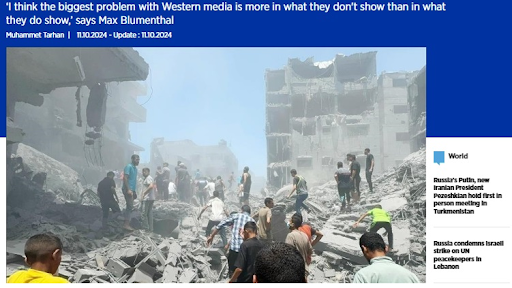
Media review: "The biggest problem with Western media is more in what they don't show than in what they do show"

    Friday, October 11, 2024   No comments

The true face of Israel's war on Gaza is hidden from Western public opinion through the Western media’s ignoring of Israel's attacks and war crimes, according to a US journalist.

Max Blumenthal, editor-in-chief of the independent news website The Grayzone, spoke to Anadolu at a conference in Istanbul, Türkiye about his views on how Western media portrays Israel's attacks on Gaza and the role of the US in the Israeli-Palestinian conflict.

“On Oct. 7, the Western media did not show the losses that the Israeli military took at the hands of Hamas and other factions in Gaza. They focused exclusively on civilians being kidnapped and then began with not just the killings that took place of civilians on Oct. 7, which were real and documented, but fabricating atrocities about beheaded babies and babies burned in ovens, and so on, in order to create leverage and political space for Israel to totally destroy Gaza,” said Blumenthal... > source article ...

Wednesday, October 09, 2024

Media review: What does CBS's handling of Ta-Nehisi Coates' interview tell us about US media when it comes to telling the story of Palestininas?

    Wednesday, October 09, 2024   No comments

News stories about Palestine cannot be covered by news media like any other news subject. That is the main point of the recent controversy surrounding CBS's interview with Ta-Nehisi Coates.

Coates response to the challenge tells the full story: Dokoupil accusing Coates of leaving some information out is not the real issue. The real issue is that Western media outlets have already set the standard for the plight of Palestinians: They should not be given any space, not an equal space, not enough space... they should be given any space at all. And that is the main point in Coates' response. 

The story of Palestinians is not told enough, and when it is, those attempting to tell it, are accused of "supporting terrorism" and of being anti-Semitic. Even Semitic persons--Jews who survived (or who are children of survivors of) the European crime against humanity inflicted on Jews, who object to a genocide committed in their name or the name of their religion or their identity, are attacked as sympathizers with terrorists.

So Dokoupil was not interested in pushing back against unbalanced "reporting", he pushed back because Coates was telling a story that no one is willing to tell for the reasons that were playing out before him live and where he was living the true experience of doing so. There is no record of Mr. Dokoupil pushing back against those who come to tell the Israeli point of view, telling them that they left out the story of Palestinians being subjected to apartheid system, the stories of Palestinians' rights to self-determination being denied by Israel for more than 75 years...

“Why leave out that Israel is surrounded by countries that want to eliminate it?” Dokoupil asked. “Why leave out that Israel deals with terror groups that want to eliminate it?”

“There is no shortage of that perspective in American media,” Coates replied. “I am most concerned, always, with those who don’t have a voice.”

This exchange says it all.

Friday, September 27, 2024

New Zealand journalist Shaneel Lal on Western Media and Genocide

    Friday, September 27, 2024   No comments

New Zealand journalist Shaneel Lal delivers a powerful speech in support of Gaza and Palestinian journalists killed by the Israeli occupation during his acceptance speech for the Journalist of the Year Award at the One Young World Summit in Montréal, Canada.

“It’s our moral obligation to give voice to those who have been oppressed and silenced by those in power” 


Friday, September 06, 2024

How serious is the killing of US citizen outside US? It depends on who does the killing

    Friday, September 06, 2024   No comments

When US citizens are killed by Muslims, US administrations exact bloody revenge swiftly and decisively, and the media always finds the way to explicitly name the persons who killed them and emphasize their being Muslim. But not when American citizens are killed by Israeli forces. The reaction to the recent killing of a US citizen by Israeli forces in West Bank is one example in a series of many including the killing of American journalist Shireen Abu Akleh and going back all the way to the gruesome killing of Rachel Corrie.

Here is how the media reported on the killing and how some Western officials, including UN officials reacted: generally, wanting the accused to investigate themselves.

US-Turkish activist Aysenur Ezgi Eygi, 26, was shot dead by Israel in the West Bank during settlement protest.

Social media users, including Scotland’s first minister, Hamza Yousaf, have criticized the BBC for not including the perpetrators of Eygi’s death in their headline.


The pattern of shielding the killer is clear; NPR reported on Israeli troops shooting of American journalist Shireen Abu Akleh in West Bank echo's BBC's:


Eygi was participating in a protest against illegal Israeli settlement expansion in the town of Beita, south of Nablus, the Palestinian Wafa agency reported.

An activist who was with Eygi at the time told Middle East Eye that she and other volunteers from the International Solidarity Movement had been attending the weekly demonstration at Beita.

"When she was shot, she was standing there doing absolutely nothing with one other woman - it was a deliberate shot because they shot from a very, very, very far distance," said the activist, who did not want to be identified.

US officials' reaction, mostly muted

The only voice in the US to demand serious action to address Israel's killing of a US citizen was US Senator Chris Van Hollen.

On Friday Van Hollen urged Biden administration to do more to hold Israel accountable for killing of American citizens.

"The Netanyahu Government - including racist extremist like Smotrich and Ben-Gvir - has fueled settler violence in the West Bank at the same time that it has announced new illegal settlements.

"The United States cannot turn a blind eye to these actions – including the killing of American citizens," Democrat senator said in a statement.

His remarks came after Turkish-American activist Aysenur Ezgi Eygi was shot dead by Israeli forces on Friday during a protest against illegal Israeli settlements in the town of Beita in the Nablus district of the occupied West Bank.

Van Hollen said the US has not received "satisfactory responses" from the Israeli Prime Minister Benjamin Netanyahu's Government about the two other Americans killed in the West Bank since Oct. 7, adding the Biden administration has "not been doing enough" to pursue justice and accountability on their behalf.

"The Biden Administration must do more to hold the Netanyahu Government accountable and use American influence to demand the prosecution of those responsible for harm against American citizens.

"If the Netanyahu Government will not pursue justice for Americans, the U.S. Department of Justice must," he added.

When UN spokesperson Stephane Dujarric was asked about the killing of American citizen Aysenur Ezgi Eygi by Israeli soldiers in the occupied West Bank, he replied, "We would want to see a full investigation of the circumstances, and that people should be held accountable. And again, civilians must be protected at all times."


A long history of bias

In the case of Corrie, even after 21 years, US media, including NPR, continue to deny her justice, using headlines that says, "the death" instead of the killing, and living the name of the actor who did the killing out.

...

Update:

On September 9, US President Joe Biden appeared to embrace Israel's explanation, which claimed that IDF killing of American activist in West Bank was accidental. 

Biden described the killing of a 26-year-old American citizen in the Israeli-occupied West Bank last week as an apparent accident, echoing the Israel government's description.

Israel has claimed that Aysenur Ezgi Eygi was "hit indirectly and unintentionally by IDF fire" on Friday. 

"We're finding more detail," Biden told reporters on the South Lawn of the White House Tuesday. "Apparently, it was an accident. It ricocheted off the ground and it – (she) got hit by accident, but we're working that out now."


Thursday, July 25, 2024

Media review of Netanyahu's visit to the US: He may have expedited US declining support Israel's War instead of increasing it

    Thursday, July 25, 2024   No comments

Israeli political leaders may not have wanted to see so many protesters in the street and in congress, but that is what Netanyahu have achived by his visit to the US: For the first time, American public displayed public displeasure with Israeli conduct. This is clear when even the most friendly TV channels, like Foxnews, give a fail review of his performance.

Fox News: Has Netanyahu Lost America?


“Israeli Prime Minister Benjamin Netanyahu is back in Washington, and in his fourth address to a joint session of Congress on Wednesday night, he broke the record of former British Prime Minister Winston Churchill. For years, he has been a fixture in American and Israeli politics, but that seems to be changing,” Fox News wrote in a report. “Things seemed different today, not just because Netanyahu is a controversial figure who has drawn thousands of anti-Gaza protesters to the streets of Washington, but because he has become increasingly marginalized,” the website added in a report by its correspondent Joshua Keating.

Fox News confirmed that Netanyahu’s speech to Congress offered little indication of a plan to end the war in Gaza, and likely undermined ongoing diplomatic efforts to achieve this. Former House Speaker Nancy Pelosi described Netanyahu’s speech as “the worst presentation by any foreign dignitary before Congress.”

According to the site, Netanyahu’s speech was remarkably defensive, devoting itself more to rebutting criticism of Israel than charting a path forward out of the quagmire it finds itself in.


He continued by recounting the horrors of Hamas’s attacks on October 7, and vowing that Israel would fight until it destroyed the movement’s military capabilities and rule in Gaza “and returned all the captives to their families.” However, these families are not inclined to believe him and are urging him to accept a ceasefire agreement to secure the release of their relatives.

Fox News was surprised by Netanyahu's attack on anti-Israel protesters in the United States, accusing them of being "useful idiots for Iran" and criticizing university presidents, and the site commented sarcastically, "This is likely to be the first speech on Middle East policy that includes a shout-out to the brothers at the University of North Carolina."

The report said, "Netanyahu may have gotten what he wanted today: a standing ovation, even if it was mostly from Republicans. But more than 70% of Israelis now say Netanyahu should resign."

He continued, "In the past, Washington was a safety valve for Netanyahu, a place where he could count on strong support. But today, the magic is gone and the era of the man who mastered verbal acrobatics is over," said Nimrod Novick, a member of the "Israel Policy Forum" and a senior foreign policy adviser to former Prime Minister Shimon Peres.


The Fox News correspondent concluded by saying, "Netanyahu has become accustomed to being a controversial figure in the more than 40 years since he came to Washington. Perhaps he should get used to being an insignificant figure."

Protesters greet Israeli leader inside and outside US Congress

Israeli Prime Minister Benjamin Netanyahu has harshly criticized pro-Palestinian protesters in the United States, saying, “Iran is funding the protesters… You have officially become useful idiots for Iran.”

Reacting to the Israeli leader's characteraization of Americans protesting what they see as a genocidal war, the Biden administration reacted with dismay. White House officials dismissed Israeli Prime Minister Benjamin Netanyahu’s description of Americans protesting Israeli attacks on Gaza as “useful idiots for Iran,” calling it “a sad and wrong idea.” White House National Security Adviser John Kirby said they do not find it right that Netanyahu has described Americans protesting Israeli attacks on Gaza as “useful idiots for Iran.”

Kirby said that the long-running demonstrations in the United States, criticizing the policies of the Netanyahu administration, are a reflection of people's real concerns, adding that "democracy is exactly that."

For his part, US State Department spokesman Matthew Miller said, “We recognize that the vast majority of protesters in the United States are not taking their orders from Iran.”

Miller added that they strongly support the right of protesters in the United States to demonstrate, stressing that the vast majority of people who have demonstrated in the streets of Washington since Wednesday in protest of Netanyahu’s visit to Washington are patriotic Americans expressing their opinions, and we support their right to do so.

In response to Netanyahu’s use of the term “idiots” and “morons” to describe the American protesters, Miller said, “As always, I will adopt a rule of not responding to specific things that the Israeli prime minister says.”

Instead of joining thousands of anti-genocide protesters outside, Rashida Tlaib chose to confront Netanyahu in Congress with keffiyeh and 'war criminal' sign

Democratic Congresswoman Rashida Tlaib objected to Israeli Prime Minister Benjamin Netanyahu's speech to the US Congress on Wednesday, holding him responsible for the genocide in the Gaza Strip. During Netanyahu's speech, Tlaib wore a keffiyeh and a Palestinian flag, and held up a black-and-white sign with the words "War Criminal" on one side and "Guilty of Genocide" on the other.


Trump's hot potato characterization of the Gaza War: Do what you want but do it fast!

Even Trump does not want to handle this hot potato if he wins the election and take over the White House in 2025. He wants this war to end fast, so that he does not want to deal with it.


Former President Donald Trump – one day before meeting Benjamin Netanyahu – called for a swift end to Israel’s war on Gaza and the return of its captives, stating that the US ally is "getting decimated" by bad publicity.

"I want him to finish up and get it done quickly, he’s got to get it done quickly," Trump told Fox News.

"For whatever reason you have Jewish people out there wearing yarmulkes and they’re, you know, pro-Palestine. You’ve never seen anything like this… They’ve got to get this done fast because the world is not taking lightly to it, it’s really incredible."

Presidential candidate Trump did not attribute his demand for an end to Israel's genocide of Palestinians over the past nine months, which has killed over 40,000 Palestinians, mostly women and children, and injured more than 100,000. Instead, he attributed his demand to Israel's negative reputation.

Middle East Media Coverage

Media outlets in the Middle East, including those published historically West-friendly nation states in the Gulf (Alkhaleej Online), concluded that the visit caused more damage and achieved nothing. Other outlets, including the Lebanese paper Alakhbar, summarized the visit with this headline, "Half of Democrats Boycott Speech: Israel's 'Sanctity' Is Not Okay", and explained it further in editorials like these.


Amidst a broad boycott by members of the House of Representatives and the Senate, especially from the Democratic Party, the Prime Minister of the occupation, Benjamin Netanyahu, tried to send a message to American officials, stating that the “fate” of the United States is linked to the fate of Israel, and that the two parties are facing one hostile “axis” and are fighting the “same battle,” and therefore, the “victory” of the latter will be a victory for the former. Apart from the “lies” that Netanyahu adopted, especially regarding the number of Palestinian martyrs in Rafah, as he claimed, when asked about the number of civilians killed there, that “no one was killed,” “except for one incident, when shrapnel from a bomb hit a Hamas weapons depot, killing twenty people,” Netanyahu’s speech, according to observers, did not carry anything new, and did not add any changes to the division within the United States regarding the war in Gaza. According to a report published by the Atlantic Council, although Netanyahu only mentioned the Lebanese front relatively quickly in his speech, the “framework” in which he placed the threat posed by Hezbollah seemed striking; he classified the latter as an “existential threat” to Israel, which cannot be separated from “Israel’s struggle against Hamas, the Houthis, and Iran.” According to those who hold this view, one of the possibilities raised is that “the speech aims to pave the way for a ground incursion into southern Lebanon, and to soften global public opinion regarding such a decision.” The report adds that “opening a new active front against Hezbollah would be disastrous for several reasons, both humanitarian and strategic,” noting that “for the besieged (Israeli Defense Forces),” such a scenario “means entering into a large-scale war against a well-armed opponent,” and increases the possibility of the war expanding regionally. In his speech, which lasted about an hour, Netanyahu stressed the need to strengthen American support for Israel and lift the ban on some weapons, considering that “fast-tracking American military aid could greatly accelerate the end of the war in Gaza and help prevent a wider war in the Middle East,” and claiming that “Israel is participating in intensive efforts to secure the release of the hostages.” Regarding his vision for “the day after,” which remains a point of contention between him and Washington, Netanyahu said that he wants “a demilitarized and non-extremist Gaza,” led by Palestinians “who do not seek to destroy Israel.” After focusing on attacking the axis of resistance with all its components, Hamas responded by issuing a statement about the speech, in which it considered that the latter “reflects the depth of Netanyahu’s military, security, and international crisis,” stressing that “his talk about intensive efforts to return the hostages is a complete lie and misleading of Israeli, American, and international public opinion, while he is the one who thwarted all efforts aimed at ending the war and concluding a deal to release prisoners (...) which holds him fully responsible for the repercussions of this position and for the fate of the prisoners in the Gaza Strip.” The movement also stressed that “the war criminal Netanyahu’s perceptions about the future of the Gaza Strip are mere illusions and fantasies that he is trying to market,” considering that “his attack on the axis of resistance reflects the depth of his military and security crisis due to the open fronts.” The movement concluded by calling on the “United Nations,” the “League of Arab States,” and the “Organization of Islamic Cooperation” to “declare their position of rejecting the occupation and working to end it by all means, and to support the steadfastness of our Palestinian people and their resistance.”

At the Capitol complex, protests were held in which thousands of people opposed to the visit of the occupation prime minister and his speech before the joint session of Congress participated, while American media reported that the Secret Service is looking into reports that the demonstrators managed to reach the hotel where Netanyahu is staying in Washington, DC, where they released insects in the hotel and “activated the fire alarms.” These demonstrators had their “share” of the attack in Netanyahu’s speech, in which he described them as “idiots who benefit from Iran” and who are funded by them, claiming that “when the tyrants of Tehran who hang gays from cranes and kill women for not covering their hair praise you, promote you and fund you, you have officially become idiots who benefit from Iran,” he claimed. As for inside the Capitol, approximately 100 Democrats from the House of Representatives and 28 Democrats from the Senate attended, according to a tally conducted by Axios. This means, in practice, that about “half” of the Democrats in both chambers were absent from the speech, including former House Speaker Nancy Pelosi, making the boycott much wider than the one Netanyahu faced in 2015, when 58 Democrats were absent from his speech. However, even some officials who attended the session were keen, in one way or another, to “annoy” Netanyahu and express their opposition to the genocide being committed in Gaza. For example, among the attendees were a number of critics of the occupation prime minister, including progressive Jewish representatives Jamie Raskin (Democrat of Maryland) and Jerry Nadler (Democrat of New York), who was carrying—and sometimes reading—a book titled “The Netanyahu Years,” which criticizes the “failures” of the latter’s rule, in a photo that was widely circulated on social media. Also in attendance was Rep. Rashida Tlaib (D-Mich.), the only Palestinian-American in Congress and a vocal critic of Israel, wearing a keffiyeh and holding a small sign reading “Guilty of Genocide” and “War Criminal.” Today, Netanyahu is expected to meet with former President Donald Trump at Mar-a-Lago, according to a post on his Truth Social platform, in their first meeting since relations between them deteriorated since the 2020 elections. Trump’s post also included: “During my first term, we saw peace and stability in the region, even signing the historic Abraham Accords,” “and we will do it again,” stressing that the wars in Ukraine and Gaza must end through the implementation of the “peace through strength” agenda, adding: “Millions are dying, and Kamala Harris is in no way capable of stopping it.”

+

Consensus of International media outlets: Netanyahu's rhetoric will not garner support without resolving the Gaza crisis

International newspapers focused on the repercussions of Israeli Prime Minister Benjamin Netanyahu's speech in the US Congress and his pressure on the White House to approve a specific list of weapons in the upcoming presidential elections. The British newspaper "The Times" saw that Netanyahu had resorted for decades to giving a speech in Congress when he was facing a decline in the voting rate, noting that the speech did not provide clear answers to those wondering about victory in the Gaza war and the threats accompanying

She pointed out that "the most difficult thing Netanyahu will have to face after his trip to Washington is the Israeli public, which is accustomed to his speeches."

In the same context, the Israeli newspaper "Haaretz" said that Netanyahu's eloquence will not mobilize support for Israel without a final solution to the crisis in Gaza, adding that "Netanyahu's words have no weight since he is in no hurry to free the prisoners and continues to refuse to discuss a clear plan for the day after the war in Gaza."

The newspaper stressed that the Israelis are more interested in the return of the prisoners and the end date of the war, not Netanyahu's popularity at home.

On the Israeli-American relations front, Politico revealed that the delegation accompanying Netanyahu during his visit to Washington is putting pressure on the administration of US President Joe Biden to agree to provide Israel with a specific list of weapons. According to the newspaper, Israel is trying to boost its transfers and weapons stockpile before the presidential elections, and quoted a source familiar with the weapons list as saying that Israel is concerned about the possibility of a larger confrontation with the Lebanese Hezbollah.

In turn, the French newspaper "Le Monde" said in its editorial that Biden has a good chance to save the two-state solution and fight forcefully against the Israeli occupation of the West Bank after announcing that he will not run for the upcoming elections.

Biden has a historic opportunity to match his words with his actions, according to the newspaper, especially since the extremist policy pursued by the ruling coalition in Israel is in stark contrast to the official American position.

As for the American newspaper "New York Times", it focused on a British study that concluded that the death toll and injuries provided by the Ministry of Health in Gaza during the first weeks of the war are credible.

___________
> Content was updated to include media reactions after Wednesday's speech, and subsequent developments.


Sampling reactions on social media, newspapers commentaries, and government officials' statements


Monday, May 13, 2024

Media Review: New York Times answers the question, why do American students choose Aljazeera?

    Monday, May 13, 2024   No comments

The New York Times, which has been accused of biased reporting on the war in Gaza even by its own contributors, and and whose editors instruct its journalists about which words to use, is now providing some answers as to why young Americans, especially students, are using other media outlets, like  Aljazeera to learn about what is happening in Palestine

Although Aljazeera is a major alternative media outlet, its connection to the State of Qatar, make its influence limited, opening the door to new media sources, like Quds News Network (an English channel) and Palestine Online (an Arabic channel),  that rely on social media platforms, like Telegram, to broadcast globally.

The paper argues that in light of the student movement in American universities to stop the Israeli war on Gaza, the reluctance of new generations in the United States to follow major Western media outlets has emerged, and their skepticism about their faithfulness in conveying the truth of what is happening.

The New York Times followed this trend among student protesters who recently held sit-ins at dozens of American universities, to shed light on their objections to the Western media, and at the same time their interest in the Aljazeera network, which has become their main source of information regarding the war on Gaza.

“Aljazeera is my go-to place for reliable storytelling,” says Nick Wilson, a student at Cornell University.

The newspaper explains that the protesting students expressed their dissatisfaction with the traditional American media’s coverage of the war, including the New York Times itself, CNN, the Atlantic, and others.

NYT explains that despite the widespread coverage of the war by these networks, students believe that they do not hold Israel responsible - to a sufficient extent - for the killing of Palestinians and do not verify the validity of what Israeli officials say, and that their coverage of student protests focused too much on anti-Semitism in universities instead From Islamophobia.

Related to Aljazeera being in the news, confirming the connection between governments and media outlets, the Israeli government banned a number of media outlets including Aljazeera.

The NYT noted that Israel's recent closure of Aljazeera's offices has strengthened the network's standing in the hearts of the protesting American students.

Benjamin Netanyahu's government closed Aljazeera's offices on May 5, a decision that was widely condemned by international press unions and human rights organizations as an attack on press freedom and an attempt to silence Aljazeera because of its coverage of the war.

Reactions continued denouncing the Israeli government's decision to close Aljazeera's offices in Israel, amid confirmation that the decision aims to silence Al Jazeera because of its coverage of the war on Gaza.

The United Nations High Commissioner for Human Rights expressed its regret at the Israeli Cabinet’s decision to close the Aljazeera office.

While the Commission stressed that freedom of expression is a basic human right, it urged Israel to rescind its decision, stressing that free and independent media are necessary to ensure transparency and accountability.

For his part, the UN rapporteur on the right to housing said that Israel's decision to close Aljazeera once again denies its claims that it is a democratic state, describing the decision as "the reaction of a terrified regime that fears freedom."

Reporters Without Borders also strongly condemned the Israeli government's unanimous vote to stop the work of Aljazeera in Israel.

The organization said in her account on the “X” platform that what she described as the blatantly repressive legislation to stop the work of Aljazeera aims to silence it because of its coverage of the war on Gaza.

It pointed out that the move indicates unacceptable censorship against the last media outlets that can report events in Gaza.

The international organization also called for the repeal of the law passed by the Israeli Parliament banning foreign media broadcasts in Israel, primarily targeting Aljazeera.


Friday, May 03, 2024

Media Review: “What is worse: Israel’s lies about Gaza or amplifying these lies by supporters?”

    Friday, May 03, 2024   No comments

To close this week, our media review highlights an article in UK media that focused on a theme our readers should be quite familiar--the fake stories that were amplified by political leaders and Western media about the war on Gaza are many. The problem has been the lack of retractions by the media, a mere tweet often appears to be enough, in the view of their editors and publishers, to absolve them of any responsibility for the injuries and harm (including deaths in a couple of cases), they have caused.

We begin today's media tour with an article published by Mehdi Hassan in the British newspaper The Guardian, entitled "What is worse, Israel's lies about Gaza or its Western backers who are repeating them?"

Hassan begins his article by quoting an Italian proverb that says, “If a man deceives me once, it is not my fault, but it is my fault if he deceives me twice.”

Mehdi Hassan says, “Since the horrific attack that occurred on October 7, the far-right Israeli government and its army have deceived Western politicians and journalists, not once, not twice, but several times.”

He adds that there are many lies and distortions that must be traced, including “the story of the forty children who were beheaded by Hamas,” which “did not happen.”

Hassan recalls that, in his opinion, there was no hideout under Al-Shifa Hospital, and the list hanging on the wall of Al-Rantisi Hospital did not display the names of those detained by Hamas, but rather just the days of the week in Arabic.

Hassan asks about those atrocities that the Israeli forces denied committing - out loud - and then revealed that they were responsible, according to the writer, who considered that there are “examples of this, such as the flour massacre in February, the bombing of the refugee convoy last October, and the attack White phosphorus in southern Lebanon in October as well.

But Hassan believes, according to him, that “there is no Israeli lie more harmful, destructive and deadly than the one that claimed that UNRWA and its employees had colluded with Hamas and participated in the attack on October 7.”

He comments on the question, “Why was this the most harmful lie?” Then he answers: “You have helped deepen a devastating and ongoing man-made famine inside the Gaza Strip.”

As a result, Mahdi says, 16 donor countries, including the United States, the main funder of UNRWA, suspended about $450 million in aid provided to the agency.

He added that "Israel starved the people of Gaza," criticizing "the fools who helped it justify this."

Hassan explains that the parties funding the Israeli file against UNRWA were warned that it contained only “false and unproven allegations,” but - according to Hassan - they trusted Israel.

The author continues by saying that many countries have resumed their funding to UNRWA, including the German government, which is the agency’s second largest source of funding, after an independent review of UNRWA’s work concluded that the agency’s work “remains pivotal in providing life-saving humanitarian assistance and basic social services.”

Hassan confirms that the independent review stated that Israel has not yet provided evidence to support these allegations, so it was, once again, “a lie from Israel.”

The writer says that, worst of all, is the statement made by Anthony Blinken, the Democratic Secretary of State, on January 29, when he admitted that “the United States did not have the ability to investigate the allegations itself.” Despite this, Washington went ahead Describing the unverified Israeli allegations as “highly credible.”

He added, "Blinken has not yet apologized for his false claim or even retracted it."

Saturday, April 27, 2024

Media Matters: Elon Musk, owner of "X", suspends the account of Mandela's grandson

    Saturday, April 27, 2024   No comments

 In a total tone-deafness, and lack of awareness of the symbolism and reality, the former white settler in South Africa and self-declared free speech absolutist, Elon Musk, suspended the account of the nephew of Nelson Mandela, South Africa’s freedom icon, without even burdening himself with an explanation—although the reasons are obvious.

Social Communication Platform X (formerly Twitter), Nkosi Zwelivelile Mandela account, grandson of the late President of South Africa Nelson Mandela، After his statements in support of the "International Fleet of Freedom", which is to be sailed from Turkey within days, to break the siege on Gaza Strip.

Mandela had arrived in Istanbul at the beginning of the week to attend the fifth conference of the Jerusalem International Parliamentary Forum, and to support preparations for the International Freedom Fleet in Istanbul.

 Mandela attended the press conference of the International Freedom Fleet, which is made up of NGOs from 12 countries last week, before expressing his support for the fleet and breaking the siege on Gaza, through several publications on the platform "X".

Friday, April 26, 2024

US Government: Infants were placed in the oven and cooked alive

    Friday, April 26, 2024   No comments

When the president of the United States, Biden,  amplified the fake story of 40 babies beheaded by Hamas, some excused his actions by claiming that he was duped by Israel intelligence to ascertain his unwavering support for the war Israel intended to unleash. 

With another US government official making a similar and even more shocking allegation, amplifying another fake story, that excuse becomes untenable.  

The third in line in the order of succession in the US government, the speaker of the House of Representatives, Johnson, on the same "trusted" news outlet that propagated the beheadings, CNN, repeated a story that was first made by some Israel person, Eli Beer, speaking at the Republican group’s summit in Las Vegas on October 28, that were later debunked by more than one investigative reports. Johnson, on that basis, claimed that Hamas "placed infants in the oven and cooked them alive". 


Sunday, April 21, 2024

Media Matters: Clash of views about Gaza, Palestine, human rights abuses, and Iranian retaliation on attack on its diplomatic mission in Syria

    Sunday, April 21, 2024   No comments

One of the most representative clashes between two worldviews: Iranian worldview versus Western worldview as represented in Piers Morgan's interview, debate with Iranian Professor Seyed Mohammad Marandi.


Morgan repeating the fabricated story of 40 babies beheaded by Hamas, to justify to mass killings in Gaza, and Mirandi referencing the investigative journalists and NGO reports that challenged the narrative of beheadings, and finding that Israeli forces have committed sexual violence and torture against Palestinians, turned Morgan flustered and rude. 

The interview is available on a number of Internet sites, and embedded from a couple of sites below.


Tuesday, April 16, 2024

New York Times tells its journalists which words to use when covering the war on Gaza

    Tuesday, April 16, 2024   No comments

According to a leaked memo, The New York Times restricts its journalists from covering the war on Gaza. The New York Times has instructed journalists covering the Israeli war on the Gaza Strip to restrict the use of the terms “genocide” and “ethnic cleansing,” and to avoid using the phrase “occupied territories” when describing the Palestinian territories, according to a copy of an internal memo obtained by The Intercept. American.

According to the site, the New York Times memo also directs journalists not to use the word Palestine except in very rare cases, and to stay away from the term “refugee camps” to describe the places to which Palestinians have historically been displaced within the Gaza Strip, who fled from other parts of Palestine during the Arab-Israeli wars. Previous.

It is noteworthy that the United Nations recognizes the areas to which Palestinians were displaced as camps housing hundreds of thousands of registered refugees.

The memo, written by New York Times Standards Editor Susan Wesling, international editor Philip Ban, and others, provides guidance on some of the terms and other issues that have imposed themselves on the scene since the start of the Israeli war on the Gaza Strip last October.

While the document is presented as a blueprint for maintaining journalistic principles of objectivity when dealing with the war on Gaza, several New York Times journalists told The Intercept that some of its contents provide evidence of the newspaper adopting the Israeli narrative.

The website quoted a source in the New York Times newsroom - who requested anonymity for fear of being held accountable - saying that the matter “seems professional and logical if you do not have knowledge of the historical context of the Palestinian-Israeli conflict, but if you do know, it will be clear how much it identifies with the Israeli narrative.” ".

The Intercept noted that the guidelines were first distributed to New York Times journalists last November, and were updated regularly over the following months.

On March 14, demonstrators supporting the Palestinian cause stormed the building of the New York Times newspaper in protest against its bias towards Israel in the ongoing war on the Gaza Strip. This is the second storming, as pro-Palestinian demonstrators had previously occupied the newspaper’s lobby on November 11, demanding an immediate cessation. Because of the Israeli aggression on Gaza, they accused the newspaper of bias towards Israel in its coverage of the war on the Gaza Strip.

The deliberate use of key words and adjectives by Western media, and all media outlets for that matter, is and established fact. 

The language used by the media became a reflexive way of describing the events. CNN consistently describes the Oct. 7 attack as "brutal" and "terrorist, but uses no adjectives to describe Israel's retaliation, for example.

Western media will add the adjective “brutal” when talking about Hamas’ attack on Oct. 7, but will use “war in Gaza” without attributing who is waging the war and what kind of war it is, which is brutal, destructive, and genocidal according to NGOs, many governments’ officials, and the International Court of Justice.

During the same time period, Western media used the phrase "Hamas' brutal" at least 554,000 times; whereas the "war in Gaza" was mentioned 33,900,000 times without any adjectives or qualifications despite the heavy loss of life and structures--a war that was described by independent observers, including the same media outlets who use this biased language, as unprecedented in the number and size of weapons dropped in the densely populated area just in in the first three weeks.

...

News media platforms’ use of guidelines, algorithms of sort, to create an acceptable narrative for their audience, financiers, shareholders, or governments is no secret nor is it practiced by limited, marginal media platforms. Journalism is a profession that teaches people who work in the field how to use words the same way a soldier is trained to use weapons.

Many people who believe in the need for free press to inform the public thought that the best model is the creation of media platforms that are not beholden to anyone. They thought a structure where a media outlet is guaranteed funding from the government with full and complete editorial independence is the way to go. This is the model of the British BBC and the American NPR. However, a close examination of the editorial policies and practices would reveal that even this model is still controlled by politics, ideology, or leadership still. The recent revelation about NPR is a good lesson in understanding the synergy between politics and journalism. Here is some reporting about the struggles inthe NPR organization.


In the letter published on Free Press, NPR’s senior business editor Uri Berliner claimed Americans no longer trust NPR – which is partly publicly funded – because of its lack of “viewpoint diversity” and its embrace of diversity, equity and inclusion (DEI) initiatives.

Berliner wrote that “an open-minded spirit no longer exists within NPR, and now, predictably, we don’t have an audience that reflects America”. He acknowledged that NPR’s audience had always tilted left, but was now no longer able to make any claim to ideological neutrality.

In the piece on Free Press, a site run by Bari Weiss, a former opinion editor at the New York Times, Berliner noted that in 2011 the public broadcaster’s audience identified as 26% conservative, 23% as middle of the road and 37% liberal. Last year it identified as 11% very or somewhat conservative, 21% as middle of the road, and 67% very or somewhat liberal.


Tuesday, March 26, 2024

Media Review: The New York Times debunks its own reporting on alleged sexual assaults in Kibbutzim by Hamas on October 7

    Tuesday, March 26, 2024   No comments

The US newspaper "The New York Times" is reporting about a new video that demolishes the story of the alleged sexual assault, which was previously reported by the same newspaper--The New York Times, in which it alleged that Hamas committed "crimes of sexual violence and rape on the 7th of last October."

The newspaper referred to a previous claim by an Israeli military medic, in which he claimed that “two teenage girls, killed in the October 7 attack, were subjected to sexual assault.”

The New York Times reported that the unnamed medic, who is from an Israeli commando unit (and served as the source of the allegation), was among dozens of people who were interviewed in an article published by the newspaper on December 28, which dealt with “sexual violence on the 7th of May.” October". He claimed that he discovered "the bodies of two partially clothed girls in a house in the Kibbutz settlement (Be'eri) with signs of sexual violence."

However, now the newspaper reports about footage taken by an Israeli soldier who was in “Be’eri” on October 7, and which it reviewed, refuting this narrative. The paper explained that this footage shows “the bodies of three female victims, fully clothed and with no clear signs of sexual violence in a house where a number of residents believe the assaults allegedly occurred.”

The newspaper quoted the settlers as saying, “there was no talk about the killing of two teenage girls in any other house in Be’eri.” Accordingly, the settlers concluded from the video that “the girls were not subjected to sexual assault.”

The newspaper referred to what was said by Nili Bar-Sinai, a member of a kibbutz group, who researched allegations of “sexual assault” at home, and said that “this story is false,” denying the existence of victims of sexual assaults.

On March 4, the spokesman for Kibbutz Be’eri, Michal Paikin, denied the accounts contained in the report published by the New York Times in December of last year, under the title “Screams Without Words,” which reported it contains allegations that Hamas used “sexual violence as a weapon on October 7,” according to the newspaper’s description.

In his statements to the US website The Intercept, the spokesman for Kibbutz Be'eri, an agricultural community within the Gaza Strip, refuted the accounts reported by the NYT newspaper.

Kibbutz Be'eri spokesman Michal Paikin cast doubt on "the graphic, highly detailed claims of the Israeli Special Forces medic, who served as the source of the allegation, and whose claims were published in the New York Times, the Washington Post, and CNN" and other media.

It should be noted that while reporting on the alleged sexual violence committed by Palestinians was extensive and persistent in western media outlets, UN reported sexual violence committed by Israeli officers, which US officials seem to confirm recenlty as well as by UN experts, went underreported or unreported. Researchers have also noted that when allegations of serious abuses or violations committed by armed forces of Western States are reported, Western media will go beyond due diligence to verify the information and sometimes refute it through resource-heavy investigations. However, when instances of alleged abuse by at the hands of non-Western actors are reported, Western media will report it without due diligence checks. The reporting of the fake story about Hamas beheading 40 babies and other atrocities, which was spread at the highest level of government and by mainstream media outlets is a good example of this media bias.


Thursday, February 29, 2024

Media Review: Bearing False Witness--New York Times, Western Media

    Thursday, February 29, 2024   No comments

Journalism (mass communication) is the fourth branch of government. As to how much power this fourth branch of government has, that depends on the circumstances and events being covered. During war times, this fourth branch of government is as powerful as the armed forces, the most potent state instrument in the hand of the first branch of government. That is because a war cannot be won without a powerful narrative that justify it and motivate soldiers to fight in it.

In the wars involving majority-Muslim countries and when covering events involving Muslims in genral, Western media often skips the due diligence protocols and releases questionable stories as long as such stories fit the narrative needed for winning the war or not release critical information that may prevent winning the war.

News media is not about breaking news. It is about how to cover breaking news, about which images to use, which headlines to blast across pages, and which words to string together an artful way that make sure that the news is narrated deliberately and purposefully. This characterization of the journalism as practiced in the West, and the rest of the world by extension, is not just a theory, it is factual “reporting” pun intended, about the code of the profession as practiced by the premiere news outlets, including the New York Times, the BBC, and the CNN.

After (and during) the US illegal invasion of Iraq in 2003, not only did the New York Times withheld information about the US torture programs for more than a year and half, but the paper methodically refused to use the word “torture” to describe the programs when writing about them as reported by Colin Kalmbachera in 2018. It was not until 2014 that the New York Times decided to “use the word “torture” to describe incidents in which we know for sure that interrogators inflicted pain on a prisoner in an effort to get information,” when ordered by NYT’s executive editor, Dean Baquet. The withholding of evidence of torture programs is likely to have continued longer if it were not for Wikileaks data dump that brought that information to the public. A person involved in Wikileaks, Julian Assange, is sought by the US government on espionage charges. In 2019, the UN Special Rapporteur on torture, Nils Melzer, stated that “while the US Government prosecutes Mr. Assange for publishing information about serious human rights violations, including torture and murder, the officials responsible for these crimes continue to enjoy impunity.”

During this ongoing war in Gaza, we are now learning that news stories that may have facilitated and justified the “plausible genocide” committed by the state of Israel, as found by the International Court of Justice in its provisional injunctions in the case brought by South Africa, these stories were fake stories, and many were based on secret government agents.

The New York Times is facing an ethical dilemma that was behind the launch of an internal investigation and review of the author of the article “Screams Without Words: How Hamas Used Sexual Violence as a Weapon on October 7,” which was published on December 28 by Israeli journalist Anat Schwartz. The investigation began after the newspaper found that Schwartz had liked posts on social media platforms calling on Israel to execute Palestinians and turn Gaza into a “slaughterhouse.”

Anat Schwartz wrote a total of seven articles for the New York Times, all of which except one, focus on the sexual violence against women angle that captured the mind of the Western public at the beginning of the war are what gave cover to the rage of the Israeli killing machine that has been going on for months. All seven stories are still published here, nytimes.com/by/anat-schwartz, as of this writing.

The “independent” Israeli journalist, who began working with the American newspaper after the operation of October 7, 2023, is being reviewed by the newspaper because she liked posts on social media that showed support for the genocide committed by Israeli forces, including posts that called for the transformation of Gaza to a “slaughterhouse” and promoting the lie of “40 headless children.” The New York Times’ social media policy prohibits its journalists from expressing partisan opinions or endorsing political views.

During her work at the newspaper, Schwartz’s reporting focused on highlighting “Israel” as a victim, especially writing fabrications about sexual violence that she claims was committed by Palestinians. It also supported publications that said


Westerners should be “afraid” and should believe that “Hamas” is like ISIS. Schwartz’s work has faced internal criticism, leading to the removal of an episode of The Daily podcast related to the original story. Schwartz quickly deactivated her account on the X platform for a short period to remove the posts she liked after users noticed them. But the matter had already turned into a scandal and the newspaper’s management was forced to take action.

Anat Schwartz was not a reporter or journalist before last October 7. She is a filmmaker who was suddenly hired by the New York Times last October. More evidence has emerged online that Schwartz also served in Israeli military intelligence. Her assistant in writing two of the articles was her nephew, Adam Sella. As the scandal escalated, one of the main media outlets in Israel, Ynet, wrote about Anat Schwartz, quoting Israeli sources who feared that the New York Times’ move against Schwartz would affect the Israeli narrative, and that the Israeli government was pressuring the American newspaper to conceal these facts.

The first person to discover that Schwartz liked racist posts calling for the extermination of the people of Gaza was an account on the X platform called zei_squirrel on the 24th of February. Then, the Internet began investigating Schwartz’s background and searching for any of her digital traces on the web. It was  revealed that she has been working at the “Israeli Public Broadcasting Corporation” since 2021, and continued her work while writing the fabrications published by the New York Times.  This means that the New York Times was aware of all these matters, but decided to rely on a film director, and a former soldier in Israeli intelligence, to write propaganda content that the paper published as reliable, vetted information.

Now, the New York Times is claiming that it is investigating Schwartz, not for the content it published, but for violating the newspaper’s rules regarding how to appear on social media platforms.

The bias does not stop there. Western media was fully saturated with newsstories after the Israeli government presented a made-for-drama show about the sexual violence allegedly committed by Hamas. The New York Times alone published six stories on the matter by the same individual reporter. However, when two independent UN bodies produced evidence documenting sexual violence committed against Palestinian women and girls at the hands of Israeli officers, Western media outlets ignore it or provide little coverage of it. The complicity of Western media in genocide, war crimes, and crimes against humanity is what enables these crimes to happen and continue to happen.


Adapted from The Way Western Media Whitewashes Illegal Invasions And Torture And Enables Genocide

Followers


Most popular articles


ISR +


Frequently Used Labels and Topics

40 babies beheaded 77 + China A Week in Review Academic Integrity Adana Agreement afghanistan Africa African Union al-Azhar Algeria Aljazeera All Apartheid apostasy Arab League Arab nationalism Arab Spring Arabs in the West Armenia Arts and Cultures Arts and Entertainment Asia Assassinations Assimilation Azerbaijan Bangladesh Belarus Belt and Road Initiative Brazil BRI BRICS Brotherhood CAF Canada Capitalism Caroline Guenez Caspian Sea cCuba censorship Central Asia Charity Chechnya Children Rights China Christianity CIA Civil society Civil War climate colonialism communism con·science Conflict conscience Constitutionalism Contras Corruption Coups Covid19 Crimea Crimes against humanity D-8 Dearborn Debt Democracy Despotism Diplomacy discrimination Dissent Dmitry Medvedev Earthquakes Economics Economics and Finance Economy ECOWAS Education and Communication Egypt Elections energy Enlightenment environment equity Erdogan Europe Events Fatima FIFA FIFA World Cup FIFA World Cup Qatar 2020 Flour Massacre Food Football France Freedom freedom of speech G20 G7 Garden of Prosperity Gaza GCC GDP Genocide geopolitics Germany Global Security Global South Globalism globalization Greece Grozny Conference Hamas Health Hegemony Hezbollah hijab Hiroshima History and Civilizations Human Rights Huquq Ibadiyya Ibn Khaldun ICC Ideas IGOs Immigration Imperialism In The News india Indonesia inequality inflation INSTC Instrumentalized Human Rights Intelligence Inter International Affairs International Law Iran IranDeal Iraq Iraq War ISIL Islam in America Islam in China Islam in Europe Islam in Russia Islam Today Islamic economics Islamic Jihad Islamic law Islamic Societies Islamism Islamophobia ISR MONTHLY ISR Weekly Bulletin ISR Weekly Review Bulletin Italy Japan Jordan Journalism Kenya Khamenei Kilicdaroglu Kurdistan Latin America Law and Society Lebanon Libya Majoritarianism Malaysia Mali mass killings Mauritania Media Media Bias Media Review Middle East migration Military Affairs Morocco Multipolar World Muslim Ban Muslim Women and Leadership Muslims Muslims in Europe Muslims in West Muslims Today NAM Narratives Nationalism NATO Natural Disasters Nelson Mandela NGOs Nicaragua Nicaragua Cuba Niger Nigeria Normalization North America North Korea Nuclear Deal Nuclear Technology Nuclear War Nusra October 7 Oman OPEC+ Opinion Polls Organisation of Islamic Cooperation - OIC Oslo Accords Pakistan Palestine Peace Philippines Philosophy poerty Poland police brutality Politics and Government Population Transfer Populism Poverty Prison Systems Propaganda Prophet Muhammad prosperity Protests Proxy Wars Public Health Putin Qatar Quran Rachel Corrie Racism Raisi Ramadan Regime Change religion and conflict Religion and Culture Religion and Politics religion and society Resistance Rights Rohingya Genocide Russia Salafism Sanctions Saudi Arabia Science and Technology SCO Sectarianism security Senegal Shahed sharia Sharia-compliant financial products Shia Silk Road Singapore Slavery Soccer socialism Southwest Asia and North Africa Sovereignty Space War Spain Sports Sports and Politics Starvation State Terror Sudan sunnism Supremacism SWANA Syria Ta-Nehisi Coates terrorism Thailand The Koreas Tourism Trade transportation Tunisia Turkey Turkiye U.S. Cruelty U.S. Foreign Policy UAE uk ukraine UN under the Rubble UNGA United States UNSC Uprisings Urban warfare US Foreign Policy US Veto USA Uyghur Venezuela Volga Bulgaria Wadee wahhabism War War and Peace War Crimes Wealth and Power Wealth Building West Western Civilization Western Sahara WMDs Women women rights Work Workers World and Communities Xi Yemen Zionism

Search for old news

Find Articles by year, month hierarchy


AdSpace

_______________________________________________

Copyright © Islamic Societies Review. All rights reserved.