
"Israel Is Meant to Be Jewish and Democratic; It Cannot Be Both"
Monday, January 27, 2025
No comments




A detailed investigative reporting on what the US state department did and did not do during the Gaza war.
Read the report.
This comes when other news media outlets reported that "Former State Department officials concerned about the U.S. role in Israel's war in Gaza."
These developments happen as the extent of death and destruction in Gaza is now being examined, with reports that the 46,000 figure for deaths, could be much lower.
Gaza death toll an underestimate, Lancet study suggests
From the beginning of the war through June 30, 2024, Gaza's heath ministry said just under 38,000 people had been killed by traumatic injuries, but the Lancet's estimate — published in a peer-reviewed study based on data from health authorities, social media obituaries and an online survey — was that more than 64,000 people had been killed during that time.


Newsmedia correspondents in Syria reported on Wednesday that a Turkish drone targeted a SDF vehicle in the countryside of Ayn al-Arab "Kobani" in the eastern countryside of Aleppo.
The report detailed that the vicinity of the Qarqozak Bridge, located south of the city of Ayn al-Arab "Kobani", was subjected to Turkish artillery shelling, while the factions of the "National Army", affiliated with Turkey, bombed the SDF sites at the bridge with missiles. A Turkish drone targeted a SDF rocket launcher in the village of Sakul in the countryside of Manbij, east of Aleppo.
In the same context, the media center of the Syrian Democratic Forces (SDF) confirmed that "Turkish warplanes bombed Tishrin Dam and its surroundings with a number of raids, coinciding with attacks carried out by the mercenary factions affiliated with Turkey on villages north of Tishrin Dam and southeast of Manbij, where violent clashes are taking place between the forces of the Manbij Military Council and the mercenaries."
In Kobani, Turkish drones bombed a civilian car in the village of "Kirk-Girik", in addition to artillery shelling on the village of "Aslanki" south of the city.
According to the center, the danger of the Tishrin Dam collapsing is increasing, as the Turkish state bears any disaster that may befall the dam and other Syrian regions as a result of the Turkish air and artillery attacks that reached their peak during the morning hours today, and which continue until now.
The center confirmed that "the forces of the Manbij Military Council destroyed two vehicles loaded with Dushka weapons belonging to the mercenaries of the Turkish occupation north of Tishrin Dam during the ongoing clashes there."
The Turkish drone targeted a "Qasd" car in an airstrike in the vicinity of the city of Al-Malikiyah, northeast of Al-Hasakah, in the far northeast of Syria.
The spokesman for the Southern Operations Room, which controls Daraa province, Nassim Abu Ara, said that the room’s fighters are not convinced by the idea of dissolving the armed groups announced by the new Syrian administration on December 25 of last year, when the new rulers confirmed that they had reached an agreement with the armed groups regarding their dissolution and integration under the Ministry of Defense.
In an interview with Agence France-Presse, Abu Ara confirmed that the fighters are hesitant to disarm and disband their ranks as ordered by the new rulers, noting that he and those with him are "an organized force in the south, possessing heavy weapons and equipment, and led by officers who defected from the army of the former regime," suggesting that they be merged as a military body with the Ministry of Defense. Abu Ara added that the "Southern Operations Room" led by local leader Ahmed al-Awda includes thousands of men who have no Islamic affiliation, and sources close to the group indicated that al-Awda enjoys good relations with Russia, as well as Jordan and the Emirates.


Ankara has emerged as a major beneficiary of the collapse of Bashar Assad’s government in Syria last month, following an offensive by rebels led by Hayat Tahrir al-Sham (HTS) and other Turkish-backed Syrian groups.
Since then, Turkish President Recep Tayyip Erdogan has pledged all forms of support, including military and security assistance, to help the new Syrian caretaker government establish public order in the country under the leadership of Ahmed al-Sharaa, also known by his nom de guerre Abu Mohammed al-Julani.
The “Committee to Evaluate the Defense Establishment Budget and Balance of Power,” headed by former National Security Council head Yaakov Nagel, is commonly referred to in Hebrew media as the Nagel Committee or the Nagel Committee.
The committee was established in 2023, before the outbreak of the Israeli war on Gaza, with the aim of making recommendations to the Defense Ministry on potential areas of conflict that Israel could face in the coming years.
The committee said that “the origins of the rebels and their leaders,” some of whom were previously associated with groups such as Al-Qaeda, should not be ignored.
For this reason, we must take into account that Israel may face a new threat emerging in Syria, which in some respects may be no less dangerous than the previous threat. This threat may take the form of a radical Sunni force that also refuses to recognize the existence of Israel,” the committee said.
Moreover, since the Sunni rebels will exercise political power by virtue of their central control in Syria, they may pose a greater threat than the Iranian threat, which has been limited by Israel’s continued actions, as well as the restrictions imposed on Iran by the sovereign Syrian state.
The committee warned that the problem could intensify if the Syrian force effectively becomes a proxy for Turkey, “as part of Turkey’s ambition to restore the Ottoman Empire to its former glory.”


The Brazilian Foreign Ministry said the most populous country in Southeast Asia “shares with other members the desire to reform global governance institutions and contribute positively to cooperation within the Global South.”
Indonesia’s candidacy was approved at the 2023 BRICS summit in Johannesburg, South Africa.
Brazil will assume the presidency of the group in 2025. BRICS comprises Brazil, Russia, India, China and South Africa, but is expanding to include other countries.
Media review: How some media outlets, commentators, and politicians from the Middle East are reacting to the fast moving developments in Syria.
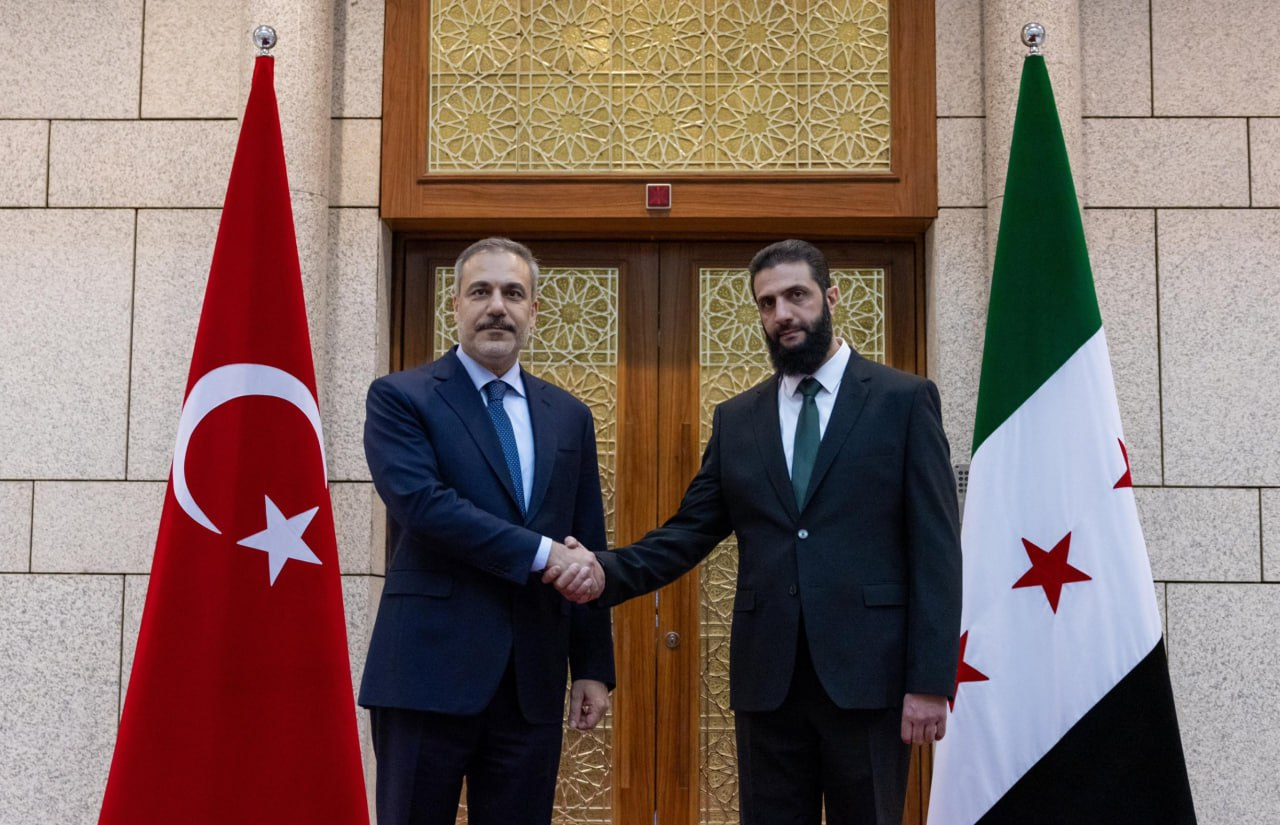
The Turkish Foreign Minister, in statements he made after a meeting with "al-Julani" during which he discussed the political developments in Syria and the issue of Syrian refugees in Turkey and ways to open the door for their return, indicated that he conveyed the greetings of Turkish President Recep Tayyip Erdogan, continuing, in his victory speech, that "the Baath regime that lasted 61 years left behind great suffering, and we are here today to stand with you in achieving your aspirations." He added: "Your joy is our joy and your sadness is our sadness, and we are proud to support the truth and stand by you," stressing the need to "draft a new constitution that respects all components of Syrian society and guarantees the rights of minorities," in a way that opens the door to "building a new Syria, with full Turkish support." He pointed out that "President Erdogan issued his instructions to support you in everything you need to achieve progress. We are here to begin a new phase of construction."
For its part, and in the context of what Ankara considers a "victory" for it, the Turkish "Anadolu" agency broadcast two photos; the first of which shows Fidan with "al-Julani", and the other of Iranian Foreign Minister Abbas Araghchi with al-Assad, on the first of this month, noting that the time difference between the two photos is 3 weeks.
Turkish relations with new Syrian leaders will be determined by how the Kurdish matter will be handled. Here is what the Turkish Minister of Foreign Affairs Hakan Fidan, said in that regard:
"We must take action immediately. The territorial integrity of Syria is non-negotiable. I would like to clarify once again that there is absolutely no place for Kurdish armed groups in Syria."
Advanced steps, therefore, cannot be taken until some of the outstanding problems with the factions in the north and south are resolved, in addition to reaching an agreement under which the Kurds in the "SDF" are integrated into the new administration. However, the last mission seems somewhat difficult in light of the ongoing battles between the factions of the "National Army" affiliated with Turkey and the "SDF" in many areas, most notably the "Tishreen Dam" area, which field sources reported that the battles taking place in its vicinity caused severe damage to it.

US officials sat face to face with the person US government designated a "terrorist" and offered $10 million bounty for his arrest. Realizing the awkwardness of the moment, the administration announced later that it will cancel the reward for Jolani’s arrest.

In what must be a bizarre turn of events, US government officials set face to face with a man they allocated $10 million for information leading to determining his whereabouts, after designating him as a "terrorist" in 2017.
State department still confirmed that the reward money is still valid, at a time when members of the State Department reportedly sat with Jolani.
This development raises questions about the designation "terrorist", and now about what it takes for one to be removed from the list, which apparently is leading an armed rebellion that overthrows a regime.
US Assistant Secretary of State Barbara Leaf announced, following a meeting with representatives of Hay'at Tahrir al-Sham, that Ahmed al-Sharaa (al-Jolani) is committed to not allowing terrorist groups to operate in Syria in a way that threatens the United States and neighboring countries.
According to news reports, US State Department delegation discussed with the commander-in-chief of the new administration in Syria, Ahmed al-Sharaa, on Friday, lifting sanctions on the Syrian people. The two sides also discussed removing Hay’at Tahrir al-Sham from the terrorist lists.

This week, the Guardian published a report about another American protesting the US government's position on the war in Gaza, this time a US state department worker resigned over Israel-Gaza policy.

An army veteran with a stint in Iraq who joined the state department for over a decade of postings across Asia, he came with the measured optimism of a career diplomat – two years of Arabic training ahead, a potential change in administration, and a chance to make a difference. He’d eventually work his way up the ranks to become the state department’s deputy political counselor on Gaza.
What he didn’t anticipate was becoming a key witness to what he describes as a systematic failure of US foreign policy.
“The more informed you become on this issue, you can’t avoid realizing how bad it is,” Casey told the Guardian.
Casey resigned from the state department in July after four years at the job, discreetly leaving the post unlike other recent high-profile government departures. Now seated at his kitchen table in the quiet suburbs of northern Michigan, Casey reflected on how, as one of only two people in the entire US government explicitly focused on Gaza, he became an unwilling chronicler of a humanitarian catastrophe.
“I got so tired of writing about dead kids,” he said. “Just constantly having to prove to Washington that these children actually died and then watching nothing happen.”
Casey’s work function included documenting the humanitarian and political landscape through classified cables, research and reporting. But his disillusionment wasn’t sudden. It was a slow accumulation of bureaucratic betrayals – each report dismissed, each humanitarian concern bulldozed by political expediency.
“We would write daily updates on Gaza,” he said. Colleagues used to joke, he said, that they could attach cash to the reports and still nobody would read them.
Read the article...
Cairo will host the 11th edition of the D8 Summit on Thursday, 19-12-2024, which will discuss ways to confront successive global economic and political changes. The summit will be held under the slogan "Investing in Youth and Supporting Small and Medium Enterprises: Shaping Tomorrow's Economy."
Egypt chairs the current edition of the summit, having assumed the presidency of the group last May and will continue to lead its work until the end of next year.
Several summits and bilateral meetings are scheduled to be held on the sidelines of the D8 Summit in Cairo, whether at the level of presidents or delegations participating in the conference.
Several heads of state will be attending this summit this year, including Iran's president.
Iranian President Masoud Pezeshkian plans to attend the summit of the Developing Eight (D8) Islamic countries in Egypt on Thursday, Iranian Foreign Ministry spokesman Esmail Baghaei said Tuesday. This is the first visit by an Iranian president to Egypt in more than a decade.
Relations between Egypt and Iran have generally been tense in recent decades, but the two countries have intensified high-level diplomatic contacts since the Gaza war broke out last year, in which Egypt has tried to mediate. Iranian Foreign Minister Abbas Araqchi traveled to Egypt in October to discuss regional issues with Egyptian officials, and his Egyptian counterpart Badr Abdel Aty traveled to Tehran in July to attend Pezeshkian’s inauguration.
Indonesian President Prabowo Subianto will travel to Egypt on Tuesday to attend meetings of a group of eight major Muslim nations known as the Developing Eight (D8) Economic Cooperation Organization, the government said.
Prabowo will attend meetings, including a D8 summit on Thursday, and accept the group’s chairmanship for a two-year term starting on Jan. 1, 2026, Foreign Ministry spokesman Roy Soemirat told reporters on Monday.
Turkish Foreign Minister Hakan Fidan will participate tomorrow, Wednesday, in the 21st meeting of the G8 Foreign Ministers Council, which will be held in the Egyptian capital, Cairo, within the framework of the D8 Summit.
According to diplomatic sources in the Turkish Foreign Ministry, the meeting will address developments in the Palestinian Gaza Strip and other regional issues.
During the meeting, Fidan is expected to call for an immediate end to the genocide committed by Israel in Palestine and its measures aimed at turning the war into a regional conflict.
He is also expected to point out the importance of advancing efforts to implement the two-state solution in conjunction with reaching an immediate ceasefire.
Fidan will highlight the importance of providing urgent humanitarian aid to Gaza and increasing support for the efforts of the workers of the United Nations Relief and Works Agency for Palestine Refugees (UNRWA).
The meeting of the Foreign Ministers Council comes within the framework of preparing for the summit hosted by Cairo next Thursday, with the participation of delegations from the group's countries: Turkey, Egypt, Nigeria, Pakistan, Iran, Indonesia, Malaysia and Bangladesh.
The summit is scheduled to be held under the theme “Investing in Youth and Supporting SMEs: Shaping Tomorrow’s Economy.”
The Indonesian government announced that President Prabowo Subianto will travel to Egypt today, Tuesday, to attend the group's meetings and the upcoming summit next Thursday, and will accept the group's presidency for a year.
In addition, Iranian Foreign Ministry spokesman Esmail Baghaei announced that Iranian President Masoud Pezeshkian will participate in the G8 Summit in Egypt.
The Pakistani Embassy in Cairo also confirmed that Pakistani Prime Minister Shehbaz Sharif will pay an official visit to Egypt from December 18 to 20 to participate in the summit's activities.
President Abdel Fattah el-Sisi handed the Lebanese caretaker Prime Minister Najib Mikati an invitation to participate in the summit's activities, as the Lebanese Prime Minister received the invitation from the Egyptian Ambassador Alaa Moussa, during his reception on December 9 at the Grand Serail.
The Middle East Eye website also reported that Turkish President Recep Tayyip Erdogan will participate in the group's meeting and will hold meetings related to current developments in Syria.
The G8, also known as the Developing Eight, is a development cooperation system between the following member states: Bangladesh, Egypt, Indonesia, Iran, Malaysia, Nigeria, Pakistan, and Turkey. This system also adds a new dimension aimed at strengthening economic relations and social ties among its members.
The G8 was officially established at the Summit of Heads of State and Government held in Istanbul on June 15, 1997 (Istanbul Declaration), following the "Cooperation for Development" Conference held on October 22, 1996 and a series of preparatory meetings.
Improving the position of developing countries in the global economy.
Creating new opportunities in trade relations.
Enhancing the participation of developing countries in international decision-making.
Achieving better living standards.
The most important features of the G8:
It is a global system, not a regional one, as is clearly evident in its founding members.
Its membership is open to other developing countries that share the objectives and principles of the Group and are linked by common ties with it.
It is a forum that has no adverse effect on the bilateral and international obligations of its member states towards its membership and towards international organizations.




 Posts
All Comments
Posts
All Comments






