Showing posts with label Poverty. Show all posts

Sunday, July 26, 2026

Media Review: Will AI Make Work Optional?

    Sunday, July 26, 2026   No comments

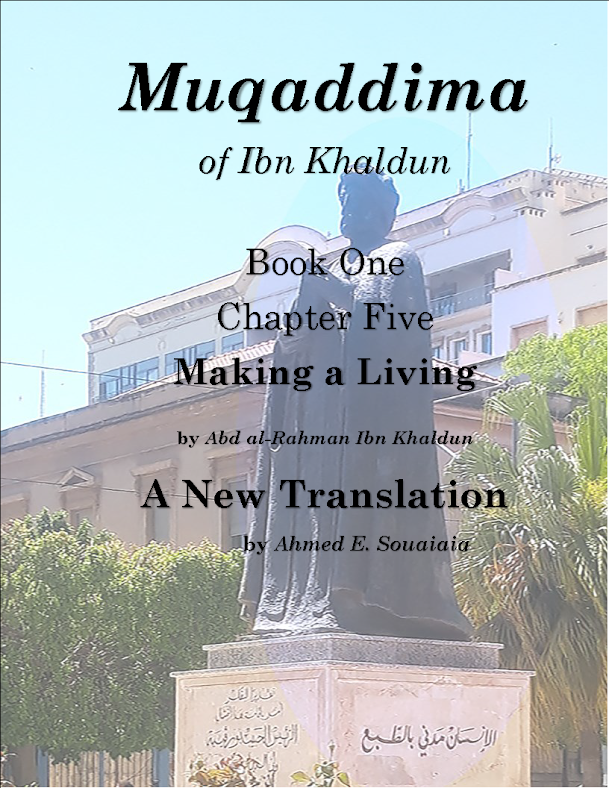
An Ibn Khaldunian Response to the Myth of the Post-Work Society

Each new technological revolution has inspired predictions about the end of work. The industrial revolution promised liberation from physical labor. Computers were expected to eliminate paperwork and usher in an era of leisure. Today, artificial intelligence has given rise to an even more ambitious claim: that work itself will become optional.

This assertion is repeated with increasing confidence by technology executives, futurists, and investors. Some envision a future in which AI performs virtually all productive labor while human beings receive a universal income, freeing them to pursue creativity, recreation, or personal fulfillment. It is an appealing vision. It is also, upon closer examination, conceptually confused.

The confusion arises from treating employment and work as though they were the same thing.

They are not.

Employment is a social institution. Work is an ontological reality.

This distinction, articulated with remarkable clarity by Ibn Khaldun more than six centuries ago, exposes the central weakness in the contemporary narrative surrounding artificial intelligence.

According to Ibn Khaldun, all value originates in work. Human prosperity does not emerge from money, markets, or ownership alone. Rather, every form of wealth traces its origin to productive activity. Agriculture, manufacturing, construction, transportation, education, governance, and commerce all create value because they involve work. Money merely records and facilitates the exchange of that value. In this framework, money is not wealth itself. It is a store of the value created by work. The implications of this principle are profound. 

Artificial intelligence may indeed perform an increasing share of productive activities. Machines may design buildings, diagnose diseases, write software, conduct scientific research, and manufacture goods with minimal human intervention. None of this abolishes work. It merely changes the system performing it.

The work has not disappeared. It has shifted from one productive system to another.

This observation reveals the first conceptual error in the claim that AI will make work optional. If an AI system produces a bridge, writes a legal brief, or discovers a new medicine, those outcomes remain the products of work. They are events produced by a system operating through energy over time. Work continues to exist because every event remains the consequence of work performed by some system.

What disappears is not work. What may disappear is human employment. This distinction fundamentally changes the discussion. Once employment is separated from work, a much more difficult question emerges.

If AI performs the productive work, who receives the value created by that work?

The popular answer is that society will simply redistribute the resulting abundance through universal income or some similar mechanism. However, this answer quietly assumes the very conclusion it must prove. Where does the money come from?

The answer cannot be "from AI." Artificial intelligence does not own itself. Robots do not collect profits. Algorithms do not pay taxes. Every productive AI system is owned by someone—individuals, corporations, governments, or investment funds. Consequently, the economic value produced by AI flows first to its owners. This is not speculation. It is precisely how modern economic systems already operate. The irony is difficult to ignore.

Many of the strongest advocates of a post-work society owe their extraordinary fortunes to institutions that rigorously protect private ownership of productive capital. Their wealth was accumulated because existing legal and economic systems reward ownership, investment, and capital appreciation. Those same institutions have produced some of the greatest concentrations of wealth in history.

If these ownership structures remain unchanged, AI will not eliminate inequality. It will likely magnify it. The contradiction is obvious. One cannot simultaneously celebrate an economic system that concentrates the returns to ownership while assuming that its future outputs will somehow be distributed equally to everyone. Technology does not produce redistribution. Institutions do. The question therefore is not whether AI can create abundance. The question is whether those who own the productive systems will willingly surrender a substantial portion of the value generated by those systems. History offers little reason for such confidence.

Indeed, one need only consider the incentives facing the owners of advanced AI. If enormous productive capacity generates unprecedented profits, the rational response within existing institutions is to reinvest those profits, acquire additional productive assets, expand market dominance, and increase future returns. Nothing in contemporary capitalism naturally converts concentrated ownership into universal prosperity. To assume otherwise is not economic analysis. It is wishful thinking.

 This is precisely where Ibn Khaldun's analysis proves remarkably contemporary. His insight was never merely that people must work. His deeper claim was that work is the source from which all economic value ultimately flows. Whenever value becomes detached from productive contribution and instead accumulates primarily through institutional mechanisms that bypass work, societies begin to experience structural distortions. Wealth becomes increasingly concentrated, productive incentives weaken, social cohesion deteriorates, and political instability follows.

The real challenge is whether societies can redesign their institutions so that the value generated by increasingly autonomous productive systems continues to circulate in ways that preserve economic participation, social legitimacy, and political stability.

That is an institutional question—not a technological one.

Artificial intelligence may become one of the greatest productive tools humanity has ever created.

But no technology, regardless of its sophistication, abolishes the fundamental principle that value originates in work.

Six centuries ago, Ibn Khaldun recognized this principle with extraordinary clarity. Today, as the world imagines a future beyond work, his insight deserves renewed attention.

 AI changes who—or more precisely, what—performs productive work. It does not eliminate the necessity of work as the source of value.

The future is not post-work

The future is a struggle over who owns the systems that perform the work, who receives the value those systems create, and whether our institutions continue to recognize that money is not wealth itself, but only a representation of work already performed.

The dream that AI will make work optional mistakes a transformation in the organization of production for the disappearance of production itself. It confuses employment with work, ownership with creation, and technological possibility with institutional reality. The machines may change. The principle does not: Work remains the foundation upon which every event—and every civilization—ultimately rests.


Friday, June 05, 2026

WFP warns war in West Asia pushing millions toward hunger

    Friday, June 05, 2026   No comments

 The war in West Asia is driving millions of people closer to hunger, as higher fuel and transportation costs push up food prices and funding shortages force humanitarian organizations to reduce aid operations, the UN World Food Programme (WFP) said on Friday.

In March, the WFP warned that up to 45 million people could face acute food insecurity if oil prices remained near $100 per barrel through June. The agency said that scenario is now materializing, with benchmark crude prices staying above that threshold since early March.

Families in Afghanistan, Somalia, and Sri Lanka are among the hardest hit, facing increasing pressure from rising fuel costs, surging food prices, declining incomes, and trade disruptions.

The WFP said it anticipates reaching 1.5 million fewer people worldwide in 2026, with that figure potentially rising to 9 million if current conditions continue for another six months.


Monday, April 08, 2024

The Saudi Mufti Prohibits giving money for Iftar charity, legitimizes slavery

    Monday, April 08, 2024   No comments

Saudi Arabia’s highest religious authority, issuing a religious decree concerning the practice of giving Iftar sadaqa in the form of cash (money), provided reference that can be seen as legitimizing slavery despite its abolition all around the world and despite the evidence in the Quran that designated slavery as evil and encouraged Muslims to free slaves when unable to fast, break an oath, or commit other moral or legal infractions. The Fatwa comes in a time when more than 2 million people in Gaza are starved to death and could need cash provided to them through aid organizations who can only receive money from the world community.

According to the Saudi Press Agency, the Grand Mufti of the Kingdom said, the Grand Mufti of Saudi Arabia, Chairman of the Council of Senior Scholars and Chairman of the Permanent Committee for Scholarly Research and Fatwa, Sheikh Abdul Aziz Al Sheikh, issued a ruling that giving Zakat al-Fitr in money is not valid “because that is contrary to the Sunnah of the Messenger of God, may God’s prayers and peace be upon him. May God bless him and grant him peace and the Rightly Guided Caliphs who used to remove it from food.”

The Saudi Mufti added that “Zakat al-Fitr has been prescribed for all Muslims, males and females, old and young, free and slaves.”

It should be noted that other Sunni schools of law consider giving iftar charity in the form of cash (or anything of value), to be valid.

The kingdom has been run through an arrangement that granted Wahhabi scholars from Al Sheikh clan, religious power in return for their blessing of the form of governance in the kingdom under the control of the Al Saudi clan. Saudi Arabia’s official religious practices are derived from the Wahhabism, the strictest religious sect in Islamic societies and Wahhabi religious figures use textual evidence irrespective of rational facts and changed circumstances. The same sect is followed by members of al-Qaeda and the “Islamic State”.


Tuesday, September 12, 2023

Inflation contributes to declining income and increasing poverty in the United States

    Tuesday, September 12, 2023   No comments

The US Census Bureau announced that inflation caused a decline in real income by 2.3% in the United States in 2022 despite raising wages, while poverty increased with the cessation of government aid, which was provided during the Corona pandemic.

Liana Fox, a Census Bureau official, explained during an online press conference that “high inflation led to a decline in real average family income,” which amounted to $47,960.


The official poverty rate remained stable compared to last year, at 11.5%, or 37.9 million people, living on less than $14,880 annually, or $29,950 for a family of four.


But another measurement showed a completely different truth. This measure, also published by the Census Bureau, adjusts the income below which a person is considered poor, taking into account government assistance and the cost of child care and medical expenses.

According to this measure, the poverty rate rose for the first time since 2010, increasing from 7.8% to 12.4% between 2021 and 2022.

The child poverty rate doubled, rising to 12.4%, while it was 5.2% in 2021, a historic low.

Friday, June 16, 2023

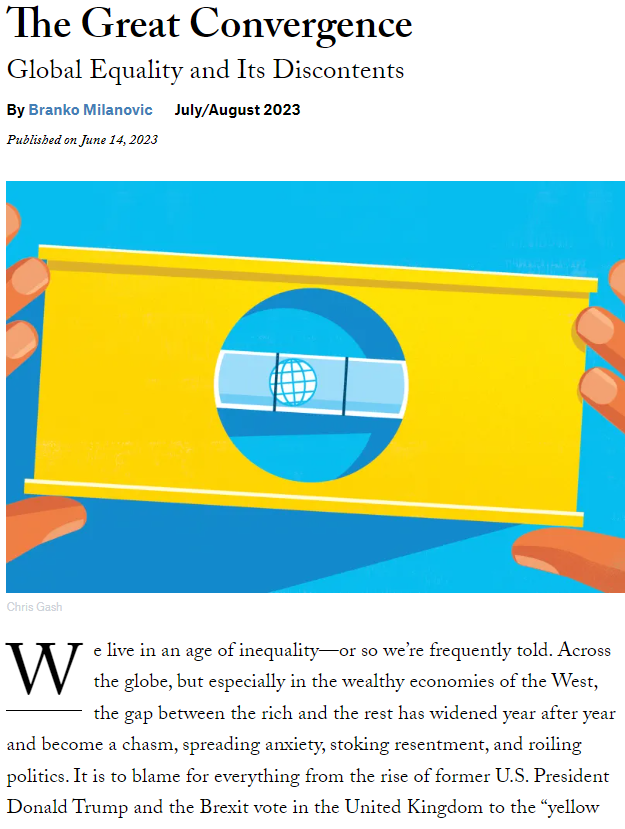
The Great Convergence: Global Equality and Its Discontents

    Friday, June 16, 2023   No comments

An article in the magazine "Foreign Affairs" talks about global income levels, within the next twenty to thirty years, and says that the number of Chinese who earn salaries equal to the salaries of middle-income Americans will be equal, which reduces American hegemony.

The current century has witnessed a significant decline in global income inequality, after falling to levels not seen in more than a century. This is the conclusion reached by Branko Milanovic, one of the world's foremost inequality researchers.


Milanovic said in an article published in the American magazine "Foreign Affairs", that "at a time when the population of the United States is only 4% of the world's population, increasing equality would be beneficial to the planet as a whole, but it heralds the end of American hegemony."


According to the author, inequality is measured using a Gini coefficient (a unit of measurement), which extends on a scale from 0 (perfect equality) to 100 (where one person gets all the income in the world).


On this measure, the inequality index fell from 69 in 2000 to 60 in 2018, and it is certainly lower today. In other words, the world is more equal now than at any time since 1875.


Recently, that number due to inequality within countries has risen slightly, and now stands at about 13, up from 7 in the 1990s. Conversely, the component decreased from a high of 63 in 1988 to only 47 in 2018 due to inequality between countries.


This is a complete reversal of what happened during most of the Cold War, when inequality between countries was increasing, but inequality within a single country was greatly reduced.


Milanovic notes in his article that "in the 1970s, India's share of global GDP was less than 3%, while the share of Germany, a major industrial power, was 7% by 2021, then these proportions reversed."


People who were poor by the standards of the United States, and other rich countries, were rich by global standards.


"People's incomes in Asia have reached unprecedented levels," adds Milanovic.


For every 100 middle-income Americans, 25 Chinese earned an equal amount.


Within the next 20 to 30 years, the number of Chinese earning salaries equal to that of middle-income Americans will be equal, and then rapidly exceed that proportion.


"This, in turn, reflects a broader shift in economic, technological and even cultural power in the world," says Milanovic.


For the global genetic coefficient (the unit of measure) to continue to decline, Africa will need to become significantly richer in the coming decades, "which is not likely to happen yet," according to Foreign Affairs.


Sunday, October 09, 2022

Chinese firms put deeper roots in Pakistan in post-flood reconstruction; more joint efforts needed for regional recovery

    Sunday, October 09, 2022   No comments

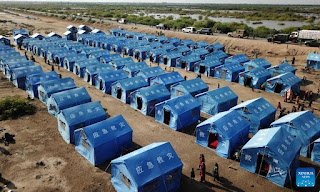
Chinese infrastructure companies in Pakistan are playing an increasingly important role in supporting the regional economy and livelihoods as the country looks for more joint efforts from the international community to facilitate the gradual recovery from the lingering devastation of recent floods.

While Chinese companies have taken an active approach in providing constant aid, they have also beefed up efforts to maintain the smooth operation of their projects in some key areas such as power generation and housing in Pakistan, as the country, hit by unprecedented floods in September, has seen its economic recovery slowing down.

Industry insiders and experts said that more joint efforts, including safety guarantees for local personnel and projects of Chinese companies, are needed more than ever to ensure the smooth operation of these projects.

Read the full story...

Submit your story (pitch an article)

Name

Email *

Message *


Trending Today...


ISR +


Frequently Used Labels and Topics

40 babies beheaded 77 + China A Week in Review Academic Integrity Adana Agreement afghanistan Africa African Union al-Azhar Algeria Aljazeera All Apartheid apostasy Arab League Arab nationalism Arab Spring Arabs in the West Armenia Arts and Cultures Arts and Entertainment Asia Assassinations Assimilation Azerbaijan Bangladesh Belarus Belt and Road Initiative Brazil BRI BRICS Brotherhood CAF Canada Capitalism Caroline Guenez Caspian Sea cCuba censorship Central Asia Charity Chechnya Children Rights China Christianity CIA Civil society Civil War climate colonialism communication communism con·science Conflict conscience Constitutionalism Contras Corruption Coups Covid19 Crimea Crimes against humanity D-8 Dearborn Debt Democracy Despotism Diplomacy discrimination Dissent Dmitry Medvedev Earthquakes Economics Economics and Finance Economy ECOWAS Education and Communication Egypt Elections energy Enlightenment environment equity Erdogan ethics Europe Events Fatima FIFA FIFA World Cup FIFA World Cup Qatar 2020 Flour Massacre Food Football France Freedom freedom of speech G20 G7 Garden of Prosperity Gaza GCC GDP Genocide geopolitics Germany Global Security Global South Globalism globalization Greece Grozny Conference Hamas Health Hegemony Hezbollah hijab Hiroshima History and Civilizations Hormuz Human Rights Huquq Ibadiyya Ibn Khaldun ICC Ideas IGOs Immigration Imperialism In The News india Indonesia inequality inflation INSTC Instrumentalized Human Rights Intelligence Inter International Affairs International Law Iran IranDeal Iraq Iraq War ISIL Islam in America Islam in China Islam in Europe Islam in Russia Islam Today Islamic economics Islamic Jihad Islamic law Islamic Societies Islamism Islamophobia ISR MONTHLY ISR Weekly Bulletin ISR Weekly Review Bulletin Italy Japan Jordan Journalism Kenya Khamenei Kilicdaroglu Kurdistan Latin America Law and Society Lebanon Libya Majoritarianism Malaysia Mali mass killings Mauritania Media Media Bias Media Review Middle East migration Military Affairs Morocco Multipolar World Muslim Ban Muslim Women and Leadership Muslims Muslims in Europe Muslims in West Muslims Today NAM Narratives Nationalism NATO Natural Disasters Nelson Mandela NGOs Nicaragua Nicaragua Cuba Niger Nigeria Normalization North America North Korea Nuclear Deal Nuclear Technology Nuclear War Nusra October 7 Oman OPEC+ Opinion Polls Organisation of Islamic Cooperation - OIC Oslo Accords Pakistan Palestine Peace Philippines Philosophy poerty Poland police brutality Politics and Government Population Transfer Populism Poverty Prison Systems Propaganda Prophet Muhammad prosperity Protests Proxy Wars Public Health Putin Qatar Quran Rachel Corrie Racism Raisi Ramadan Ramadan War Regime Change religion and conflict Religion and Culture Religion and Politics religion and society Resistance Rights Rohingya Genocide rule of law Russia Salafism Sanctions Saudi Arabia Science and Technology SCO Sectarianism security Senegal Shahed sharia Sharia-compliant financial products Shia Silk Road Singapore Sistani Slavery Soccer socialism Southwest Asia and North Africa Sovereignty Space War Spain Sports Sports and Politics Starvation State Power State Terror Sudan Sunni Axis sunnism Supremacism SWANA Syria Ta-Nehisi Coates terrorism Thailand The Koreas Tourism Trade transportation Tunisia Turkey Turkiye U.S. Cruelty U.S. Foreign Policy UAE uk ukraine UN under the Rubble UNGA United States UNSC Uprisings Urban warfare US Foreign Policy US Veto US-Iran MoU USA Uyghur Venezuela Volga Bulgaria Wadee wahhabism War War and Peace War Crimes War on Iran Wealth and Power Wealth Building West Western Civilization Western Sahara WMDs Women women rights Work Workers World and Communities Xi Yemen Zionism

Search for old news

Find Articles by year, month hierarchy


WEEKLY AdSpace 3

_______________________________________________

Copyright © Islamic Societies Review. All rights reserved.