Showing posts with label Kurdistan. Show all posts

Thursday, July 23, 2026

Will the US War on Iran, Aimed at Regime Change in Tehran, Result in Regime Change in Jordan and the GCC?

    Thursday, July 23, 2026   No comments

In the annals of modern geopolitical irony, few developments are as stark as the current trajectory of the US war on Iran. Initially championed by Donald Trump and Benjamin Netanyahu with overt calls for the Iranian people to overthrow their government, the conflict has undergone a profound and dangerous shift. The stated objective is no longer regime change in Tehran, but rather the forced reopening of the Strait of Hormuz and the degradation of Iran’s military capabilities.

To achieve this, the United States is launching continuous attacks from military bases embedded within the territories of Jordan and the Gulf Cooperation Council (GCC) states. In doing so, Washington has inadvertently placed its most vulnerable allies—non-representative monarchies with long-standing grievances among their own populations—directly in the crosshairs. Now, Iran is skillfully exploiting this dynamic, driving a wedge between these regimes and their people, and raising the very real specter of regime change in Amman, Kuwait City, and beyond.

The Sovereignty Paradox: Iran’s "Hearts and Minds" Offensive


Tehran’s strategy has evolved beyond mere military retaliation; it has launched a sophisticated psychological and information warfare campaign directed squarely at the Arab street. The Islamic Revolutionary Guard Corps (IRGC) has issued direct, impassioned statements to the peoples of Jordan and Kuwait, reframing Iran’s strikes not as violations of national sovereignty, but as legitimate acts of self-defense against an occupying force.

In a recent statement addressed to the "honorable and noble people of Jordan," the IRGC justified its lightning strikes against US bases on Jordanian soil—which reportedly destroyed a THAAD radar, a Patriot air defense system, and set ablaze fuel storage and helicopter maintenance hangars. The message was unequivocal:

"What is a US military base inside another country? It is a place where Americans, and anyone they choose, can enter and leave without the oversight of your border authorities... Order there is enforced by the US military police, not yours. Crimes committed there are judged by American judges, not your own... Therefore, it is the United States, not us, that has violated your territorial integrity and sovereignty."

To anchor this argument in raw emotional resonance, the IRGC invoked the tragedy of Minab, stating:

 "Yesterday, the grieving people of Minab buried the remaining body parts of their schoolchildren... 168 students who were martyred on the first day of this war in an attack carried out by the child-killing US military. It is our legal, religious, and rational right to target the aggressor against our country and the killer of our children wherever it launches its attacks from."

A parallel message was delivered to Kuwait, where the IRGC claimed drone strikes on a large US military equipment depot, a Patriot system, and an MQ-9 drone hangar at Ali al-Salem Air Base, alongside troop housing at Camp Udairi (Camp Buehring). Once again, the narrative was carefully calibrated: Iran respects Kuwait’s sovereignty; it is the unchecked US military footprint that violates it.

The Jordanian Powder Keg

Nowhere is this dynamic more volatile than in Jordan. The Hashemite Kingdom’s government has long been perceived by its populace as helpless to alter US policy, particularly regarding Israeli violence against Palestinians. This impotence has severely weakened the regime’s legitimacy, a fact exacerbated by the demographic reality that roughly 65% of Jordan’s population has Palestinian heritage or direct connections to Palestine.

The disconnect between the Jordanian street and the palace was laid bare following recent Israeli provocations. When Israeli National Security Minister Itamar Ben Gvir, alongside Knesset members and settlers, stormed the Al-Aqsa Mosque under Israeli police protection, the Jordanian Foreign Ministry issued a stern condemnation, calling it a "blatant violation" of the mosque’s historic and legal status. For the average Jordanian, verbal condemnations ring hollow while US military assets in their country continue to facilitate a broader regional war, and while their government remains unable to protect Islamic holy sites from desecration. By hosting US forces that Iran now actively targets, the Jordanian monarchy is increasingly viewed not as a protector of national sovereignty, but as a complicit facilitator of foreign aggression.

The GCC Dilemma

The GCC states face a similar, if not more complex, vulnerability. Countries like Kuwait and Bahrain host significant Shia communities and populations in the GCC generally are deeply, historically sympathetic to the Palestinian cause. The presence of US bases has always been a quiet source of domestic tension, managed through a combination of economic patronage and political suppression.

Iran’s messaging directly punctures this fragile social contract. By framing US bases as extraterritorial colonies where "American law prevails, not your national law," Tehran is handing local opposition groups a powerful nationalist and religious narrative. If US bases are the launchpads for attacks on Iran, and Iran retaliates against those bases, the resulting collateral damage, economic disruption, and perception of humiliation will inevitably be directed at the monarchs who permitted the bases to exist in the first place.

The Crumbling US Domestic Front

This geopolitical boomerang effect is being accelerated by a rapid collapse in US domestic support for the war. President Trump, who once boasted of unwavering backing from his base, is now facing a severe political reckoning.

According to a POLITICO / Public First poll published on July 22, 2026, support for the war on Iran has fallen sharply among Trump’s core MAGA supporters. Just over a third now believe the economic price of the war is justified—a precipitous 13-point drop from 50 percent in May. Another 37 percent of self-identified MAGA voters stated they would back continued US involvement only if costs stop rising, while around one-fifth said the US should end the war no matter the costs. Opposition is even deeper among Trump voters outside the MAGA bloc.

The primary catalyst for this disillusionment is economic pain and mounting casualties. With gas prices having climbed to over $4 per gallon since Trump returned to office, 57 percent of MAGA voters and 63 percent of non-MAGA Trump voters directly blame the war.

The human cost is also becoming impossible to white-wash. At least 18 US soldiers have been killed since the start of the war, with wounded personnel surpassing 500. Just days ago, Trump attended a dignified transfer ceremony at Dover Air Force Base for four US soldiers killed in Iranian attacks: three in a missile strike on the Muwaffaq Salti Air Base in Jordan, and a fourth at Erbil Air Base in Iraq. Right before the ceremony, Trump warned that Iran would "pay a big price," but the rhetoric increasingly rings hollow against the backdrop of American coffins.

Behind closed doors, the playbook of endless escalation has been replaced by White House panic. A source close to the administration told POLITICO that the government is at a "maximum level of frustration," with senior figures accepting that "the victory Trump wants cannot be won because the public will not back the escalation required. We've got more dead Americans and a politically impossible situation." With Trump’s approval ratings hovering near the lowest levels of his political career, the Republican Party faces the very real risk of losing its House majority and possibly the Senate in the upcoming November midterms.

The Irony of Hegemony

The United States entered this conflict with the maximalist goal of regime change in Iran, openly encouraging the Iranian people to rise up. The mechanics of modern warfare and the realities of regional geography have turned that logic on its head. By relying on the territories of non-representative, deeply unpopular monarchies to wage war, the US has transformed those regimes into strategic liabilities.

Iran, far from being isolated, has seized the narrative high ground. By positioning itself as the defender of regional sovereignty against American imperialism, Tehran is successfully weaponizing the legitimate grievances of the Jordanian and GCC publics. If the war continues to drag on, exacting a heavy toll in American lives, regional infrastructure, and economic stability, the ultimate irony may be realized: the US war intended to topple the Islamic Republic could instead become the catalyst that brings down the very monarchies Washington relies upon to project its power in the Middle East.

Friday, December 06, 2024

Syria and the "Arab Spring" 2.0

    Friday, December 06, 2024   No comments

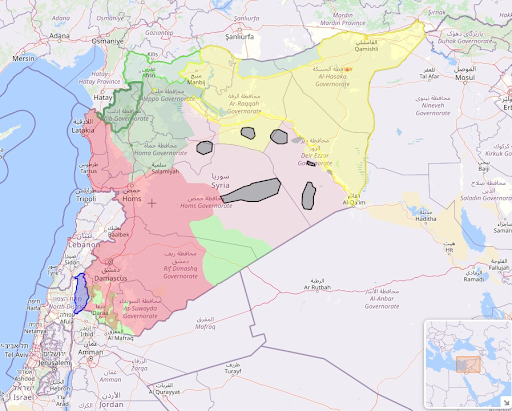
The popular uprising that broke in the Southwest Asian and North African, SWANA, in 2011, that transformed the region was frozen ten years later, especially in Syria and Yemen. Syria, after ten years of war, saw some calm since 2021, with the country still divided into three areas of control: one under "Sunni" rebels supported by Turkey and Qatar controlling the northwest, a second under Kurdish control in the northeast supported by the US, and the rest of Syria controlled by the Syrian government supported by Russia and Iran. On November 27 of this year, the calm was shattered when the Turkish backed armed groups regained major cities they lost in 2017-19. The crisis is unlikely to be resolved short of outside strong intervention, which is also unlikely, given that the outside actors are now busy dealing with new crises centers. So, for the foreseeable future, there are two possible paths forward. The various faction will continue to fight, but unlikely that one will prevail over the other two. Alternatively, a reshuffle of the alliances internally will consolidate some power leading to a stalemate, which will force all three sides to negotiate a deal that preserve the gains and interests of all ethnic, religious, sectarian, and ideological groups. That seem to be the realization of some world and regional powers, though not all think they have to give anything to dial down violence.

Erdogan: We hope that the Syrian "opposition" factions will continue their progress.. and the goal is Damascus


Turkish President Recep Tayyip Erdogan said he hopes that the progress of what he called the "opposition" in Syria will continue "without problems," considering that the next "target" after the armed factions took control of Idlib, Hama and Homs, "is Damascus."

Erdogan's words came in press statements, and he added: "We had invited Assad (Syrian President Bashar al-Assad)... and we told him: Let us determine the future of Syria together. Unfortunately, we did not receive a positive response on this issue."

Recently, Syria's permanent representative to the United Nations, Qusay al-Dahhak, confirmed that the terrorist attack on northern Syria could not have been carried out without a green light and a joint Turkish-Israeli operational order paved by repeated Israeli attacks on Syrian territory.

Syrian President Bashar al-Assad also confirmed his country's insistence on eradicating terrorism, stressing that terrorists do not represent a people or institutions, but rather the apparatuses that support them.


Foreign Ministers of Iraq, Syria and Iran: Protecting Syria's Security is Necessary to Protect the Security of the Region

The foreign ministers of Iraq, Syria and Iran stressed on Friday that "threatening Syria's security poses a general danger to the stability of the entire region," stressing that "there is no choice but to coordinate, cooperate and consult diplomatically continuously, in order to eliminate all risks of escalation in the region."

In a joint statement following the meeting at the Iraqi Foreign Ministry, the ministers stressed "the seriousness of the events in Syria and their sensitivity to all parties in the region," warning of "the possibility of their expanding dimensions, which will pose a grave danger to the three countries and threaten the security of their peoples and the entire region."

The ministers also urged "the need to mobilize all Arab, regional and international efforts to reach peaceful solutions to the challenges facing the region in general, and Syria in particular."


In addition, the statement stressed "the agreement on the need to continue consultation and coordination between the three countries, follow up on these developments and prepare for any developments in the coming days," and respect for Syria's sovereignty, independence, unity and territorial integrity.


They also condemned "terrorism in all its forms and manifestations classified by the Security Council," stressing "collective action to confront it." They also condemned the ongoing Israeli attacks on Syria, Gaza and Lebanon.


Sunday, July 07, 2024

Turkish President announces readiness to extend an invitation to President Assad

    Sunday, July 07, 2024   No comments

Turkish President Recep Tayyip Erdogan confirmed on Sunday that "once Bashar al-Assad takes a step towards improving relations with Turkey, we will respond appropriately."


He continued in press statements: "We will extend our invitation to Assad, and with this invitation we want to return Turkish-Syrian relations to the same point they were in the past."

He added: "Our invitation can happen at any time."

The Turkish president added in his press statements: "Russian President Vladimir Putin has an approach regarding our meeting (with Assad) in Turkey, and Iraqi Prime Minister Mohammed Shia al-Sudani has an approach. We are talking here about mediation, so what is wrong with it with our neighbor?"


On Friday, Turkish President Recep Tayyip Erdogan confirmed that he could, in cooperation with his Russian counterpart Vladimir Putin, "extend an invitation" to Syrian President Bashar al-Assad to start a new process of normalizing relations with Syria.


"I already said on Friday (last), after the Friday prayers, that we can start a new process (of normalizing relations) with Syria. We can invite Mr. Assad with Mr. Putin," Erdogan told reporters upon his arrival from Astana.


Erdogan added that Russian President Vladimir Putin's upcoming visit to Turkey could be the beginning of a new process of normalizing relations between Ankara and Damascus.


He commented: "If our honorable Mr. Putin can visit Turkey, this could be the beginning of a new process (of normalizing relations between Turkey and Syria). All the years that have passed in the Syrian arena have clearly shown everyone that it is necessary to create a mechanism for a permanent settlement. Syria, whose infrastructure has been destroyed and whose people have been scattered, must stand on its own feet and end the instability. The recent calm in this area can open the door to peace if wise policies and an approach to solving problems are adopted without bias."


Commenting on Syrian President Bashar al-Assad's statements about normalizing relations between Syria and Turkey last week, Erdogan said that "there are no reasons not to establish diplomatic relations between the two countries," and according to him, "Ankara does not aim to interfere in Damascus' internal affairs." Assad had stated on June 26, during a meeting with the Russian President's special representative, Alexander Lavrentiev, that "Syria is open to all initiatives related to its relations with Turkey, which are based on respect for the country's sovereignty."

Previously, Syrian President Bashar al-Assad confirmed Syria's openness to all initiatives related to the relationship between Syria and Turkey, based on "the sovereignty of the Syrian state over all its territories on the one hand, and the fight against all forms of terrorism and its organizations on the other hand."


The Syrian presidency stated in a statement on its Telegram channel that "President al-Assad confirmed during his meeting with the special envoy of the Russian President, Alexander Lavrentiev, Syria's openness to all initiatives related to the relationship between Syria and Turkey, based on the sovereignty of the Syrian state over all its territories on the one hand, and the fight against all forms of terrorism and its organizations on the other hand, stressing that these initiatives reflect the will of the countries concerned to establish stability in Syria and the region in general."


Earlier, a Turkish newspaper reported, citing sources, that military delegations from Turkey and Syria, with Russian mediation, held talks at the Hmeimim air base, and another meeting is expected to be held in Baghdad.


The newspaper said: "In this regard, a meeting of military officials from the Turkish Armed Forces and the Syrian army was held at the Russian Hmeimim Air Base southeast of Latakia on June 11," and stated that "the meeting discussed the latest developments in and around Idlib province."


The first meeting of the foreign ministers of the four countries (Russia, Turkey, Iran, Syria) was held in Moscow on May 10, 2023. Based on its results, the ministers ordered the preparation of a draft roadmap for normalizing relations between Turkey and Syria.


Earlier, the Russian President's Special Representative for Syria, Alexander Lavrentiev, stated in an interview with Sputnik that Moscow had handed Ankara and Damascus a draft roadmap for normalizing relations between the two sides, indicating that they could make amendments to it.


Russian Foreign Minister Sergei Lavrov has previously identified priority topics in the roadmap, which include restoring Syrian government control over all parts of the country, ensuring the security of the Syrian-Turkish border, and eliminating the possibility of cross-border attacks and terrorist infiltration.


Monday, November 14, 2022

The Turkish Minister of Interior accuses Kurdish Units of masterminding the Istanbul bombing and criticizes the United States

    Monday, November 14, 2022   No comments

The Turkish authorities continued to reveal the latest details and pictures as part of their investigations into the Istiklal Street bombing in Istanbul. Interior Minister Suleiman Soylu accused the PKK and the Syrian Kurdish People's Protection Units of being responsible for the bombing, but they denied it.

And the Turkish Security Directorate in Istanbul announced today, Monday, that the suspect - who was arrested at dawn with more than 40 others - holds Syrian nationality and is called Ahlam Al-Bashir (23 years old).

Soylu accused the PKK and the Syrian Kurdish People's Protection Units (YPG) of being responsible for the bombing, and said that the order to carry it out was issued in the city of Ayn al-Arab (Kobani) in northern Syria, where Turkish forces have carried out operations against those units in recent years.


The Turkish minister criticized the support provided by the United States to these units, and said that his country does not accept the condolences offered by the American embassy.


Soylu likened the American position to "a murderer who is among the first to arrive at the crime scene."


"We do not accept condolences from the US embassy, ​​we know who supports terrorism in northern Syria, and we know the message they wanted to deliver to Turkey through this attack," he said.


He stressed that "those who support terrorist organizations in northern Syria carried out the attack against us."


For its part, the Kurdistan Workers' Party (PKK) denied responsibility for the bombing of Istiklal Street, and said in a statement posted on its website today, Monday, "It is not possible for us to target civilians in any way."


The so-called Syrian Democratic Forces, of which the Kurdish units are the main component, also denied any connection to the Istanbul bombing.


Tuesday, October 22, 2019

Full text of the Sochi Memorandum on Northern Syria signed by Putin and Erdogan

    Tuesday, October 22, 2019   No comments
The full text of the memorandum of understanding reached by the two countries, Russia and Turkey, related to Northern Syria. This version of the memorandum was provided to the media by the Turkish foreign ministry.
________________
 "President of the Republic of Turkey, Recep Tayyip Erdogan and President of the Russian Federation, Vladimir Putin agreed on the following points:

1. The two sides reiterate their commitment to the preservation of the political unity and territorial integrity of Syria and the protection of national security of Turkey.

2. They emphasise their determination to combat terrorism in all forms and manifestations and to disrupt separatist agendas in the Syrian territory.

3. In this framework, the established status quo in the current Operation Peace Spring area covering Tel Abyad and [Ras al-Ain] with a depth of 32km (20 miles) will be preserved.

4. Both sides reaffirm the importance of the Adana Agreement. The Russian Federation will facilitate the implementation of the Adana Agreement in the current circumstances.

5. Starting 12.00 noon of October 23, 2019, Russian military police and Syrian border guards will enter the Syrian side of the Turkish-Syrian border, outside the area of Operation Peace Spring, to facilitate the removal of YPG elements and their weapons to the depth of 30km (19 miles) from the Turkish-Syrian border, which should be finalized in 150 hours. At that moment, joint Russian-Turkish patrols will start in the west and the east of the area of Operation Peace Spring with a depth of 10km (six miles), except Qamishli city.

6. All YPG elements and their weapons will be removed from Manbij and Tal Rifat.

7. Both sides will take necessary measures to prevent infiltrations of terrorist elements.

8. Joint efforts will be launched to facilitate the return of refugees in a safe and voluntary manner.

9. A joint monitoring and verification mechanism will be established to oversee and coordinate the implementation of this memorandum.

10. The two sides will continue to work to find a lasting political solution to the Syrian conflict within Astana Mechanism and will support the activity of the Constitutional Committee."

Friday, October 18, 2019

Full text of Turkey, US statement on northeast Syria

    Friday, October 18, 2019   No comments
U.S.-Turkey statement on pausing Syria incursion – full text

  1.     The US and Turkey reaffirm their relationship as fellow members of NATO. The US understands Turkey's legitimate security concerns on Turkey's southern border.
  2.     Turkey and the US agree that the conditions on the ground, northeast Syria in particular, necessitate closer coordination on the basis of common interests.
  3.     Turkey and the US remain committed to protecting NATO territories and NATO populations against all threats with the solid understanding of "one for all and all for one".
  4.     The two countries reiterate their pledge to uphold human life, human rights, and the protection of religious and ethnic communities.
  5.     Turkey and the US are committed to D-ISIS/DAESH activities in northeast Syria. This will include coordination on detention facilities and internally displaced persons from formerly ISIS/DAESH-controlled areas, as appropriate.
  6.     Turkey and the US agree that counter-terrorism operations must target only terrorists and their hideouts, shelters, emplacements, weapons, vehicles and equipment.
  7.     The Turkish side expressed its commitment to ensure safety and well-being of residents of all population centers in the safe zone controlled by the Turkish Forces (safe zone) and reiterated that maximum care will be exercised in order not to cause harm to civilians and civilian infrastructure.
  8.     Both countries reiterate their commitment to the political unity and territorial integrity of Syria and UN-led political process, which aims at ending the Syrian conflict in accordance with UNSCR 2254.
  9.     The two sides agreed on the continued importance and functionality of a safe zone in order to address the national security concerns of Turkey, to include the re-collection of YPG heavy weapons and the disablement of their fortifications and all other fighting positions.
  10.     The safe zone will be primarily enforced by the Turkish Armed Forces and the two sides will increase their cooperation in all dimensions of its implementation.
  11.     The Turkish side will pause Operation Peace Spring in order to allow the withdrawal of YPG from the safe zone within 120 hours. Operation Peace Spring will be halted upon completion of this withdrawal.
  12.     Once Operation Peace Spring is paused, the US agrees not to pursue further imposition of sanctions under the Executive Order of October 14, 2019, Blocking Property and Suspending Entry of Certain Persons Contributing to the Situation in Syria, and will work and consult with Congress, as appropriate, to underline the progress being undertaken to achieve peace and security in Syria, in accordance with UNSCR 2254. Once Operation Peace Spring is halted as per paragraph 11 the current sanctions under the aforementioned Executive Order shall be lifted.
  13.     Both parties are committed to work together to implement all the goals outlined in this Statement.
______________

Submit your story (pitch an article)

Name

Email *

Message *


Trending Today...


ISR +


Frequently Used Labels and Topics

40 babies beheaded 77 + China A Week in Review Academic Integrity Adana Agreement afghanistan Africa African Union al-Azhar Algeria Aljazeera All Apartheid apostasy Arab League Arab nationalism Arab Spring Arabs in the West Armenia Arts and Cultures Arts and Entertainment Asia Assassinations Assimilation Azerbaijan Bangladesh Belarus Belt and Road Initiative Brazil BRI BRICS Brotherhood CAF Canada Capitalism Caroline Guenez Caspian Sea cCuba censorship Central Asia Charity Chechnya Children Rights China Christianity CIA Civil society Civil War climate colonialism communication communism con·science Conflict conscience Constitutionalism Contras Corruption Coups Covid19 Crimea Crimes against humanity D-8 Dearborn Debt Democracy Despotism Diplomacy discrimination Dissent Dmitry Medvedev Earthquakes Economics Economics and Finance Economy ECOWAS Education and Communication Egypt Elections energy Enlightenment environment equity Erdogan ethics Europe Events Fatima FIFA FIFA World Cup FIFA World Cup Qatar 2020 Flour Massacre Food Football France Freedom freedom of speech G20 G7 Garden of Prosperity Gaza GCC GDP Genocide geopolitics Germany Global Security Global South Globalism globalization Greece Grozny Conference Hamas Health Hegemony Hezbollah hijab Hiroshima History and Civilizations Hormuz Human Rights Huquq Ibadiyya Ibn Khaldun ICC Ideas IGOs Immigration Imperialism In The News india Indonesia inequality inflation INSTC Instrumentalized Human Rights Intelligence Inter International Affairs International Law Iran IranDeal Iraq Iraq War ISIL Islam in America Islam in China Islam in Europe Islam in Russia Islam Today Islamic economics Islamic Jihad Islamic law Islamic Societies Islamism Islamophobia ISR MONTHLY ISR Weekly Bulletin ISR Weekly Review Bulletin Italy Japan Jordan Journalism Kenya Khamenei Kilicdaroglu Kurdistan Latin America Law and Society Lebanon Libya Majoritarianism Malaysia Mali mass killings Mauritania Media Media Bias Media Review Middle East migration Military Affairs Morocco Multipolar World Muslim Ban Muslim Women and Leadership Muslims Muslims in Europe Muslims in West Muslims Today NAM Narratives Nationalism NATO Natural Disasters Nelson Mandela NGOs Nicaragua Nicaragua Cuba Niger Nigeria Normalization North America North Korea Nuclear Deal Nuclear Technology Nuclear War Nusra October 7 Oman OPEC+ Opinion Polls Organisation of Islamic Cooperation - OIC Oslo Accords Pakistan Palestine Peace Philippines Philosophy poerty Poland police brutality Politics and Government Population Transfer Populism Poverty Prison Systems Propaganda Prophet Muhammad prosperity Protests Proxy Wars Public Health Putin Qatar Quran Rachel Corrie Racism Raisi Ramadan Ramadan War Regime Change religion and conflict Religion and Culture Religion and Politics religion and society Resistance Rights Rohingya Genocide rule of law Russia Salafism Sanctions Saudi Arabia Science and Technology SCO Sectarianism security Senegal Shahed sharia Sharia-compliant financial products Shia Silk Road Singapore Sistani Slavery Soccer socialism Southwest Asia and North Africa Sovereignty Space War Spain Sports Sports and Politics Starvation State Power State Terror Sudan Sunni Axis sunnism Supremacism SWANA Syria Ta-Nehisi Coates terrorism Thailand The Koreas Tourism Trade transportation Tunisia Turkey Turkiye U.S. Cruelty U.S. Foreign Policy UAE uk ukraine UN under the Rubble UNGA United States UNSC Uprisings Urban warfare US Foreign Policy US Veto US-Iran MoU USA Uyghur Venezuela Volga Bulgaria Wadee wahhabism War War and Peace War Crimes War on Iran Wealth and Power Wealth Building West Western Civilization Western Sahara WMDs Women women rights Work Workers World and Communities Xi Yemen Zionism

Search for old news

Find Articles by year, month hierarchy


WEEKLY AdSpace 3

_______________________________________________

Copyright © Islamic Societies Review. All rights reserved.