Showing posts with label Islam Today. Show all posts

Wednesday, April 15, 2026

Analyzing the Potential Role of General Asim Munir in Iran‑U.S. Diplomacy

    Wednesday, April 15, 2026   No comments
Diplomacy between Iran and the United States has traditionally been channeled through civilian foreign ministries, backchannel envoys, and multilateral frameworks. Should Pakistani Army Chief General Asim Munir assume an active, visible role in facilitating talks between the two nations, it would represent a deliberate recalibration of diplomatic signaling. Such a move would not merely reflect personal stature, but would communicate institutional commitment, security prioritization, and alignment with an evolving regional security architecture.

Analyzing this scenario reveals why a military figure, rather than Pakistan’s prime minister or foreign minister, could carry unique diplomatic weight, what cultural and strategic dimensions his involvement introduces, and how this might intersect with broader efforts to stabilize an emerging network of Muslim-majority security partnerships.

The primary rationale for deploying a military chief lies in the nature of the assurances Iran has historically sought from Washington: binding security guarantees, non-interference commitments, and mechanisms that outlast electoral cycles or partisan shifts. Civilian leaders in Pakistan, like their counterparts elsewhere, operate within volatile political ecosystems, coalition dependencies, and shifting parliamentary majorities. A military chief, by contrast, embodies institutional continuity, direct command over national security apparatuses, and a long-standing role in Pakistan’s strategic foreign policy. By placing General Munir at the center of Iran‑U.S. dialogue, Pakistan would signal that any resulting understandings are backed by its defense establishment, not merely by a transient government. For Tehran, which has repeatedly emphasized regime security and protection from external coercion, this military-backed diplomacy offers a tangible anchor of credibility.

The religious and cultural dimensions of Munir’s involvement also warrant careful consideration, though not through a reductive sectarian lens. Pakistan’s military leadership has historically operated at the intersection of Islamic cultural diplomacy, counterterrorism coordination, and regional security management. General Munir’s operational experience across diverse Muslim contexts, combined with Pakistan’s tradition of leveraging shared religious-cultural frameworks to build trust, could facilitate discreet channels of communication that civilian diplomats might find constrained by protocol or domestic political optics. For Washington, recognizing these dimensions means understanding that Pakistani military diplomacy often functions as a stabilizing interlocutor in regions where religious identity intersects with security calculus. The strategic implication is clear: a figure who commands institutional respect across sectarian and national lines can help de-escalate mistrust, provided the U.S. engages with cultural fluency rather than instrumentalization.

This diplomatic posture gains further significance when viewed against Pakistan’s deepening defense ties with Saudi Arabia and Turkey. Joint exercises, training agreements, and strategic dialogues have increasingly positioned Pakistan as a connective node in a loose but consequential security corridor spanning the Gulf, Anatolia, and South Asia. While this is not a formalized alliance, it reflects a pragmatic convergence of interests: counterterrorism coordination, defense industrial cooperation, and efforts to reduce regional polarization. Integrating Iran into a Pakistan-mediated diplomatic framework could serve as a stabilizing counterweight to isolation-driven security dilemmas. If Munir’s involvement helps translate Iran‑U.S. understandings into actionable security arrangements, it could function as a missing link in a broader architecture that prioritizes de-escalation, economic reintegration, and institutionalized crisis management among Muslim-majority states.

Nevertheless, the potential of such military-led diplomacy must be weighed against inherent constraints. Over-militarizing diplomatic processes risks marginalizing civilian institutions, complicating long-term democratic accountability, and triggering skepticism from Iranian hardliners or U.S. congressional actors wary of defense-centric negotiations. Moreover, Pakistan’s own economic vulnerabilities and domestic political transitions could limit its capacity to sustain high-stakes mediation without robust international backing. For the arrangement to succeed, military diplomacy must eventually interface with civilian statecraft, multilateral verification mechanisms, and transparent economic incentives to ensure durability beyond security guarantees.

In sum, General Asim Munir’s active participation in Iran‑U.S. talks would signal a strategic shift toward institutionalized, security-first diplomacy. It would underscore Pakistan’s evolving role as a regional stabilizer, leverage cultural and operational credibility to bridge trust deficits, and align with a nascent network of Muslim-state security cooperation. While not a substitute for comprehensive civilian diplomacy, such military-backed engagement could provide the continuity and assurance necessary to convert fragile understandings into durable stability. The ultimate test will lie in whether this approach can be integrated into inclusive, multilateral frameworks that balance security, sovereignty, and economic development across a deeply interconnected region.


Wednesday, February 21, 2024

Media review: The West is losing “liberal Muslims” because of the Gaza War

    Wednesday, February 21, 2024   No comments

The American magazine "Foreign Policy" saw that what it described as "Western indifference towards Palestinian suffering in the Gaza Strip" alienates what it calls "liberal Muslims" throughout the Islamic world, and "distorts the appeal of liberal democratic values," as it described it.

In an analytical article it published, the magazine highlighted the presence of an unprecedented level of anger towards the United States of America and its Western allies throughout the Middle East and the broader Islamic world, warning that this matter could have “long-term consequences.”

She warned that the current reality “could be much worse than the impact of the American invasion and occupation of Iraq in 2003,” because the massacre, committed by the Israeli occupation, is worse than anything that happened during the American wars in the Middle East.

Foreign Policy attributed this anger to millions watching horrific scenes from Gaza every day, explaining that this is often done via live broadcast on television, showing the bombing of entire neighborhoods, and the bodies of children and infants emerging from under the rubble.


The magazine also pointed out the martyrdom of Palestinian civilians by occupation bullets in the West Bank, which is relatively calmer.


Here, it should be noted that the pace of Israeli incursions into various cities and towns in the West Bank has increased since the 7th of last October, and this was accompanied by an increase in the number of Palestinian martyrs who were killed by the bullets of the occupation forces.


When Muslims listen to what Western leaders, such as US President Joe Biden, say about what the occupation is committing in occupied Palestine, all they hear is about “Israel’s right to defend itself,” as the magazine reported.


Moreover, all they see is “granting more American dollars and weapons” to the Israeli government, so that it can continue its war on Gaza, according to what the magazine continued.


In view of this, a number of people, especially in the Islamic world, believe that the lives of Israelis are, for Western leaders, “more important” than the lives of Palestinians, according to what Foreign Policy reported.


The magazine also saw that the West is practicing a “historical denial” of the liberal values that its governments have adopted and defended since the end of World War II, with regard to “universal human rights.”


In this context, the magazine explained that some say that “these noble ideals were never fully achieved,” as national interests, alliances, and hypocrisy led to “double standards.”


The “loss of faith” in Arab standards does not affect people who tend to oppose the United States, or criticize the Western-led global order, and among these Muslims are those with liberal tendencies, which leads to “discrediting the West and its liberal narrative, in the eyes of the rest of the world.” According to Foreign Policy.


In light of all of this, the magazine borrowed the satirical political principle of the German thinker, Carl Schmitt, which states that “sovereign powers are able, according to their desire, to determine exceptions to their rules,” in reference to the West’s disavowal of the responsibility it has shouldered for itself, and which it has used as an excuse to fight its wars. It claimed the lives of millions around the world and the Middle East.

Saturday, February 10, 2024

Media review: The Gaza war creates a new Islamic front and threatens American influence--Foreign Affairs

    Saturday, February 10, 2024   No comments

The American magazine Foreign Affairs published a long article dealing with the impact of the Gaza war on the Islamic and Arab worlds, saying that this war created a new Islamic front that may be the greatest challenge facing America.


The article, written by Toby Matthiesen, a senior lecturer in global religious studies at the University of Bristol in the United Kingdom, explained that the Gaza war is no longer limited to the Islamic Resistance Movement (Hamas) and Israel.


He pointed out the extension of this war and the participation of the so-called “Axis of Resistance” that includes Iran, Lebanon, Syria, Iraq and Yemen in it, and it has gone beyond that until it has now become, 4 months after its beginning, a strong unifying force for Sunnis and Shiites and has awakened a comprehensive Islamic front that includes the Sunni Arab masses, who are opposed by a majority. Overwhelming, Arab normalization.

The article added that for the United States and its partners, this development constitutes a strategic challenge that goes far beyond confronting the Iraqi factions and the Houthis with targeted strikes. By bringing together a region long divided, the war in Gaza threatens to further undermine American influence and, in the long term, could make many American military missions untenable.

He said that this new rapprochement also raises major obstacles to any US-led efforts to impose a top-down peace agreement that excludes Palestinian Islamists.

The writer reported that Arab opinion polls and social media show great Arab support for the Hamas movement and its strategy of armed resistance, and a significant decline in support for the United States and the regimes closely associated with it.

The same opinion polls now show, according to the article, that an overwhelming percentage of the population - more than 90% - opposes establishing relations with Israel, adding that the Arab Opinion Index for last January, a survey conducted in Doha that included 16 Arab countries, shows agreement. More than 3 quarters of respondents said their views of the United States had become more negative since the war began.

Matthiesen advised the pro-Western Arab countries to seek to bridge the widening gap between their policies and the sympathy of their citizens, saying that after years of neglect, these masses will urgently press for a just solution to the Palestinian issue, which threatens to spark a new wave of Arab uprisings.

He stressed that it is increasingly clear that it will be impossible for Washington to stop the regional escalation unless it is able to secure a ceasefire in Gaza, end the occupation, and finally establish a viable Palestinian state, adding that in the absence of concrete, credible steps in this direction, the pressure will continue. Popular influence on governments in the region.

Matthiesen concluded his article by emphasizing that without a just and broad solution to the Palestinian issue, the Middle East will never achieve lasting peace or the kind of political and economic cooperation that many have long dreamed of, indicating that the alternative is an endless cycle of violence, the decline of Western influence, and the integration of the region. In a way that is completely different from what the West wants, and even fundamentally hostile to it.

Wednesday, November 29, 2023

Israeli PM: “Islam in the Arab countries needs radical change”

    Wednesday, November 29, 2023   No comments

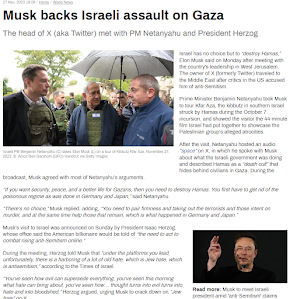
The war in Gaza may not be a war against Hamas after all, it is a war on the ideology and beliefs of Hamas. Echoing France’ President who called for an “Enlightened Islam”, Israeli Prime Minister Benjamin Netanyahu said during his meeting with American businessman Elon Musk, who visited the Gaza Strip settlements, that “Islam in the Arab countries needs a radical change.”


Israel will purge Gaza’s mosques and schools of their “poisonous” ideology once its war with Hamas concludes, Israeli Prime Minister Benjamin Netanyahu told X (aka Twitter) owner Elon Musk in an interview on Monday.


The Israeli premier pointed to the wealthy Gulf states as examples of Muslim countries that had been “de-radicalized.”


Speaking to Musk in an interview live-streamed on X, Netanyahu said that the destruction of Hamas would be a “precursor” to more systemic changes in Gaza.


Expanding on his vision of a “de-radicalized” Gaza, Netanyahu told Musk that “you first have to get rid of the poisonous regime, as you did in Germany, as you did in Japan in World War II.”


Netanyahu pointed to the United Arab Emirates and Bahrain as examples of Arab states that had undergone this process, likely referring to their recognition of Israel in 2020. With Riyadh on the cusp of a US-brokered recognition deal before the current war began, Netanyahu added that the “same thing is happening to a considerable extent in Saudi Arabia.”


The Israeli leader suggested that his country’s “Arab friends” could help rebuild Gaza, where the UN estimates that around half of all homes have been destroyed since the war began. Earlier this month, Jordanian Foreign Minister Ayman Safadi said that the Arab nations would not take part in any potential post-conflict peacekeeping in Gaza, nor would they “clean the mess” left behind by the Israeli military.


Wednesday, August 30, 2023

Philippines: Muslims affirm that the first dictionary of Islamic law will be issued bearing the slogan of justice and mercy

    Wednesday, August 30, 2023   No comments

With the Philippines achieving the achievement of publishing the first dictionary of Islamic law, Muslims expressed their happiness that the aforementioned book promotes neutrality and moves for it and benevolence.

Attorney Maysara Dandamoon Latif, a former Member of Parliament who is now the head of a local council, emphasized that the newly released dictionary enhances appreciation between different cultures.


He added, “The dictionary embraces the spirit of inclusiveness that welcomes individuals of different religions and ethnicities to enrich their understanding of Islamic concepts.


Latif emphasized that Sharia guides have never had dictionaries, and that the newly launched Islamic Sharia Dictionary is the first of its kind.


The responsible authorities stressed that the reader will understand that Sharia promotes justice and mercy instead of hatred and that it enhances understanding because Islamic Sharia teaches mercy, kindness and humanity.


Former Muslim Senator Sameera Gutuk said that the Dictionary of Islamic Law is a wonderful contribution to literature.


And she stressed, "Those who stand behind the completion of this book were not just authors and writers, but rather advocates who gathered together as one community."


Thursday, June 01, 2023

Sheikh al-Azhar: Western civilization bears the largest part of the tragedy of modern man

    Thursday, June 01, 2023   No comments

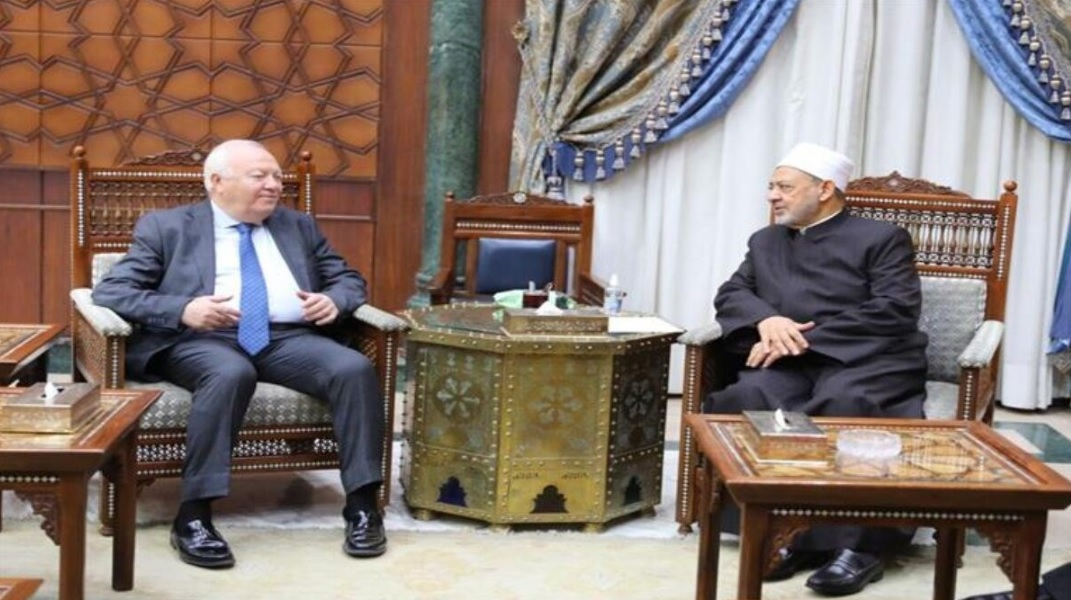
The Grand Sheikh of al-Azhar, Ahmed Al-Tayeb, received today, Thursday, at the headquarters of the Sheikh of Al-Azhar, the United Nations High Representative for the Dialogue of Civilizations, Miguel Moratinos, and ways to enhance joint cooperation were discussed.

The Sheikh of Al-Azhar welcomed Moratinos, stressing Al-Azhar's openness to dialogue with all believers in religions, cultures and civilizations.


Al-Tayeb pointed out that the world is currently facing a very complex crisis, which is the crisis of excluding religious and moral values from people's lives, stressing that this crisis does not only resonate and affect its makers, but also extends to all humanity, east and west, indicating that this crisis is The basis for all the conflicts and wars that our world is exposed to today.


The Sheikh of Al-Azhar pointed out that Western civilization bears the largest part in the tragedy of modern man, when it sought to exclude religion from people's lives, and focused on satisfying human desires and promoting material thought.


The Sheikh of Al-Azhar touched on the human suffering today, from the lack of food and medicine, and the climate change crisis, in addition to social crises.


Followers


Trending now...


ISR +


Frequently Used Labels and Topics

40 babies beheaded 77 + China A Week in Review Academic Integrity Adana Agreement afghanistan Africa African Union al-Azhar Algeria Aljazeera All Apartheid apostasy Arab League Arab nationalism Arab Spring Arabs in the West Armenia Arts and Cultures Arts and Entertainment Asia Assassinations Assimilation Azerbaijan Bangladesh Belarus Belt and Road Initiative Brazil BRI BRICS Brotherhood CAF Canada Capitalism Caroline Guenez Caspian Sea cCuba censorship Central Asia Charity Chechnya Children Rights China Christianity CIA Civil society Civil War climate colonialism communication communism con·science Conflict conscience Constitutionalism Contras Corruption Coups Covid19 Crimea Crimes against humanity D-8 Dearborn Debt Democracy Despotism Diplomacy discrimination Dissent Dmitry Medvedev Earthquakes Economics Economics and Finance Economy ECOWAS Education and Communication Egypt Elections energy Enlightenment environment equity Erdogan Europe Events Fatima FIFA FIFA World Cup FIFA World Cup Qatar 2020 Flour Massacre Food Football France Freedom freedom of speech G20 G7 Garden of Prosperity Gaza GCC GDP Genocide geopolitics Germany Global Security Global South Globalism globalization Greece Grozny Conference Hamas Health Hegemony Hezbollah hijab Hiroshima History and Civilizations Hormuz Human Rights Huquq Ibadiyya Ibn Khaldun ICC Ideas IGOs Immigration Imperialism In The News india Indonesia inequality inflation INSTC Instrumentalized Human Rights Intelligence Inter International Affairs International Law Iran IranDeal Iraq Iraq War ISIL Islam in America Islam in China Islam in Europe Islam in Russia Islam Today Islamic economics Islamic Jihad Islamic law Islamic Societies Islamism Islamophobia ISR MONTHLY ISR Weekly Bulletin ISR Weekly Review Bulletin Italy Japan Jordan Journalism Kenya Khamenei Kilicdaroglu Kurdistan Latin America Law and Society Lebanon Libya Majoritarianism Malaysia Mali mass killings Mauritania Media Media Bias Media Review Middle East migration Military Affairs Morocco Multipolar World Muslim Ban Muslim Women and Leadership Muslims Muslims in Europe Muslims in West Muslims Today NAM Narratives Nationalism NATO Natural Disasters Nelson Mandela NGOs Nicaragua Nicaragua Cuba Niger Nigeria Normalization North America North Korea Nuclear Deal Nuclear Technology Nuclear War Nusra October 7 Oman OPEC+ Opinion Polls Organisation of Islamic Cooperation - OIC Oslo Accords Pakistan Palestine Peace Philippines Philosophy poerty Poland police brutality Politics and Government Population Transfer Populism Poverty Prison Systems Propaganda Prophet Muhammad prosperity Protests Proxy Wars Public Health Putin Qatar Quran Rachel Corrie Racism Raisi Ramadan Ramadan War Regime Change religion and conflict Religion and Culture Religion and Politics religion and society Resistance Rights Rohingya Genocide Russia Salafism Sanctions Saudi Arabia Science and Technology SCO Sectarianism security Senegal Shahed sharia Sharia-compliant financial products Shia Silk Road Singapore Slavery Soccer socialism Southwest Asia and North Africa Sovereignty Space War Spain Sports Sports and Politics Starvation State Power State Terror Sudan Sunni Axis sunnism Supremacism SWANA Syria Ta-Nehisi Coates terrorism Thailand The Koreas Tourism Trade transportation Tunisia Turkey Turkiye U.S. Cruelty U.S. Foreign Policy UAE uk ukraine UN under the Rubble UNGA United States UNSC Uprisings Urban warfare US Foreign Policy US Veto USA Uyghur Venezuela Volga Bulgaria Wadee wahhabism War War and Peace War Crimes War on Iran Wealth and Power Wealth Building West Western Civilization Western Sahara WMDs Women women rights Work Workers World and Communities Xi Yemen Zionism

Search for old news

Find Articles by year, month hierarchy


AdSpace

_______________________________________________

Copyright © Islamic Societies Review. All rights reserved.