Showing posts with label Aljazeera. Show all posts

Monday, June 01, 2026

Media and Journalism: How Wealthy States Buy Credibility While Whitewashing Atrocities

    Monday, June 01, 2026   No comments

Media as Narrative Infrastructure

The UK’s Sky News Group has quietly exited its joint venture with Abu Dhabi-based International Media Investments (IMI), handing full strategic and operational control of Sky News Arabia to the Emirati firm. While the station will continue to use the Sky brand under a lucrative multi-year licensing agreement, the buyout ends a sixteen-year partnership originally established to compete with regional giants Al-Jazeera and Al-Arabiya.

This restructuring is not merely a commercial recalibration. It is a case study in how media partnerships serve as soft-power infrastructure for authoritarian states, and how Western media brands enable reputation laundering while preserving revenue streams. IMI is owned by UAE Vice President Sheikh Mansour bin Zayed Al-Nahyan, and the transfer effectively cements absolute Emirati state control over the network's editorial direction.

The Sudan Test Case: When Propaganda Becomes Unmanageable

The abrupt restructuring follows intense scrutiny and growing panic among UK executives over the channel’s biased coverage of the Sudanese genocide. Sky News Arabia has faced severe condemnation for acting as a direct mouthpiece for the Rapid Support Forces (RSF), the UAE-backed paramilitary group accused by United Nations investigators of carrying out a campaign of genocide and starvation in Darfur.

Internal sources revealed to some media outlets that Sky executives became deeply concerned after the Arabic channel repeatedly aired reports whitewashing RSF atrocities and questioning the evidence of mass killings brought forward by survivors and international monitors. This pattern reflects a broader global trend: authoritarian regimes increasingly invest in Western-branded media platforms to lend credibility to state narratives while obscuring human rights violations.

The final straw for the British broadcaster came after Sky News Arabia sent a reporter married to a senior RSF official to the besieged city of El-Fasher, where she was filmed hugging an RSF commander who had previously incited fighters to rape Darfuri women. The blatant propaganda prompted the Sudanese government to ban the station from operating in the country.

The Licensing Loophole: Profit Without Accountability

While IMI claims the ownership transfer was purely commercial, the divestment allows the UK parent company to distance itself from Abu Dhabi’s direct complicity in the Sudan genocide while continuing to profit from brand licensing. This arrangement exemplifies a growing ethical gray zone in global media: Western outlets license their trusted brands to state-backed entities in authoritarian contexts, reaping financial rewards while outsourcing editorial risk.

The Sky News Arabia deal underscores how wealthy nations strategically invest in "narrative creators" to shape international perceptions. The UAE, for instance, has systematically expanded its media footprint through outlets like Sky News Arabia, Al-Arabiya, and strategic investments in Western think tanks and PR firms. This is part of a coordinated soft-power strategy designed to reframe its regional military interventions as stabilizing, development-oriented forces.

Meanwhile, the UK’s willingness to license its media brand—despite documented concerns about editorial integrity—reveals how commercial incentives can override journalistic ethics. Authoritarian regimes increasingly understand that minimizing or obscuring evidence of corruption and human rights abuses enables them to rebrand themselves as legitimate global actors. Sky’s continued licensing arrangement with IMI fits this pattern precisely: the brand remains visible, the revenue flows, and the accountability dissipates.

A Broader Pattern: Media as Soft-Power Currency

This episode is not isolated. Gulf states have poured billions into Western media, sports, academia, and cultural institutions in recent years, raising persistent questions about undue influence and narrative control. Such investments rarely target these sectors for purely financial returns. The goal is legitimacy: shaping how these states are perceived in Western capitals, international courts, and global public opinion.

Western media brands, facing declining traditional revenues and intensifying geopolitical competition, have become willing partners in this exchange. By licensing their logos to state-backed outlets, they provide an aura of journalistic credibility that authoritarian regimes cannot manufacture domestically. In return, they receive licensing fees and market access, while using limited editorial oversight as a legal shield against accusations of complicity.

Credibility Cannot Be Licensed

Sky News Arabia’s evolution—and Sky UK’s calculated exit—offers a cautionary tale about the commodification of media credibility. When trusted news brands become tradable assets, the line between journalism and state propaganda blurs. The Sudan coverage controversy demonstrates the human cost: when media platforms amplify denialism about genocide, they become complicit in the violence they claim to report.

For media consumers, the lesson is clear: brand recognition is not a proxy for editorial independence. For policymakers, the challenge is to develop frameworks that hold Western media companies accountable for how their brands are deployed abroad. And for journalists, the imperative remains unchanged: truth-telling requires structural independence—not just from governments, but from the financial architectures that incentivize silence.

As the world watches atrocities unfold, the Sky News Arabia episode reminds us that in the economy of global perception, credibility is the ultimate currency. And it cannot be licensed without consequence.


Friday, March 27, 2026

How Gulf Resource Wealth Fuels Ambition—and Vulnerability

    Friday, March 27, 2026   No comments

 Glass Houses in the Desert

In the geopolitics of the Middle East, few phenomena are as striking as the outsized influence wielded by two small Gulf states: Qatar and the United Arab Emirates. Both nations have leveraged immense wealth derived from the rapid extraction of finite natural resources to project power far beyond their borders. As regional tensions escalate, the very strategies that elevated them are exposing profound vulnerabilities. Their glass towers of influence, built on sand and hydrocarbons, are proving fragile when the desert winds of conflict blow hard.

Qatar's transformation from a modest peninsula emirate into a global diplomatic player rests largely on its vast natural gas reserves. Since the 1990s, Doha has channelled this wealth into a sophisticated strategy of soft power projection, with the Al Jazeera Media Network as its centerpiece. Founded to give Arab audiences a platform free from state-controlled narratives, Al Jazeera quickly became something more: an instrument of Qatari foreign policy, amplifying voices and stories that aligned with Doha's strategic interests.

For decades, the network shaped Arab public opinion, particularly during the Arab Spring, when its coverage of Islamist movements resonated with Qatar's political alignments. But this instrumentalization of media has increasingly drawn scrutiny. In early 2026, Al Jazeera faced a significant credibility test during heightened tensions between Iran and the United States. The channel was accused of sidelining voices supportive of Tehran while platforming analysts who called for targeting Iranian civilians—a stance that sparked widespread criticism across the Arab street.

The controversy forced a visible recalibration. By late March, Al Jazeera began restoring previously muted voices and reducing its focus on Iran-focused content, signaling an attempt to repair its reputation as an impartial platform. Analysts who had made inflammatory remarks defended themselves by claiming their comments were taken out of context, but the episode underscored a broader dilemma: when a media outlet is perceived as an instrument of statecraft rather than journalism, its credibility becomes collateral damage in geopolitical disputes.

As one commentator observed, the contemporary Arab consciousness has moved beyond the era of untouchable icons. For Qatar, the lesson is clear: media influence built on perceived bias can backfire, eroding the very soft power it was meant to generate. When audiences sense that "the opinion and the other opinion" is merely a slogan rather than a principle, trust evaporates—and with it, influence.

Most recent coverage show the trend of selective reporting by aljazeera persists: it shields the Guld states and Qatar rulers.

Noramlly, media organizations bear a fundamental responsibility to provide audiences with complete, contextualized information. When coverage systematically omits facts that conflict with the interests of a network's funders, that responsibility is compromised. Al Jazeera's reporting on former President Trump's recent speech regarding Iran offers a compelling case study in how state-funded media can shape narratives through strategic omission.

According to multiple social media reports and regional coverage, Trump explicitly praised Qatar, Saudi Arabia, and the UAE as "excellent" and "incredible" partners during his remarks at the Future Investment Initiative summit in Miami. He reportedly acknowledged their support for U.S. military attack on Iran—a significant geopolitical development given these states' desire to avoid public association with what many international observers deem an illegal war. Al Jazeera Arabic article summarizing the speech highlighted Trump's criticism of NATO allies while making no mention of his gratitude toward Gulf partners. This selective framing is not incidental; it aligns precisely with Qatar's diplomatic interests in maintaining plausible deniability regarding its regional military posture.

This pattern reflects broader structural realities. Al Jazeera receives the vast majority of its budget from the Qatari government, and while the network asserts editorial independence, former correspondents have publicly cited Qatari influence over coverage decisions. Research from independent media watchdogs notes that Al Jazeera's English-language coverage has routinely engaged in narratives that question U.S. strategic motives while promoting perspectives aligned with Doha's foreign policy. When reporting on Gulf-U.S. coordination against Iran, the network faces an inherent conflict: acknowledging overt Gulf support for American military action would undermine Qatar's carefully cultivated image as a neutral mediator.

The consequences extend beyond a single omitted quote. By emphasizing Trump's NATO criticisms while silencing his Gulf acknowledgments, Al Jazeera's coverage subtly reinforces a narrative that isolates Western alliances while normalizing Gulf states' behind-the-scenes military involvement. This serves Doha's foreign policy objectives but deprives audiences of the full picture necessary for informed judgment about regional power dynamics.

Media bias is rarely about fabrication; it is more often about curation—what to include, what to emphasize, and what to omit. In an era of complex geopolitical conflicts, audiences deserve transparency about the interests shaping their news. When state-funded outlets like Al Jazeera omit facts that inconvenience their patrons, they do not merely report the news; they participate in its construction. Recognizing these patterns is not an attack on any single network, but a necessary step toward demanding journalism that serves truth over patronage.


The United Arab Emirates has pursued a different, more militarized path to regional influence. Like Qatar, the UAE's wealth stems from hydrocarbon extraction—but at a pace that raises serious sustainability concerns. The rapid depletion of finite oil and gas reserves, without adequate investment in post-hydrocarbon economies, risks mortgaging the future for present-day ambition.

Abu Dhabi has deployed this wealth to build an extensive network of military and political influence across the Middle East and Africa. The UAE has been deeply involved in conflicts in Libya, Yemen, Sudan, and Somalia, often backing proxy forces to advance its strategic interests. In Libya, it provided critical air support and equipment to eastern-based factions. In Sudan, it faces repeated allegations—denied by officials—of arming and funding paramilitary groups accused of atrocities. Sudan has even filed a case against the UAE at the International Court of Justice, accusing it of complicity in grave human rights violations.

These interventions have yielded mixed results. While the UAE has secured strategic footholds, such as ports and military bases, its activism has also generated significant backlash. Traditional Gulf partners have grown uncomfortable with Emirati policies that appear to undermine regional stability. In Yemen, Saudi-backed forces actively curtailed advances by UAE-aligned militias, demonstrating that Gulf partnerships are not immune to friction.

Moreover, when Iran's foreign minister accused Gulf states hosting U.S. forces of covertly encouraging attacks on Iranians, it underscored how entangled these small states have become in great-power conflicts. When Iran launched drone strikes against Bahrain, Saudi Arabia, Qatar, and the UAE in early 2026, it highlighted the vulnerability of even the wealthiest Gulf capitals to asymmetric retaliation. Power projection, it turns out, invites counter-pressure.

Glass Houses at the Mercy of Regional Security Fractures

Both Qatar and the UAE have built literal and figurative glass houses—spectacular skylines, global business hubs, and diplomatic networks that project an image of invincibility. These achievements rest on a foundation of regional stability that is increasingly precarious.

Dubai, marketed as the business center of the world, exemplifies this paradox. In early 2026, as tensions with Iran escalated, the emirate faced an unprecedented economic shock: stock markets were suspended, hotel bookings plummeted, and critical port operations halted after missile debris caused fire damage. An estimated tens of billions in wealth that flowed into Dubai in recent years now faced the risk of exodus, with charter jets reportedly sold out as wealthy residents sought safer havens.

The attacks on iconic locations directly challenge the security narrative that attracted global capital. While Dubai's economy is heavily diversified—with oil accounting for a minimal share of GDP—its reputation as a safe, neutral hub depends on perceptions of stability that conflict can quickly erode. When investors weigh risk, glass towers can cast long shadows.

The sustainability question extends beyond economics. Gulf states' rapid extraction of oil and gas, without sufficient investment in renewable alternatives or economic diversification, poses long-term risks. While natural resource rents boost short-term growth, they can exacerbate inequality and delay necessary structural reforms. For nations whose populations are predominantly young, the intergenerational equity implications are profound: wealth generated today may come at the cost of environmental degradation and economic fragility tomorrow.

Both Qatar and the UAE appear to be learning that influence projection carries inherent risks. Al Jazeera's editorial adjustments in early 2026 suggest an awareness that perceived bias can undermine media credibility. Similarly, the UAE's public denials of involvement in sensitive conflicts and its emphasis on humanitarian aid reflect an effort to manage diplomatic fallout.

Adaptation requires more than rhetoric. For Qatar, it means grappling with the tension between state interests and journalistic integrity. Can a media network truly serve as a global beacon of free expression while advancing a single government's agenda? For the UAE, it entails reassessing whether military interventions in distant conflicts truly serve long-term national interests—or simply entangle the country in intractable disputes that drain resources and generate enemies.

The broader lesson for resource-rich small states is that wealth alone cannot guarantee security or influence. When regional order fractures, the very assets that symbolize power—skyscrapers, media networks, overseas bases—can become liabilities. Ambiguity in foreign policy invites escalation; perceived partiality erodes trust; and economic hubs dependent on perceptions of stability are vulnerable to regional shocks.


Qatar and the UAE have achieved remarkable feats: transforming desert outposts into global nodes of finance, media, and diplomacy. Their use of natural resource wealth to punch above their weight is a masterclass in strategic statecraft. But the events of early 2026 reveal the limits of this model.

Media influence built on perceived bias invites backlash. Military interventions in fragile states can generate blowback. Economic hubs dependent on perceptions of stability are vulnerable to regional shocks. And the rapid extraction of finite resources, without sustainable planning, mortgages the future.

The glass houses of the Gulf are not destined to become ruins of the desert. But they will endure only if their builders recognize that true resilience requires more than wealth—it demands legitimacy, sustainability, and a commitment to the stability of the region they seek to lead. In an era of escalating tensions, that lesson may be the most valuable resource of all.

For two small states that have leveraged hydrocarbon wealth to shape the fate of nations, the path forward is clear: influence without accountability is fragile; power without prudence is perilous. The desert remembers what the glass forgets—that foundations matter more than facades, and that lasting influence is built not on extraction, but on trust.


Monday, March 25, 2024

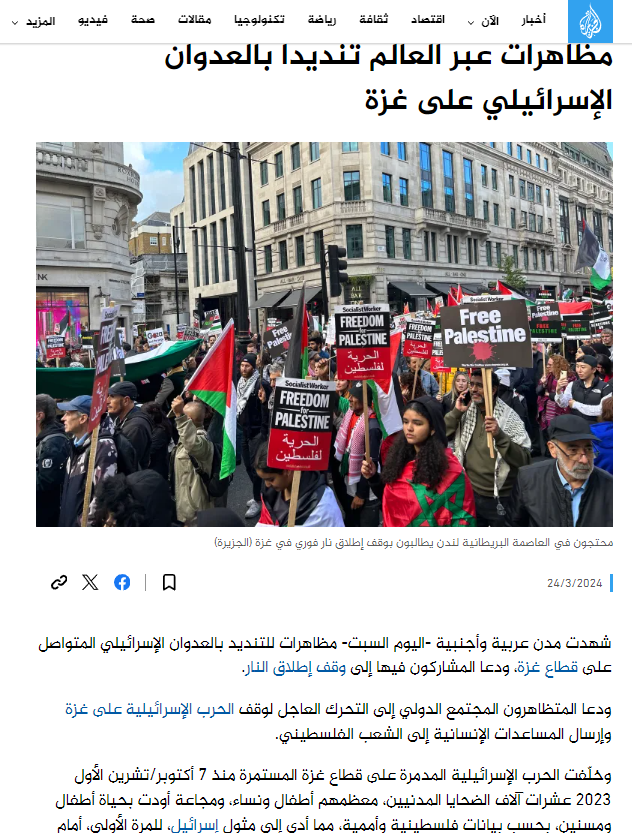
Aljazeera coverage of demontrations denouncin "the ongoing Israeli aggression against the Gaza Strip"

    Monday, March 25, 2024   No comments

Aljazeera provided detailed coverage of people protesting the war in Gaza, but did not provide any comments as to why none of these events is happening in Qatar and other Gulf States.

On Saturday, Aljazeera reported that protesters around the world took to the streets to denounce the "the ongoing Israeli aggression against the Gaza Strip", and provided a list of countries and cities where such demonstrations took place. 

Arab and foreign cities witnessed demonstrations to denounce the ongoing Israeli aggression against the Gaza Strip, and the participants called for a ceasefire.

The demonstrators called on the international community to take urgent action to stop the Israeli war on Gaza and send humanitarian aid to the Palestinian people.

Britain

Thousands of Britons demonstrated in more than 30 cities in solidarity with the Palestinian cause and in support of Palestinian rights, led by the capital, London, from which 11 demonstrations were launched alone.

The demonstrators chanted slogans demanding an immediate end to the Israeli war and genocide in the Gaza Strip, the entry of aid to its besieged residents, and holding Israel accountable for its crimes.

Germany

The German capital, Berlin, witnessed a protest march denouncing what they described as genocide committed by Israel in Gaza.

In the march called for by the Unified Palestinian Committee in Berlin, the protesters denounced Israel's use of starvation as a weapon against civilians. The demonstrators also denounced the German government's support of Israel with weapons.


Austria

In the Austrian capital, Vienna, dozens demonstrated in solidarity with the Palestinian people.


On Maria Hilfer Street, an important street in Vienna, the demonstrators carried Palestinian flags and banners reading “Immediate ceasefire,” “No to genocide,” and “Free Palestine.”


Sweden

In the Swedish capital, Stockholm, a massive demonstration took place in support of Palestine and Gaza.


The demonstrators demanded an end to the Israeli attacks on the Gaza Strip and the entry of humanitarian aid to the residents of the Strip who are suffering from famine.


Finland

Dozens organized a human chain in the Finnish capital, Helsinki, in support of Gaza and denouncing the ongoing occupation massacres against the Palestinian people.


The protesters raised Palestinian flags and demanded an immediate end to the Israeli war on the Gaza Strip and the entry of humanitarian aid.


Italy

In northern Italy, hundreds demonstrated in the city of Milan in solidarity with Gaza and denouncing the occupation's massacres against the Palestinian people.


South Korea

In East Asia, dozens of activists demonstrated in the city of Seoul, South Korea, to denounce the ongoing Israeli aggression against the Gaza Strip.


The demonstrators raised Palestinian flags and chanted slogans against the international position regarding the war in Gaza and the continued massacres.


Tunisia

In the Arab world, Tunisians demonstrated on Habib Bourguiba Street in the capital, Tunis, in solidarity with the Palestinian people and in protest against the continued Israeli aggression on the Gaza Strip.


The demonstrators demanded an end to the massacres and violations against the residents of Gaza. They denounced the international silence regarding the crimes of the Israeli occupation, and the continued closure of border crossings, preventing the passage of food and health aid to the people of the Gaza Strip.


Morocco

In turn, several Moroccan cities, including Oujda, El Jadida, Meknes, and Tangier, organized vigils to demand an end to starving the residents of the Gaza Strip and to lift the siege imposed on them.


The demonstrators called on Arab and Islamic countries to take urgent action to stop the Israeli war and send humanitarian aid to the Palestinian people, denouncing at the same time the inability of the international community to stop the war in Gaza.


Yemen

In Yemen, the Ansar Allah Houthi group said that more than 148 squares in the governorates it controls witnessed, on the second Friday of the month of Ramadan, massive demonstrations in support of the people of the Gaza Strip, which has been subjected to an Israeli war that has been going on for months.


The Houthi Al-Masirah satellite channel reported in a news item on its website that the capital, Sanaa, witnessed a massive million-man demonstration in solidarity with the Palestinian people who are being subjected to genocide in the Gaza Strip.


The demonstrators stressed the necessity of continuing Yemeni military operations in support of the Al-Aqsa Flood Battle until the aggression stops and the siege on the Palestinian people is lifted.


Trending now...


ISR +


Frequently Used Labels and Topics

40 babies beheaded 77 + China A Week in Review Academic Integrity Adana Agreement afghanistan Africa African Union al-Azhar Algeria Aljazeera All Apartheid apostasy Arab League Arab nationalism Arab Spring Arabs in the West Armenia Arts and Cultures Arts and Entertainment Asia Assassinations Assimilation Azerbaijan Bangladesh Belarus Belt and Road Initiative Brazil BRI BRICS Brotherhood CAF Canada Capitalism Caroline Guenez Caspian Sea cCuba censorship Central Asia Charity Chechnya Children Rights China Christianity CIA Civil society Civil War climate colonialism communication communism con·science Conflict conscience Constitutionalism Contras Corruption Coups Covid19 Crimea Crimes against humanity D-8 Dearborn Debt Democracy Despotism Diplomacy discrimination Dissent Dmitry Medvedev Earthquakes Economics Economics and Finance Economy ECOWAS Education and Communication Egypt Elections energy Enlightenment environment equity Erdogan ethics Europe Events Fatima FIFA FIFA World Cup FIFA World Cup Qatar 2020 Flour Massacre Food Football France Freedom freedom of speech G20 G7 Garden of Prosperity Gaza GCC GDP Genocide geopolitics Germany Global Security Global South Globalism globalization Greece Grozny Conference Hamas Health Hegemony Hezbollah hijab Hiroshima History and Civilizations Hormuz Human Rights Huquq Ibadiyya Ibn Khaldun ICC Ideas IGOs Immigration Imperialism In The News india Indonesia inequality inflation INSTC Instrumentalized Human Rights Intelligence Inter International Affairs International Law Iran IranDeal Iraq Iraq War ISIL Islam in America Islam in China Islam in Europe Islam in Russia Islam Today Islamic economics Islamic Jihad Islamic law Islamic Societies Islamism Islamophobia ISR MONTHLY ISR Weekly Bulletin ISR Weekly Review Bulletin Italy Japan Jordan Journalism Kenya Khamenei Kilicdaroglu Kurdistan Latin America Law and Society Lebanon Libya Majoritarianism Malaysia Mali mass killings Mauritania Media Media Bias Media Review Middle East migration Military Affairs Morocco Multipolar World Muslim Ban Muslim Women and Leadership Muslims Muslims in Europe Muslims in West Muslims Today NAM Narratives Nationalism NATO Natural Disasters Nelson Mandela NGOs Nicaragua Nicaragua Cuba Niger Nigeria Normalization North America North Korea Nuclear Deal Nuclear Technology Nuclear War Nusra October 7 Oman OPEC+ Opinion Polls Organisation of Islamic Cooperation - OIC Oslo Accords Pakistan Palestine Peace Philippines Philosophy poerty Poland police brutality Politics and Government Population Transfer Populism Poverty Prison Systems Propaganda Prophet Muhammad prosperity Protests Proxy Wars Public Health Putin Qatar Quran Rachel Corrie Racism Raisi Ramadan Ramadan War Regime Change religion and conflict Religion and Culture Religion and Politics religion and society Resistance Rights Rohingya Genocide Russia Salafism Sanctions Saudi Arabia Science and Technology SCO Sectarianism security Senegal Shahed sharia Sharia-compliant financial products Shia Silk Road Singapore Sistani Slavery Soccer socialism Southwest Asia and North Africa Sovereignty Space War Spain Sports Sports and Politics Starvation State Power State Terror Sudan Sunni Axis sunnism Supremacism SWANA Syria Ta-Nehisi Coates terrorism Thailand The Koreas Tourism Trade transportation Tunisia Turkey Turkiye U.S. Cruelty U.S. Foreign Policy UAE uk ukraine UN under the Rubble UNGA United States UNSC Uprisings Urban warfare US Foreign Policy US Veto USA Uyghur Venezuela Volga Bulgaria Wadee wahhabism War War and Peace War Crimes War on Iran Wealth and Power Wealth Building West Western Civilization Western Sahara WMDs Women women rights Work Workers World and Communities Xi Yemen Zionism

Search for old news

Find Articles by year, month hierarchy


WEEKLY AdSpace 3

_______________________________________________

Copyright © Islamic Societies Review. All rights reserved.