Wednesday, June 04, 2025

Media Review: Nuclear Talks Enter Critical Phase as Iran Holds Firm on Sovereignty

    Wednesday, June 04, 2025   No comments

Recent statements from both U.S. and Iranian leaders indicate that nuclear negotiations have reached a decisive turning point. The talks now stand at a crossroads: they will either collapse or move into a technical phase aimed at working out implementation details, following what appears to be the establishment of a preliminary framework for an agreement.

A central point that has emerged is that any potential deal will not deny Iran the right to enrich uranium on its own soil. This position has been echoed in the latest remarks by top officials on both sides. Iran’s Supreme Leader has reinforced this stance, emphasizing that uranium enrichment is a matter of national sovereignty and national security. He also issued a fatwa prohibiting the development or possession of nuclear weapons, underscoring Iran’s declared commitment to peaceful nuclear energy.

These red lines—especially the right to enrichment—are seen as non-negotiable, rooted in Iran’s lack of trust toward the West based on previous experiences. As a result, any viable deal will likely have to respect these boundaries to move forward.

Iran's leader provides the reasoning behind Iran's right to Uranium enrichment 

“Now, in the nuclear industry, there is one key point that functions like the master key: Uranium enrichment.

Our enemies have fixated on this enrichment—they’ve put their finger exactly on this. A vast nuclear industry, without the ability to enrich uranium, is essentially useless. Why? Because for our power plants, we’d have to stretch out our hand and ask others for fuel.

It’s like having oil in your country but being forbidden from building refineries or producing gasoline—you have crude oil, but you have to buy gasoline from someone else. And that country might sell it to you at whatever price they wish—or they might just refuse altogether, making up an excuse. That’s how they behave.

Even if we had 100 nuclear reactors, without enrichment, they’d be useless—because nuclear power plants require fuel. If we can’t produce that fuel ourselves, we’d have to go begging to the US, and they might set dozens of conditions just to give us fuel.

We already experienced this in the 2000s, when we needed 20% enriched uranium. The US president at the time sent 2 heads of state—so-called friends—to act as intermediaries and told us: ‘Give us part of your 3.5% enriched uranium, and we’ll give you the 20% fuel you need.’ Our officials agreed, and an exchange was planned.

I said the exchange must be done like this: They bring the 20% enriched fuel to Bandar Abbas, we test it to ensure it’s genuine, and then we hand over the 3.5% in return. When they saw that we were serious and insistent on inspecting the 20% fuel first, they backed out of the deal and broke their promise.

Meanwhile, amid all this political back-and-forth, our scientists produced the 20% enriched uranium domestically, right here inside this country. 

... 

Iran is a strong nation, an independent nation. Our nuclear industry is one of the most advanced in the world, and we employ thousands of scientists, researchers, and other workers. Should we give all of this up? Should we make all of them jobless? Are we insane?

You [United States] have nuclear capabilities. You have atomic bombs. You possess devastating weapons. 

What right do you have to question whether the Iranian nation should have nuclear enrichment or not, or a nuclear industry or not? We are a sovereign nation, we have the right to decide our own future. It has nothing to do with you. This is the principle of our independence.

The latest American proposal is 100% against our doctrine and against our positions.

From here on, I pledge to the Iranian nation, with the help of God, we will strengthen our national power as much as we can."


After the statement by the Iranian leader, the foreign minister, Abbas Araqchi, issued his own declaration on X:

"There is a reason why only a few nations master the ability to fuel nuclear reactors. Apart from significant financial resources and political vision, it requires a solid industrial base and a technological-academic complex that can produce necessary human resources and know-how. Iran has paid dearly for these capabilities, and there is no scenario in which we will give up on the patriots who made our dream come true. To reiterate: No enrichment, no deal. No nuclear wrapons, we have a deal."

Saturday, May 31, 2025

U.S. Ambassador Blows Hole in Israel’s Official Dual Citizenship Figures

    Saturday, May 31, 2025   No comments

The issue of dual citizenship in Israel, particularly involving American-Israelis, is mired in significant statistical inconsistencies. On one hand, the Israeli government has maintained that only about 10% of its population holds dual citizenship. On the other, a recent statement by the U.S. Ambassador to Israel in May 2025 directly contradicts that figure, asserting that there are 700,000 U.S. citizens currently inside Israel. This number, when examined in the context of Israel’s demographics, immigration history, and citizenship laws, reveals deep flaws in the official Israeli narrative.

Israel’s Nationality Law and the Facilitation of Dual Citizenship

Established in 1952, the Israeli Nationality Law enables individuals to acquire citizenship by birth, marriage, naturalization, and most notably, under the Law of Return. The Law of Return has been the foundation for a significant influx of Jewish immigrants worldwide, particularly from North America, the former Soviet Union, and Europe. Crucially, Israeli law does not require immigrants to renounce their original citizenship. As such, dual and even multiple citizenships are legally permitted and in practice, quite common. This legislative openness was designed to encourage Jews to migrate to Israel while maintaining their national ties elsewhere.

From a population of less than a million in 1948, Israel has grown to 9.9 million by 2024. This growth has been driven significantly by immigration. Since Israel’s founding, 3.46 million people have immigrated, nearly half of them since 1990. Among these immigrants, major influxes came from the United States, Russia, and Europe. 


The U.S. Ambassador’s just obliterated Israel's narrative about the number of Israel citizens with dual citizenship

A key moment revealing this data discrepancy occurred when the U.S. Ambassador to Israel stated in May 2025:

“We don't need Israel's permission to conclude an agreement with the Houthis. If one of the 700,000 American citizens inside Israel is hurt by a Houthi attack, then we'll respond.”

This figure of 700,000 American citizens currently residing in Israel starkly contradicts the Israeli government’s longstanding claim that only 120,000 Israeli citizens hold U.S. citizenship. Crucially, the ambassador's statement referred specifically to U.S. citizens physically present in Israel, whether as residents, dual citizens, or extended-stay nationals. It does not include the significantly larger population of Jewish Americans who have claimed Israeli citizenship under the Law of Return but continue to reside in the United States.

This distinction is important: under Israeli law, any Jew worldwide can obtain Israeli citizenship without relinquishing their existing nationality. Many Jewish Americans—estimated at 7.2 million people—have already taken up this option, even if they have never relocated to Israel. These individuals, while not living in Israel, remain Israeli citizens on paper, often eligible for Israeli government services, voting rights (if they return), and military service for their children.

Thus, the 700,000 figure represents only a subset of U.S.-Israeli dual nationals: those currently inside Israel, according to the ambassador. When including all U.S. citizens who have acquired Israeli citizenship under the Law of Return but reside abroad, particularly in the U.S., the total number of American-Israeli dual citizens could be substantially higher.

Many countries, including Russia, the United States, France, and the UK, allow citizenship by descent. If a parent retains foreign nationality, their Israeli-born children can often claim the same. For example, Russian law does not prohibit dual citizenship and considers children of Russian citizens to be eligible for Russian nationality. Thus, second-generation Israelis born to immigrants from countries allowing citizenship by descent further swell the ranks of dual citizens—often without being officially counted.

A 2011 report on Israeli expatriates in the UK revealed that over 44% of Israelis in Britain held dual citizenship, and many more entered the UK with EU passports—an avenue unavailable without direct family links to European citizenship.

This pattern undermines Israel's claim that dual citizenship is confined to a minor share of the population. If anything, it demonstrates a widespread and systemic underreporting or obfuscation of dual nationality status for political or strategic reasons—perhaps to downplay foreign influence or demographic vulnerability.

This further exposes the deep inconsistency in the Israeli government’s claim that only 10% of its population holds dual citizenship. If 700,000 U.S. citizens live in Israel, that alone constitutes nearly 7% of Israel’s total population. When factoring in the large number of Israeli citizens with Russian, French, British, or other citizenships—and the reality of hereditary citizenship laws—it becomes mathematically impossible to reconcile this with the official 10% figure. Moreover, these figures do not account for the vast number of Israeli citizens living abroad, many of whom hold dual or multiple nationalities, nor do they capture the legal eligibility of millions of Israelis to reclaim foreign citizenship through their parents or grandparents. 

In light of the growing involvement of dual nationals in key state institutions and military operations, including in controversial conflicts like the war in Gaza, and possible violation of international law where many of these participants are accused of war crimes and crimes against humanity are,  the need for transparency and accountability is more pressing than ever.

Update: In Feb. 2026, Data released by the IDF in response to a Freedom of Information request show that the most common additional citizenships include the United States, France, Russia, Germany, Ukraine, and Canada.

More than 50,000 IDF service members hold foreign citizenship in addition to Israeli citizenship, with thousands holding two additional nationalities. 

The figures mark the first known public disclosure of such data.


Monday, May 26, 2025

Media Review: Human Rights, Selective Outrage, and the Politics of Condemnation

    Monday, May 26, 2025   No comments

In the realm of global politics, the language of morality is often wielded not as a principle, but as a weapon—selectively applied, conveniently ignored. Nowhere is this hypocrisy more glaring than in the recent reactions of Western leaders to the wars in Ukraine and Gaza. When Russia retaliated against a Ukrainian drone assault by launching strikes that killed 12 people, leaders like U.S. President Donald Trump were quick to label Vladimir Putin as “absolutely crazy” and a “killer.” Yet, just days later, Israel launched a brutal airstrike on a school in Gaza sheltering displaced families, killing at least 54 Palestinians—mostly children—and silence or cautious equivocation followed. In fact, these same leaders continue to fund, arm, and diplomatically shield Israel’s Prime Minister Benjamin Netanyahu, a man already indicted by the International Criminal Court (ICC) for war crimes. This double standard reveals a painful truth: in the eyes of Western powers, not all human lives are equal, and not all victims are mourned.

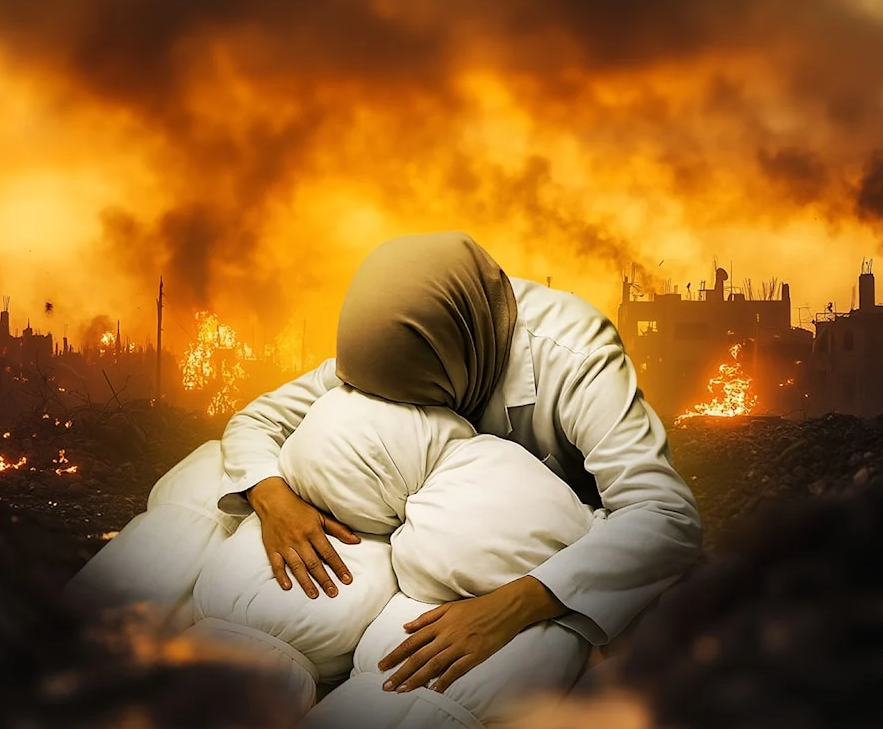
The facts are indisputable. According to reports from Al Jazeera, the BBC, and eyewitness accounts, Israeli airstrikes targeted the Fahmi al-Jargawi school in Gaza City, killing dozens, many of whom were burnt beyond recognition. These were not militants or combatants; they were civilians—babies and children asleep in makeshift shelters after fleeing other bombardments. Just days earlier, another Israeli strike obliterated the home of Palestinian doctor Alaa Al-Najjar, killing all nine of her children. She was saving other lives in a hospital while her own were buried in rubble. The loss was not just personal—it was emblematic of a systemic campaign of destruction. As the Arabic-language article poignantly described, “this is not a story of one family, it is the recurring scene of Gaza.”

Meanwhile, when Russia responded to a coordinated assault involving 96 drones launched by Ukraine toward Moscow, killing 12 civilians in a retaliatory strike, the condemnation from Western capitals was swift and categorical. Putin was called irrational, genocidal, and in Trump’s words, “absolutely CRAZY.” While no act of violence against civilians can be morally justified, the disparity in the global reaction is stark. What makes the death of 12 Ukrainians worthy of universal outrage and sanctions, while the burning of 36 Palestinian children in their sleep barely moves the needle of Western conscience?

The answer lies not in law or logic, but in power and politics. Israel is a key ally of the United States and other Western nations. It receives billions in annual military aid, enjoys diplomatic protection at the United Nations, and is portrayed as a bastion of democracy in a volatile region. Russia, by contrast, is a geopolitical rival. Condemning its actions aligns with the strategic and ideological interests of the West. But in elevating political allegiance over human dignity, Western leaders have exposed the hollowness of their professed values.

The roots of this selective empathy is found in supremacism. As Israeli journalist Gideon Levy notes, the Israeli public is conditioned to view Palestinians not as humans, but as threats—mere shadows on a moral map that excludes them. This dehumanization enables the normalization of mass death, the obliteration of entire neighborhoods, and the bombing of hospitals and schools. Western complicity compounds this tragedy by offering political and military support without meaningful accountability. When the victims are viewed as less than human, their deaths demand no justice.

The implications are devastating—not just for Gaza, but for the moral credibility of the West itself. If the universal declaration of human rights only applies to those within a favored political camp, then it is not universal at all. If war crimes are condemned in Moscow but ignored in Tel Aviv, then the West is not defending international law—it is manipulating it. And if leaders like Netanyahu are embraced while others are vilified for similar or lesser acts, then the claim to moral leadership rings hollow.

In Gaza, as one article lamented, people no longer wait for justice from the world. “We write, we witness, we record,” it says, “so that if we die today, history will know who killed us—and why no one trembled.” It is a chilling testament to the abandonment of an entire people, not just by their occupiers, but by the global community that claims to uphold their rights.

Justice cannot be selective. Empathy cannot be conditional. If Western leaders are to retain even a shred of moral authority, they must confront their own hypocrisy. The lives of Palestinian children matter as much as those in Kyiv. War crimes are war crimes, whether committed by an adversary or an ally. And silence, when the bombs fall on schools and hospitals, is not neutrality—it is complicity.

Wednesday, May 21, 2025

China, Pakistan agree with Kabul to expand CPEC to Afghanistan

    Wednesday, May 21, 2025   No comments

Pakistan, China, and Afghanistan agreed in a trilateral meeting in Beijing to formally extend the China-Pakistan Economic Corridor (CPEC) to Afghanistan, strengthening regional connectivity under the Belt and Road Initiative (BRI).

The foreign ministers emphasized deeper cooperation in trade, infrastructure, and security, reaffirming their commitment to counterterrorism and regional stability. 


The next trilateral meeting will be held in Kabul. The talks took place during Deputy PM Ishaq Dar’s visit to China, which also addressed the recent Pakistan-India tensions and reaffirmed the strong China-Pakistan partnership.

Israeli soldiers fired at foreign diplomats visiting west bank, Palestine

    Wednesday, May 21, 2025   No comments

Approximately one hour ago, Israeli soldiers fired at foreign diplomats from European and Arab states who were touring Jenin in the West Bank, Palestine.


The IDF has released an official statement on the incident, claiming that the delegation 'deviated from the approved route,' leading soldiers to fire 'warning shots.' 

The delegation reportedly included 35 ambassadors, consuls, and diplomats from the European Union, the United Kingdom, Egypt, Jordan, China, Russia, Japan, and others.

Italy has summoned the Israeli ambassador due to the event, and soon after, France has also summoned the Israeli ambassador for an explanation.

EU foreign policy chief states, 'Any threats to the lives of diplomats are unacceptable,' in response to the attack on diplomats by Israel in Jenin.

EU foreign policy chief states, 'Any threats to the lives of diplomats are unacceptable,' in response to the attack on diplomats by Israel in Jenin.


Tuesday, May 20, 2025

media review: Israeli General Sparks Political Firestorm with Condemnation of Gaza War Tactics

    Tuesday, May 20, 2025   No comments

In a rare and explosive critique from within Israel’s military and political establishment, retired general and former deputy chief of staff Yair Golan has ignited controversy by denouncing the government’s conduct in its war on Gaza. In a radio interview Tuesday, Golan declared, “A sane state does not wage war on civilians, does not kill children as a hobby, and does not aim to displace populations.” His remarks, which questioned the strategic rationale and morality of Israel’s ongoing military campaign, provoked a fierce backlash across the Israeli political spectrum.

Golan, now head of the left-wing Democratic Party, is no stranger to criticism. But this time, even his military credentials were not enough to shield him from a torrent of attacks by leaders of right-wing, religious, and centrist parties alike. Critics portrayed him as a traitor, accusing him of undermining the army and aiding Israel’s enemies. Political rivals, including those opposed to Prime Minister Benjamin Netanyahu, appeared eager to exploit the controversy for political gain, leaving Golan largely isolated.

Despite the outcry, Golan stood firm. He reiterated that the war, now in its eighth month, has shifted from a military campaign to a political tool used to preserve the current government’s grip on power. Referring to the latest phase of the conflict as “Operation Chariots of Gideon,” Golan argued that the main military objectives had already been achieved by mid-2024 with the degradation of Hamas’s military capabilities. He accused the government of prolonging the conflict for political reasons rather than national security.


“Israel hasn’t eliminated Hamas, hasn’t militarily or politically defeated them, and hasn’t recovered the hostages,” Golan noted. “The war’s objectives have been confused and contradictory from the beginning. Our priority must be returning all hostages home. That’s the essence of our solidarity as a people.”


His comments gained further resonance as the international community, including the UK, France, and Canada, issued stern warnings about Israel’s conduct in Gaza. The U.S. has also signaled growing unease. Golan warned that Israel risks becoming a “pariah state” akin to apartheid-era South Africa if it continues down its current path. He invoked the Jewish historical experience, saying it is unacceptable for a people with a legacy of persecution and genocide to adopt “morally indefensible policies.”

Golan’s stand, while earning him few allies in the Knesset, has been lauded by some as an act of moral courage. Known for his principled stances, he refused to walk back his statements despite the political storm. “We already tried Gantz’s way—flattering Netanyahu, Ben Gvir, and Smotrich. It failed,” he said. He added, “This war is the embodiment of Ben Gvir and Smotrich’s delusions. If we allow them to realize their vision, Israel will be a fractured state.”


Calling for an end to the war, the return of hostages, and a restoration of democratic values, Golan concluded with a stark contrast between Israel’s military and its leadership: “The Israeli soldiers are heroes. The ministers are corrupt. The army is moral, the people are righteous, and the government is rotten.”


As the war grinds on and internal dissent grows louder, Golan’s words have injected a jolt of urgency into Israel’s political debate. Whether his challenge will influence policy or public opinion remains to be seen, but it has undeniably shattered taboos about criticizing the war from within the ranks of Israel’s own elite.

Monday, May 19, 2025

Joint Statement by the United Kingdom, France, and Canada on Israel's actions in Gaza

    Monday, May 19, 2025   No comments

 Joint Statement by the United Kingdom, France, and Canada on Israel's actions in Gaza


"We will not stand by while the Netanyahu Government pursues these egregious actions. If Israel does not cease the renewed military offensive and lift its restrictions on humanitarian aid, we will take further concrete actions in response. We oppose any attempt to expand settlements in the West Bank. Israel must halt settlements which are illegal and undermine the viability of a Palestinian state and the security of both Israelis and Palestinians. We will not hesitate to take further action, including targeted sanctions. "


Saturday, May 17, 2025

Media review: What if Iranians, Americans and Arabs made uranium together?

    Saturday, May 17, 2025   No comments

 President Donald Trump, still touring the Middle East, keeps saying how “very happy” he’d be if he could make a deal with Iran. Iran, meanwhile, needs such a deal to avoid being bombed by Israel and strangled economically by the resumption of United Nations sanctions later this year.

If reports out of Tehran are correct, those pressures may have motivated Iranian leaders to come up with an unconventional idea that deserves a hearing: They want to work with their enemies, not against them, to build Iran’s nuclear programme.

Their brainstorm envisions a kind of joint venture among Iranians, Saudis and Emiratis, as well as private investors including US companies. This new consortium would enrich uranium, a fissile material that can be used to generate electricity or make medical isotopes – and to build nuclear bombs. Because Iranians, Arabs, Americans and others would be working together, it would be easy to verify that this atomic programme remains civilian rather than military.

At first blush, the idea seems outlandish. How could mortal enemies (Tehran’s theocracy is based in large part on wishing death to America as well as Israel) collaborate around the very material that has brought them to the brink of war?

At second glance, though, the notion’s sheer audacity – let’s call it chutzpah – may be exactly what these nuclear negotiations need to get unstuck.


AN ELEGANT IDEA

In a way, the Iranian proposal reminds me of the European Coal and Steel Community, set up in 1951 by six founding nations and led by France and Germany, who had fought three bitter wars in one lifetime and struggled to imagine each other as anything other than enemies.

To prevent a fourth war, French statesmen such as Jean Monnet and Robert Schuman proposed joint custody over the raw materials of warfare – at the time, coal and steel. And German leaders such as Konrad Adenauer, eager to reconcile with their neighbours, agreed. Against all odds, this ECSC would blossom into what is today the European Union.


Continue reading the article >>


Thursday, May 15, 2025

The Political Instrumentalization of “Terrorism” and Sanctions in Contemporary Foreign Policy

    Thursday, May 15, 2025   No comments

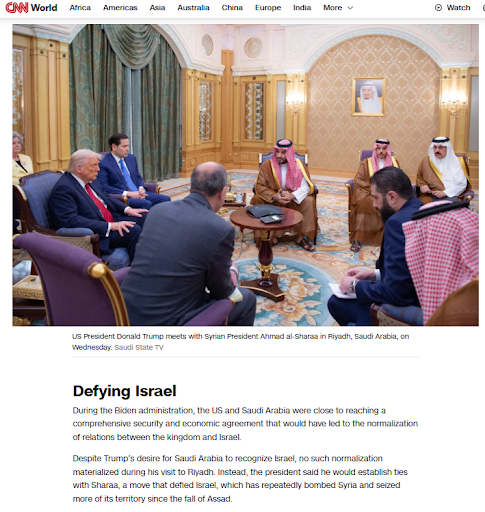
 The recent developments surrounding former jihadist Ahmed al-Sharaa—formerly known as Abu Mohammed al-Jolani—and his transformation from a wanted terrorist leader into a sitting president welcomed by the President of the United States illustrate a deeply troubling fact in international relations: the arbitrary use of the “terrorism” label and economic sanctions as tools of political convenience rather than principled governance.

In 2013, al-Sharaa was designated by the United States as a “Specially Designated Global Terrorist” due to his leadership of the al-Qaeda affiliate in Syria, Jabhat al-Nusra, and his alleged role in orchestrating suicide bombings. At one point, the U.S. placed a $10 million bounty on his capture. Today, however, he shares tea and diplomatic smiles with President Donald Trump, without any transparent legal or procedural process to formally clear his name of terrorism charges. This dramatic pivot—absent any public renunciation of past actions, judicial review, or commitment to democratic norms like elections—exposes the malleability of the terrorism designation when it becomes inconvenient for geopolitical strategy... read more >>

Tuesday, May 13, 2025

Trump’s “America First” and the Shifting Middle East

    Tuesday, May 13, 2025   No comments

Under the banner of “America First,” President Donald Trump’s second term is leaving an unmistakable imprint on the Middle East. The traditional American posture—strongly aligned with Israel and antagonistic toward Iran—is giving way to a new configuration driven more by economic pragmatism and regional stability than ideology. At the heart of this shift is a surprising warming of ties between Iran and Saudi Arabia, a recalibration in U.S.-Israel relations amid the Gaza war, and a relentless push for commercial deals that serve both American and regional interests.

Trump's Strategic Bet: Trade Over Troops


Trump’s latest Middle East tour, which began with a high-profile stop in Riyadh, highlights a clear message: economic engagement is now Washington’s primary tool of influence. In Saudi Arabia, he and Crown Prince Mohammed bin Salman signed a “Strategic Economic Partnership” encompassing energy, mining, and defense. The visit was touted by Trump as “historic,” with the New York Times reporting the president’s desire to announce deals worth over $1 trillion, which he believes will bolster American jobs and global influence.

Instead of pursuing a comprehensive foreign policy doctrine, Trump’s second term appears guided by transactional diplomacy—striking business deals and forging bilateral agreements without broader regional conditions. This is a marked departure from previous administrations that often tied economic or military cooperation to political reform or diplomatic alignment, especially concerning Israel.

Practical decisions:Saudi Arabia and the United States have signed a historic $142 Billion dollar arms deal, the largest in history. Saudi Crown Prince Bin Salman also pledged that Saudi Arabia would invest a staggering $600 Billion USD into the U.S. economy.


Gaza War Reveals Strains in U.S.-Israel Ties

Meanwhile, the ongoing war in Gaza is exposing growing daylight between Washington and Tel Aviv. Trump, once hailed by Israeli leaders as one of their strongest allies, is now signaling fatigue with the conflict. According to The Guardian, Trump’s envoy Steve Witkoff criticized Israel’s prolongation of the war, stating plainly that “Israel is not ready to end it,” while the U.S. wants it resolved—especially with American hostages involved.

Trump’s reluctance to visit Israel during this regional tour, and his administration’s quiet disengagement from Israeli military priorities—like launching strikes on Iran or continuing the Gaza war indefinitely—signals a pivot. One former Israeli diplomat noted bluntly: “Trump is not anti-Israel, but he doesn’t care that much.”

This pragmatism is echoed in Trump’s decision to finalize a ceasefire with the Iran-backed Houthis in Yemen—without consulting Israel—and even referring to the Houthis as “brave.” These actions underscore a major shift: the U.S. is prioritizing regional calm and economic deals over ideological battles or military entanglements.

Israeli Prime Minister Benjamin Netanyahu: "There will be no scenario in which we stop the war...even if Hamas releases additional Israeli prisoners, IDF operations in Gaza will continue."

Iran-Saudi Talks: A New Regional Axis?

Perhaps the most striking development of all is the quiet but determined rapprochement between Iran and Saudi Arabia—two rivals long seen as polar opposites in the region. Iranian Foreign Minister Abbas Araghchi recently visited Jeddah to meet his Saudi counterpart, Faisal bin Farhan. The two discussed bilateral cooperation and regional challenges, signaling a thaw in relations that were icy during Trump’s first term.

The visit came on the heels of indirect U.S.-Iran nuclear talks, which Araghchi described as entering a “detailed” and “constructive” phase. Oman, playing mediator, confirmed a shared desire to reach a “dignified agreement.” Trump’s administration appears to be backing this diplomatic track quietly, a sign that America no longer seeks to isolate Iran at any cost.

More significantly, Saudi Arabia is engaging with Iran not because of American pressure, but despite it. The economic rationale is compelling: both nations are navigating uncertain oil markets, diversifying their economies, and facing youth-driven demand for growth and jobs. Regional stability is no longer optional—it’s essential for survival.


Normalization with Israel? Not at Any Price

While Trump continues to advocate for Saudi-Israeli normalization, the path is increasingly steep. As long as the war in Gaza rages, Riyadh has made clear it will not move forward. The Jerusalem Post warned that normalization “is no longer given for free,” and Israel may no longer be a necessary partner for American-Arab relations.

This mirrors Trump’s broader approach: if a deal serves economic interests, it’s pursued; if not, it's sidelined—regardless of who the traditional allies are.

The Middle East Reorders Around Stability and Commerce

Trump’s “America First” no longer means a blanket commitment to old alliances or ideological battles. It means pushing American interests through trade and stability. This pivot has encouraged unlikely conversations—between Iran and Saudi Arabia, between economic development and military restraint. It has also cooled previously unquestionable loyalties, as seen in Washington’s growing impatience with Israel’s war strategy.

The new Middle East is one where economic realism outweighs ideological loyalty, and where Trump’s transactional instincts are reshaping the region—not through force, but through a cold calculation of mutual benefit.

Followers


Trending now...


ISR +


Frequently Used Labels and Topics

40 babies beheaded 77 + China A Week in Review Academic Integrity Adana Agreement afghanistan Africa African Union al-Azhar Algeria Aljazeera All Apartheid apostasy Arab League Arab nationalism Arab Spring Arabs in the West Armenia Arts and Cultures Arts and Entertainment Asia Assassinations Assimilation Azerbaijan Bangladesh Belarus Belt and Road Initiative Brazil BRI BRICS Brotherhood CAF Canada Capitalism Caroline Guenez Caspian Sea cCuba censorship Central Asia Charity Chechnya Children Rights China Christianity CIA Civil society Civil War climate colonialism communication communism con·science Conflict conscience Constitutionalism Contras Corruption Coups Covid19 Crimea Crimes against humanity D-8 Dearborn Debt Democracy Despotism Diplomacy discrimination Dissent Dmitry Medvedev Earthquakes Economics Economics and Finance Economy ECOWAS Education and Communication Egypt Elections energy Enlightenment environment equity Erdogan Europe Events Fatima FIFA FIFA World Cup FIFA World Cup Qatar 2020 Flour Massacre Food Football France Freedom freedom of speech G20 G7 Garden of Prosperity Gaza GCC GDP Genocide geopolitics Germany Global Security Global South Globalism globalization Greece Grozny Conference Hamas Health Hegemony Hezbollah hijab Hiroshima History and Civilizations Hormuz Human Rights Huquq Ibadiyya Ibn Khaldun ICC Ideas IGOs Immigration Imperialism In The News india Indonesia inequality inflation INSTC Instrumentalized Human Rights Intelligence Inter International Affairs International Law Iran IranDeal Iraq Iraq War ISIL Islam in America Islam in China Islam in Europe Islam in Russia Islam Today Islamic economics Islamic Jihad Islamic law Islamic Societies Islamism Islamophobia ISR MONTHLY ISR Weekly Bulletin ISR Weekly Review Bulletin Italy Japan Jordan Journalism Kenya Khamenei Kilicdaroglu Kurdistan Latin America Law and Society Lebanon Libya Majoritarianism Malaysia Mali mass killings Mauritania Media Media Bias Media Review Middle East migration Military Affairs Morocco Multipolar World Muslim Ban Muslim Women and Leadership Muslims Muslims in Europe Muslims in West Muslims Today NAM Narratives Nationalism NATO Natural Disasters Nelson Mandela NGOs Nicaragua Nicaragua Cuba Niger Nigeria Normalization North America North Korea Nuclear Deal Nuclear Technology Nuclear War Nusra October 7 Oman OPEC+ Opinion Polls Organisation of Islamic Cooperation - OIC Oslo Accords Pakistan Palestine Peace Philippines Philosophy poerty Poland police brutality Politics and Government Population Transfer Populism Poverty Prison Systems Propaganda Prophet Muhammad prosperity Protests Proxy Wars Public Health Putin Qatar Quran Rachel Corrie Racism Raisi Ramadan Ramadan War Regime Change religion and conflict Religion and Culture Religion and Politics religion and society Resistance Rights Rohingya Genocide Russia Salafism Sanctions Saudi Arabia Science and Technology SCO Sectarianism security Senegal Shahed sharia Sharia-compliant financial products Shia Silk Road Singapore Slavery Soccer socialism Southwest Asia and North Africa Sovereignty Space War Spain Sports Sports and Politics Starvation State Power State Terror Sudan Sunni Axis sunnism Supremacism SWANA Syria Ta-Nehisi Coates terrorism Thailand The Koreas Tourism Trade transportation Tunisia Turkey Turkiye U.S. Cruelty U.S. Foreign Policy UAE uk ukraine UN under the Rubble UNGA United States UNSC Uprisings Urban warfare US Foreign Policy US Veto USA Uyghur Venezuela Volga Bulgaria Wadee wahhabism War War and Peace War Crimes War on Iran Wealth and Power Wealth Building West Western Civilization Western Sahara WMDs Women women rights Work Workers World and Communities Xi Yemen Zionism

Search for old news

Find Articles by year, month hierarchy


AdSpace

_______________________________________________

Copyright © Islamic Societies Review. All rights reserved.