Monday, May 01, 2023

Amman Consultative Meeting Statement: For the exit of illegal foreign forces from Syria

    Monday, May 01, 2023   No comments

Summary:


- Cooperation between Damascus, the concerned countries, and the United Nations in developing a comprehensive strategy to combat terrorism in all its forms and organizations.

- The need for illegal foreign forces to leave Syrian soil.

- The need to deliver humanitarian and medical aid to the Syrian people.

- Working on ending the presence of armed and terrorist groups on Syrian soil.

- Cooperation of #Syria, #Jordan and #Iraq to locate and identify the sources of drug production and smuggling methods.

- Provide appropriate conditions in #Syria for the voluntary and safe return of refugees.


________________

Review of the meeting:

The final statement of the consultative meeting of the foreign ministers of Jordan, Saudi Arabia, and Egypt, with the Syrian Foreign Minister, Faisal Al-Miqdad, held in the Jordanian capital, Amman, affirmed the priority of ending the Syrian crisis and all the suffering it caused to the Syrian people.


The statement stressed the need to end the negative repercussions of the crisis, regionally and internationally, through "a political solution that preserves Syria's unity, cohesion and sovereignty, meets the aspirations of its people, rids it of terrorism, and contributes to strengthening the appropriate conditions for the voluntary and safe return of refugees."


The statement called for a political solution to the crisis to lead to "the exit of all illegal foreign forces from it, to achieve national reconciliation, and to restore Syria's security, stability, health and role."


The statement called for the delivery of humanitarian and medical aid that contributes to meeting the life needs of all those who need it among the Syrian people, in all their places of residence, stressing that it is a necessity that all efforts must be combined to meet, in cooperation and coordination between the Syrian government and the relevant United Nations bodies, and in accordance with the decisions relevant United Nations.


The ministers participating in the consultative meeting welcomed the Syrian government's decision to open the Bab al-Salama and al-Rai crossings for the United Nations to deliver humanitarian and medical aid, after the earthquake that struck Syria on February 6.


The priority of the return of the displaced Syrians

The statement touched on the voluntary and safe return of Syrian refugees to their country, stressing that it is a top priority and the necessary steps must be taken to start implementing it immediately.


He also called for strengthening cooperation between the Syrian government and countries hosting refugees, and coordination with the relevant United Nations bodies, to organize voluntary and safe returns for refugees and end their suffering, according to specific procedures and a clear time frame, provided that the Syrian government begins by identifying the necessary needs to improve public services provided in areas of refugee return.


The statement called for intensified work with the international community and the United Nations to accelerate the implementation of early recovery projects for Syria, in a way that contributes to stabilization, and that steps be taken, as appropriate, to resolve the issue of the internally displaced, including the issue of the Rukban camp.


The statement referred to cooperation between the Syrian government and the Jordanian government, in coordination with the relevant United Nations bodies, in organizing a voluntary return of about a thousand Syrian refugees in Jordan.


The need to end the existence of various terrorist organizations

The meeting statement stressed the need for cooperation between the Syrian government, the concerned countries and the United Nations, in developing a comprehensive strategy to enhance security and combat terrorism in all its forms and organizations, and to end the presence of terrorist organizations in the Syrian territories, and neutralize their ability to threaten regional and international security.


In addition to affirming work to support Syria and its institutions in any legitimate efforts to achieve "extending its control over its lands, imposing the rule of law, and ending the presence of armed and terrorist groups on its lands," calling for stopping external interference in Syrian internal affairs, and for establishing effective coordination mechanisms between the military and security agencies. Syria and its counterparts in neighboring countries.


The statement called for work to resume the work of the Constitutional Committee, as soon as possible, in the context of political steps aimed at achieving comprehensive national reconciliation.


The meeting discussed the humanitarian aspect, and the steps required to achieve progress in efforts to address it, in a way that will directly affect the Syrian people, in addition to a number of security and political issues.


The foreign ministers also agreed with their Syrian counterpart on the agenda of the talks, which will continue according to a timetable to be agreed upon, according to the statement, and on the formation of a technical team at the level of experts, which will follow up on the outcomes of this meeting and determine the next steps.


The Jordanian Foreign Minister, Ayman Safadi, and his Syrian counterpart discussed efforts to launch an Arab leadership role to reach a political solution to the Syrian crisis and bilateral relations prior to the Amman Consultative Meeting.


Iran’s Inside man who sold secret information to Britain's MI6 for power and greed

    Monday, May 01, 2023   No comments

 In April of 2008, a senior British intelligence official traveled to Tel Aviv, in addition to several European capitals, with the aim of conveying unusual information to his counterparts.

The British official said that Britain has a spy in Iran who has access to the country's nuclear and security secrets.

The identity of the spy remained unknown for many years, but at the beginning of this year, with the execution by hanging of former Deputy Minister of Defense Ali Reza Akbari, who was convicted of espionage, what had been kept secret for 15 years was revealed, as Akbari was the British spy.


In a comprehensive investigative article published by The New York Times, in which journalist Ronen Bergman, a journalist for Yedioth Ahronoth, participated, it was revealed that Akbari was responsible for delivering the most important piece of information that came from Iran, which is the existence of an underground enrichment site in Fordo, according to the “Acre” website.

Over the years, Akbari lived a double life. He was known to the Iranian public as a religious fanatic, political hawk, senior commander in the Revolutionary Guards, deputy defense minister, and later moved to London and the private sector, but he never lost the confidence of the leadership in Tehran.

  But in 2004, according to sources, he began sharing Iran's nuclear secrets with Britain's MI6 intelligence service.


European intelligence officials said Akbari provided important information, and continued to do so for years. The intelligence proved crucial to dispelling suspicions in the West that Iran was indeed seeking nuclear weapons. The information Akbari provided convinced the world to impose heavy sanctions on Tehran.

Akbari was arrested in 2019 after Iran discovered with the help of Russian intelligence that he was the one who revealed the existence of a secret Iranian nuclear program deep in the mountains near Tehran.


In addition to revealing nuclear and security secrets, Iran claimed that Akbari revealed the identity and activities of more than 100 high-ranking officials, the most important of whom was Mohsen Fahrzadeh, “the father of the Iranian nuclear program,” who was liquidated in 2020 in an operation attributed to Israel.

Britain has never publicly admitted that Akbari, who became a British citizen in 2012 and has been described by Iranian media as a "veteran spy", had spied for it.

A British Foreign Office spokesman said: "We do not comment on intelligence matters, as this has always been our policy."

The US State Department and the US National Security Council did not respond to questions on this matter.

In September 2019, The New York Times reported that the source of the intelligence about the Purdue nuclear site was a British spy.

Britain transferred that information to Germany, the United States and Israel.

Akbari was a teenager at the time of the Iranian revolution in 1979, and he joined the army and left it after six years. Akbari also advanced quickly in the leadership ladder until he was appointed Deputy Minister of Defense and worked as an advisor to the Supreme National Security Council, and he had close relations with two senior figures in Iran, namely the nuclear scientist Fahrzadeh, Ali Shamkhani, former defense minister and head of the Supreme Security Council.

In eight short videos shown on state television after his execution, Akbari is seen describing his espionage operations and how he was recruited by Britain.

The motives behind his actions remain unknown, but he said in one of the videos that he did so out of “greed and power” while denying that he was in financial difficulty.

In the videos, Akbari said he was recruited in 2004 and a year later he traveled to Britain and met his handler at MI6.

In the years that followed, Akbari opened companies in Austria, Spain and Britain to serve as a cover for his meetings with his operators, and Iran said MI6 paid Akbari $2.4 million.

Akbari retired from his official duties in 2008, but continued to serve as an advisor to Shamkhani and other officials.

Akbari's brother said that in the same year Akbari was arrested for four months on charges of spying for Britain, but several senior officials testified on his behalf and he was released on bail and the case was closed.


According to a former senior German intelligence official, in April 2008 Britain received information about the Perdue site, a uranium enrichment site built on a mountainside that was part of Iran's plan to develop a nuclear reactor.

The Perdue revelations changed the world's understanding of Iran's nuclear program and led to the development of military and cyber programs to deal with it.

In September 2009, then-US President Barack Obama revealed that Fordo is an enrichment site.

Western intelligence agencies had long known about it from satellite images showing underground construction work in Fordo but thought it was a military equipment storage facility and did not know it had become a secret nuclear site.

Akbari was a frequent traveler between Tehran and London, and in 2010 he claimed that he had a heart attack and remained living in London, and then his wife and two daughters joined him and he was subsequently granted citizenship.

During his confession, Akbari said he faked his heart attack in order to stay in Britain, and subsequently traveled to Iran at least three times.

In 2019, Akbari traveled to Iran for the last time, and this happened after the head of the Supreme National Security Council, Shamkhani, informed him that the council needed him in an urgent security and nuclear issue. A few days after his arrival in Tehran, he was summoned by the intelligence and arrested.

According to Iranian officials who spoke to the New York Times, it was the Russian intelligence services that revealed to Iran that Akbari was a spy and he was the one who revealed the secret of the Fordo enrichment site.

Sunday, April 30, 2023

With Truce or Ceasefire remain elusive in Sudan, Clashes continue between the army and the Rapid Support Forces

    Sunday, April 30, 2023   No comments

Today, Sunday, the Rapid Support Forces in Sudan announced the extension of the truce for 72 hours, in response to international, regional and local calls.

The statement issued by the official spokesman for the Rapid Support Forces said: "In response to international, regional and local calls, we announce the extension of the humanitarian truce for a period of 72 hours, starting from midnight tonight, in order to open humanitarian corridors and facilitate the movement of citizens and residents, and enable them to fulfill their needs and reach safe areas."

Simultaneously, the Sudanese Ministry of Foreign Affairs accused the Rapid Support Forces of carrying out "flagrant and repeated" attacks on the headquarters of diplomatic missions and bodies.

The statement added, "In a flagrant violation of all international norms and treaties, on April 28, these rebel forces attacked the Indonesian embassy," accusing them of stealing a diplomatic vehicle belonging to the embassy.

Witnesses told AFP that clashes took place near the army headquarters in Khartoum, and the city of Omdurman, west of the capital, was bombed.

From southern Khartoum, a witness said, "There is very fierce fighting and heavy shooting in the street every few minutes since early morning."

The arrival of the first aid shipment from the Red Cross by air

On Sunday, the first shipment of humanitarian aid from the Red Cross arrived in the city of Port Sudan, as part of the emergency operations it has been carrying out since the outbreak of fighting in Sudan, according to what officials said in a virtual press conference from Geneva.


A statement from the International Committee of the Red Cross stated that the shipment, which was sent from Amman, weighed eight tons and "contained surgical equipment to support Sudan's hospitals and volunteers of the Sudanese Red Crescent Society who provide medical care to the wounded who were injured during the fighting."


The Red Cross added in the statement that it would "send a second plane carrying additional medical supplies and emergency personnel."


"We were able to fly to Port Sudan from Amman as a medical staff with supplies to deal with war-wounded, enough to stabilize 1,500 wounded," said Patrick Youssef, the ICRC's regional director for Africa, at the press conference.


"We now hope to get them as soon as possible to some of the busiest hospitals in Khartoum," he added.


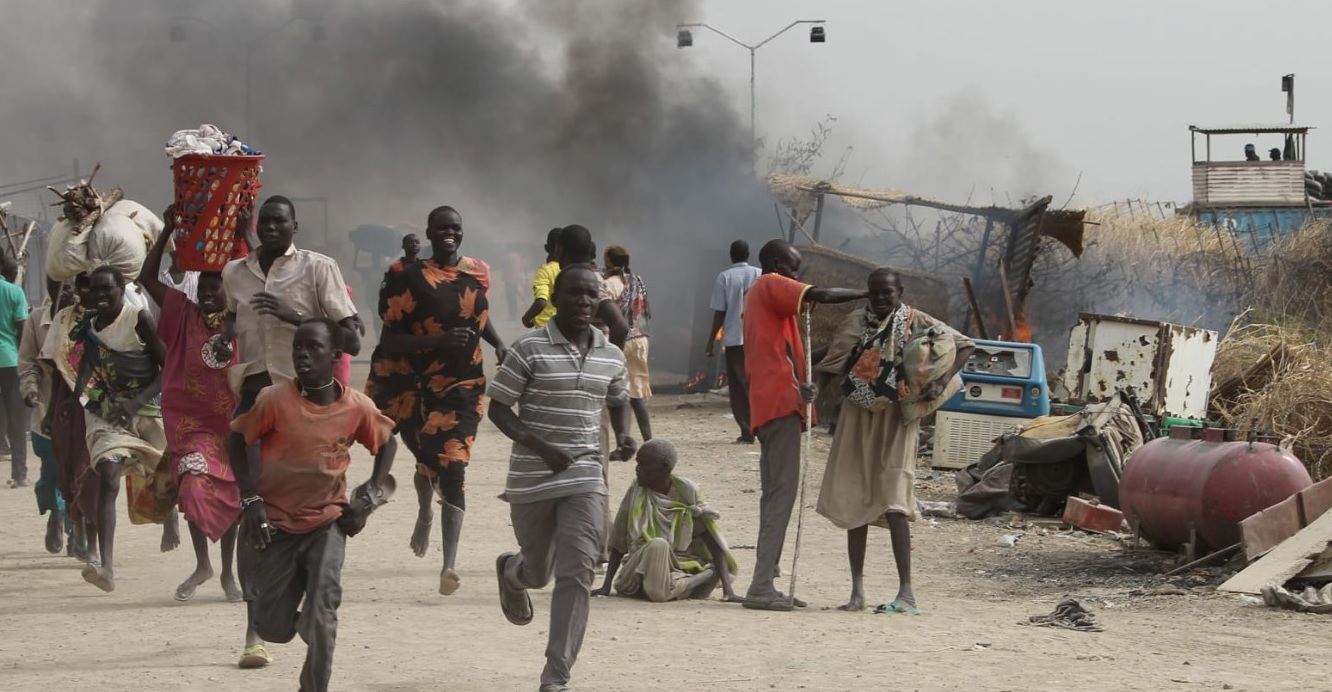
As the fighting enters its third week, families in the capital, which has a population of about five million, and its suburbs are still suffering from a lack of food, water, electricity, and cash, and many of them are staying at home.


Tens of thousands of people have been displaced internally or to neighboring countries, while several foreign and Arab countries are organizing large-scale evacuations.


International and regional powers called for an end to the escalating violence between the two military leaders, but they refused direct talks and exchanged accusations through the media.


Today, UN Secretary-General Antonio Guterres urged support for African-led mediation.


"The United Nations is intensifying its efforts to help people seeking safety in neighboring countries," he wrote on Twitter.


The United Nations said that nearly 75,000 people were internally displaced during the first week of fighting, mainly in the states of Khartoum, Northern, Blue Nile, North Kordofan, North, West and South Darfur.


More than 30,000 people have fled to Chad, South Sudan, Ethiopia and Central Africa, according to estimates by the United Nations, which warned that the number of people fleeing could reach 270,000 if the fighting continues.


The continuous battles between the army and the Rapid Support Forces prompted many countries to intensify their efforts to evacuate their nationals or members of diplomatic missions, by land, sea and air.


The Sudanese Ministry of Health said that the fighting affected 12 states out of 18 in the country.


Sudan has plunged into chaos since the bloody struggle for power erupted in mid-April between army commander Abdel Fattah al-Burhan and the commander of the Rapid Support Forces, Mohamed Hamdan Dagalo, nicknamed "Hemedti".


The war left at least 528 dead and 4,599 wounded, according to figures announced by the Ministry of Health on Saturday, but the toll is likely to be higher.


The two parties to the conflict exchange accusations of violating the armistice, which was extended for three days under international mediation, and ends, Sunday, at midnight.


Earlier, the Sudanese army accused the Rapid Support Forces of turning a hospital into a heavily armed military barracks and command center for operations.


In the details, a statement issued by the General Command of the Armed Forces said: "The rebels turned the East Nile Hospital into a heavily armed military barracks and a command center for operations and continued hostile action after evacuating patients, including critical cases, in intensive care."


The statement also accused the Rapid Support Forces of continuing "indiscriminate shelling and looting of public and private property, including banks, shops, and citizens' homes."


He said that the army is monitoring the rapid support forces moving from the west to the capital, which confirms the continuation of these forces in violating the declared armistice.


The head of the Human Rights Commission in Sudan, Rifaat Mirghani Abbas, warned that the country's health system is on the verge of collapse, as a result of the ongoing clashes since the middle of this month between the army and the Rapid Support Forces.


Abbas said, "We are now talking about a health system on the verge of collapse. Hospitals have become a battleground for both sides and have not been spared from their fire."


He added that the medical personnel are working in very bad conditions, the necessary medicines have become almost non-existent, and ambulances cannot operate safely, in addition to multiple problems related to the health situation.


It is noteworthy that the ongoing battles in Sudan between the Sudanese army on the one hand and the "rapid support" forces on the other, in separate areas, have resulted in at least 14 attacks on health facilities since the fighting began.


Saturday, April 29, 2023

China's Special Envoy for the Middle East, Zhai Jun: China looks at relations with Syria from a strategic perspective, and within a comprehensive vision for the region

    Saturday, April 29, 2023   No comments

Syrian President Bashar al-Assad discussed, today, Saturday, during his meeting with the Chinese government's special envoy to the Middle East, Zhai Jun, the Syrian-Chinese relations, common perceptions of the bilateral relationship, and China's vital role throughout this region.

President al-Assad pointed out that the most important positive change that occurred in the world was represented by the Chinese role, "which is escalating in a calm and balanced manner."


President al-Assad praised the Chinese mediation, which culminated in the rapprochement between Saudi Arabia and Iran and the improvement of relations between them, in a way that will be reflected in the stability of the entire Middle East region, as he described it.


He also pointed to the importance of the Belt and Road Initiative in achieving economic development and cooperation, stressing that "confrontation has always been primarily economic. Therefore, liberation from the restriction of dealing in US dollars has become necessary."


He added, "This role is presenting a new model in politics, economy and culture, especially as it is based on the principle of achieving stability, peace and profit for all," noting that "the whole world today needs the Chinese presence, politically and economically, in order to restore balance to the global situation, especially In light of the Russian-Chinese relations, and the strong international space that the BRICS alliance represents, capable of creating a multipolar international system.


He pointed out that the BRICS countries can play a leading role in this field, in addition to the option of adopting the Chinese yuan in trade transactions between countries.


Al-Assad stressed that Syria does not forget that China stood by its side during the war in order to defend Syrian sovereignty, in accordance with international law and the United Nations Charter, and that it appreciates all the assistance provided by Beijing during the earthquake period.


For his part, the Special Envoy, Zhai Jun, conveyed to President Assad the greetings of Chinese President Xi Jinping, and his keenness to achieve greater results in bilateral relations, stressing that China views relations with Syria from a strategic perspective, and within a comprehensive vision for the region.


Zhai Jun expressed his country's satisfaction with the victory achieved by the Syrian people in their battle against terrorism, "because it is a victory for all countries that defend their sovereignty and dignity," stressing that Beijing "will stand with Syria in international forums, in word and deed, in defense of truth and justice, and will support its battle." Against hegemony, terrorism and external interference.


Zhai Jun expressed China's support for the positive developments regarding the rapprochement path between Syria and the Arab countries.


Sunday, April 23, 2023

ISR Weekly Review Bulletin for April 23, 2023

    Sunday, April 23, 2023   No comments

To keep our readers informed about the most consequential events in this fast changing world, ISR researchers cull through current events news, so you don’t have to.

Manage your Subscription; invite a friend to subscribe to ISR’s Weekly Review Bulletin

Saturday, April 22, 2023

Eid Mubarak: Muslims around the world celebrate the end of the month of Ramadan

    Saturday, April 22, 2023   No comments

After a month of fasting, reflection, and prayers, Muslims around the world mark the end of the month of fasting, Ramadan, with prayers, visits to family and neighbors to ask forgiveness, and recommit to a more balanced life.

These are some images of Muslims celebrating Eid 2023.

Friday, April 21, 2023

In The News: Vatican official says the West bears a great responsibility in destabilizing the Middle East

    Friday, April 21, 2023   No comments

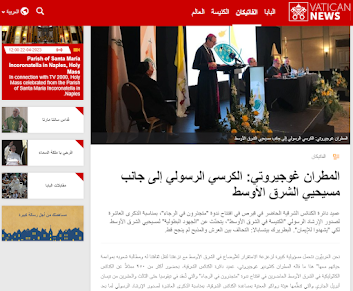
The Dean of the Department of Eastern Churches in the Vatican, Archbishop Claudio Gugerotti, said that the West bears a great responsibility in destabilizing the Middle East, because of its tendency to transfer its culture to the region, and to demand that its peoples adapt their lives to this culture.

The Dean of the Department of Eastern Churches added that they, "as Western Catholics, apologize for their support of this short-sighted vision," adding, "We commend your heroic efforts in being witnesses to our common faith over hardships, of all kinds."


The "Vatican News" website indicated that this statement was made in the presence of more than 250 representatives of the Catholic Churches in the Middle East, who were present at the opening of the "Rooted in Hope" symposium, which is being held in Nicosia until April 23, and is organized by the "ROACO" organization concerned with aid. Eastern churches.


Vatican Radio pointed out that what worries Archbishop Gugerotti is "the dispersion of Christians in the Middle East, resulting from the current tragic situation, which profoundly affects their daily lives."


It is noteworthy that Pope Francis said, last year, that the West cannot be described as an "example to follow" because it took the wrong path, describing it as the greatest graveyard of humanity.


He also said last month that the interests of multiple "empires" are driving the war in Ukraine, not just Russia, adding that the conflict was fueled by "colonial interests, and not only because of the Russian Empire, but because of other empires as well."


Thursday, April 20, 2023

Media review: is France's Macron rebelling against the Western world order?

    Thursday, April 20, 2023   No comments

The Economist thinks so.

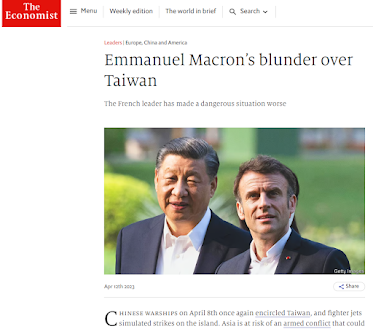
The prestigious British newspaper The Economist launched, in its latest issue, a fierce attack on President Macron because of his statements that he made to a very limited number of journalists who accompanied him during his recent visit to China, describing them as very dangerous and at the wrong time.


What angered the well-established magazine, which represents the Western liberal capitalist world in one way or another, and was reflected in its editorial, which is followed by most of the leaders of the Western world in particular, and topped its latest issue, the saying of the French president, whom she described as one of the most experienced European leaders, “It is not the business of the European continent to fall into crises.” It is not our business, and in the name of strategic autonomy, and we should not be in Europe following America in a crisis like the Taiwan crisis.”

Macron, from the magazine's point of view, made two fatal mistakes:

The first: strengthening the ambition of China and its president to divide the European continent and separate the Europeans from America.

The second: undermining the allies' support for Taiwan, because diplomacy alone will not reduce the risks of war, and the West needs to strengthen military deterrence, which requires strengthening the US-European Western alliance in the face of tyranny.

What is certain and indisputable is that Emmanuel Macron is not Charles de Gaulle, the historical leader of France, and it is not possible to compare the two for many reasons that are long to explain, but his recent positions, that is, Macron, are trying to emulate de Gaulle's strategic positions, the most prominent of which is preventing Britain from entering the European market The joint (European Union later) because it does not trust it, and not to join the “NATO” alliance led by America.

Wednesday, April 19, 2023

Strong reaction by Medvedev to South Korea's readiness to supply Kiev with weapons: What will the South Koreans say if Russian weapons reach their northern neighbor?

    Wednesday, April 19, 2023   No comments

It would seem that Russian leader have a counter-move to every move by Western countries who are increasing or thinking about increasing their support to Ukraine. To this end, Deputy Chairman of the Russian Security Council Dmitry Medvedev commented on South Korean President Yoon Sok Yul's statement of his country's readiness to supply weapons to the Kiev regime. He asked: What will the South Koreans say if Russian weapons reach their northern neighbor?

This came in a post by Medvedev on his official channel on the “Telegram” application, where he wrote: There are new people willing to help our enemies, as South Korean President Yoon Sok Yul said that this country, in principle, is ready to supply weapons to the Kiev regime.

And this is given that the South Koreans have been asserting strongly, until recently, that the possibility of supplying Kiev with lethal weapons is completely excluded.

What will the people of this country say when they see the latest Russian weapons designs in their closest neighbours, our partners from North Korea?

This is called bartering.

The Kremlin said on Wednesday that South Korea's provision of military aid to Ukraine would mean Seoul's participation in the conflict to some extent.


Here is a translation of his statement:


There are new ones willing to help our enemies. South Korean President Yun Sok-yeol said that, in principle, this state is ready to supply weapons to the Kyiv regime. 
Moreover, until recently, the South Koreans ardently assured that the possibility of supplying lethal weapons to Kyiv was completely ruled out.

I wonder what the inhabitants of this country will say when they see the latest designs.
Russian weapons from their closest neighbors - our partners from the DPRK?

What is called 
Quid pro quo…

Renewed clashes between the Sudanese army and the Rapid Support Forces in Omdurman

    Wednesday, April 19, 2023   No comments

Today, Wednesday, clashes renewed between the Sudanese army and the Rapid Support Forces, despite the declared 24-hour truce, and fighting intensified between the two forces loyal to the two rival military leaders, after the truce quickly collapsed.


Continuous gunfire, artillery and air strikes rocked the capital, Khartoum, and the city of Omdurman, across the Nile.


Residents reported clashes around the army headquarters, and near the international airport.

The Sudanese army accused the RSF of not adhering to the implementation of the armistice agreement, which was concluded with international mediation for humanitarian purposes, which led to the continuation of the fighting for the fifth day in a row.


The spokesman for the Sudanese Armed Forces, Brigadier General Nabil Abdullah Ali Musa, also accused the Rapid Support Forces of "violating citizens, looting their property, and burning a sea market in the Khartoum Bahri neighborhood."


In parallel, the Sudanese Rapid Support Forces announced, in a statement today, that "the Egyptian nationals who were at Meroe Airport during the clashes have been transferred to the capital, Khartoum."


The forces said in the statement that "Egyptian nationals will be handed over when the appropriate opportunity arises, according to the conditions the country is going through."


It also announced its agreement to a truce for a period of 24 hours, starting at 6 pm today, Wednesday, and continuing until 6 pm tomorrow, Thursday,” according to the statement.


The Rapid Support Forces affirmed its "full commitment to a complete ceasefire," hoping that "the other side will abide by that."


Followers


Trending now...


ISR +


Frequently Used Labels and Topics

40 babies beheaded 77 + China A Week in Review Academic Integrity Adana Agreement afghanistan Africa African Union al-Azhar Algeria Aljazeera All Apartheid apostasy Arab League Arab nationalism Arab Spring Arabs in the West Armenia Arts and Cultures Arts and Entertainment Asia Assassinations Assimilation Azerbaijan Bangladesh Belarus Belt and Road Initiative Brazil BRI BRICS Brotherhood CAF Canada Capitalism Caroline Guenez Caspian Sea cCuba censorship Central Asia Charity Chechnya Children Rights China Christianity CIA Civil society Civil War climate colonialism communication communism con·science Conflict conscience Constitutionalism Contras Corruption Coups Covid19 Crimea Crimes against humanity D-8 Dearborn Debt Democracy Despotism Diplomacy discrimination Dissent Dmitry Medvedev Earthquakes Economics Economics and Finance Economy ECOWAS Education and Communication Egypt Elections energy Enlightenment environment equity Erdogan Europe Events Fatima FIFA FIFA World Cup FIFA World Cup Qatar 2020 Flour Massacre Food Football France Freedom freedom of speech G20 G7 Garden of Prosperity Gaza GCC GDP Genocide geopolitics Germany Global Security Global South Globalism globalization Greece Grozny Conference Hamas Health Hegemony Hezbollah hijab Hiroshima History and Civilizations Hormuz Human Rights Huquq Ibadiyya Ibn Khaldun ICC Ideas IGOs Immigration Imperialism In The News india Indonesia inequality inflation INSTC Instrumentalized Human Rights Intelligence Inter International Affairs International Law Iran IranDeal Iraq Iraq War ISIL Islam in America Islam in China Islam in Europe Islam in Russia Islam Today Islamic economics Islamic Jihad Islamic law Islamic Societies Islamism Islamophobia ISR MONTHLY ISR Weekly Bulletin ISR Weekly Review Bulletin Italy Japan Jordan Journalism Kenya Khamenei Kilicdaroglu Kurdistan Latin America Law and Society Lebanon Libya Majoritarianism Malaysia Mali mass killings Mauritania Media Media Bias Media Review Middle East migration Military Affairs Morocco Multipolar World Muslim Ban Muslim Women and Leadership Muslims Muslims in Europe Muslims in West Muslims Today NAM Narratives Nationalism NATO Natural Disasters Nelson Mandela NGOs Nicaragua Nicaragua Cuba Niger Nigeria Normalization North America North Korea Nuclear Deal Nuclear Technology Nuclear War Nusra October 7 Oman OPEC+ Opinion Polls Organisation of Islamic Cooperation - OIC Oslo Accords Pakistan Palestine Peace Philippines Philosophy poerty Poland police brutality Politics and Government Population Transfer Populism Poverty Prison Systems Propaganda Prophet Muhammad prosperity Protests Proxy Wars Public Health Putin Qatar Quran Rachel Corrie Racism Raisi Ramadan Ramadan War Regime Change religion and conflict Religion and Culture Religion and Politics religion and society Resistance Rights Rohingya Genocide Russia Salafism Sanctions Saudi Arabia Science and Technology SCO Sectarianism security Senegal Shahed sharia Sharia-compliant financial products Shia Silk Road Singapore Slavery Soccer socialism Southwest Asia and North Africa Sovereignty Space War Spain Sports Sports and Politics Starvation State Power State Terror Sudan Sunni Axis sunnism Supremacism SWANA Syria Ta-Nehisi Coates terrorism Thailand The Koreas Tourism Trade transportation Tunisia Turkey Turkiye U.S. Cruelty U.S. Foreign Policy UAE uk ukraine UN under the Rubble UNGA United States UNSC Uprisings Urban warfare US Foreign Policy US Veto USA Uyghur Venezuela Volga Bulgaria Wadee wahhabism War War and Peace War Crimes War on Iran Wealth and Power Wealth Building West Western Civilization Western Sahara WMDs Women women rights Work Workers World and Communities Xi Yemen Zionism

Search for old news

Find Articles by year, month hierarchy


AdSpace

_______________________________________________

Copyright © Islamic Societies Review. All rights reserved.