Showing posts with label Western Sahara. Show all posts

Monday, August 03, 2026

Morocco’s Sahara Obsession and Migrant Weaponization Are Backfiring

    Monday, August 03, 2026   No comments

Moroccan security forces preventing migrants from returning
The recent mass migrant breach into the Spanish enclave of Ceuta was not a spontaneous humanitarian crisis; it was a calculated geopolitical weapon. As tens of thousands of desperate people surged across the border—resulting in a tragic death toll of up to 88 souls and prompting emergency border militarization across Europe—the underlying mechanics of the crisis revealed a darker reality. It laid bare the grand strategy of the Moroccan monarchy: a regime that operates much like a colonial power, prioritizing its own self-preservation and territorial ambitions over human life, regional stability, and the genuine will of its own people.

Morocco’s current foreign policy is built on a fragile foundation of transactional blackmail. But as the kingdom’s domestic demographics shift and its alliances alienate the broader public, this strategy is rapidly becoming a flawed trap that will keep the nation in a diplomatic and social tight spot for the long run.

The Domestic Disconnect: A Monarch Out of Touch

King Mohammed VI has long relied on his constitutional and religious title as the "Commander of the Faithful" to legitimize his absolute rule. Historically, this religious narrative provided a unifying canopy that demanded total submission from the populace. However, this same narrative is failing the King on both the global stage and the domestic front.

In light of the ongoing devastation in the Middle East and the broader Arab peoples’s solidarity with Gaza, the Moroccan regime’s quiet alignment with Western and Israeli preferences has created a deep cognitive dissonance. The King's foreign alliances simply do not resonate with the larger segment of the Moroccan population.


Furthermore, the ruler is a self-serving figure demanding submission from a population that is fundamentally changing. Today’s Moroccan youth are younger, vastly more educated, and deeply informed thanks to new technology. The state can no longer control the flow of information as it did in the analog past. Moroccans watch in real-time as their government bends over backward to please Washington and Tel Aviv, while domestic economic struggles go unaddressed. The regime’s attempt to project power abroad is increasingly viewed at home as a distraction from its failures within.

The Sahara Trap: A Flawed Diplomatic Doctrine


For years, Rabat has based its entire foreign relations apparatus on a single, rigid metric: how a nation speaks about Morocco’s occupation of Western Sahara. This hyper-fixation has reduced Moroccan diplomacy to a series of transactional shakedowns.

The most glaring example of this subservience was the renaming of the 1,055-kilometer Tiznit–Dakhla road to the "President Donald J. Trump Highway"—a sycophantic monument built to reward a former US president for his unilateral recognition of Morocco's claims to the Sahara.

Basing national security and foreign policy on the whims of foreign leaders regarding the Sahara is a deeply flawed, short-term strategy. It strips Morocco of its strategic autonomy, turning the kingdom into a client state that must constantly offer concessions—whether in normalization deals or border security—to maintain its "alliances." It keeps the nation in a perpetual tight spot, forever vulnerable to the shifting winds of Washington, Paris, and Madrid.


Weaponizing Desperation: The Anatomy of the Ceuta Breach


When diplomacy fails to yield the desired concessions, the Moroccan royal family has shown a willingness to weaponize human misery--leading to human rights abuses. The recent crisis in Ceuta was a state-directed operation. Reports confirmed that migrants were literally trucked to the border to incite an organized, massive crossing into Spanish-controlled territory.

The goals of this manufactured crisis were twofold:

  • Punish Spain for its stance on Gaza: Spain has recently defied US and Israeli preferences by recognizing Palestine, confronting Israel over the war in Gaza, and restricting arms transit.
  • Punish Spain for the Sahara: Madrid has hesitated to fully endorse Morocco's continued occupation of Western Sahara and its claims over Spanish territories.

The operation was executed with chilling precision. Moroccan intelligence agents were documented by the Guardia Civil embedded among the migrants, using the chaos to conduct reconnaissance on Ceuta’s defenses. Meanwhile, in a display of sheer cruelty, images emerged of Moroccan security forces physically blocking migrants from returning to Morocco once the political point had been made, trapping them in the Spanish enclave.

Morocco covets the territories controlled by Spain (Ceuta and Melilla) and the UK (such as the Peñón de Vélez de la Gomera). The monarchy hopes to claim these territories not through war or traditional diplomatic challenge, but by making the cost of holding them so unbearably high that Europe simply hands them over.

Proxy Warfare: Washington’s $40 Million Slap at Madrid


The Ceuta crisis also exposed a cynical alignment between Rabat and elements within the US government to punish Madrid. While US Republicans performed public outrage over the migrant invasion, Representative Thomas Massie pointed to the fine print of a recent GOP-backed bill.

Just two weeks before tens of thousands of migrants poured into Ceuta, the US House passed H.R. 8595, which included a $40 million payout to Morocco. More damning was the accompanying House Appropriations Committee report, which explicitly stated that the "Spanish-administered cities of Ceuta and Melilla are located in Moroccan territory."

This was a direct diplomatic slap in the face to Spain. The US did not just acknowledge Morocco’s claim; it validated it on American legislative paper. The message was clear: Washington was willing to let Morocco do its dirty work, using a $40 million incentive to facilitate a migrant surge against a NATO ally that had dared to step out of line on Middle Eastern policy.

The European Blowback and the Double Standard


The immediate fallout of Morocco’s gamble has been chaotic. Spain was overwhelmed, leading to anarchy in Ceuta and the tragic deaths of dozens, including teenagers and women, who drowned or were crushed at the Tarajal breakwater. In response, Spain deployed a 500-meter floating sea barrier to allow for legal "hot returns" and expedited the deportation of 48,000 migrants.

The crisis has fractured European unity. Right-wing leaders like Spain's Santiago Abascal (Vox) have demanded a "military act" against Morocco, the freezing of EU agreements, and the total militarization of the border. Italy took the drastic step of unilaterally suspending the EU’s Schengen free-travel pact with Spain, while Portugal has heavily reinforced its southern borders.

Yet, a glaring double standard remains. When Belarus used similar tactics to funnel migrants into Poland and Lithuania, it was hit with sweeping EU sanctions and total diplomatic isolation for "weaponizing migration." Morocco, despite staging a state-directed surge complete with intelligence infiltration, faces no such consequences because it is shielded by its status as a US and Israeli partner.

A Tight Spot in the Long Run

The Moroccan monarchy operates under the illusion that it is playing a masterful game of geopolitical chess. In reality, it is eroding its own moral standing and destabilizing its neighborhood.

Basing foreign policy on the Sahara issue and weaponizing migrants may force temporary concessions from Madrid or Washington, but it is a fundamentally flawed strategy. It breeds intense resentment among European neighbors, invites the militarization of the Mediterranean, and exposes the regime's colonial, self-serving nature to the world.

Most importantly, it alienates a young, tech-savvy Moroccan population who can no longer be blinded by state-sponsored narratives. As the flow of information continues to bypass royal censors, the Moroccan people are increasingly recognizing that their King’s alliances serve the preservation of the palace (makhzen), not the prosperity of the populace. In the long run, no amount of highways named after foreign presidents or weaponized border crises can secure a regime that has lost the genuine consent of its own people.

Updates:

Chinese intelligence reportedly believes Ceuta crisis orchestrated by Mossad


Chinese intelligence and academic circles have reportedly raised suspicions that Israel was behind the recent surge of migrants into Spain’s North African enclave of Ceuta.


According to El Mundo, reports circulating in Beijing claim the border crisis was a deliberate hybrid warfare operation allegedly coordinated by Mossad and enabled by Morocco, with the aim of destabilizing the Spanish government.


The assessment reportedly connects the incident to worsening relations between Madrid and Tel Aviv, particularly after Spain’s criticism of Israel’s war on Gaza and its recognition of a Palestinian state.

Nadia Helmy, an Egyptian political scientist specializing in Sino-Israeli relations, said Chinese security analysts view the Ceuta events as a potential pressure operation targeting Prime Minister Pedro Sanchez’s government.

"Chinese intelligence analysis centers have examined the escalation of diplomatic and political tensions between Spain and Israel," Helmy stated. "From that perspective, the deterioration of bilateral relations could have motivated Mossad to get involved in the migration crisis between Morocco and Spain, exacerbating the situation and infiltrating agents to foment discontent and chaos among the Moroccan population."
Monday, July 31, 2023

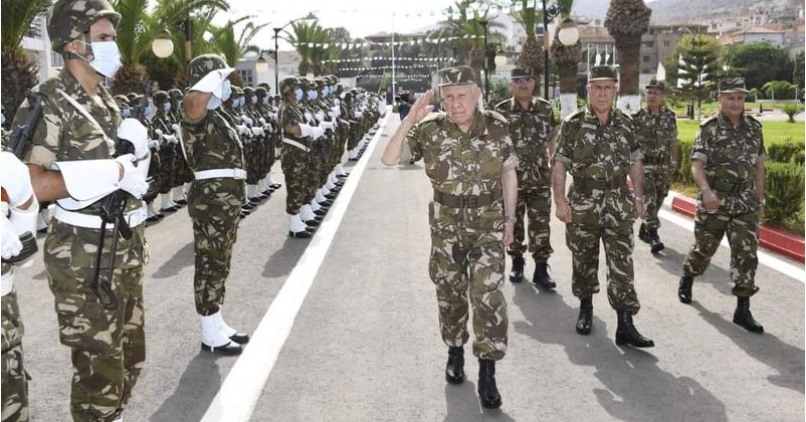
Algeria's Lieutenant General Saïd Chanegriha, Chief of Staff of People's National Army, on an official visit to the Russian Federation

    Monday, July 31, 2023   No comments

And the statement of the Ministry of National Defense stated that, "At the invitation of Lieutenant General Sergey Shoigu, Minister of Defense of the Russian Federation, Lieutenant General Said Chanegriha, Chief of Staff of the People's National Army, pays an official visit to the Russian Federation, starting today."

"The visit, which falls within the framework of strengthening cooperation between the People's National Army and the Russian Armed Forces, will enable the two parties to discuss issues of common concern," the statement added.


The visit happens as Algeria’s media outlets reported on increased tension with Morocco, which appears to be using its connections to some Western governments to normalize its occupation of Western Sahara.

The Algerian newspaper, Al-Khabar, accused the UAE of supplying Morocco with a new spying system developed by the Israeli company Quadream, intended to penetrate the phones of officials and journalists in ten countries, as it was installed near the Algerian border, in a detailed report published last Thursday titled “Abu Dhabi.” The capital of confusion,” which is an Algerian slang word meaning “sedition.’


Algerian lawmakers comment on regional security matters: Tensions with Morocco are unprecedented, the return of relations is excluded, and Israel's participation in the US-led African Assad maneuver is provocative


Two Algerian parliamentarians said that restoring relations with Morocco is unlikely, and that they are going through a period of intense tension.
According to their talk, the current tensions are unprecedented in the relations between the two countries in recent years, and they are in contrast to the message of reassurance sent by King Mohammed VI in his last Throne Day speech.

Earlier, King Mohammed VI of Morocco called on Algeria to open the borders between the two brotherly neighboring countries and peoples.

This came during a speech by the King of Morocco to his people, on the occasion of Throne Day, which coincides with the twenty-fourth anniversary of his accession to the throne.

The King of Morocco said, “Our work to serve our people is not limited only to internal issues, but we are also keen to establish strong relations with brotherly and friendly countries, especially neighboring countries, according to a statement that Sputnik obtained a copy of.

"In recent months, many people have been asking about the relations between Morocco and Algeria, which are stable, and we look forward to them being better," he added.

Commenting on what was stated in King Mohammed VI's speech on Algeria, the Algerian parliamentarian, Moussa Kharfi, says that restoring relations with Morocco at the present time is not possible.
Kharfi explained, in his interview with “Sputnik”, that the matter is mainly related to relations between Morocco and Israel, as well as the issue of the Sahara.

Pointing out that the failure to settle the Sahara issue excludes the restoration of relations with him.
The Algerian parliamentarian, Riz
kani Suleiman, says that the relations between the two countries are currently farther than ever from the dialogue table.

Adding: “The statements of King Mohammed VI contradict the reality of relations between the two countries, as tension prevails in relations, which the Algerian president described four months ago as having reached the point of no return.”

And he continued, in his interview with “Sputnik”, that the prevailing tension in relations comes against the backdrop of what he describes as “provocations regarding the Sahara issue, as well as with regard to normalization with Israel.”

He believes that Israel's participation in the African Assad maneuver, led by the United States, came within the framework of provocations on the part of Morocco.

And he went on to say, “Algeria severed its relations with Morocco two years ago and prevented Moroccan airlines from passing through Algerian airspace as a response to the amount of evil that it received from Morocco.”

And he added, "Certainly no one benefits from the situation, and we all hope for a better reality for relations, especially for the common denominators that bring the two peoples together."

Earlier, Algerian President Abdelmadjid Tebboune said that severing relations with Morocco was an alternative to war.

On August 24, 2021, Algeria severed its relations with Morocco, after closing the borders between the two countries since 1994 after the “Atlas Asni” hotel bombings in Marrakech, when the late King Hassan II imposed a visa on Algerians to enter the country, which prompted Algeria at the time to close the land borders. Between the two countries, this tension was also perpetuated by the severing of diplomatic relations between the two countries.


Africa's new and perennial challenges

The African continent is a state of flux as it seeks to adjust to the new multipolar world order. 

Many African leaders attended the Russia-Africa Summit hosted by Putin in Russia this week. This week also saw another military takeover of the government, the removal of the president of Niger.


Algeria will support Niger in case of external military aggression, according to the Algerian publication Intel Kirby.

They reported on the potential invasion of Niger under the leadership of ECOWAS, stating that Algeria will not remain idle while its neighboring country faces an invasion.


There were already unconfirmed reports that the Algerian army has started increasing security measures and raising its level of readiness on the border with Niger.


Friday, January 13, 2023

Western Sahara: The Polisario movement's 16th congress began its conference to renew its leadership

    Friday, January 13, 2023   No comments

The Polisario Front, seeking to obtain the right to self-determination in Western Sahara, began its conference to renew its leadership, in the context of severe tensions between its ally Algeria and Morocco, which controls 80% of this region.

The conference will be held in the presence of more than 2,200 members of the Front and 370 foreign guests over a period of five days, 175 kilometers south of the Algerian city of Tindouf, in the Dakhla refugee camp, which bears the name of a coastal town in Western Sahara, an area rich in phosphates and fisheries at the heart of an ongoing conflict. half a century ago.


Polisario leader Brahim Ghali, 73, who enjoys indispensable support from Algeria, appears confident of his re-election at the conference, which kicks off at noon on Friday.


"This is the first conference since the resumption of the armed struggle" at the end of 2020, Mohamed Yeslam Bessat, the representative of the Sahrawis in South Africa, told AFP.


A decades-old dispute has been taking place over Western Sahara, which Morocco controls most of its territory, and considers it an integral part of its territory, proposing to grant it autonomy under its sovereignty, while the Polisario Front, supported by Algeria, is calling for its independence.


It is a major cause of tension in relations between the two Maghreb countries, as Algeria cut off diplomatic relations with Rabat since the summer of 2021.


A ceasefire resolution in force since 1991 was violated, in mid-November 2020, after the deployment of Moroccan forces in the far south of the region to expel the Polisario fighters who were blocking the only road leading to Mauritania and considered it illegal because it did not exist when the agreement was reached with Rabat.


Since then, the Polisario Front says it is "in a state of war in self-defense" and has declared "a war zone for all the territory of the Sahrawi Republic, including land, sea and air."


The conference takes place at a time when Western Sahara is at the center of escalating tensions between the two powerful states of the Maghreb.


Algeria effectively cut off its diplomatic relations with Morocco in August 2021 due to deep differences over this file and the security rapprochement between Rabat and Israel.


And after the recognition of former US President Donald Trump's administration at the end of 2020 encouraged Morocco's sovereignty over this region in exchange for rapprochement with Israel, Rabat has since increasingly used its diplomatic activity to mobilize the support of other countries for its positions.


The 16th conference is being organized under the slogan "Escalating Fighting to Expel the Occupation and Complete Sovereignty."


And ending with the convening of the conference, the governorship of Ghali, who succeeded in July 2016 the historical leader Muhammad Abdel Aziz, who died a few weeks ago. In addition, Ghali is the president of the “Sahrawi Arab Republic,” declared unilaterally in 1976.


The representative of the Polisario Front in Geneva, Omaima Abdel Salam, confirms that “the last word will be for the Sahrawi people during this conference. The position of Secretary-General is not exclusive to anyone,” refuting press reports about a struggle to succeed Ghali.


She explained, “So far, there is no list of candidates for the position of Secretary-General. These are just rumours.”


Submit your story (pitch an article)

Name

Email *

Message *


Trending Today...


ISR +


Frequently Used Labels and Topics

40 babies beheaded 77 + China A Week in Review Academic Integrity Adana Agreement afghanistan Africa African Union al-Azhar Algeria Aljazeera All Apartheid apostasy Arab League Arab nationalism Arab Spring Arabs in the West Armenia Arts and Cultures Arts and Entertainment Asia Assassinations Assimilation Azerbaijan Bahrain Bangladesh Belarus Belt and Road Initiative Brazil BRI BRICS Brotherhood CAF Canada Capitalism Caroline Guenez Caspian Sea cCuba censorship Central Asia Charity Chechnya Children Rights China Christianity CIA Civil society Civil War climate colonialism communication communism con·science Conflict conscience Constitutionalism Contras Corruption Coups Covid19 Crimea Crimes against humanity D-8 Dearborn Debt Democracy Despotism Diplomacy discrimination Dissent Dmitry Medvedev Earthquakes Economics Economics and Finance Economy ECOWAS Education and Communication Egypt Elections energy Enlightenment environment Epstein equity Erdogan ethics Europe Events Fatima FIFA FIFA World Cup FIFA World Cup Qatar 2020 Flour Massacre Food Football France Freedom freedom of speech G20 G7 Garden of Prosperity Gaza GCC GDP Genocide geopolitics Germany Global Security Global South Globalism globalization Greece Grozny Conference Hamas Health Hegemony Hezbollah hijab Hiroshima History and Civilizations Hormuz hum Human Rights Huquq Ibadiyya Ibn Khaldun ICC Ideas IGOs Immigration Imperialism In The News india Indonesia inequality inflation INSTC Instrumentalized Human Rights Intelligence Inter International Affairs International Law Iran IranDeal Iraq Iraq War ISIL Islam in America Islam in China Islam in Europe Islam in Russia Islam Today Islamic economics Islamic Jihad Islamic law Islamic Societies Islamism Islamophobia ISR MONTHLY ISR Weekly Bulletin ISR Weekly Review Bulletin Italy Japan Jordan Journalism Kenya Khamenei Kilicdaroglu Kurdistan Latin America Law and Society Lebanon Libya Majoritarianism Malaysia Mali mass killings Mauritania Media Media Bias Media Review Middle East migration Military Affairs Morocco Multipolar World Muslim Ban Muslim Women and Leadership Muslims Muslims in Europe Muslims in West Muslims Today NAM Narratives Nationalism NATO Natural Disasters Nelson Mandela NGOs Nicaragua Nicaragua Cuba Niger Nigeria Normalization North America North Korea Nuclear Deal Nuclear Technology Nuclear War Nusra October 7 Oman OPEC+ Opinion Polls Organisation of Islamic Cooperation - OIC Oslo Accords Pakistan Palestine Peace Philippines Philosophy poerty Poland police brutality Politics and Government Population Transfer Populism Poverty Prison Systems Propaganda Prophet Muhammad prosperity Protests Proxy Wars Public Health Putin Qatar Quran Rachel Corrie Racism Raisi Ramadan Ramadan War Regime Change religion and conflict Religion and Culture Religion and Politics religion and society Resistance Rights Rohingya Genocide rule of law Russia Salafism Sanctions Saudi Arabia Science and Technology SCO Sectarianism security Senegal Shahed sharia Sharia-compliant financial products Shia Silk Road Singapore Sistani Slavery Soccer socialism Southwest Asia and North Africa Sovereignty Space War Spain Sports Sports and Politics Starvation State Power State Terror Sudan Sunni Axis sunnism Supremacism SWANA Syria Ta-Nehisi Coates terrorism Thailand The Koreas Tourism Trade transportation Tunisia Turkey Turkiye U.S. Cruelty U.S. Foreign Policy UAE uk ukraine UN under the Rubble UNGA United Arab Emirates United States UNSC Uprisings Urban warfare US Foreign Policy US Veto US-Iran MoU USA Uyghur Venezuela Volga Bulgaria Wadee wahhabism War War and Peace War Crimes War on Iran Wealth and Power Wealth Building West Western Civilization Western Sahara WMDs Women women rights Work Workers World and Communities Xi Yemen Zionism

Search for old news

Find Articles by year, month hierarchy


WEEKLY AdSpace 3

_______________________________________________

Copyright © Islamic Societies Review. All rights reserved.