Showing posts with label UAE. Show all posts

Wednesday, April 01, 2026

UAE Explores Military Role in Strait of Hormuz Operation Amid Escalating Iran Tensions

    Wednesday, April 01, 2026   No comments

The United Arab Emirates is reportedly preparing to support potential military operations to reopen the Strait of Hormuz and is lobbying for a United Nations Security Council resolution to authorize such action, according to a Wall Street Journal report citing Arab officials. If the UAE proceeds, it would become the first Gulf state to formally participate in the conflict as a combatant.

Emirati diplomats have urged the United States and military powers in Europe and Asia to form a coalition to secure the strategic waterway, which handles approximately one-fifth of global oil and liquefied natural gas shipments. According to officials familiar with the discussions, the UAE is evaluating potential military contributions, including mine-clearing operations and logistical support.

The UAE has also reportedly suggested that the United States consider occupying Iranian-held islands in the strait, including Abu Musa—a territory claimed by Abu Dhabi for decades.

The reported shift in UAE posture comes amid intensified Iranian attacks on Gulf states. On April 1, 2026, UAE air defense systems intercepted five ballistic missiles and 35 drones originating from Iran, according to the UAE Ministry of Defense. Since the onset of hostilities, UAE defenses have engaged a total of 438 ballistic missiles, 19 cruise missiles, and 2,012 drones, the ministry reported.

These attacks have resulted in casualties, including two members of the UAE Armed Forces killed while on duty, one Moroccan civilian under military contract, and nine civilians of Pakistani, Nepalese, Bangladeshi, Palestinian, and Indian nationalities. An additional 190 individuals of diverse nationalities sustained injuries ranging from minor to severe.

Iran has warned it will target civilian infrastructure in any Gulf state that supports military operations against its territory. Tehran has framed its actions as defensive responses to what it characterizes as aggression.

The UAE has framed its position around international norms, citing UN resolutions condemning Iran's attacks and disruptions to maritime traffic. The UAE Foreign Ministry stated there is "broad global consensus that freedom of navigation in the Strait of Hormuz must be preserved."

The UN Security Council recently adopted a resolution condemning Iran's attacks on Gulf Cooperation Council states and demanding an immediate cessation of hostilities. The resolution passed with 13 votes in favor and two abstentions.

While Saudi Arabia and other Gulf states have expressed support for continuing pressure on Iran's leadership, they have stopped short of committing their own militaries to direct combat operations.

Military analysts caution that reopening the Strait of Hormuz by force presents significant operational challenges. Securing the waterway would likely require control not only of maritime routes but also of adjacent coastal areas—a complex undertaking with uncertain outcomes.

"I don't think we can do it," said Rep. Adam Smith (D-WA), former chair of the House Armed Services Committee. "All Iran has to do is keep the strait under threat—one drone, one mine, one small suicide boat."

The ongoing conflict has already impacted the UAE's economy, disrupting air travel, affecting tourism, and creating uncertainty in property markets. The UAE has responded with measures including restrictions on Iranian nationals and the closure of Iranian-linked institutions in Dubai.

As diplomatic and military calculations continue, the UAE faces a consequential decision: whether to maintain its current defensive posture or take a more active role in efforts to secure one of the world's most critical energy chokepoints.


Sunday, March 29, 2026

How the UAE's Reparations Demand Opens the Door to Iran's Counterclaim

    Sunday, March 29, 2026   No comments

The Mirror of Accountability


In the fraught theater of Middle East diplomacy, a striking rhetorical pivot has emerged: the United Arab Emirates, a key U.S. ally in the Gulf, has publicly demanded that Iran pay reparations for attacks on Gulf civilians and infrastructure. Anwar Gargash, diplomatic adviser to the UAE president, stated that any political solution to Iranian attacks must include reparations for damage to vital facilities and civilians, alongside guarantees to prevent recurrence, accusing Iran of deceiving its neighbors before the war and engaging in premeditated aggression despite Gulf efforts to avoid conflict. This stance, reflecting growing Gulf frustration over the human and economic costs of the widening conflict, seeks to embed accountability into any future settlement.

In advancing this argument, the UAE has inadvertently furnished Iran with a powerful legal and moral framework to advance its own claim—one that turns the logic of reparations back upon its originators. Just days after Gargash's statement, Iran's U.N. Ambassador, Amir-Saeid Iravani, formally notified the U.N. Secretary-General that Tehran seeks compensation from the UAE, accusing it of enabling U.S. attacks against Iranian territory. In the letter, Iravani asserted that the UAE's decision to allow its territory to be used for the strikes constituted an internationally wrongful act that entailed state responsibility. Tehran further argued that the UAE had an international responsibility to provide reparation, including compensation for all material and moral damages incurred.

The Legal Symmetry of State Responsibility

At the heart of this diplomatic duel lies a foundational principle of international law: the doctrine of state responsibility. Under this framework, a state is legally accountable for internationally wrongful acts attributable to it, including facilitating the use of its territory for attacks against another sovereign state. The UAE's demand for reparations rests on the premise that Iran's attacks violated Gulf sovereignty and caused measurable harm—a premise Iran does not dispute in principle, but rather redirects. If Iranian strikes launched from its own territory warrant compensation, then, by identical legal reasoning, the use of Emirati soil, airspace, or logistical support to launch U.S. strikes against Iran constitutes a parallel wrongful act. As Iravani emphasized in subsequent complaints, Jordan, the UAE, Bahrain, Saudi Arabia, Oman, Qatar, and Kuwait were all allegedly used to facilitate these attacks, urging these governments to observe the principle of good neighbourliness and prevent the continued use of their territories against the Islamic Republic of Iran.

This is not merely rhetorical tit-for-tat. It is a strategic invocation of legal symmetry: the same standard applied to hold Iran accountable can—and should—be applied to those who enabled the aggression. The UAE's omission of this context in its public statements is telling. By demanding reparations without acknowledging that Iran's retaliatory strikes occurred within the context of a broader conflict initiated, in part, from Gulf territory, the UAE presents a one-sided narrative. However, international law does not operate on selective memory. If premeditated aggression merits compensation, then so too does the premeditated provision of territory for launching that aggression.

The Transactional Calculus: Trump, Gulf Allies, and Shifting the Burden

Enter the variable of U.S. presidential politics. Donald Trump, known for his transactional approach to foreign policy, has repeatedly signaled openness to deals that redistribute costs and benefits among regional actors. Reports indicate that several Gulf states—including the UAE, Saudi Arabia, Qatar, Kuwait, and Bahrain—reportedly lobbied the U.S. government to initiate and sustain military pressure on Iran, even as some U.S. officials privately urged de-escalation. Should Trump embrace Iran's compensation claim, he could theoretically agree to the principle of reparations while shifting the financial burden onto those Gulf states deemed to have benefited from or enabled the conflict.

This would align with Trump's documented preference for making allies pay their share and leveraging economic pressure to achieve strategic outcomes. In this scenario, the UAE's demand for Iranian reparations could backfire spectacularly: rather than receiving compensation, it might find itself on the hook for paying it. The logic is elegantly circular: if the UAE insists that aggression emanating from Iranian territory creates liability, then aggression emanating through Emirati territory must create equivalent liability. A transactional president, focused on outcomes rather than ideological consistency, could seize upon this symmetry to broker a settlement that holds Gulf allies financially accountable for their role in the conflict.

"Be Careful What You Wish For": The Strategic Peril of Selective Justice

The UAE's rhetorical gambit thus embodies a classic strategic hazard: the weaponization of a principle that can be turned against its wielder. By foregrounding reparations as a non-negotiable element of peace, Gulf officials have elevated a legal standard that Iran is now deploying with precision. This is not merely about assigning blame for specific incidents; it is about establishing a precedent for how accountability is adjudicated in regional conflicts. If the international community accepts that states can be held liable for enabling attacks launched from their territory, then every Gulf capital that hosted U.S. aircraft, shared intelligence, or provided logistical support becomes a potential defendant in Iran's counterclaim.


Moreover, the broader context matters. The war on Iran has been widely criticized by international legal scholars and human rights organizations as lacking clear authorization under the U.N. Charter, raising questions about its legality under international law. If the conflict itself is deemed an illegal use of force, then states that facilitated it may bear heightened responsibility for resulting damages. Iran's diplomatic offensive, framed in the language of state responsibility and good neighborliness, seeks to capitalize on this ambiguity. By demanding compensation from the UAE, Tehran is not only seeking redress for specific strikes but also challenging the legitimacy of the entire military campaign waged against it.

Accountability Must Be Reciprocal to Be Credible

The UAE's call for Iranian reparations is understandable from a national interest perspective: Gulf states have borne real costs from the conflict, including damage to infrastructure, disruption to energy markets, and threats to civilian safety. Nonetheless, credibility in demanding accountability requires consistency in applying its principles. International law does not permit states to claim the benefits of legal norms while evading their burdens. If the UAE wishes to hold Iran accountable for attacks launched from its territory, it must also accept accountability for enabling attacks launched through its territory.

For policymakers in Washington, Riyadh, Abu Dhabi, and beyond, this moment presents a choice: double down on selective justice and risk legitimizing Iran's counterclaims, or embrace a more reciprocal framework for accountability that acknowledges the complex interdependencies of modern warfare. In an era where transactional diplomacy increasingly shapes geopolitical outcomes, the most sustainable path forward may be one that recognizes a simple truth: the logic used to claim reparations can, and will, be used to claim them in return. The UAE's demand for Iranian compensation has not only opened the door to Iran's counterclaim—it has handed Tehran the legal keys to walk through it. As the region grapples with the aftermath of conflict, the principle of reciprocal accountability may prove to be the only foundation durable enough to support a lasting peace.

Update (3/30):

Trump likely to ask Arab states to pay for war, and that may include compensation for Iran: 


Friday, March 27, 2026

How Gulf Resource Wealth Fuels Ambition—and Vulnerability

    Friday, March 27, 2026   No comments

 Glass Houses in the Desert

In the geopolitics of the Middle East, few phenomena are as striking as the outsized influence wielded by two small Gulf states: Qatar and the United Arab Emirates. Both nations have leveraged immense wealth derived from the rapid extraction of finite natural resources to project power far beyond their borders. As regional tensions escalate, the very strategies that elevated them are exposing profound vulnerabilities. Their glass towers of influence, built on sand and hydrocarbons, are proving fragile when the desert winds of conflict blow hard.

Qatar's transformation from a modest peninsula emirate into a global diplomatic player rests largely on its vast natural gas reserves. Since the 1990s, Doha has channelled this wealth into a sophisticated strategy of soft power projection, with the Al Jazeera Media Network as its centerpiece. Founded to give Arab audiences a platform free from state-controlled narratives, Al Jazeera quickly became something more: an instrument of Qatari foreign policy, amplifying voices and stories that aligned with Doha's strategic interests.

For decades, the network shaped Arab public opinion, particularly during the Arab Spring, when its coverage of Islamist movements resonated with Qatar's political alignments. But this instrumentalization of media has increasingly drawn scrutiny. In early 2026, Al Jazeera faced a significant credibility test during heightened tensions between Iran and the United States. The channel was accused of sidelining voices supportive of Tehran while platforming analysts who called for targeting Iranian civilians—a stance that sparked widespread criticism across the Arab street.

The controversy forced a visible recalibration. By late March, Al Jazeera began restoring previously muted voices and reducing its focus on Iran-focused content, signaling an attempt to repair its reputation as an impartial platform. Analysts who had made inflammatory remarks defended themselves by claiming their comments were taken out of context, but the episode underscored a broader dilemma: when a media outlet is perceived as an instrument of statecraft rather than journalism, its credibility becomes collateral damage in geopolitical disputes.

As one commentator observed, the contemporary Arab consciousness has moved beyond the era of untouchable icons. For Qatar, the lesson is clear: media influence built on perceived bias can backfire, eroding the very soft power it was meant to generate. When audiences sense that "the opinion and the other opinion" is merely a slogan rather than a principle, trust evaporates—and with it, influence.

Most recent coverage show the trend of selective reporting by aljazeera persists: it shields the Guld states and Qatar rulers.

Noramlly, media organizations bear a fundamental responsibility to provide audiences with complete, contextualized information. When coverage systematically omits facts that conflict with the interests of a network's funders, that responsibility is compromised. Al Jazeera's reporting on former President Trump's recent speech regarding Iran offers a compelling case study in how state-funded media can shape narratives through strategic omission.

According to multiple social media reports and regional coverage, Trump explicitly praised Qatar, Saudi Arabia, and the UAE as "excellent" and "incredible" partners during his remarks at the Future Investment Initiative summit in Miami. He reportedly acknowledged their support for U.S. military attack on Iran—a significant geopolitical development given these states' desire to avoid public association with what many international observers deem an illegal war. Al Jazeera Arabic article summarizing the speech highlighted Trump's criticism of NATO allies while making no mention of his gratitude toward Gulf partners. This selective framing is not incidental; it aligns precisely with Qatar's diplomatic interests in maintaining plausible deniability regarding its regional military posture.

This pattern reflects broader structural realities. Al Jazeera receives the vast majority of its budget from the Qatari government, and while the network asserts editorial independence, former correspondents have publicly cited Qatari influence over coverage decisions. Research from independent media watchdogs notes that Al Jazeera's English-language coverage has routinely engaged in narratives that question U.S. strategic motives while promoting perspectives aligned with Doha's foreign policy. When reporting on Gulf-U.S. coordination against Iran, the network faces an inherent conflict: acknowledging overt Gulf support for American military action would undermine Qatar's carefully cultivated image as a neutral mediator.

The consequences extend beyond a single omitted quote. By emphasizing Trump's NATO criticisms while silencing his Gulf acknowledgments, Al Jazeera's coverage subtly reinforces a narrative that isolates Western alliances while normalizing Gulf states' behind-the-scenes military involvement. This serves Doha's foreign policy objectives but deprives audiences of the full picture necessary for informed judgment about regional power dynamics.

Media bias is rarely about fabrication; it is more often about curation—what to include, what to emphasize, and what to omit. In an era of complex geopolitical conflicts, audiences deserve transparency about the interests shaping their news. When state-funded outlets like Al Jazeera omit facts that inconvenience their patrons, they do not merely report the news; they participate in its construction. Recognizing these patterns is not an attack on any single network, but a necessary step toward demanding journalism that serves truth over patronage.


The United Arab Emirates has pursued a different, more militarized path to regional influence. Like Qatar, the UAE's wealth stems from hydrocarbon extraction—but at a pace that raises serious sustainability concerns. The rapid depletion of finite oil and gas reserves, without adequate investment in post-hydrocarbon economies, risks mortgaging the future for present-day ambition.

Abu Dhabi has deployed this wealth to build an extensive network of military and political influence across the Middle East and Africa. The UAE has been deeply involved in conflicts in Libya, Yemen, Sudan, and Somalia, often backing proxy forces to advance its strategic interests. In Libya, it provided critical air support and equipment to eastern-based factions. In Sudan, it faces repeated allegations—denied by officials—of arming and funding paramilitary groups accused of atrocities. Sudan has even filed a case against the UAE at the International Court of Justice, accusing it of complicity in grave human rights violations.

These interventions have yielded mixed results. While the UAE has secured strategic footholds, such as ports and military bases, its activism has also generated significant backlash. Traditional Gulf partners have grown uncomfortable with Emirati policies that appear to undermine regional stability. In Yemen, Saudi-backed forces actively curtailed advances by UAE-aligned militias, demonstrating that Gulf partnerships are not immune to friction.

Moreover, when Iran's foreign minister accused Gulf states hosting U.S. forces of covertly encouraging attacks on Iranians, it underscored how entangled these small states have become in great-power conflicts. When Iran launched drone strikes against Bahrain, Saudi Arabia, Qatar, and the UAE in early 2026, it highlighted the vulnerability of even the wealthiest Gulf capitals to asymmetric retaliation. Power projection, it turns out, invites counter-pressure.

Glass Houses at the Mercy of Regional Security Fractures

Both Qatar and the UAE have built literal and figurative glass houses—spectacular skylines, global business hubs, and diplomatic networks that project an image of invincibility. These achievements rest on a foundation of regional stability that is increasingly precarious.

Dubai, marketed as the business center of the world, exemplifies this paradox. In early 2026, as tensions with Iran escalated, the emirate faced an unprecedented economic shock: stock markets were suspended, hotel bookings plummeted, and critical port operations halted after missile debris caused fire damage. An estimated tens of billions in wealth that flowed into Dubai in recent years now faced the risk of exodus, with charter jets reportedly sold out as wealthy residents sought safer havens.

The attacks on iconic locations directly challenge the security narrative that attracted global capital. While Dubai's economy is heavily diversified—with oil accounting for a minimal share of GDP—its reputation as a safe, neutral hub depends on perceptions of stability that conflict can quickly erode. When investors weigh risk, glass towers can cast long shadows.

The sustainability question extends beyond economics. Gulf states' rapid extraction of oil and gas, without sufficient investment in renewable alternatives or economic diversification, poses long-term risks. While natural resource rents boost short-term growth, they can exacerbate inequality and delay necessary structural reforms. For nations whose populations are predominantly young, the intergenerational equity implications are profound: wealth generated today may come at the cost of environmental degradation and economic fragility tomorrow.

Both Qatar and the UAE appear to be learning that influence projection carries inherent risks. Al Jazeera's editorial adjustments in early 2026 suggest an awareness that perceived bias can undermine media credibility. Similarly, the UAE's public denials of involvement in sensitive conflicts and its emphasis on humanitarian aid reflect an effort to manage diplomatic fallout.

Adaptation requires more than rhetoric. For Qatar, it means grappling with the tension between state interests and journalistic integrity. Can a media network truly serve as a global beacon of free expression while advancing a single government's agenda? For the UAE, it entails reassessing whether military interventions in distant conflicts truly serve long-term national interests—or simply entangle the country in intractable disputes that drain resources and generate enemies.

The broader lesson for resource-rich small states is that wealth alone cannot guarantee security or influence. When regional order fractures, the very assets that symbolize power—skyscrapers, media networks, overseas bases—can become liabilities. Ambiguity in foreign policy invites escalation; perceived partiality erodes trust; and economic hubs dependent on perceptions of stability are vulnerable to regional shocks.


Qatar and the UAE have achieved remarkable feats: transforming desert outposts into global nodes of finance, media, and diplomacy. Their use of natural resource wealth to punch above their weight is a masterclass in strategic statecraft. But the events of early 2026 reveal the limits of this model.

Media influence built on perceived bias invites backlash. Military interventions in fragile states can generate blowback. Economic hubs dependent on perceptions of stability are vulnerable to regional shocks. And the rapid extraction of finite resources, without sustainable planning, mortgages the future.

The glass houses of the Gulf are not destined to become ruins of the desert. But they will endure only if their builders recognize that true resilience requires more than wealth—it demands legitimacy, sustainability, and a commitment to the stability of the region they seek to lead. In an era of escalating tensions, that lesson may be the most valuable resource of all.

For two small states that have leveraged hydrocarbon wealth to shape the fate of nations, the path forward is clear: influence without accountability is fragile; power without prudence is perilous. The desert remembers what the glass forgets—that foundations matter more than facades, and that lasting influence is built not on extraction, but on trust.


Sunday, February 08, 2026

Algeria-UAE Relations Downturn: Saudi-UAE Rift Emboldens Regional Pushback Against Abu Dhabi's Foreign Policy

    Sunday, February 08, 2026   No comments

A significant realignment appears underway in Gulf politics as Saudi Arabia's increasingly assertive foreign policy stance toward the United Arab Emirates has created space for other Arab nations to challenge Abu Dhabi's regional interventions—moves previously tempered by Gulf diplomatic protocols and Riyadh's traditional restraint toward its smaller neighbor.


Recent developments underscore this shift. Algeria announced formal proceedings to cancel its 2013 air transport agreement with the UAE, with state media citing concerns over Emirati interference in domestic affairs. President Abdelmadjid Tebboune had previously hinted at tensions, describing relations with Gulf states as "brotherly" except for one unnamed country he accused of attempting to "destabilize the region and interfere in internal affairs"—widely interpreted as referring to Abu Dhabi.

Simultaneously, Saudi Arabia issued unusually direct condemnation of Sudan's Rapid Support Forces (RSF), which Western intelligence agencies and UN experts have documented as receiving Emirati military support. Riyadh denounced RSF attacks on humanitarian convoys and medical facilities as "blatant violations of humanitarian norms," demanding adherence to the 2023 Jeddah Declaration and emphasizing rejection of "foreign interventions and continued illicit weapons flows" prolonging Sudan's conflict.

These developments reflect deeper fractures in the once-unified Gulf approach to regional conflicts. According to diplomatic sources cited in recent analyses, Saudi Arabia delivered a stark ultimatum to Abu Dhabi in late 2025 demanding withdrawal of Emirati forces from Yemen and cessation of support for the Southern Transitional Council—a separatist movement directly contradicting Riyadh's objective of preserving Yemeni territorial integrity. Saudi airstrikes subsequently targeted the port of Mukalla, allegedly striking vessels carrying Emirati weapons shipments.

"The Saudi position has shifted from quiet frustration to public insistence on a unified Gulf front," noted Gulf affairs analyst Dr. Layla Al-Mansoori. "Riyadh under Crown Prince Mohammed bin Salman is asserting itself as the undisputed regional leader and will no longer tolerate parallel Emirati agendas that complicate Saudi security interests—particularly regarding Yemen's stability and Sudan's trajectory."

The diplomatic friction coincides with intensified scrutiny of the UAE's domestic governance model. Human rights organizations continue documenting systemic issues within the kafala (sponsorship) system governing the 85–89% of UAE residents who are foreign workers—predominantly from South Asia and Africa. While recent labor reforms permit job changes without employer permission, fundamental disenfranchisement persists: migrant workers remain barred from citizenship pathways, political participation, or collective bargaining rights regardless of decades of residence.

Critics argue these domestic arrangements parallel Abu Dhabi's regional conduct. Western intelligence assessments and UN reports have alleged Emirati support for factions in Libya, Somalia, and Sudan that operate outside internationally recognized frameworks. The UAE's simultaneous cultivation of relationships with geopolitical rivals—maintaining close U.S. security ties while hosting sanctioned Russian oligarchs and deepening technological cooperation with China—has further complicated its standing with traditional partners.


Algeria's decisive move may signal a broader recalibration. For years, smaller Arab states exercised caution when addressing Gulf interventions, mindful of economic dependencies and Riyadh's traditional role as regional arbiter. With Saudi Arabia now publicly challenging Emirati actions it deems destabilizing, other capitals may feel greater latitude to voice longstanding grievances.

"This isn't about Saudi 'permission' for others to speak," clarified political scientist Dr. Karim El-Sayed. "It's about changed calculations. When the region's dominant power openly questions a neighbor's interventions, it reshapes diplomatic risk assessments. Countries previously hesitant to confront Abu Dhabi may now calculate that Riyadh's stance provides diplomatic cover."


The UAE's strategy—leveraging hydrocarbon wealth to purchase global influence while maintaining tight political control domestically—faces mounting pressures. Saudi assertiveness, American strategic recalibration amid great-power competition, and growing regional resistance to external interference collectively challenge Abu Dhabi's transactional approach to foreign policy.

Whether this moment catalyzes genuine Emirati course correction remains uncertain. Options exist: doubling down on opportunistic hedging risks isolation as great powers demand clearer allegiances; alternatively, accepting constraints on destabilizing interventions and advancing meaningful labor reforms could restore diplomatic capital.

What is clear is that the era of unchallenged Emirati maneuvering in regional conflicts appears to be ending. As Sudan's humanitarian catastrophe deepens and Yemen's fragmentation threatens Saudi security, Gulf states are increasingly insisting that partnership requires alignment—not parallel agendas. The UAE built a glittering global hub on desert sands. Its next test is whether that foundation can sustain its ambitions when regional partners demand accountability alongside investment.

Friday, January 30, 2026

The UAE's Precarious Balancing Act

    Friday, January 30, 2026   No comments

Wealth, Power, and the Cost of Ambition

The United Arab Emirates has engineered one of the most remarkable transformations in modern history—morphing from a collection of desert sheikhdoms into a glittering global hub of finance, tourism, and geopolitical influence. Yet beneath the soaring skyscrapers of Dubai and Abu Dhabi lies a more complicated reality: a nation-state where approximately 85% of residents possess no political voice, where foreign policy pivots between great powers with transactional precision, and where regional ambitions increasingly strain alliances once considered unshakable.


The UAE's economic miracle rests upon a demographic paradox. Emirati citizens—ethnic Arabs whose families trace roots to the seven emirates—comprise only 11–15% of the population. The remaining 85–89% are foreign workers, ranging from highly paid Western executives to South Asian laborers who constructed the very towers that define the UAE's skyline. This majority population lives under a kafala (sponsorship) system that legally ties workers to employers, restricts freedom of movement, and denies pathways to citizenship regardless of decades of residence.

Human Rights Watch and Amnesty International have documented systemic abuses: confiscated passports, wage theft, dangerous working conditions, and barriers to unionization. While recent labor reforms have introduced modest improvements—such as allowing job changes without employer permission—fundamental disenfranchisement remains. Migrant workers cannot vote, run for office, or meaningfully influence laws governing their lives. The state justifies this arrangement as necessary for economic management; critics call it a caste system financed by oil wealth, where prosperity for the few depends on the political silencing of the many.

Playing All Sides: A Foreign Policy of Calculated Ambiguity

The UAE has mastered what some analysts call "hedging diplomacy"—cultivating relationships with rival powers simultaneously to maximize leverage and minimize vulnerability. This approach has yielded significant returns but carries growing risks.

Abu Dhabi positions itself as a steadfast U.S. security partner: hosting American military bases, normalizing relations with Israel through the Abraham Accords, and providing counterterrorism intelligence. Yet it simultaneously deepens ties with Washington's strategic competitors. The UAE has become a favored sanctuary for sanctioned Russian oligarchs, with Dubai's luxury real estate market absorbing billions in assets fleeing Western sanctions after Moscow's 2022 invasion of Ukraine. U.S. intelligence sources have alleged Emirati officials shared identities of American intelligence officers with Russian counterparts—a breach that would constitute a profound betrayal of trust.


With China, the relationship runs deeper still. The UAE hosts Chinese surveillance technology firms, collaborates on artificial intelligence development, and welcomed Huawei's 5G infrastructure despite U.S. security warnings. When Washington conditioned a potential F-35 fighter jet sale on guarantees against Chinese espionage, Abu Dhabi responded by purchasing French Rafale jets—a pointed signal of its refusal to choose sides.

This multi-vector strategy extends to regional conflicts. While publicly aligned with Saudi Arabia in Yemen's civil war, the UAE covertly armed the Southern Transitional Council (STC), a separatist force seeking to fracture Yemen—a direct contradiction of Riyadh's objective to preserve Yemeni unity. Similar patterns emerged in Libya, where UAE-backed forces assaulted Tripoli against UN wishes, and in Sudan, where Western intelligence agencies accuse Abu Dhabi of supplying weapons to the Rapid Support Forces amid a campaign of ethnic cleansing.

The Saudi Rift and America's Reckoning

These contradictions may be reaching a breaking point. In late 2025, Saudi Arabia—long the UAE's senior Gulf partner—issued a stark ultimatum: withdraw all military forces from Yemen and cease support for separatists within 24 hours. Riyadh backed its demand with airstrikes on the port of Mukalla, targeting vessels allegedly carrying Emirati weapons. The move signaled an end to Riyadh's tolerance for Abu Dhabi's parallel agenda in Yemen, which Saudi officials now view as an existential threat to their southern border.


For Washington, the Saudi-UAE rupture presents a dilemma. The UAE remains valuable: a stable platform for U.S. forces, a counterweight to Iranian influence, and an investor in American assets. Yet its simultaneous courtship of Moscow and Beijing, its sanctuary for sanctioned oligarchs and organized crime figures like drug lord Daniel Kinahan, and its destabilizing regional interventions increasingly undermine core U.S. interests.

The Biden administration had grown wary of Emirati duplicity. The Trump administration, while embracing Gulf monarchies rhetorically, also confronted UAE-China technology ties. With geopolitical competition intensifying, American patience for "allies" who hedge against U.S. strategic priorities may be wearing thin—especially as Saudi Arabia, under Crown Prince Mohammed bin Salman, asserts itself as the undisputed Gulf leader and aligns more closely with Washington's regional framework.

An Empire of Sand?

The UAE's model—concentrating political power among a tiny citizen elite while leveraging hydrocarbon wealth to purchase global influence—has proven remarkably effective for decades. But its sustainability faces mounting pressures: Saudi assertiveness, American strategic recalibration, and the moral contradiction of a "tolerant" society built on systemic disenfranchisement.


The UAE is not an empire in the classical sense. It commands no formal colonies. Yet its strategy—using capital to shape outcomes in Sudan, Somalia, Yemen, and beyond while denying political rights at home—reflects an imperial mindset: that wealth confers the right to reorder weaker states' destinies without accountability.

Whether this model survives depends on choices Abu Dhabi now faces. It can double down on transactional opportunism, risking isolation as great powers demand clearer allegiances. Or it can undertake genuine reforms—extending labor rights, accepting constraints on destabilizing interventions, and choosing strategic clarity over perpetual hedging.

The world has long excused the UAE's contradictions because of its gleaming airports and financial hubs. But as Yemen fractures, Sudan burns, and great-power competition hardens, the luxury of ambiguity may be ending. The UAE built a nation on sand. Its next challenge is proving that sand can bear the weight of empire—or that it ever should have tried.

Tuesday, December 30, 2025

Saudi-UAE Rift Deepens--A Regional Power Struggle with Global Implications

    Tuesday, December 30, 2025   No comments

A dramatic escalation between Saudi Arabia and the United Arab Emirates (UAE) has laid bare the fractures within the once-unified Gulf coalition, revealing a deepening strategic schism over influence in Yemen—and, by extension, the broader Middle East. The latest trigger came on December 30, 2025, when Saudi Arabia launched airstrikes on the Yemeni port of Mukalla, targeting vessels it alleges were carrying weapons from the UAE destined for separatist militias. Simultaneously, Riyadh issued a 24-hour ultimatum demanding the UAE withdraw all military forces from Yemen and cease financial and logistical support to factions operating within the country.

The implications of this confrontation go far beyond Yemen’s fragile borders. They expose the UAE’s increasingly assertive—and often destabilizing—foreign policy, fueled by vast petro-wealth and an ambition to project power disproportionate to its small geographic size and population. More critically, they spotlight the contradictions at the heart of the Emirati state: a gleaming global city built on the backs of a disenfranchised foreign workforce, ruled by a hereditary elite that constitutes just 14% of the population, while the rest—millions of expatriates—are denied basic civil and political rights.

The Yemen Flashpoint

Yemen has long been the proving ground for Gulf rivalries, but the Saudi-UAE split has now reached a breaking point. While both nations ostensibly joined forces in 2015 under the banner of the “Arab Coalition” to restore Yemen’s internationally recognized government, their objectives diverged sharply over time. Saudi Arabia prioritized border security and countering Houthi influence, while the UAE invested heavily in southern separatist groups like the Southern Transitional Council (STC), viewing a fragmented Yemen as strategically advantageous.


Recent developments confirm Saudi Arabia’s worst fears. The STC, with evident Emirati backing, has seized large swaths of land in Hadhramaut and Al-Mahra—governorates adjacent to Saudi territory. Riyadh interprets this not as a local power grab but as a direct threat to its national security. The Saudi Foreign Ministry’s unusually blunt language—calling UAE actions “extremely dangerous” and “incompatible with the foundations of the coalition”—signals a dramatic rupture in bilateral trust.


Yemen’s Presidential Leadership Council, under President Rashad al-Alimi, responded by declaring a 90-day state of emergency, revoking a security agreement with the UAE, and imposing a comprehensive blockade on ports and crossings. These measures underscore the extent to which Emirati interference is now seen as an existential threat to Yemeni sovereignty—even by a government that once welcomed UAE support.


The UAE’s Destabilizing Regional Ambitions

The Yemen crisis is not an isolated case. The UAE has consistently leveraged its financial might to back proxy forces across the region—often in defiance of international law and regional stability:


Sudan: The UAE has been accused by the UN and Western intelligence agencies of supplying weapons to the Rapid Support Forces (RSF), intensifying the brutal civil war that has killed tens of thousands and displaced millions. Abu Dhabi sees the RSF as a counterweight to Islamist and Turkish influence, but its intervention has prolonged and deepened the conflict.

Libya: The UAE openly backed Khalifa Haftar’s Libyan National Army (LNA) in its failed 2019 assault on Tripoli, providing drones, air support, and mercenaries. Its actions contradicted UN arms embargoes and undermined diplomatic efforts to unify the country.

Somalia: Emirati military presence in Berbera and its port investments have fueled tensions with the Somali federal government, which accuses Abu Dhabi of undermining national sovereignty and cultivating separatist sentiment in Somaliland.

This pattern reveals a consistent Emirati strategy: exploit regional chaos to install pliable local actors, secure strategic ports and military bases, and project influence far beyond its borders—all while avoiding democratic accountability at home.


A Domestic System Built on Exclusion

The UAE’s aggressive external posture is mirrored by a deeply hierarchical internal order. Despite hosting over 9 million foreign workers—many of whom have lived and labored in the country for decades—they are systematically denied pathways to citizenship, political representation, or even basic labor protections. Human rights organizations have long documented systemic abuses: wage theft, passport confiscation, unsafe working conditions, and the absence of collective bargaining rights.


Meanwhile, the Emirati citizen elite—roughly 14% of the population—enjoy immense privileges, including state-funded housing, education, and employment guarantees. This de facto caste system is rarely scrutinized due to the UAE’s carefully cultivated image as a modern, tolerant hub. Yet beneath the skyscrapers and luxury malls lies a rigid social contract: obedience in exchange for wealth, with dissent tolerated only when it comes from the palace, never the pavement.


The Danger of Emirati Supremacism

What makes the UAE’s regional behavior particularly alarming is its ideological underpinning. Unlike Iran or Turkey, whose regional ambitions are framed in religious or civilizational terms, the UAE promotes a form of Gulf-centric supremacism: the belief that small, oil-rich monarchies have the right—and duty—to shape the political destiny of larger, poorer nations through coercion, patronage, and covert warfare.


This worldview is not merely opportunistic; it is imperial in spirit. And it thrives in the absence of accountability. While Saudi Arabia, despite its own human rights record, is increasingly aligning with international diplomatic frameworks the UAE remains defiantly opaque, operating through shadowy networks of private military contractors, offshore finance, and media manipulation.


A Turning Point?

The Saudi ultimatum may mark a historic inflection point. For years, Abu Dhabi skillfully played Riyadh and Washington against each other, presenting itself as a reliable counterterrorism partner while quietly undermining Saudi interests in Yemen and beyond. But with Saudi Arabia now asserting red lines and Yemen’s government turning against its former Emirati patrons, the UAE risks diplomatic and strategic isolation.

More importantly, this crisis could force a long-overdue reckoning with the UAE’s role in the region. If the world continues to treat Abu Dhabi as a benign economic hub while ignoring its role in fueling wars in Sudan, Libya, and Yemen, it will only embolden further adventurism. The cruelty of the Emirati model—both at home and abroad—must no longer be excused by its skyscrapers or sovereign wealth funds.

Saudi Arabia’s warning is clear: destabilization has consequences. Whether the UAE heeds it—or doubles down—will determine not just the fate of Yemen, but the future balance of power in the entire Middle East.

Updated: UAE claims it is ending its presence in Yemen


  UPDATE:

 In an official statement released by the United Arab Emirates' Ministry of Foreign Affairs, the UAE expressed "deep regret" over statements made by Saudi Arabia over the Saudi airstrike on Yemen’s Mukalla port, calling for restraint and warning against further escalation between the two Gulf partners. The UAE also rejected claims that the targeted shipment included weapons and denied that it was supplying arms to local factions.

The statement further reads:

"The Ministry affirms that the shipment in question did not contain any weapons, and the vehicles unloaded were not intended for any Yemeni party but were shipped for use by UAE forces operating in Yemen."


Friday, September 12, 2025

Media review: Israeli Airstrike on Qatar Shakes Gulf States' Confidence in US Protection, Report Says

    Friday, September 12, 2025   No comments

A recent Israeli military strike on Qatar’s capital has triggered a significant crisis of confidence among Gulf Arab states, casting serious doubt on the reliability of American security guarantees, according to a report by The Washington Post.


The attack, which targeted Doha, has reportedly fueled deep-seated anger and a sense of insecurity across the Persian Gulf. Analysts suggest that Israel’s apparent ease in carrying out the strike led many regional powers to a stark conclusion: if a U.S. partner like Qatar can be attacked, then no neighboring American ally is truly safe.

At the core of the growing disillusionment is the perception that the United States was either unable or unwilling to restrain its close ally, Israel, even when its actions directly threatened another American partner. This has fundamentally shaken the long-standing pillar of Gulf security, which has heavily relied on U.S. military and diplomatic backing for decades.

One researcher from the International Institute for Strategic Studies (IISS) noted that the uniquely close relationship between Washington and Jerusalem made this strike "qualitatively different" from previous conflicts. Rather than acting as a deterrent, the U.S. response was perceived as weak, often limited to "pro-forma expressions of dissatisfaction" without imposing any concrete, deterrent measures to stop what is seen as "Israel’s unrestricted military aggression in the region."

The strike has "reinforced the feeling that Washington is an unreliable security partner," the analyst stated.

This incident is not an isolated event but the latest in a years-long erosion of trust. The Post highlights that Gulf confidence in American protection has been declining through both Democratic and Republican administrations. This trend is driven by a perceived U.S. "strategic pivot" towards Asia and the diminished strategic importance of Middle Eastern oil to Washington.

Furthermore, the attack on Doha has undermined a previously held belief among some Gulf leaders that a close personal relationship with a U.S. president could directly influence policy. Hopes that such a bond with former President Donald Trump would shape American actions were decisively dashed by the bombing of Qatar.

The event signals a potential strategic inflection point, forcing Gulf nations to seriously reconsider the foundation of their security architecture and question the dependability of a partnership that has been a cornerstone of regional stability for over half a century.

Wednesday, January 08, 2025

Are the fighting in the north and the resisting in the south signs of disintegration of Syria?

    Wednesday, January 08, 2025   No comments

Weeks since the fall of the Baath regime in Syria, one main armed faction, the most organized and powerful group—HTS, took control of the country. The group’s leader has been acting as the country’s leader and governments that supported the armed rebellion are accepting his role as the de facto leader. However, instead of starting a process of reconciliation, the new rulers are placing themselves in a positions that would allow them to control the future of the country. This approach appears to be pushing other groups to do the same: hold tight to whatever power they secured in the past 14 years and leverage such power to secure a significant role in the future. This trend may result in the breakdown of Syrian into at least three regions, similar to what happened in Libya. These are some of the signs that point to that possibility.

Violent clashes between Turkey-supported "National Army" and US-supported "SDF"

Newsmedia correspondents in Syria reported on Wednesday that a Turkish drone targeted a SDF vehicle in the countryside of Ayn al-Arab "Kobani" in the eastern countryside of Aleppo.

The report detailed that the vicinity of the Qarqozak Bridge, located south of the city of Ayn al-Arab "Kobani", was subjected to Turkish artillery shelling, while the factions of the "National Army", affiliated with Turkey, bombed the SDF sites at the bridge with missiles. A Turkish drone targeted a SDF rocket launcher in the village of Sakul in the countryside of Manbij, east of Aleppo.

In the same context, the media center of the Syrian Democratic Forces (SDF) confirmed that "Turkish warplanes bombed Tishrin Dam and its surroundings with a number of raids, coinciding with attacks carried out by the mercenary factions affiliated with Turkey on villages north of Tishrin Dam and southeast of Manbij, where violent clashes are taking place between the forces of the Manbij Military Council and the mercenaries."

In Kobani, Turkish drones bombed a civilian car in the village of "Kirk-Girik", in addition to artillery shelling on the village of "Aslanki" south of the city.

According to the center, the danger of the Tishrin Dam collapsing is increasing, as the Turkish state bears any disaster that may befall the dam and other Syrian regions as a result of the Turkish air and artillery attacks that reached their peak during the morning hours today, and which continue until now.

The center confirmed that "the forces of the Manbij Military Council destroyed two vehicles loaded with Dushka weapons belonging to the mercenaries of the Turkish occupation north of Tishrin Dam during the ongoing clashes there."

The Turkish drone targeted a "Qasd" car in an airstrike in the vicinity of the city of Al-Malikiyah, northeast of Al-Hasakah, in the far northeast of Syria.


In Southern Syria, armed groups' leaders say they are not convinced to hand over weapons

The spokesman for the Southern Operations Room, which controls Daraa province, Nassim Abu Ara, said that the room’s fighters are not convinced by the idea of dissolving the armed groups announced by the new Syrian administration on December 25 of last year, when the new rulers confirmed that they had reached an agreement with the armed groups regarding their dissolution and integration under the Ministry of Defense.

In an interview with Agence France-Presse, Abu Ara confirmed that the fighters are hesitant to disarm and disband their ranks as ordered by the new rulers, noting that he and those with him are "an organized force in the south, possessing heavy weapons and equipment, and led by officers who defected from the army of the former regime," suggesting that they be merged as a military body with the Ministry of Defense. Abu Ara added that the "Southern Operations Room" led by local leader Ahmed al-Awda includes thousands of men who have no Islamic affiliation, and sources close to the group indicated that al-Awda enjoys good relations with Russia, as well as Jordan and the Emirates.

Tuesday, April 16, 2024

Saudi Arabia UAE--two allies no longer able to solve their problems on their own

    Tuesday, April 16, 2024   No comments

Disagreements in secret come to light with the Saudi complaint to the United Nations due to a border dispute.. “Al Yasat” is showing that the two allies and regional economic powers no longer able to solve their problems on their own.

In a letter addressed to the United Nations, Saudi Arabia accused Abu Dhabi of encroaching on the Kingdom’s borders, through the UAE authorities issuing an Emiri decree in 2019, declaring Al Yasat a “marine protected area.”

The complaint indicated that Saudi Arabia does not recognize any measures or practices taken, or their consequences, by the UAE government in the area off the Saudi coast, the “Al Yasat area,” including the Kingdom’s territorial sea and the area of joint sovereignty on the two islands of Makasib.

The UAE demanded the completion of implementation of Article Five of the agreement demarcating the land and sea borders dated between the two countries in 1974.

Riyadh considered the memorandum official, and also called on the United Nations to circulate it to the members of the United Nations, according to established procedures.

This step, according to Gulf affairs experts, means that both Saudi Arabia and the Emirates are no longer able to solve their problems on their own, or within Gulf frameworks such as the Gulf Cooperation Council or Arab ones such as the Arab League, and that the dispute has reached the United Nations, the highest international body for conflict resolution. The issue of the “Al Yasat” region is not the only controversial issue between the two countries, as there is something bigger than it, according to what experts point out. The dispute over the “Shaybah” oil field is considered one of the most prominent headlines at the core of the border disputes, and the silent struggle between the two countries over influence in Yemen. Both Abu Dhabi and Riyadh were unable to hide it, or solve it through understandings, and it remained like fire under the ashes. The UAE’s support for the Transitional Council in Yemen, its efforts to divide it north and south, and its fight against the Islah Party, are all actions that worry Riyadh, and push it to thwart Emirati projects and stand up to them. Although the conflict has so far been in its silent and hidden context, most odds say that the clash is not coming. A dispute between groups affiliated with both parties in Yemen.

These are some of the forces that are reshaping a critical region in the world, Southwest Asia and North Africa, the center of gravity of human civilizations for thousands of years,


Sunday, December 24, 2023

Iran Summons Russian Envoy Over Statement on Disputed Gulf Islands

    Sunday, December 24, 2023   No comments

Those familair with Iranian culture would say that Iran's leaders do not do "ta`aruf" when it comes to their sovereignty. That is, “no kidding allowed” on the matter. In a move similar to its reaction to China putting its name on an Arab-Chinese joint statement when the Chinese president visit the Gulf region, Iran foreign ministry summoned the Russian diplomat to protest a similar event that took place in Morocco earlier this month. 

Iran has summoned the Russian chargé d'affaires to Tehran in protest at a recent statement issued by Russia and several Arab countries on Iran’s three Persian Gulf islands of Abu Musa, the Greater Tunb, and the Lesser Tunb.

The Russian diplomat was summoned by the assistant to the Iranian Foreign Ministry's director general for the Persian Gulf affairs on Saturday.

The development came after the final statement of the 6th Arab-Russian Cooperation Forum, which was held in Morocco on December 20, reiterated the United Arab Emirates' baseless claims about the three Iranian islands.


Iran has summoned Russia's envoy to protest a recent statement by Moscow and Arab countries calling for talks over three islands controlled by Tehran but claimed by the United Arab Emirates.


The summoning of Moscow's charge d'affaires came days after Iran's key ally Russia signed a joint declaration with Arab countries which "supported peaceful solutions and initiatives" to resolve the dispute over the islands.

Iran's foreign ministry said on Saturday it summoned Moscow's charge d'affaires in Tehran, in the absence of its ambassador, to submit a "note of protest" on the contents of the joint statement.


"The Islamic Republic of Iran considers any claim from any side in this regard as rejected and unacceptable," Iran's foreign ministry said in a statement.


Iran's top diplomat Hossein Amir-Abdollahian also called the islands "an integral part of Iran's territorial integrity" in a phone call with his Russian counterpart Sergei Lavrov on Friday.


"Tehran will not compromise with any side on the issue of respect for territorial integrity and sovereignty," he added.


Iran in July summoned the Russian ambassador to protest a similar joint statement signed by Moscow and Arab countries on the islands.


Located in the Gulf, the three strategic islands of Greater Tunb, Lesser Tunb and Abu Musa are located near the Strait of Hormuz, through which a fifth of world oil output passes.


Monday, September 04, 2023

The aftermath of BRICS expansion: The West will warn its Arab Allies who joined the Bloc

    Monday, September 04, 2023   No comments

BRICS membership expanded, and with that expansion comes benefits and responsibilities. Among them is closer economic cooperation among member states. This would mean that Russia, the hardest hit country by Western sanctions, and Iran, the second longest hit country by Western sanctions will be able to trade without fear of Western limits. Tow of the Arab nations that joined BRICS recently, Saudi Arabia and UAE, will feel the heat from their Western allies. It already started.

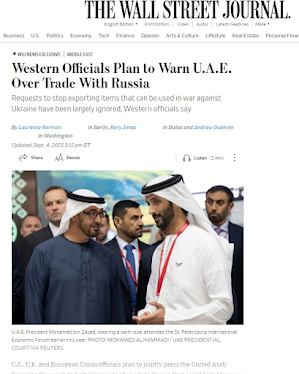
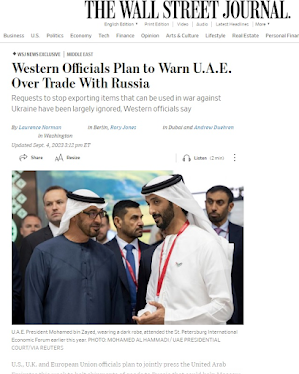
Officials from the US, UK, and EU are planning to “jointly press” the UAE into halting shipments of goods to Russia that "could help Moscow in its war against Ukraine,' according to western officials who spoke with the Wall Street Journal (WSJ).

Several US and European officials started a trip to the Gulf monarchy on 4 September “as part of a collective global push to keep computer chips, electronic components, and other so-called dual-use products” away from Russia.

Western envoys also traveled “jointly and separately” to countries such as Turkiye and Kazakhstan to pressure authorities into preventing western dual-use products from reaching Russia.


Despite ongoing pressure from the west, Abu Dhabi has not enforced sanctions imposed on Russia, instead deepening cooperation with the Kremlin. Nonetheless, the Gulf nation has condemned the invasion of Ukraine at the UN several times, and an Emirati official told the WSJ that the country enforces UN-imposed sanctions on Russia.


The official added the Gulf state is monitoring the export of dual-use products and is committed to protecting “the integrity of the global financial system.”


In response to the position taken by the UAE, US officials publicly labeled the UAE "a country of focus" earlier this year as they look to clamp down on Russia's ties with independent nations.


Dubai, in particular, has reaped the benefits of the Emirati government's neutrality, as Russian nationals have become the largest buying group of real estate in the luxurious Emirate, which has also become a hub for Russian oil traders.


The new pressure campaign from the west comes less than two weeks after the UAE was officially invited to join the Russian and Chinese-led BRICS+ group of nations. The expanded bloc also pledged to help Africa develop its local economy through investments by member states who have the cash and loans from the New Development Bank (BRICS bank). UAE, a country with cash that need to be invested, is taking advantage of this new opportunity.


The UAE pledged $4.5 billion in clean energy investments for the African continent on 5 September during the second day of the three-day African Climate Summit held in the Kenyan capital, Nairobi.


“We will deploy $4.5 billion … to jumpstart a pipeline of bankable clean energy projects in this very important continent,” Sultan Ahmed al-Jaber, the head of state-owned renewable energy firm Masdar and the Emirati national oil company ADNOC, told attendees on Tuesday.


“If Africa loses, we all lose,” warned Jaber, adding that the investment aims “to develop 15 GW (gigawatts) of clean power by 2030” and “catalyze at least an additional $12.5 billion from multilateral, public and private sources.”


Jaber, who is also president of the upcoming COP28 climate summit to be hosted by the UAE, said a consortium including Masdar would help achieve the clean power goals and stressed that a “surgical intervention of the global financial architecture that was built for a different era” is needed, urging institutions to lower debt burdens.


According to the International Renewable Energy Agency (IREA), Africa’s renewable generation capacity was 56 GW in 2022. Despite possessing an abundance of natural resources, just 3 percent of energy investments worldwide are made in Africa.


The three-day climate summit in Nairobi has attracted heads of state, government, and industry, including UN head Antonio Guterres, EU chief Ursula von der Leyen, and US climate envoy John Kerry.


“Renewable energy could be the African miracle, but we must make it happen,” Guterres told the summit on Monday. He also addressed the member states of the G20 to “assume your responsibilities” in the battle to combat climate catastrophe.


Kenyan President William Ruto said trillions of dollars in “green investment opportunities” would be needed as the climate crisis accelerates.


“Africa holds the key to accelerating decarbonization of the global economy. We are not just a continent rich in resources. We are a powerhouse of untapped potential, eager to engage and fairly compete in the global markets,” Ruto said.


Abu Dhabi sealed a deal with Egypt in June to build Africa's largest wind farm as the nation looks to rapidly expand the use of clean energy abroad and at home, where it operates three nuclear power reactors. The UAE also has three of the world's largest and lowest-cost solar plants. 


This focus on clean energy is part of the UAE’s Net Zero by 2050 Strategic Initiative.


The development of renewable energy sources has recently become a priority for Gulf states, including Saudi Arabia, which plans to source 50 percent of its energy requirements from renewables by 2030.


Keeping our readers informed about the most consequential events in this fast changing worldManage your Subscription; invite a friend to subscribe to ISR’s Weekly Review Bulletin

Tuesday, March 28, 2023

An investigative report reveals that some countries, including Saudi Arabia and the UAE, are secretly sending ammunition to Ukraine

    Tuesday, March 28, 2023   No comments

A report on the "Intelligence Online" website said that a number of countries, which are part of an alliance with Western countries and NATO, secretly send ammunition and military aid to Ukraine.

The report stated that a large group of these countries, "despite their formal neutrality, especially countries dealing with the military industry sector in the West, are indirectly helping the war effort to support Ukraine militarily, by secretly opening up its stockpiles of weapons in favor of Kiev."


The site investigated, in particular, the supply of French "Crotal" and "Mistral" missiles, anti-aircraft and air targets, short and medium range, and French "Milan" anti-tank missiles, for use against Russia.


Ukraine's extensive use of missiles and missiles is a motive for its allies to urgently find new military supplies, especially after Kiev's growing demands for more ammunition and weapons to be used against Russian forces.


French officials remain silent so far on this issue, and it seems that the participation of these countries came as part of an agreement at the level of Western countries and their allies, according to which these participating countries were requested.


According to information obtained in the relevant capitals, a group of neutral governments have officially opened their military stockpiles, in order to compensate for the shortage caused by dwindling Western ammunition stocks, after more than a year of conflict in Ukraine.

The information stated that "the UAE, Saudi Arabia and Qatar provided, within this framework, hundreds of "Mistral" anti-aircraft missile systems, which were delivered to Ukraine, thanks to the intermediary countries working for Kiev.

Other countries, officially involved in supporting Ukraine, such as Finland, supplied it with weapons and made it public. However, countries, such as the Gulf states, which have relations with Moscow, chose to maintain secrecy regarding the provision of "Mistral" missiles to Ukraine.


A few days ago, Ukrainian President Volodymyr Zelensky urged Europe to "strengthen the supply of modern weapons, expedite their dispatch, and impose tougher sanctions on Russia."


"It is up to the 27-nation bloc to take measures to contain Russia, more than a year after its war with Ukraine," Zelensky said, in a speech that expressed exceptional and frank frustration.


He pointed out that the European Union "was the one that postponed decisions on providing long-range weapons and modern combat aircraft, and moving forward with talks to grant Ukraine its membership."


Czech Republic announces the cessation of military assistance to Ukraine

This comes after the President of the Czech Republic declared that his country “can no longer help Ukraine militarily by supplying weapons,” due to “the shortage of its military depots,” and its “inability to adequately produce ammunition,” especially since its forces “are suffering significant deficiency."


According to the Czech president, his country "has the opportunity to expand production in the field of air defense and ammunition, but there is a problem due to a shortage of labor with the current unemployment rate, which is very low in the republic," noting that "a way out of the situation requires attracting workers from Ukraine."


Last week, US Secretary of State Anthony Blinken announced a new US military aid package worth $350 million to Ukraine, based on an authorization from US President Joe Biden, while the thirty-fourth withdrawal of US weapons and equipment from the stockpile allocated to the Ministry of Defense within a year.


Followers


Most popular articles


ISR +


Frequently Used Labels and Topics

40 babies beheaded 77 + China A Week in Review Academic Integrity Adana Agreement afghanistan Africa African Union al-Azhar Algeria Aljazeera All Apartheid apostasy Arab League Arab nationalism Arab Spring Arabs in the West Armenia Arts and Cultures Arts and Entertainment Asia Assassinations Assimilation Azerbaijan Bangladesh Belarus Belt and Road Initiative Brazil BRI BRICS Brotherhood CAF Canada Capitalism Caroline Guenez Caspian Sea cCuba censorship Central Asia Charity Chechnya Children Rights China Christianity CIA Civil society Civil War climate colonialism communication communism con·science Conflict conscience Constitutionalism Contras Corruption Coups Covid19 Crimea Crimes against humanity D-8 Dearborn Debt Democracy Despotism Diplomacy discrimination Dissent Dmitry Medvedev Earthquakes Economics Economics and Finance Economy ECOWAS Education and Communication Egypt Elections energy Enlightenment environment equity Erdogan Europe Events Fatima FIFA FIFA World Cup FIFA World Cup Qatar 2020 Flour Massacre Food Football France Freedom freedom of speech G20 G7 Garden of Prosperity Gaza GCC GDP Genocide geopolitics Germany Global Security Global South Globalism globalization Greece Grozny Conference Hamas Health Hegemony Hezbollah hijab Hiroshima History and Civilizations Hormuz Human Rights Huquq Ibadiyya Ibn Khaldun ICC Ideas IGOs Immigration Imperialism In The News india Indonesia inequality inflation INSTC Instrumentalized Human Rights Intelligence Inter International Affairs International Law Iran IranDeal Iraq Iraq War ISIL Islam in America Islam in China Islam in Europe Islam in Russia Islam Today Islamic economics Islamic Jihad Islamic law Islamic Societies Islamism Islamophobia ISR MONTHLY ISR Weekly Bulletin ISR Weekly Review Bulletin Italy Japan Jordan Journalism Kenya Khamenei Kilicdaroglu Kurdistan Latin America Law and Society Lebanon Libya Majoritarianism Malaysia Mali mass killings Mauritania Media Media Bias Media Review Middle East migration Military Affairs Morocco Multipolar World Muslim Ban Muslim Women and Leadership Muslims Muslims in Europe Muslims in West Muslims Today NAM Narratives Nationalism NATO Natural Disasters Nelson Mandela NGOs Nicaragua Nicaragua Cuba Niger Nigeria Normalization North America North Korea Nuclear Deal Nuclear Technology Nuclear War Nusra October 7 Oman OPEC+ Opinion Polls Organisation of Islamic Cooperation - OIC Oslo Accords Pakistan Palestine Peace Philippines Philosophy poerty Poland police brutality Politics and Government Population Transfer Populism Poverty Prison Systems Propaganda Prophet Muhammad prosperity Protests Proxy Wars Public Health Putin Qatar Quran Rachel Corrie Racism Raisi Ramadan Ramadan War Regime Change religion and conflict Religion and Culture Religion and Politics religion and society Resistance Rights Rohingya Genocide Russia Salafism Sanctions Saudi Arabia Science and Technology SCO Sectarianism security Senegal Shahed sharia Sharia-compliant financial products Shia Silk Road Singapore Slavery Soccer socialism Southwest Asia and North Africa Sovereignty Space War Spain Sports Sports and Politics Starvation State Power State Terror Sudan sunnism Supremacism SWANA Syria Ta-Nehisi Coates terrorism Thailand The Koreas Tourism Trade transportation Tunisia Turkey Turkiye U.S. Cruelty U.S. Foreign Policy UAE uk ukraine UN under the Rubble UNGA United States UNSC Uprisings Urban warfare US Foreign Policy US Veto USA Uyghur Venezuela Volga Bulgaria Wadee wahhabism War War and Peace War Crimes War on Iran Wealth and Power Wealth Building West Western Civilization Western Sahara WMDs Women women rights Work Workers World and Communities Xi Yemen Zionism

Search for old news

Find Articles by year, month hierarchy


AdSpace

_______________________________________________

Copyright © Islamic Societies Review. All rights reserved.