Showing posts with label Narratives. Show all posts

Wednesday, April 22, 2026

How Journalistic Narrative Shapes History—and Why Power Fears It

    Wednesday, April 22, 2026   No comments

The Pen and the Sword

History is a story we tell ourselves about who we are, where we came from, and what matters. And at the heart of that storytelling lies journalism—the "first rough draft of history," as the aphorism attributed to Washington Post publisher Philip Graham goes. But when those who wield power attempt to dictate that draft, the stakes for democratic memory rise dramatically.

Scholars have long recognized that narrative is not decorative in historical writing—it is foundational. As historian Jill Lepore notes, the revival of narrative in academic history parallels the emergence of narrative journalism, with both genres using storytelling techniques to make sense of complex events. Narrative history, when done well, integrates "story and context," moving from specific events to broader structures that help us understand causation and consequence.

Journalism plays a crucial role in this process. Through investigative reporting, eyewitness accounts, and contextual analysis, journalists document events as they unfold, creating the primary sources future historians will rely upon. But this process depends on editorial independence. When journalists lose their "prudent distrust" and become "guardians of official narratives," the historical record becomes distorted.


Recent events offer a stark case study. In an April 2026 post on Truth Social, Trump, a political leader ad president of the US, launched a blistering attack on The Wall Street Journal's editorial board, demanding that media outlets narrate history according to his preferred version of events. In his post, he claimed sweeping military victories, the obliteration of an adversary's capabilities, and the silencing of dissenting voices—all while criticizing journalists for reporting outcomes that complicated that narrative.

This moment reveals a profound tension: the desire to control historical memory through present-day media pressure. As research on political communication shows, leaders operate in a "mediatized environment" where their public image is constantly negotiated through news coverage. When that coverage includes scrutiny of policy failures or contradictions, some seek not to engage with the critique but to discredit the messenger.


The specific claims in the April 2026 post warrant careful examination. Fact-checking organizations have analyzed similar assertions about military outcomes in the war on Iran. While U.S., Israel, and Gulf allies who allowed their territories to be used to manage the war achieved significant tactical successes—including damage to Iranian naval, air defense, and missile infrastructure—experts caution against declaring "total victory."


Key contradictions emerge upon scrutiny:

  • Claims that an adversary's leadership has been "eliminated" sit uneasily alongside ongoing diplomatic outreach to that same government
  • Assertions of complete military degradation conflict with evidence of continued asymmetric capabilities, including drone and missile attacks
  • Declarations of economic collapse must be weighed against the adversary's demonstrated ability to leverage strategic chokepoints like the Strait of Hormuz

As independent fact-checking analyses note, "tactical battlefield victories do not always translate into actual victory in a war." History written in the heat of conflict often requires the cooling perspective of time to separate rhetoric from reality.


The insistence that media adopt a preferred narrative misunderstands how historical truth emerges. Truth does not bend to the application of brute force; it emerges through the accumulation of evidence, the scrutiny of multiple perspectives, and the patient work of verification. As the American Historical Association observes, journalists and historians share a commitment to "narrative structure that invites historical comparison, contemplation, and consequence."

A free press serves as what scholars call a "critical mechanism for ensuring transparency, accountability, and public engagement." When political figures attack media institutions for reporting inconvenient facts, they are not merely criticizing individual journalists—they are challenging the infrastructure through which democratic societies construct shared understanding.

There is a profound irony in demanding that history be written to one's liking while simultaneously dismissing the institutions that preserve historical record. As one analysis of media and politics notes, "interactions between politics and media turned more complex in recent years," but the fundamental principle endures: those who seek to control the narrative often reveal their anxiety about how they will be remembered.

History will be written. Primary sources—diaries, official documents, news reports, eyewitness accounts—will be gathered, evaluated, and interpreted by future scholars. The voices that dominate today's headlines may not hold the same weight tomorrow. As the Library of Congress reminds us, primary sources are "the raw materials of history," and their preservation depends on institutions that operate independently of transient political power.

The attempt to force media to narrate history according to a preferred script is not new. But in an era of fragmented information ecosystems, the stakes are higher. When journalistic narrative is subordinated to political messaging, the historical record suffers. When journalists maintain their commitment to verification, context, and accountability—even under pressure—they fulfill their essential role as stewards of democratic memory.

Truth may not win every news cycle. But as historians know, it has a powerful ally: time. And in the long arc of historical judgment, the narratives that endure are those built not on assertion, but on evidence; not on power, but on principle.

Wednesday, July 30, 2025

Media Review: Shifting Public Opinion and Israel’s Media Suppression Amid Gaza’s Devastation

    Wednesday, July 30, 2025   No comments

Sunday, April 21, 2024

Media Matters: Clash of views about Gaza, Palestine, human rights abuses, and Iranian retaliation on attack on its diplomatic mission in Syria

    Sunday, April 21, 2024   No comments

One of the most representative clashes between two worldviews: Iranian worldview versus Western worldview as represented in Piers Morgan's interview, debate with Iranian Professor Seyed Mohammad Marandi.


Morgan repeating the fabricated story of 40 babies beheaded by Hamas, to justify to mass killings in Gaza, and Mirandi referencing the investigative journalists and NGO reports that challenged the narrative of beheadings, and finding that Israeli forces have committed sexual violence and torture against Palestinians, turned Morgan flustered and rude. 

The interview is available on a number of Internet sites, and embedded from a couple of sites below.


Tuesday, December 26, 2023

Media review: Western warning against use of the term “Gaza genocide” despite the continued killing and displacement of people

    Tuesday, December 26, 2023   No comments

The New York Times: There is no food or water... Two million displaced people are living in a difficult crisis in southern Gaza

The American newspaper "The New York Times" revealed that the residents of the Gaza Strip are suffering from a lack of food or water, as well as from a lack of sanitation, with the Israeli aggression and siege continuing for the 81st day, noting that the humanitarian crisis has worsened since the end of the temporary truce, and because the occupation forced the population to evacuate some Regions.

The newspaper explained that more than 1.7 million displaced people were registered in shelters in the southern regions, including several hundred thousand people who cannot be accommodated within their walls, and who sleep along roads and in open spaces.


According to analysis of satellite images, damage caused by Israeli air strikes was identified in the vicinity of almost every shelter in the southern areas of Gaza, and in some cases the shelters were directly bombed, doubling the suffering of the displaced.


The newspaper confirmed that the Israeli bombing, especially which “was relentless during the first 6 weeks of the war,” also affected the areas “to which the occupation asked the residents of Gaza to move.”


She indicated that Rafah is the area most crowded with displaced people in the Strip, as data indicates that the United Nations shelters in Rafah host, on average, more than 15,000 registered people each, although most shelters are designed to accommodate only 2,000 people.


On the other hand, officials of relief organizations said that the region is not equipped to provide basic services to the displaced, noting that its 3 hospitals are only partially functioning, and people in shelters and camps live in difficult conditions with little food or water, and approximately 500 people share a toilet. One.


According to the World Food Programme, 93% of Gaza's population currently suffers from "severe food insecurity," and the UN Security Council issued a resolution calling for "large-scale" humanitarian aid to be delivered to the Gaza Strip.

Wednesday, September 27, 2023

A Dead Russian General Walking: A Ukrainian government run by amateurs and through PR

    Wednesday, September 27, 2023   No comments

For a country at war with a superpower, its leaders should be realistic and steady. So far, the leaders of Ukraine, both political leaders and military officers show no sign that they are up to the challenges they are facing. In the span of one week, the Ukrainian leadership committed two serious unforced errors that must be deeply embarrassing and, importantly, costly.

First, Ukrainian president visited Canada after his trip to the UN. In Canada, he ended up standing to honor a Nazi who fought Russia (these words should have made a middle school child realize that there is a problem in this narrative--since Russia was on the side of the allies against Germany then). 

Given that Russia’s main justification of its military operation in Ukraine was to stop Nazis from killing ethnic Russians in eastern Ukraine, the optics of honoring a Nazis who “fought the Russians” should be the last thing you want to do.

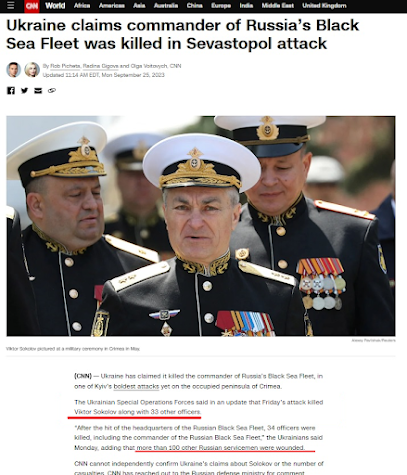
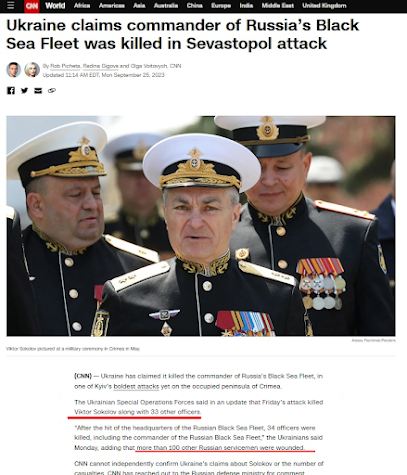
Second, after launching their first missile attack on a military installation in Crimea, Ukrainian leaders released the results of the strike: destruction of the building and the killing of 33 Russian officers, including the commanding general.

“After the hit of the headquarters of the Russian Black Sea Fleet, 34 officers were killed, including the commander of the Russian Black Sea Fleet, Viktor Sokolov.” the Ukrainians said Monday, adding that more than 100 other Russian servicemen were wounded.

You don’t have to be an experienced leader to know that you must be certain that the person you are naming is actually dead. Because if the person is not dead, the entire narrative collapses and so goes the credibility of the entire government.

Sure enough, Russia treated that mistake as a gift, and casually released footage of the General alive, without even commenting on Ukrainian claim, as if to say: Russia gives no attention to Ukrainian leaders.

The real problem for the world now is this: If Ukrainian leaders make such untrue claims about things that are easily proven wrong, how serious should the world take their claim of taking back all of the territory they lost, including Crimea?

The answer to this question could help put that crisis on the right path to a resolution and stop the killing.


Followers


Trending now...


ISR +


Frequently Used Labels and Topics

40 babies beheaded 77 + China A Week in Review Academic Integrity Adana Agreement afghanistan Africa African Union al-Azhar Algeria Aljazeera All Apartheid apostasy Arab League Arab nationalism Arab Spring Arabs in the West Armenia Arts and Cultures Arts and Entertainment Asia Assassinations Assimilation Azerbaijan Bangladesh Belarus Belt and Road Initiative Brazil BRI BRICS Brotherhood CAF Canada Capitalism Caroline Guenez Caspian Sea cCuba censorship Central Asia Charity Chechnya Children Rights China Christianity CIA Civil society Civil War climate colonialism communication communism con·science Conflict conscience Constitutionalism Contras Corruption Coups Covid19 Crimea Crimes against humanity D-8 Dearborn Debt Democracy Despotism Diplomacy discrimination Dissent Dmitry Medvedev Earthquakes Economics Economics and Finance Economy ECOWAS Education and Communication Egypt Elections energy Enlightenment environment equity Erdogan Europe Events Fatima FIFA FIFA World Cup FIFA World Cup Qatar 2020 Flour Massacre Food Football France Freedom freedom of speech G20 G7 Garden of Prosperity Gaza GCC GDP Genocide geopolitics Germany Global Security Global South Globalism globalization Greece Grozny Conference Hamas Health Hegemony Hezbollah hijab Hiroshima History and Civilizations Hormuz Human Rights Huquq Ibadiyya Ibn Khaldun ICC Ideas IGOs Immigration Imperialism In The News india Indonesia inequality inflation INSTC Instrumentalized Human Rights Intelligence Inter International Affairs International Law Iran IranDeal Iraq Iraq War ISIL Islam in America Islam in China Islam in Europe Islam in Russia Islam Today Islamic economics Islamic Jihad Islamic law Islamic Societies Islamism Islamophobia ISR MONTHLY ISR Weekly Bulletin ISR Weekly Review Bulletin Italy Japan Jordan Journalism Kenya Khamenei Kilicdaroglu Kurdistan Latin America Law and Society Lebanon Libya Majoritarianism Malaysia Mali mass killings Mauritania Media Media Bias Media Review Middle East migration Military Affairs Morocco Multipolar World Muslim Ban Muslim Women and Leadership Muslims Muslims in Europe Muslims in West Muslims Today NAM Narratives Nationalism NATO Natural Disasters Nelson Mandela NGOs Nicaragua Nicaragua Cuba Niger Nigeria Normalization North America North Korea Nuclear Deal Nuclear Technology Nuclear War Nusra October 7 Oman OPEC+ Opinion Polls Organisation of Islamic Cooperation - OIC Oslo Accords Pakistan Palestine Peace Philippines Philosophy poerty Poland police brutality Politics and Government Population Transfer Populism Poverty Prison Systems Propaganda Prophet Muhammad prosperity Protests Proxy Wars Public Health Putin Qatar Quran Rachel Corrie Racism Raisi Ramadan Ramadan War Regime Change religion and conflict Religion and Culture Religion and Politics religion and society Resistance Rights Rohingya Genocide Russia Salafism Sanctions Saudi Arabia Science and Technology SCO Sectarianism security Senegal Shahed sharia Sharia-compliant financial products Shia Silk Road Singapore Slavery Soccer socialism Southwest Asia and North Africa Sovereignty Space War Spain Sports Sports and Politics Starvation State Power State Terror Sudan Sunni Axis sunnism Supremacism SWANA Syria Ta-Nehisi Coates terrorism Thailand The Koreas Tourism Trade transportation Tunisia Turkey Turkiye U.S. Cruelty U.S. Foreign Policy UAE uk ukraine UN under the Rubble UNGA United States UNSC Uprisings Urban warfare US Foreign Policy US Veto USA Uyghur Venezuela Volga Bulgaria Wadee wahhabism War War and Peace War Crimes War on Iran Wealth and Power Wealth Building West Western Civilization Western Sahara WMDs Women women rights Work Workers World and Communities Xi Yemen Zionism

Search for old news

Find Articles by year, month hierarchy


AdSpace

_______________________________________________

Copyright © Islamic Societies Review. All rights reserved.