Showing posts with label Multipolar World. Show all posts

Saturday, March 14, 2026

Media review: Asymmetric Resistance and the Limits of American Power in the War on Iran

    Saturday, March 14, 2026   No comments

The Driver and the Machine


You can have the fastest car in the world, but if you are an average or poor driver, you won't be able to win the race. This analogy captures the strategic dilemma facing the Trump administration in its war on Iran, but it also reveals a deeper truth about the nature of modern conflict. There is no dispute that the U.S. military is the most powerful in the world—indeed, as the agency with the largest budget outside entitlement programs, it is the most armed, lethal, and destructive machine in human history. Yet, military capability alone does not guarantee strategic success. A military is only as effective as the political leadership that sets its goals, strategy, and timeline. Outcomes are determined not by raw power, but by the wisdom, foresight, and skill of those who wield it.


However, to view this conflict solely through the lens of American "victory" or "defeat" is to adopt a biased framework that ignores the agency, resilience, and strategic logic of the defender. In asymmetric warfare, the definition of victory is not symmetrical. For the aggressor, victory often means total domination, regime change, or the complete neutralization of a threat. For the defender, particularly a nation facing an existential threat from a superpower, victory is defined simply by survival. If the Iranian state remains standing, its institutions functioning, and its core sovereignty intact despite the onslaught of the world's most powerful military, then from Tehran's perspective, the aggression has already failed. This essay reviews media stories to examine the gap between tactical success and strategic failure, arguing that the inability of the United States to achieve its maximalist objectives speaks less to American weakness and more to the enduring power of resistance against overwhelming force.

The Aggressor's Dilemma: Seven Pillars of Strategic Stalemate


Analysts from CNN, Al Jazeera, and The Independent have identified at least seven interlocking reasons why the United States has not achieved a decisive victory, despite inflicting significant physical damage. These factors highlight the limits of kinetic power when divorced from political reality.

1. The Strait of Hormuz: The Weaponization of Geography

Iran's closure of the Strait of Hormuz transformed a military confrontation into a global economic crisis. While the U.S. Navy possesses unmatched firepower, reopening the Strait by force presents extraordinary risks. More importantly, Iran’s ability to hold the world’s energy supply hostage demonstrates that a regional power can leverage geography to offset conventional military inferiority. Even if the U.S. forcibly reopens the channel, the requirement for a permanent, resource-intensive naval presence signifies a strategic drain, not a victory.

2. The Resilience of the Iranian State

The assassination of Supreme Leader Ali Khamenei was intended to catalyze regime collapse. Instead, the swift appointment of Mojtaba Khamenei as successor signaled institutional continuity. Far from sparking the popular uprising Trump anticipated, the attacks appear to have reinforced the regime's narrative of external aggression. From Tehran’s viewpoint, the survival of the leadership structure amidst decapitation strikes is a testament to the depth of the state’s roots and a defeat for the U.S. objective of regime change.

3. Divergent Timelines and Alliance Friction

While Trump seeks a swift, politically marketable conclusion, Israel views security as a perpetual struggle. This misalignment complicates the U.S. exit strategy. Iran, conversely, operates on a timeline of generations. By absorbing the initial shock and prolonging the conflict, Tehran exploits the short-term political cycles of Western democracies, betting that American public patience will erode before Iranian resolve does.

4. The Unresolved Nuclear Question

Despite claims that U.S. strikes have "obliterated" Iran's nuclear program, international reports suggest Tehran retains stocks of highly enriched uranium. The inability to physically locate and destroy every gram of fissile material—a task requiring high-risk ground operations—means the core nonproliferation objective remains unfulfilled. The latent capacity to reconstitute the program remains a powerful deterrent and a symbol of technological resilience.

5. The Absence of Internal Collapse

Trump’s rhetoric framed the war as a liberation effort, expecting Iranians to rise up. No such uprising materialized. Instead, the security apparatus maintained control. This disconnect undermines the moral narrative of the intervention. For Iran, the lack of internal fracture despite massive external pressure validates the state’s claim to represent a significant portion of national sentiment, or at least its ability to enforce unity in the face of foreign invasion.


6. Regional Escalation as a Force Multiplier

The conflict has spilled beyond Iran’s borders, with Hezbollah, Iraqi militias, and Houthi forces intensifying operations. This "Axis of Resistance" strategy effectively expands the battlefield, stretching U.S. resources thin across multiple fronts. For Iran, activating these proxies transforms a bilateral conflict into a regional war of attrition, a domain where the superpower’s technological edge is diluted by the sheer complexity of the theater.

7. Domestic and Economic Blowback

Rising fuel prices and economic uncertainty have begun to erode U.S. public support. Unlike the post-9/11 rally effect, the war on Iran has generated immediate domestic pain. Iran’s strategy of targeting global energy markets directly impacts the American voter, turning the war’s cost into a political liability for the aggressor.

The Defender’s Perspective: Victory Through Survival and Resistance

To understand the full scope of this conflict, one must shift the perspective from Washington to Tehran. In the annals of military history, from Vietnam to Afghanistan, a consistent pattern emerges: when a superpower fails to achieve its rapid, decisive objectives against a determined regional actor, the defender claims a strategic victory.

For Iran, the metrics of success are fundamentally different. They do not need to invade the United States, sink its carrier groups, or bomb Washington D.C. to "win." Their objective is negative: to prevent the positive objectives of the aggressor.

  • Did the U.S. topple the government? No.
  • Did the U.S. permanently disarm Iran? No.
  • Did the U.S. force unconditional surrender? No.

By these measures, Iran has succeeded. The mere fact that the Islamic Republic continues to function, issue commands, and project power through its proxies after weeks of intense bombardment by the world's sole superpower is, in itself, a profound statement of resilience. As noted by The Independent, the war has exposed the limits of air power; bombs can destroy buildings, but they cannot easily destroy a political will forged in decades of isolation and perceived existential threat.

The Moral and Political Dimension

From the Iranian perspective, this war validates the doctrine of "resistance" (muqawama). The narrative that a smaller nation can stand toe-to-toe with the "Great Satan" and survive serves as a powerful ideological tool, not just domestically, but across the Global South. It challenges the notion of American invincibility. When the Wall Street Journal reports that U.S. bases in Saudi Arabia have been struck and tankers seized, it highlights that Iran retains the capacity to inflict pain, raising the cost of aggression to unacceptable levels.

Furthermore, the failure of the U.
S. to spark an internal revolution suggests that the American understanding of Iranian society was flawed. By underestimating the cohesion of the Iranian state—even among those who may disagree with the government—the U.S. played into the hands of hardliners who could point to the bombing raids as proof that the West seeks destruction, not democracy. In this light, every day the regime survives is a propaganda victory that offsets the physical damage inflicted by U.S. ordnance.

The Economic Counter-Strike

Iran’s decision to close the Strait of Hormuz and potentially trade oil in Yuan rather than dollars is not just a tactical move; it is a strategic challenge to the global order dominated by the U.S.. By threatening the global economy, Iran demonstrates that in an interconnected world, a regional power holds leverage that can paralyze a superpower. The resulting spike in gas prices in the U.S. serves as a tangible reminder to the American public that the war is not a distant video game, but a reality with immediate consequences. This economic resistance acts as a check on unlimited military escalation.

The Strategic Paradox: Truth vs. Narrative

The central paradox of this conflict is the divergence between the narrative of victory and the reality of stalemate. President Trump’s declaration—"We won, in the first hour"—stands in stark contrast to the unfolding reality of a widening war, rising costs, and an unyielding adversary (CNN).

This dissonance highlights a critical lesson: Truth has a way of offsetting oppressive and lies-driven actions. No amount of rhetorical flourish can permanently mask the facts on the ground:

  • The truth is that the Strait remains closed.
  • The truth is that Iranian missiles are still flying.
  • The truth is that the regime has not fallen.
  • The truth is that the American public is feeling the pinch at the pump.

When an aggressor relies on a narrative of easy victory that contradicts the lived experience of soldiers, civilians, and markets, the credibility of the leadership erodes. The "fog of war" eventually lifts, revealing that the "fastest car" has been driven into a ditch by a driver who refused to read the map.

For Iran, the "truth" of their survival is their strongest weapon. It proves that military superiority is not absolute. It demonstrates that a nation with fewer resources, if unified by a cause of national defense and equipped with asymmetric strategies, can blunt the spear of empire. This does not mean Iran is without suffering; the humanitarian cost, warned of by the WHO, is tragic and severe (Al Jazeera). But in the cold calculus of strategic objectives, the survival of the state against such odds redefines the balance of power in the Middle East.

The Endurance of the Defended

The war on Iran underscores a fundamental principle of statecraft that the Trump administration appears to have overlooked: the most powerful military in history cannot compensate for unclear objectives, unrealistic expectations, or the underestimation of an opponent’s will to resist.

Viewing the conflict fairly requires acknowledging that while the U.S. may claim tactical successes in destroying specific targets, it faces a strategic failure in achieving its overarching goals. Conversely, Iran, despite suffering immense physical damage and humanitarian hardship, has achieved a form of victory through endurance. By refusing to collapse, by keeping its command structure intact, and by leveraging its geographic and asymmetric advantages to impose heavy costs on the aggressor, Iran has demonstrated that resistance is a viable strategy against superior firepower.

Ultimately, the outcome of this war will not be decided by the tonnage of bombs dropped, but by the political staying power of the participants. If the United States withdraws without having achieved regime change or permanent disarmament, history will likely record this not as an American victory, but as another chapter in the long saga of imperial overreach meeting the unyielding wall of national resistance. In the race between the fast car and the skilled, determined driver who knows the terrain, the latter often finds a way to block the road. The truth of that resilience is the ultimate counterweight to the illusion of dominance.


Monday, March 02, 2026

Media Review: How a Unilateral Strike on Iran Threatens the Foundations of Global Order

    Monday, March 02, 2026   No comments

In the predawn darkness of late February 2026, the world watched as two allied powers crossed a threshold from which there may be no return. The United States and Israel launched a coordinated military assault on Iran, targeting not merely military installations but the very heart of its political leadership. Supreme Leader Ayatollah Ali Khamenei was killed. Dozens of senior officials perished. A school in southern Iran was struck, claiming the lives of children. And with that single act of force, the fragile architecture of international law—built painstakingly in the ashes of two world wars—began to crack.

This was not a defensive action. It was not a response to an imminent attack. By the admission of Pentagon officials themselves, there was no intelligence suggesting Iran was preparing to strike first. There were no smoking guns, no intercepted orders, no imminent threat that satisfied even the most permissive interpretations of self-defense under international law. What there was, instead, was a decision: a choice to act unilaterally, to bypass the United Nations, to abandon ongoing diplomacy, and to assert through force what could not be achieved through law.

The consequences of that choice ripple far beyond the Middle East. They strike at the heart of global economic stability and the security structures that have, however imperfectly, prevented great-power war for eight decades.

The Economic Precipice

The Strait of Hormuz is not merely a geographic feature; it is an artery of the global economy. Roughly twenty percent of the world's oil supply passes through its narrow waters. When Iran signals that US bases in the region will remain targets unless removed, and when retaliatory strikes already echo across Gulf states, the market does not hesitate. Oil prices surge. Shipping insurers recalculate risk. Supply chains tremble.

But the economic vulnerability runs deeper. The attack has shattered confidence in the predictability of international relations. Investors do not fear conflict alone; they fear the arbitrariness of conflict. When the world's most powerful military alliance demonstrates that it will act without legal authorization, without transparent evidence, and without regard for diplomatic process, the foundation of long-term planning erodes. Contracts become riskier. Capital becomes cautious. The delicate machinery of global trade, which depends on stable rules and predictable behavior, begins to seize.

Consider the ripple effects: European economies still recovering from energy shocks now face renewed uncertainty. Asian manufacturing hubs dependent on Middle Eastern energy confront potential disruption. Emerging markets, already strained by debt and inflation, brace for capital flight. This is not speculation; it is the logical consequence of replacing law with might. When force becomes the first resort rather than the last, every nation must prepare for a world where power, not principle, dictates outcomes.

The Collapse of Security Architecture

The United Nations Charter was designed precisely to prevent what has now occurred: unilateral wars of choice justified by self-defined threats. Its prohibition on the use of force, except in self-defense against an actual armed attack or with Security Council authorization, was not an idealistic aspiration. It was a hard-learned lesson from centuries of catastrophic war.

By acting outside this framework, the US and Israel have not merely violated a treaty; they have undermined the very logic of collective security. If powerful states can decide for themselves what constitutes a threat, when diplomacy has failed, and when force is justified, then the Charter becomes optional—a suggestion for the weak, a constraint to be ignored by the strong.

The precedent is perilous. What prevents other nuclear-armed powers from adopting the same logic? What stops regional rivals from citing this attack as justification for their own preventive strikes? The non-proliferation regime, already strained, faces existential doubt: if diplomatic engagement can be aborted by military action at any moment, why would any state relinquish its deterrent capabilities?

Even alliances are fracturing. Spain has refused to allow its bases to be used for further attacks. France has called for Security Council debate. Oman, which mediated talks, has condemned the abandonment of diplomacy. This is not mere disagreement; it is a recognition that the attack threatens the cohesion of the very partnerships that underpin global security. When allies begin to distance themselves from unilateral aggression, the foundation of collective defense weakens.

The Sovereignty Double Standard: A Self-Condemnation in Plain Sight

Nowhere is the incoherence of the attackers' position more starkly revealed than in their response to Iran's retaliation. Hours after Iranian forces struck back against military assets and logistics centers used in the initial assault, the United States issued a joint statement with Bahrain, Jordan, Kuwait, Qatar, Saudi Arabia, and the United Arab Emirates. The declaration denounced Iran's actions in unequivocal terms: "These unjustified strikes targeted sovereign territory, endangered civilian populations, and damaged civilian infrastructure."

The statement is remarkable not for what it says, but for what it omits. There is no mention of Iran's sovereignty. No acknowledgment that the strikes Iran retaliated against were launched against its territory, its leadership, and its civilian infrastructure. No reference to the school hit in southern Iran, or to the assassination of a leader of state during ongoing diplomatic talks. The principle of sovereignty—so fiercely invoked when convenient—is silently abandoned when it protects the vulnerable rather than the powerful.

This is not diplomacy. It is not law. It is a performative contradiction that reasonable observers recognize for what it is: a self-condemnation. To attack a sovereign nation without authorization, then invoke that same sovereignty to condemn the victim's response, is not a coherent legal position. It is an admission that the rules apply only in one direction. It reveals a worldview in which sovereignty is not a universal right, but a privilege granted selectively by those with the power to enforce their preferences.

The danger of this double standard extends far beyond rhetoric. It erodes the foundational doctrine of non-aggression that has, however imperfectly, served as a brake on endless war. That doctrine holds that peace is not the absence of conflict among the powerful, but the presence of equal protection under law for all nations. When that principle is fractured—when aggression is legitimized for some and criminalized for others—the entire edifice of international order begins to tilt.

The Rhetoric of Supremacy

Perhaps the most dangerous element of this crisis is not the bombs themselves, but the language used to justify them. "We did not start this war," declared a senior US official, moments before adding, "We set the terms of this war from start to finish." This is not contradiction; it is doctrine. It is the assertion that the United States reserves the right to define reality—to decide when a conflict begins, who is an aggressor, and what constitutes legitimate self-defense—regardless of evidence, international consensus, or the sovereignty of others.

This rhetoric reveals a deeper assumption: that certain lives matter less than others. When Iranian officials are targeted and killed, it is framed as necessary counterterrorism. When Iranian civilians die, including children in a school strike, it is regrettable but incidental. When Iran retaliates against military bases, it is condemned as indiscriminate escalation. The asymmetry is not accidental; it is ideological. It treats the sovereignty and security of non-Western nations as inherently subordinate to the strategic preferences of imperial powers.

Such thinking is not new. It is the character of empires throughout history: the belief that their interests are universal, their actions inherently legitimate, and their victims collateral to a greater good. But in a world of nuclear weapons, interconnected economies, and rising multipolarity, this arrogance is not merely morally bankrupt—it is existentially dangerous.

Law or Chaos?

Iran has made its position clear: US bases in the region will remain targets unless removed. Retaliation will continue. The cycle of violence is accelerating, not because diplomacy failed, but because it was deliberately abandoned. Every missile launched, every base struck, every civilian casualty deepens the crisis and narrows the space for de-escalation.

The international community now faces a stark choice. It can accept the normalization of unilateral preventive war, allowing might to supersede law and setting a precedent that will inevitably be used against weaker states—and eventually, against the powerful themselves. Or it can reaffirm the principles that have, however imperfectly, maintained a measure of order: that sovereignty matters, that evidence must precede action, that diplomacy must be exhausted, and that the use of force requires collective legitimacy.

The double standard exposed in the wake of Iran's retaliation is not a minor diplomatic inconsistency. It is a reminder that the principle of non-aggression cannot be a selective doctrine. Peace cannot be secured by granting some nations the right to attack while denying others the right to defend. If sovereignty is to mean anything, it must mean the same thing for Tehran as it does for Washington, for Riyadh as for Ramallah.

The stakes could not be higher. This is not merely a regional conflict. It is a test of whether the post-1945 international system can survive the actions of those who helped create it. If the rules apply only when convenient to the powerful, they are not rules. They are suggestions. And a world governed by suggestions, rather than law, is a world where every dispute becomes a potential catalyst for catastrophe.

The attack on Iran was more than a military operation. It was a statement: that some nations believe they stand above the law. The question now is whether the rest of the world will accept that premise—or whether it will defend the fragile, essential idea that no state, however powerful, is entitled to wage war by its own decree. 

Monday, February 23, 2026

Media Review: Geopolitics, Technology, and the US-Iran Tension

    Monday, February 23, 2026   No comments

In recent weeks, heightened rhetoric around Iran's nuclear program has dominated headlines. US Special Envoy Steve Witkoff stated on Fox News that Iran could be "a week away from having industrial-grade bomb-making material." However, credible reporting provides crucial context: following joint US-Israeli strikes in June 2025 that destroyed Iran's centrifuges and nuclear infrastructure, US and Israeli intelligence assessments currently place Iran "at least two years away from being able to produce a nuclear weapon." This discrepancy between political messaging and intelligence assessments raises an important question: what truly drives the current escalation?

While non-proliferation remains a stated priority, a growing body of analysis suggests that US strategic concerns extend beyond the nuclear file to encompass the deepening alignment between Iran, China, and Russia—a convergence that could reshape regional power dynamics and challenge Western technological and diplomatic influence.

The foundation for this alignment was formalized in the 2021 China-Iran 25-Year Comprehensive Strategic Partnership Agreement. Recent reporting confirms the agreement is actively being implemented, with Iranian officials stating it is "progressing" and serving as a "cornerstone" of bilateral ties. While some analyses note implementation challenges, the strategic intent is clear: deepen economic, energy, and security cooperation.

China's Belt and Road Initiative positions Iran as a critical energy supplier and transit corridor. Beijing has repeatedly warned that military escalation against Iran would "destabilize the region and threaten its Belt and Road investments and energy security." This is not merely diplomatic posturing; it reflects tangible economic stakes.

Several reports describe China assisting Iran in reducing dependence on Western-controlled technology—a move with significant security implications:

  • Satellite Navigation: Iran has publicly explored adopting China's BeiDou satellite navigation system as an alternative to US-controlled GPS. Iranian officials cited GPS disruptions during the 2025 conflict as a key motivator. While some niche outlets claim Iran has "fully replaced" GPS with BeiDou, broader reporting indicates this is an ongoing transition aimed at enhancing "digital sovereignty" and military resilience.
  • Cybersecurity Cooperation: According to analysis from Modern Diplomacy, China has encouraged Tehran to strengthen digital infrastructure by adopting encrypted Chinese systems to counter intelligence penetration. While Modern Diplomacy is an independent analysis platform rather than a wire service, its reporting aligns with documented patterns of Sino-Iranian security cooperation noted by the Institute for the Study of War.
  • Air Defense Capabilities: Multiple reports indicate Iran has deployed China's YLC-8B long-range anti-stealth radar. While these outlets are not mainstream wire services, the technical plausibility of such a transfer is consistent with the deepening military-technical cooperation between the two countries. Independent verification from major defense publications would strengthen this claim.

The convergence of Iranian, Chinese, and Russian interests presents a strategic challenge for Washington. As noted in analysis from the Critical Threats Project, "Iran likely seeks Chinese support to strengthen its domestic security and repressive capabilities." From Beijing's perspective, supporting Iran serves multiple objectives: securing energy flows, advancing BRI infrastructure, and creating a counterweight to US influence in a strategically vital region.

Some analysts argue that US pressure on Iran is partly motivated by a desire to prevent this trilateral alignment from solidifying further. A report in The Jerusalem Post contextualized Witkoff's nuclear comments within broader US efforts to establish "very hard red lines" regarding Iran's enrichment capabilities. However, the same reporting acknowledges ongoing diplomatic channels, with US-Iran talks scheduled to resume in Geneva.

China's position is unambiguous: it "categorically rejects" military threats against Iran and emphasizes diplomatic solutions. Beijing has warned that "military adventurism" in the Middle East would destabilize global energy markets—a direct reference to its own economic interests. This stance positions China as a potential mediator while simultaneously strengthening its partnership with Tehran.

Attributing US policy toward Iran solely to a desire to disrupt China-Russia ties would be an oversimplification. Legitimate non-proliferation concerns, regional security dynamics involving Israel and Gulf states, and domestic political factors all play significant roles. However, dismissing the geopolitical dimension would also be inaccurate.

The evidence supports several verified conclusions:

  • Public claims about Iran's immediate nuclear breakout capability conflict with current intelligence assessments.
  • The China-Iran strategic partnership is actively being implemented, with cooperation expanding in technology and security domains.
  • Iran is actively seeking to reduce technological dependencies on Western systems, with China positioned as a key alternative partner.
  • China views regional stability as essential to its economic interests and has explicitly opposed military escalation against Iran.

Relations with Russia

After inking the agreement with China, Iran signed a similar strategic agreement with Russia that was finalized and ratified last year. The terms of that agreement are also being implemented now. It has been reported recently that Iran signs secret $589 million missile deal with Russia. According to the Financial Times, Iran has signed a secret $589 million arms deal with Russia to obtain thousands of advanced shoulder-fired missiles.

The agreement, reportedly signed in Moscow in December, obligates Russia to supply 500 man-portable "Verba" launch units and 2,500 "9M336" missiles over three years, the FT said, citing leaked Russian documents and sources familiar with the deal.

Deliveries are planned in three tranches from 2027 to 2029, according to the FT. The negotiations took place between Russian state arms exporter Rosoboronexport and the Moscow representative of Iran's Ministry of Defense and Armed Forces Logistics, the FT reported. Tehran officially requested the systems last July, as indicated in a contract seen by the FT.


The current tensions around Iran cannot be reduced to a single motive. While the nuclear file remains central, the broader context of great-power competition adds layers of complexity. China's efforts to support Iran's technological sovereignty and security capabilities are documented, though the precise scope of some transfers requires verification from primary defense sources.

A fact-based approach acknowledges that US policy likely seeks to address multiple objectives simultaneously: preventing nuclear proliferation, maintaining regional alliances, and managing strategic competition with China and Russia. Similarly, China's engagement with Iran serves its own strategic interests in energy security, infrastructure development, and multipolar diplomacy.

As negotiations continue in Geneva, the path forward will require distinguishing between verified capabilities and political rhetoric, and recognizing that in an interconnected world, regional conflicts inevitably resonate across global power structures. Sustainable solutions will depend on addressing legitimate security concerns on all sides while preventing escalation that could destabilize the broader international order.

Friday, February 06, 2026

Scientists Report Compact Weapon Prototype Capable of Disrupting Low-Orbit Satellites

    Friday, February 06, 2026   No comments

New research published in a Chinese scientific journal describes engineering advances in high-power microwave technology—raising questions about the future vulnerability of satellite constellations like Starlink

Researchers at China's Northwest Institute of Nuclear Technology have developed what they describe as the world's first compact driver for a high-power microwave (HPM) weapon system capable of delivering 20 gigawatts of power for up to 60 seconds—a dramatic leap in duration compared to existing systems.


The device, designated TPG1000Cs, measures just four meters long and weighs five tonnes—compact enough to potentially be mounted on trucks, warships, aircraft, or even satellites, according to a paper published December 30 in High Power Laser and Particle Beams, a Chinese peer-reviewed scientific journal. The research team, led by Wang Gang from the Key Laboratory on Science and Technology on High Power Microwave at the Northwest Institute of Nuclear Technology (NINT) in Xi'an, Shaanxi province, reported the system has already accumulated more than 200,000 operational pulses during testing.

The researchers achieved this performance through several design breakthroughs. They replaced high-strength steel components with aluminum alloy, reducing the system's weight by approximately one-third. Insulating plates were etched with wavy grooves to lengthen the electrical surface path and prevent discharges—a principle analogous to how winding mountain roads prevent vehicles from taking dangerous shortcuts. Perhaps most significantly, the team redesigned energy storage components from traditional long, straight tubes into a dual-U-shaped structure that allows energy to "bounce back and forth," achieving equivalent performance in half the physical space.

These innovations reportedly enable the TPG1000Cs to deliver up to 3,000 high-energy pulses in a single session—far exceeding the capabilities of comparable systems. For context, Russia's Sinus-7 driver, according to available reports, can operate for approximately one second while delivering roughly 100 pulses per burst and weighs around 10 tonnes.

The development arrives amid growing strategic concerns about satellite constellations in low Earth orbit (LEO). Chinese military researchers have repeatedly warned that systems like SpaceX's Starlink pose national security challenges due to their potential military applications—including battlefield communications, precision navigation, and intelligence gathering.

Experts cited in the South China Morning Post report estimate that ground-based microwave weapons with outputs exceeding 1 gigawatt could severely disrupt or potentially damage Starlink satellites operating in LEO. This vulnerability is heightened by SpaceX's recent decision to lower Starlink satellites' orbital altitude to reduce collision risks—a move that inadvertently brings them closer to potential ground-based directed-energy threats.

HPM weapons operate by emitting focused electromagnetic energy that can penetrate electronic systems through antennas or other apertures—a phenomenon known as "front-door" coupling—potentially frying circuitry or causing temporary disruption without physical destruction.

Critical context often missing from sensationalized coverage: the TPG1000Cs remains a research prototype documented in a scientific journal, not a confirmed operational weapons system deployed by the People's Liberation Army. Publication in an academic venue suggests this represents an engineering milestone in component development rather than a battlefield-ready capability.

Furthermore, successfully disrupting satellites in controlled laboratory conditions differs substantially from reliably engaging fast-moving targets hundreds of kilometers away through Earth's atmosphere—a challenge involving precise targeting, power projection over distance, and overcoming atmospheric attenuation of microwave energy.

China's interest in counterspace capabilities reflects broader global trends. The United States, Russia, and other spacefaring nations have long researched directed-energy weapons for both defensive and offensive applications. What makes China's reported progress notable is the claimed combination of high power output, extended duration, and compact form factor—attributes that could theoretically enable more flexible deployment options if the technology matures.

Beijing has expressed particular concern about Starlink's integration with Western military operations, including its documented use by Ukrainian forces during the Russia-Ukraine conflict. Chinese defense analysts have published papers exploring various "Starlink killer" concepts, including lasers and electronic warfare systems, as potential asymmetric responses to proliferated satellite constellations.

While the TPG1000Cs represents a significant engineering achievement on paper, numerous hurdles remain before such technology could transition from laboratory prototype to operational weapon system. These include power generation requirements, thermal management during sustained firing, precise targeting systems for orbital objects traveling at approximately 27,000 kilometers per hour, and the political consequences of demonstrating anti-satellite capabilities that could trigger debris-generating conflicts in space.

As satellite constellations become increasingly vital to both civilian infrastructure and military operations worldwide, developments in counterspace technology will continue to shape strategic calculations—and underscore the fragility of our orbital commons. For now, the TPG1000Cs stands as a reminder that the next battlefield may extend far above our atmosphere, where invisible beams of energy could determine the outcome of future conflicts.

Sunday, January 18, 2026

Media Review: U.S. Multitrack Foreign Interventions Push Superpower to the Brink

    Sunday, January 18, 2026   No comments
In a world already teetering on the edge of geopolitical realignment, the United States—under President Donald J. Trump’s second administration—has launched an unprecedented wave of coercive foreign interventions that may be testing the very limits of superpower endurance. From Arctic ambitions to Middle Eastern brinkmanship and African strategic contests, Washington’s simultaneous pressure campaigns across multiple continents are triggering a global counter-reaction with historic implications.

The Greenland Gambit: Tariffs as Geopolitical Leverage


At the heart of this escalation lies a surreal yet strategically serious episode: the U.S. demand for the “complete and total purchase of Greenland.” In a January 2026 Truth Social post, President Trump declared that national security—and even “World Peace”—depends on American control of the Danish autonomous territory. Citing the need to integrate Greenland into the so-called “Golden Dome” missile defense system, Trump announced sweeping tariffs on eight European nations—Denmark, Norway, Sweden, France, Germany, the UK, the Netherlands, and Finland—starting at 10% in February and rising to 25% by June unless a deal is struck.

The move stunned allies and adversaries alike. French President Emmanuel Macron responded swiftly, declaring on X (formerly Twitter): “No intimidation or threat will influence us—neither in Ukraine, nor in Greenland, nor anywhere else.” He emphasized that European participation in Danish-led Arctic exercises was a matter of continental security, not provocation. The EU has signaled a unified response, warning that tariff coercion over sovereign territory sets a dangerous precedent.

Greenland, though small in population, sits at the nexus of Arctic resource competition and emerging military corridors. But Trump’s framing—equating tariff policy with planetary survival—reveals a broader strategy: using economic instruments not just as leverage, but as weapons of submission.


A Global List of Targets: From Caracas to Pretoria

This approach extends far beyond the Arctic. In a brazen operation reminiscent of Cold War-era coups, the U.S. executed a “made-for-TV” abduction of Venezuela’s president and his wife from their bedroom—an act designed less for regime change alone than for psychological deterrence. The message was clear: defiance invites humiliation.

The list of targeted nations now reads like a who’s who of global resistance: Cuba, Mexico, Colombia, Iran, Nigeria, South Africa—even close partners like Denmark. Each faces a tailored mix of sanctions, tariffs, military posturing, or covert pressure. Yet unlike past eras of unipolar dominance, today’s targets are not isolated. Many are turning to Beijing and Moscow for support, accelerating a multipolar realignment.

Nowhere is this more evident than in South Africa. Following BRICS+ naval exercises involving Russia, China, and Iran off its coast, Washington issued sharp condemnations, calling Pretoria’s actions a threat to U.S. national security. But rather than cowing South Africa, the rebuke galvanized deeper strategic cooperation among non-Western powers.

The Iranian Flashpoint: When Deterrence Worked


Perhaps the most dramatic test came in early January 2026. After the U.S. ordered all citizens to evacuate Iran—a classic prelude to military action—and positioned the USS Gerald R. Ford carrier strike group in the Persian Gulf, war seemed imminent. Trump declared “all options are open” and slapped 25% tariffs on any nation trading with Tehran, aiming for total economic isolation.

But Iran did not buckle. Millions of its citizens took to the streets in a show of nationalist resolve. More critically, Russia and China intervened—not with rhetoric, but with credible threats. According to intelligence sources, Russian President Vladimir Putin delivered a stark ultimatum: if the U.S. launched a full-scale war, Moscow would supply Iran with advanced anti-ship missiles capable of sinking an American aircraft carrier. Simultaneously, China drew its own red line, opposing any use of force.

The result? A stunning reversal. Within 48 hours, internal dissent within the U.S. national security apparatus—led by Vice President JD Vance and senior generals—forced a retreat. The Abraham Lincoln carrier, originally en route to the South China Sea, was diverted to the Gulf, exposing critical gaps in U.S. global force projection. Trump’s “72-hour countdown” evaporated into a two-week diplomatic window.

This episode marked a turning point: the first time in decades that coordinated great-power deterrence successfully checked American military adventurism.

The Starlink Shadow War: Electronic Frontiers

Even in the realm of information warfare, the U.S. finds itself outmaneuvered. Unconfirmed reports suggest Iran is now deploying Russia’s “Tobol” electronic warfare system—a satellite-jamming platform proven in Ukraine—to neutralize Starlink terminals used by rioters. If verified, this would represent a major leap in asymmetric capabilities, turning Elon Musk’s commercial satellite network into a vulnerability rather than an asset.

Should mobile variants of Tobol reach battlefields like Ukraine or the South China Sea, the U.S. and its allies could face sudden communication blackouts during critical operations. The irony is palpable: a technology hailed as a tool of democratic resistance may become a vector for detection and destruction.

Regime Change Redux—and Its Limits

Despite these setbacks, the Trump administration continues to openly advocate for regime change in Iran. “It’s time to look for new leadership,” Trump declared, calling Iran “the worst place to live” and blaming Supreme Leader Ali Khamenei for internal unrest. Yet such rhetoric rings hollow when the U.S. lacks the capacity to enforce it—militarily, economically, or diplomatically.

The core problem is overextension. Attempting to simultaneously coerce Europe over Greenland, destabilize Latin America, contain China in the Pacific, confront Russia in Eurasia, and overthrow regimes in the Middle East is a strategy no single power—even a superpower—can sustain indefinitely. The world is no longer unipolar; it is contested, interconnected, and increasingly resistant to unilateral diktats.

A New Era of Multipolar Deterrence

What we are witnessing is not merely a series of crises, but the birth pangs of a new international order. The U.S. remains powerful, but its ability to dictate outcomes is waning. Russia and China, once reactive, are now proactive—coordinating military drills, sharing advanced technologies, and offering alternative security architectures to nations weary of American pressure.

As French President Macron implied, sovereignty is no longer a privilege granted by Washington—it is a right asserted by nations, often in concert. The lesson of January 2026 is clear: in a multipolar world, even the strongest empire can overreach. And when it does, the world pushes back—not with declarations, but with fleets, tariffs, and the quiet calculus of mutual deterrence. The 20th century ended with American triumphalism. The 21st may be defined by its limits.

Friday, January 16, 2026

Historic China-Canada Trade Reset Signals a Shifting Global Order

    Friday, January 16, 2026   No comments

 In a landmark diplomatic and economic breakthrough, Canada and China have agreed to slash bilateral tariffs on key goods—including electric vehicles (EVs), canola, and seafood—marking what Canadian Prime Minister Mark Carney called a “historic reset” of relations strained for nearly a decade. The agreement, finalized during Carney’s state visit to Beijing—the first by a Canadian prime minister since 2017—comes not only in the wake of long-standing trade tensions but also amid growing global resistance to America’s increasingly unilateral economic coercion.

The Enduring Fallout of Trump-Era Protectionism—and Its Escalation


The roots of today’s China-Canada trade thaw lie in the turbulence unleashed by the Trump administration’s aggressive tariff regime. Beginning in 2018, Washington imposed sweeping duties on Chinese goods, triggering retaliatory measures from Beijing and setting off a chain reaction that ensnared allied economies like Canada’s. When Ottawa aligned with U.S.-led sanctions on Chinese EVs in 2024—imposing a blanket 100% tariff—Beijing responded by targeting Canadian agricultural exports, particularly canola, with tariffs soaring to 84%. The fallout was swift: by 2025, China’s imports of Canadian goods had dropped by 10.4%, hitting farmers and rural communities hardest.


Now, both nations are stepping back from the brink. Under the new deal, Canada will allow up to 49,000 Chinese EVs annually at a reduced 6.1% most-favored-nation tariff, while China will lower its canola seed tariff to approximately 15%. The changes take effect March 1, 2026, and are expected to unlock billions in trade across agriculture, fisheries, and clean tech sectors.


But this reset is not just about mending past wounds—it’s a strategic recalibration in response to a broader American policy trend that threatens global economic stability.


New U.S. Tariffs on Iran Partners Backfire Before They Even Take Effect

Adding fuel to this realignment is the Biden administration’s recently announced plan to impose 25% punitive tariffs on any country that conducts significant trade with Iran—a move ostensibly aimed at isolating Tehran but one that risks alienating two of the world’s largest economies: China and India. Both nations are among Iran’s top trading partners, with China alone importing over $20 billion in Iranian oil annually under long-term energy agreements, often settled in yuan or rupees to bypass U.S. financial controls.


Rather than compelling compliance, this latest U.S. sanction threat is accelerating a counter-movement. Countries unwilling to sacrifice lucrative partnerships with Iran—or bow to Washington’s extraterritorial demands—are deepening ties with China as a hedge against American economic coercion. The Canada-China deal is just the latest example. Similar overtures are already underway from Gulf states like the UAE and Saudi Arabia, which—while maintaining security ties with the U.S.—are quietly expanding yuan-denominated trade, joint infrastructure projects, and technology partnerships with Beijing.

As one Asian diplomat recently confided: “If doing business with half the world means being punished by Washington, then we must build alternatives that don’t depend on it.”

Prime Minister Carney made this shift explicit. Speaking after his meeting with President Xi Jinping, he warned that “the architecture, the multilateral system is being eroded—undercut.” His reference to a “new global order” reflects a sober recognition: the era of unquestioned U.S. economic leadership is ending—not because of Chinese aggression, but because of American overreach.

President Xi reinforced this vision, stating: “A divided world cannot address the common challenges facing humanity. The solution lies in upholding and practicing true multilateralism.” Notably, both leaders pledged to expand cooperation in green technology, critical minerals, and food security—sectors central to future economic sovereignty.

Carney set an ambitious goal: a 50% increase in Canadian exports to China by 2030. Achieving it would not only revive rural economies but also position Canada as a pragmatic player in a multipolar trade system—one where loyalty is earned through partnership, not enforced through tariffs.


The Self-Defeating Logic of Economic Coercion

The irony is stark. By wielding tariffs as weapons—first against China, now against any nation engaging with Iran—the United States is not strengthening its global position but weakening it. Each new sanction pushes traditional allies and neutral economies closer to Beijing’s orbit, not out of ideological alignment, but out of economic necessity and strategic self-preservation.

The Canada-China reset is not an isolated event. It is a harbinger. As more nations conclude that reliance on U.S. markets comes with unacceptable political risk, they will seek alternatives. And China—offering market access without political strings—is ready to fill the void. In the long run, America’s tariff wars may succeed only in hastening the very multipolar world it fears.

Saturday, January 10, 2026

GCC is on the line: How Bahrain Emerged as a New Front in the Growing Saudi-Emirati Rift

    Saturday, January 10, 2026   No comments

Media review: An exclusive report from Darkbox (France)

Confidential sources revealed to Darkbox that Saudi forces, specifically the Peninsula Shield Force, withdrew from Bahrain following a sharp political and security dispute between Saudi Arabia and the Bahraini government.

According to these sources, the withdrawal was neither routine nor planned, but rather a consequence of escalating tensions between Riyadh and Abu Dhabi, with Manama finding itself caught in the middle.

The sources describe this move as highly unusual, given the long-standing Saudi military presence in Bahrain and the Kingdom's traditional role as a key guarantor of Bahrain's security. They say the decision to withdraw the forces came after a breakdown in coordination and trust, resulting from what Saudi officials perceived as Bahrain's alignment with Emirati positions that conflicted with Saudi interests.


Tuesday, December 30, 2025

China’s “Justice Mission 2025” Drills Signal Strategic Shift Around Taiwan

    Tuesday, December 30, 2025   No comments

In a powerful display of military coordination and strategic messaging, China’s People’s Liberation Army (PLA) has concluded the second day of its expansive “Justice Mission 2025” joint military drills encircling Taiwan. The maneuvers, which began on December 29, represent far more than routine training—they constitute a calibrated assertion of Beijing’s resolve to deter “Taiwan independence” and block foreign interference, particularly from the United States and Japan.

The exercises, orchestrated by the PLA Eastern Theater Command, brought together integrated forces from the Army, Navy, Air Force, and Rocket Force. Live-fire drills on Tuesday morning targeted waters north of Taiwan, followed by simulated joint strikes to the south in the afternoon. According to official reports, every rocket launched from long-range modularized rocket systems struck its intended target—a demonstration not only of precision but of psychological pressure.

“This series of exercises demonstrates our strong capability to seize comprehensive control of the Taiwan Strait,” said Zhang Chi, a professor at China’s National Defense University. He emphasized that the drills combined “blockade and strike” operations across multiple domains—sea, air, land, and cyber—to enforce what Beijing describes as “multidimensional isolation” of the island.

A Three-Tiered Operational Framework

Zhang outlined the spatial architecture of the drills in three concentric arcs:

  1. Nearshore enforcement: China Coast Guard (CCG) vessels patrolled contested waters near Matsu and Wuqiu, enforcing maritime law and signaling administrative control.
  2. Encirclement of Taiwan: Naval and air assets pressed closer to the island, overseeing critical sea lanes and chokepoints, effectively disrupting civilian air traffic—941 flights were reportedly affected on Monday alone.
  3. Eastern theater projection: In the Pacific-facing waters east of Taiwan, the PLA conducted anti-submarine operations, air superiority drills, and amphibious raids using elite forces and unmanned systems, underscoring its readiness to interdict external reinforcements.

A provocative “Throat-Choking” poster released by the CCG depicted the interception of a Taiwanese cargo ship allegedly carrying U.S.-made HIMARS rocket launchers—highlighting Beijing’s focus on cutting off military supply lines as part of its coercive strategy.


Political Messaging and Domestic Repercussions

The timing of the drills is no coincidence. They follow a major U.S. arms sale to Taiwan worth $11.1 billion and escalating rhetoric from Taipei under President Lai Ching-te, whose approval ratings have slumped—52.2% of Taiwanese now express dissatisfaction with his leadership, according to a December poll.

Meanwhile, China is coupling military pressure with diplomatic outreach. Song Tao, head of the Communist Party’s Taiwan Affairs Office, met with nearly 200 Taiwanese business leaders during the drills, urging them to oppose “Taiwan independence” and support peaceful reunification. This dual-track approach—“tough on the tough, soft on the soft”—reflects Beijing’s evolving Taiwan policy, aimed at dividing pro-independence elites from the broader public and business community.

Despite the scale of the exercises, Washington’s response has been conspicuously muted. When asked by CBS News, the Pentagon offered “nothing to say,” while former U.S. President Donald Trump downplayed the drills as routine, saying, “They’ve been doing this for 20 years.”

But analysts suggest this restraint may mask strategic realism. “The mainland not only has vast numerical superiority, it now has qualitative superiority across the board—in weaponry and probably in training as well,” noted Lyle Goldstein of the U.S.-based think tank Defense Priorities.

Japanese media, including Nikkei and Jiji Press, interpreted the drills as a direct warning to Tokyo not to intervene in any future cross-strait contingency. A senior Japanese defense official acknowledged the exercises as a serious escalation, pledging to “stay vigilant.”


The Shadow of Taipei 101

Adding symbolic weight to the maneuvers, the PLA released drone footage on Monday showing Taipei 101—the island’s iconic skyscraper—under the shadow of Chinese military aircraft. The image resurrected a haunting prediction made a year ago by former Taiwanese security chief Su Chi: that if PLA jets ever photographed Taipei 101 at night, Taiwan would be powerless to stop them.

Now, that scenario appears less like prophecy and more like practice.

While Beijing insists the drills are defensive and aimed solely at separatists, their scope and synchronization suggest a rehearsal for real-world contingencies—including blockade, amphibious assault, and rapid decapitation strikes. As Professor Li Haidong of China Foreign Affairs University noted, “The U.S. and Japan know full well that achieving a military victory against China in the Taiwan Strait today is unrealistic.”

The “Justice Mission 2025” may not herald imminent invasion, but it undeniably marks a new threshold in China’s campaign to normalize military dominance over the Taiwan Strait—reshaping regional power dynamics while testing the limits of American and allied resolve. 

US precendent

This escalation around Taiwan must also be viewed in the broader context of U.S. foreign policy, which has repeatedly employed military pressure and coercive tactics against sovereign nations—most recently in Venezuela, where the U.S. government has intensified sanctions, conducted naval drills off the Caribbean coast, and openly supported opposition figures in efforts to undermine the Maduro administration. Washington justifies such actions under the guise of promoting democracy or countering authoritarianism, yet it rarely faces meaningful international consequences for violating principles of non-intervention. From China’s perspective, this double standard is glaring: if the United States can openly threaten, isolate, and destabilize a recognized sovereign state like Venezuela—without renouncing its own adherence to the “One China” policy—then Beijing contends it is well within its rights to treat Taiwan not as an independent actor, but as an internal matter. After all, every U.S. administration since 1979 has formally acknowledged that Taiwan is part of China, even while deepening unofficial ties. China thus frames its military posturing not as aggression, but as a proportionate and legitimate response to what it sees as American hypocrisy—using force to uphold sovereignty in one context while undermining it in another.


Wednesday, October 23, 2024

BRICS Calling for a ceasefire in Gaza: We condemn Israel's attacks on Lebanon and Syria

    Wednesday, October 23, 2024   No comments

The BRICS group of countries stressed the need for an immediate and permanent ceasefire in Gaza, expressing its condemnation of the Israeli occupation's targeting of humanitarian operations and aid distribution centers in the Strip.


In a statement issued by the summit held in Russia on Wednesday, BRICS expressed its support for granting occupied Palestine full membership in the United Nations.


In addition, the group's countries confirmed that they consider the occupation's bombing of pagers in Lebanon a violation of international laws, expressing their condemnation of Israel's targeting of Iranian diplomatic buildings in Damascus.


In the statement, BRICS urged all parties to resume the Iranian nuclear agreement, calling for strengthening the "non-proliferation regime and establishing a nuclear-weapon-free zone in the Middle East."


Regarding the war in Ukraine, BRICS countries welcomed "good offices proposals on the Ukrainian settlement."


They also called for accelerating "the development and adoption of a comprehensive agreement to combat international terrorism within the framework of the United Nations," expressing "deep concern about the negative impact of unilateral sanctions on the global economy and other areas," and stressing the group's "leading role in the process of improving the global financial system."


It is noteworthy that the activities of the second day of the BRICS Summit 2024 began on Wednesday in the Russian city of Kazan, where a number of leaders, leaders and guests arrived in the city to participate in the summit, which was held in an expanded manner.


During a brief meeting held by Russian President Vladimir Putin with the group’s leaders, he confirmed “the existence of radical changes in a multipolar world,” stressing that his country “seeks to strengthen BRICS’ position in the world and focus on solving global and local problems,” adding that the group’s countries “show responsibility in their dealings with global situations through actions, not words.”

What to expect from BRICS under Russia's leadership

Russian President Vladimir Putin announced today, Wednesday, during a narrow meeting with the leaders of the BRICS group, that there are radical changes in a multipolar world.

During the meeting, Putin stressed that the BRICS countries have enormous economic, scientific, demographic and political potential.

He pointed out that Russia seeks to strengthen the position of BRICS in the world and focus on solving global and local problems, adding that the group's countries "show responsibility in their dealings with global situations through actions, not words."

The Russian president also stressed that "the BRICS countries' share in the global economy by the end of this year will represent 36.7%, which is more than the share of the G7 countries," adding that "the BRICS countries have become the most powerful economic group in the world."

He stressed that using the dollar as a weapon undermines confidence in it, noting that Russia is not abandoning it but is forced to look for alternatives.

Regarding the expansion of BRICS, Putin said: “Of course, it would be wrong to ignore the unprecedented interest of the countries of the Global South and East in strengthening contacts with the group’s countries, as more than 30 countries have already expressed this desire in one form or another,” but at the same time, “it is necessary to maintain balance and prevent a decline in BRICS’ effectiveness.”

During the meeting, the Russian President proposed to form a list of BRICS partner countries and to fix this in the final declaration of the Kazan Summit.

An alternative to SWIFT and de-dollarization.. BRICS expansion pushes towards a new global financial system

With the BRICS summit being held in the Russian city of Kazan with the participation of 36 countries, the group's aims have begun to materialize in practice, as its serious and decisive efforts to expand its membership circle have become apparent, and thus push towards creating a new financial system, far from the SWIFT system, which serves specific economic entities and entrenches economic crises that harm every entity trying to find a place outside the framework of Western hegemony.

The use of the US dollar and the SWIFT system as a weapon by the United States of America, especially after targeting Russia and separating it from the SWIFT system in 2022, has raised deep concerns about the security of the global financial system centered around America, as this exclusion has serious economic consequences, not only for the targeted countries, but for global trade in general.

This situation has highlighted the urgent need for alternatives to SWIFT, and for a financial system less dependent on the dollar to mitigate such risks. In this context, the group has long been discussing the idea of ​​a BRICS currency, which could be a basket of currencies backed by natural resources such as gold, oil and gas. What helps BRICS is that its countries collectively have larger gold reserves than the International Monetary Fund and the European Central Bank combined, according to the Independent Online website, and it is now seeking to expand its membership.


Monday, July 08, 2024

Media Review: Finnish President's article in The Economist, "the era of Western dominance as we know it is over"

    Monday, July 08, 2024   No comments

Finnish President Alexander Stubb has said that what we are witnessing today is in many ways equivalent to what happened in 1918, 1945 and 1989, and that the next few years will likely determine the world order, its balance and its dynamics for the rest of the century, or at least for decades to come.

In an article in The Economist, Stubb spoke of “moments in international relations when we know that the world is changing, but we don’t know exactly where it is heading,” stressing that “we are living in one of those moments when an era dies and a new one is born.”

The Finnish president noted in his article that “the things that were supposed to bring us together – trade, technology, energy, information and currency – are now tearing us apart.”

Stubb admitted that he was among many who believed that the end of the Cold War would mean the end of history, but that did not happen. The era of Western hegemony, as we used to know it, is over.

He believed that the question now is how global power will be shared in the future, while we are now witnessing a reorganization of the balance between three areas of power: the global West, the global East, and the Global South, stressing that this classification of the power triangle, if it constitutes an oversimplification, helps to clarify how the world is changing.

"West and East are fighting for hearts and minds in the South"

Stubb summed up the equation by saying that "West and East are fighting for hearts and minds in the South", attributing the matter to his realization that the South will decide the direction of the new world order.


Stubb believed that the West is mistaken if it imagines that the South will be attracted to it only because of what he called "the values ​​or power of freedom and democracy", and that the East is also mistaken if it imagines that huge infrastructure projects and direct financing will give it complete influence in the South.


The Finnish president concluded in his article that "it is ultimately a matter of values ​​and interests together", and that "the South will choose what it wants, because it can do so".


Stubb believed that the West must choose between continuing to believe in the illusion that it can remain dominant, as it has done for centuries, or accepting the facts of change and starting to act accordingly, especially towards the South.


Stubb stressed that Indian Foreign Minister Vinay Mohan Kwatra provided material worthy of thought when he pointed out that “Europe must get rid of the mentality that Europe’s problems are the world’s problems, but the world’s problems are not Europe’s problems.”


He pointed out that one of the reasons why the East is a more convincing partner for the South is related to the systematic infrastructure, financial and development programs that China is implementing around the world, describing China’s strategy as “successful.”


Stubb concluded his article by emphasizing that if the West “returns to its old ways of direct or indirect domination, or outright arrogance, it will lose the battle.”


Thursday, June 06, 2024

Russian official: Washington and its allies may face the use of our weapons by third parties

    Thursday, June 06, 2024   No comments

Russia appears to be changing its military posture in reaction to Western countries allowing Ukraine to use NATO weapons to strike inside Russia. Russia is now open to supplying other countries with Russian weapons the same way US, France, and the UK are supplying Ukraine with their weapons that are used to kill Russians; according to Russian officials. This is a significant development that could impact events in conflict zones, including the wars in Syria and Gaza.

Deputy Chairman of the Russian Security Council Dmitry Medvedev confirmed on Thursday that the United States and its allies may face the direct use of Russian weapons by third parties.

Medvedev said in posts on the "X" platform and his telegram channel that these people or regions were intentionally left unnamed, but they could be all those who consider the United States and its partners their enemy, regardless of their political outlook and international recognition.

He added that "their enemy is the United States, which means they are our friends."

This statement comes after Russian President Vladimir Putin announced on Wednesday that Russia may consider supplying areas of the world with its long-range weapons, in order to launch sensitive strikes against countries that supply Ukraine with weapons.

The US State Department confirmed, in late May, that US President Joe Biden had given the green light to launch Ukrainian strikes using weapons supplied by the United States inside Russian territory, near the city of Kharkiv.

A US State Department spokesman told the Russian Sputnik Agency that "Biden recently tasked his team with ensuring that Ukraine is able to use weapons provided by the United States for counterattack purposes in the Kharkiv region so that Kiev can respond to Russian forces."

The US spokesman claimed that Washington's policy of not allowing long-range strikes using ATACMS missiles inside Russia has not changed.

As for Germany, it backtracked on a position it had previously announced, and granted Ukraine permission to use the weapons it had supplied to it, in order to strike targets inside Russia.

In the same context, NATO Secretary General Jens Stoltenberg called for Ukraine to be allowed to use Western weapons to strike targets inside Russia.

Stoltenberg said that it is time for member states to "reconsider the restrictions that hinder Kyiv's ability to defend itself."

In response, Italian Deputy Prime Minister Matteo Salvini called on Stoltenberg to resign.

Russia has previously sent a memorandum to NATO countries due to the supply of weapons to Ukraine, and Russian Foreign Minister Sergei Lavrov indicated that any shipment containing weapons to Ukraine "will become a legitimate target for Russia."

Lavrov stated that the United States and NATO are directly involved in the conflict in Ukraine, "not only through the supply of weapons, but also through training in the territories of Britain, Germany, Italy and other countries."

Tuesday, November 21, 2023

Argentina will likely withdraw its application to join BRICS

    Tuesday, November 21, 2023   No comments

With a new president who wants to align Argentina with the US, especially if Trump returns to the White House next year, Argentina is likely to halt its pursuit of joining BRICS.

Diana Mondino, the candidate for Argentine Foreign Minister, relayed to Sputnik after the elections that Argentina will not be joining BRICS.

 “I don’t know why there is such interest in BRICS,” Mondino added.

 Mondino further added that joint collaborations with China and Brazil will stop, despite them being Argentina's main trading partners, as she stressed that the country intends to stay in the South American trade bloc Mercosur.

 It is worth noting that Milei is against joining BRICS.

Earlier in August, Argentina, alongside Egypt, Iran, Ethiopia, UAE, and Saudi Arabia were invited to join BRICS.

Argentinian president Fernandez articulated at the time that Buenos Aires is grappling with an economic crisis with high inflation and weak foreign currency reserves, and was looking to join the bloc.

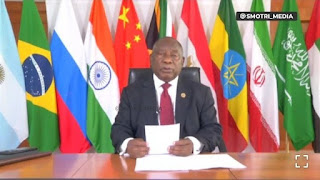
Meanwhile, BRICS nations meet today in a virtual summit to discuss the crisis in Gaza. After the meeting, the President of South Africa read the final statement of the BRICS countries regarding the situation in the Gaza Strip.

The statement expresses condolences to all those affected in Israel and the Gaza Strip, while also accusing Israel of violating international law. Ramaphosa, states that the primary cause of the conflict is Israel's illegal construction of settlements. The President of South Africa calls for the release of hostages taken during the Palestinian-Israeli conflict — a statement from the BRICS countries. The President of South Africa urges the International Criminal Court to initiate an investigation into those who committed war crimes during the Palestinian-Israeli conflict — a statement from the BRICS countries.


Chinese Foreign Ministry: We are good friends of the Arab and Islamic countries

    Tuesday, November 21, 2023   No comments

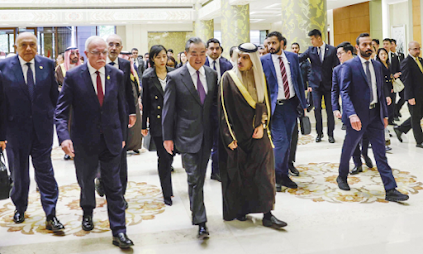
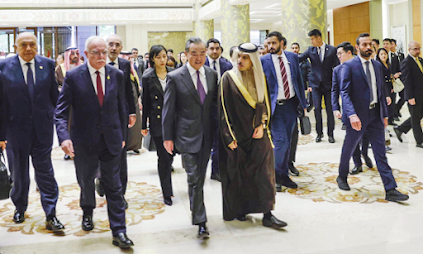
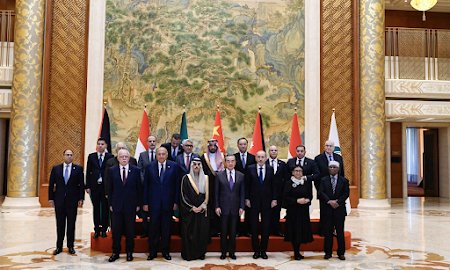
Chinese Foreign Minister Wang Yi announced on Monday before a delegation including Arab foreign ministers that the international community must take urgent measures to stop the “humanitarian catastrophe” unfolding in Gaza.

"Let us work together to quickly calm the situation in Gaza and restore peace in the Middle East as soon as possible," Wang said in his opening speech in Beijing.

Wang added to the diplomats that “there is a humanitarian catastrophe unfolding in Gaza,” noting that “the situation in Gaza affects all countries around the world and reconsiders the principle of good and evil and the basic principles of humanity.”


He stressed that "the international community must act urgently and take effective measures to prevent the spread of this tragedy."


Wang said, "China is a good friend and brother of the Arab and Islamic countries," adding that it "firmly defended the legitimate rights and interests of the Arab and Islamic countries, and strongly supported the efforts of the Palestinian people to restore their legitimate national rights and interests."


Earlier, the Chinese Foreign Minister expressed "China's strong sympathy for the Palestinians, especially in the Gaza Strip," adding that "what the people of Gaza need most is security, food and medicine, not war, weapons and ammunition."

Wang Yi stressed that "the historical injustice against Palestine cannot continue," and that "China is currently working closely with all parties to strengthen the ceasefire and end the war."


The Arab delegation includes the foreign ministers of Saudi Arabia, Egypt, Jordan and Palestine, and the Secretary-General of the Council of Islamic Cooperation.


The visit of the Arab ministerial delegation comes as part of a tour to the capitals of a number of countries that are permanent members of the Security Council, with the participation of the foreign ministers of the committee formed from the recent Arab-Islamic summit, with the aim of advancing the process of stopping the war on Gaza, and dealing with the deteriorating humanitarian conditions in the Strip.


China backs an international peace conference to push the Palestinian issue back to the track of two-state solution: top diplomat


China supports the convening of a more authoritative, broader and more effective international peace conference as soon as possible to push the Palestinian issue back to the track of the two-state solution, said Chinese Foreign Minister Wang Yi, in a phone conversation on Wednesday with Omani Foreign Minister Sayyid Badr Albusaidi.

Wang, also a member of the Political Bureau of the Communist Party of China Central Committee, noted that the current situation in Gaza continues to deteriorate, with an increasing number of casualties among the civilians. Any country with a conscience and a sense of responsibility can't allow such a tragedy to continue. The recent emergency special session of the UN General Assembly passed a resolution calling for an immediate humanitarian truce, reflecting the strong call from the international community, Wang said.


Followers


Most popular articles


ISR +


Frequently Used Labels and Topics

40 babies beheaded 77 + China A Week in Review Academic Integrity Adana Agreement afghanistan Africa African Union al-Azhar Algeria Aljazeera All Apartheid apostasy Arab League Arab nationalism Arab Spring Arabs in the West Armenia Arts and Cultures Arts and Entertainment Asia Assassinations Assimilation Azerbaijan Bangladesh Belarus Belt and Road Initiative Brazil BRI BRICS Brotherhood CAF Canada Capitalism Caroline Guenez Caspian Sea cCuba censorship Central Asia Charity Chechnya Children Rights China Christianity CIA Civil society Civil War climate colonialism communication communism con·science Conflict conscience Constitutionalism Contras Corruption Coups Covid19 Crimea Crimes against humanity D-8 Dearborn Debt Democracy Despotism Diplomacy discrimination Dissent Dmitry Medvedev Earthquakes Economics Economics and Finance Economy ECOWAS Education and Communication Egypt Elections energy Enlightenment environment equity Erdogan Europe Events Fatima FIFA FIFA World Cup FIFA World Cup Qatar 2020 Flour Massacre Food Football France Freedom freedom of speech G20 G7 Garden of Prosperity Gaza GCC GDP Genocide geopolitics Germany Global Security Global South Globalism globalization Greece Grozny Conference Hamas Health Hegemony Hezbollah hijab Hiroshima History and Civilizations Hormuz Human Rights Huquq Ibadiyya Ibn Khaldun ICC Ideas IGOs Immigration Imperialism In The News india Indonesia inequality inflation INSTC Instrumentalized Human Rights Intelligence Inter International Affairs International Law Iran IranDeal Iraq Iraq War ISIL Islam in America Islam in China Islam in Europe Islam in Russia Islam Today Islamic economics Islamic Jihad Islamic law Islamic Societies Islamism Islamophobia ISR MONTHLY ISR Weekly Bulletin ISR Weekly Review Bulletin Italy Japan Jordan Journalism Kenya Khamenei Kilicdaroglu Kurdistan Latin America Law and Society Lebanon Libya Majoritarianism Malaysia Mali mass killings Mauritania Media Media Bias Media Review Middle East migration Military Affairs Morocco Multipolar World Muslim Ban Muslim Women and Leadership Muslims Muslims in Europe Muslims in West Muslims Today NAM Narratives Nationalism NATO Natural Disasters Nelson Mandela NGOs Nicaragua Nicaragua Cuba Niger Nigeria Normalization North America North Korea Nuclear Deal Nuclear Technology Nuclear War Nusra October 7 Oman OPEC+ Opinion Polls Organisation of Islamic Cooperation - OIC Oslo Accords Pakistan Palestine Peace Philippines Philosophy poerty Poland police brutality Politics and Government Population Transfer Populism Poverty Prison Systems Propaganda Prophet Muhammad prosperity Protests Proxy Wars Public Health Putin Qatar Quran Rachel Corrie Racism Raisi Ramadan Ramadan War Regime Change religion and conflict Religion and Culture Religion and Politics religion and society Resistance Rights Rohingya Genocide Russia Salafism Sanctions Saudi Arabia Science and Technology SCO Sectarianism security Senegal Shahed sharia Sharia-compliant financial products Shia Silk Road Singapore Slavery Soccer socialism Southwest Asia and North Africa Sovereignty Space War Spain Sports Sports and Politics Starvation State Power State Terror Sudan sunnism Supremacism SWANA Syria Ta-Nehisi Coates terrorism Thailand The Koreas Tourism Trade transportation Tunisia Turkey Turkiye U.S. Cruelty U.S. Foreign Policy UAE uk ukraine UN under the Rubble UNGA United States UNSC Uprisings Urban warfare US Foreign Policy US Veto USA Uyghur Venezuela Volga Bulgaria Wadee wahhabism War War and Peace War Crimes War on Iran Wealth and Power Wealth Building West Western Civilization Western Sahara WMDs Women women rights Work Workers World and Communities Xi Yemen Zionism

Search for old news

Find Articles by year, month hierarchy


AdSpace

_______________________________________________

Copyright © Islamic Societies Review. All rights reserved.