Sunday, July 23, 2023

Algerian President Abdelmadjid Tebboune: Algeria had submitted an official request to join the BRICS group

    Sunday, July 23, 2023   No comments

On Friday, the Algerian “An-Nahar” TV quoted the Algerian President, Abdelmadjid Tebboune, as saying that Algeria has submitted an official request to join the “BRICS” group, and that it will become a shareholder in the “BRICS” bank, with an amount of $ 1.5 billion.


Tebboune said, "Algeria has officially asked the president of the BRICS bank, Dilma Rousseff, to agree to be a shareholder in the bloc's bank," noting that "Algeria's first contribution will be $1.5 billion."


Earlier, Tebboune considered that his country's accession to the "BRICS" group would help it in development, more than the assistance of international financial bodies, adding that "the BRICS bank contains $100 billion, more than the World Bank."


Likewise, Tebboune said, on December 22, 2022, that "Algeria is close to joining the BRICS bloc," stressing that the BRICS countries will not mind granting Algeria full membership, and that they have approval from Russia.


The North African country, which is rich in oil and gas, seeks to diversify its economy and strengthen its partnership with countries such as China. Tebboune announced, during his visit to Beijing, that China will invest $36 billion in various fields in his country, including industry, modern technology, the knowledge economy, transportation, and agriculture.


In turn, a South African diplomat said, yesterday, Thursday, that 22 countries have submitted an official request to become members of the "BRICS" economic bloc, adding that countries, including Saudi Arabia and Iran, have officially requested to become members of the "BRICS" group, while the countries that have expressed interest in joining include Argentina, the Emirates, Algeria, Egypt, Bahrain and Indonesia.



Russian President Vladimir Putin announced on Sunday that the Ukrainian counterattack had failed.

    Sunday, July 23, 2023   No comments
Russian President Vladimir Putin announced on Sunday that the Ukrainian counterattack had failed.

Putin said, during talks with his Belarusian counterpart Alexander Lukashenko, today, Sunday, in Moscow, that there is no effect of the Ukrainian counterattack, explaining that it "is existing but has failed."

Putin also noted that the Ukrainian army destroyed a record number of Western equipment.

https://www.almayadeen.net/news/politics/%D8%A8%D9%88%D8%AA%D9%8A%D9%86:-%D8%A7%D9%84%D9%87%D8%AC%D9%88%D9%85-%D8%A7%D9%84%D8%A3%D9%88%D9%83%D8%B1%D8%A7%D9%86%D9%8A-%D8%A7%D9%84%D9%85%D8%B6%D8%A7%D8%AF-%D9%82%D8%A7%D8%A6%D9%85-%D9%84%D9%83%D9%86%D9%87-%D9%81%D8%B4%D9%84

Saturday, July 22, 2023

Too Hot? Learn how communities dealth with heat for 2500 years: The legacy of the wind towers of an ancient Iranian city

    Saturday, July 22, 2023   No comments

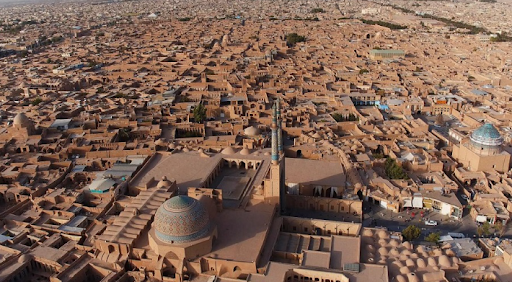
The temperature in some areas in Iran often exceeds 40 degrees Celsius, but what helps to withstand these high levels of heat are the wind towers (Barajil), which are the predecessors of current air conditioners, and do not pose any harm to the environment, which made architects pay attention to them again.

The city of Yazd, which is close to the Silk Road, is among the hottest cities in the world. It is characterized by hot summers and very rare rains, as it is surrounded by deserts.


How the wind catchers work

Iran is an extreme hot/cold and arid climate. 

It can get very hot in the daytime sun and then cool down completely at night. 

Before we had electric sockets and Iran was called Persia,  people engineered windcatchers. read the article or view it below.

Monday, July 17, 2023

Is NATO expansion a cause for the war in Ukraine?

    Monday, July 17, 2023   No comments

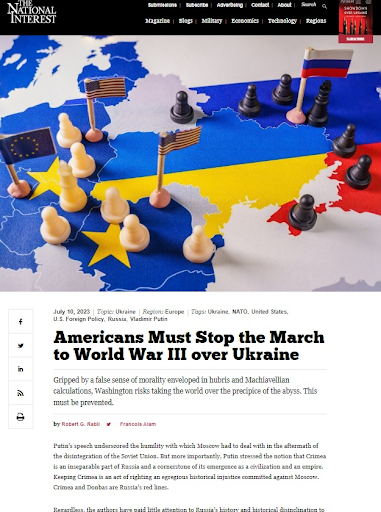
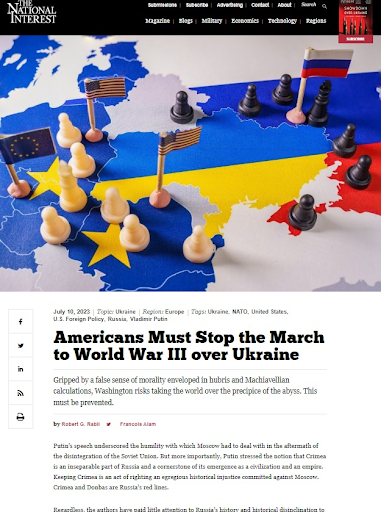
Prof. Robert G. Rabil and attorney Francois Alam wrote a provocative essay to underscore the danger of ignoring Russia's legitimate national security interests. They concluded that "gripped by a false sense of morality enveloped in hubris and Machiavellian calculations, Washington risks taking the world over the precipice of the abyss. This must be prevented." 

The writers see that after America pledged to the Soviet Union that NATO would not approach its borders in 1990, we see that in 1997 NATO called on Poland, Hungary and the Czech Republic to join the alliance at the Madrid summit. In a second round in 2004, Bulgaria, Estonia, Latvia, Lithuania, Romania, Slovakia and Slovenia became members of NATO. Then came the US position on the Rose, Orange and Square revolutions in Georgia, in the years 2003, 2004 and 2014, to put Washington and Moscow in violent confrontation.

The authors also believe that, in order to clarify Moscow's position in the current war in Ukraine, it is useful to look at history. The Donbass region has been part of the formation of Russia since Moscow defeated the Mongols in the 15th century. Crimea and its vicinity also had a special place to highlight the power of the tsarist empire. As for Peter the Great, he was the first to establish a Russian naval base on the Sea of Azov. During the reign of Catherine the Great, Moscow established its strategic naval base in Sevastopol, which served as the main base for the Russian Black Sea Fleet.

The authors considered that America's insistence on ensuring the victory of Ukraine, and considering America's security and stability as part of the security and stability of Ukraine, as well as providing Kiev with the most dangerous conventional weapons, is nothing but an open invitation to World War III and the mutual destruction of the West and Eurasia, and ignoring the fact that NATO's expansion to the east means besieging Russia in its heartland. And ignoring the attempts of the Russian leadership to dissuade the West from its plan.

The authors conclude by saying that supporting Ukraine's victory in such a blatant way is a great incentive for World War III. They stress that the Americans must stop this madness, and the coalition must realize that the way to peace is not through weapons.


The article is linked here: Americans Must Stop the March to World War III over Ukraine


Friday, June 23, 2023

Towards a world without American hegemony

    Friday, June 23, 2023   No comments

In an essay written for the electronic magazine "Responsible Statecraft", which is affiliated with the American Quincy Institute for Studies, William Minter states that the United States has achieved limited success in building a global coalition to support Ukraine, stressing that it has not succeeded in expanding the required alliance that it sought to achieve, despite being "stronger than opponents on paper.

The essay referred to the amount of military spending of the United States in 2022, as it amounted to 877 billion dollars, more than the total of 849 billion dollars spent by the following ten countries combined, pointing out that the volume of its military spending is three times greater than the 292 billion dollars spent by China, and more than 10 times the amount spent by Russia.

The article also shed light on the stationing of US military forces in more than 750 military bases, in 80 countries around the world, noting that "if there is any country that may claim global hegemony, it will be the United States. 

I assumed that if hegemony meant the ability to get other countries to comply with demands, the United States was thus far from being a global hegemon.


Washington proved its ability to cause massive destruction, in a long series of wars in Korea and Vietnam in the latter half of the 20th century, to Iraq and Afghanistan in the 21st century, but it won no more than costly victories, as the cost included not only lives, but also the erosion of trust. inside and outside.


And the magazine dealt with showing American opinion polls that public support for the war in Ukraine has decreased somewhat this year, in addition to some Republicans in Congress questioning its cost, but most American politicians still see support for negotiations as a step too far.


In turn, the US Secretary of State, Anthony Blinken, strongly rejected the option of a ceasefire in Ukraine, and the President of the United States, Joe Biden, and the Prime Minister of Britain, Rishi Sunak, also pledged that their countries would continue to support Ukraine "for as long as it takes."


The Russian expert, Fiona Hill, of the Brookings Institution in Washington, said that "in 2023 we will hear a resounding rejection of American hegemony, and we will see a clear appetite for a world free of hegemony." Ukraine is an open rebellion.


Hill asserted that this rebellion against the "collective West" "dominates the international discourse and imposes its problems on others," explaining that it is "a very clear negative reaction to the American tendency to define the world order and force countries to take sides."


The refusal to take sides among the competing great powers seems clear among the countries of Southeast Asia, where one might expect the competition between the United States and China to be at its peak, and all ten ASEAN member states participate in China's Belt and Road initiative to build infrastructure. Despite the strong American campaign against it.


The "Responsible Statecraft" called on American policymakers to accept the new reality, explaining that they must do so in practice, as most developing countries, including the emerging powers in the south, are no longer willing to make "zero-sum" choices between the United States and its geopolitical competitors.


_____________

William Minter is the editor of AfricaFocus Bulletin. He has been a writer, researcher, and activist since the mid-1960s, concentrating on African and global issues. He taught in Tanzania and Mozambique at the secondary school of the Mozambique Liberation Front (FRELIMO) in 1966-68 and 1974-76. He has worked with Africa News Service (now allAfrica.com ), the Washington Office on Africa , and other Africa-related groups. Since November 2020, he has served as a senior consultant with the new U.S.-Africa Bridge Building Project.

Minter studied at the University of Ibadan in Nigeria in 1961-62. He holds a Ph.D. in sociology and a certificate in African studies from the University of Wisconsin at Madison. Minter’s most recent book is No Easy Victories: African Liberation and American Activists over a Half Century, 1950-2000, co-edited with Gail Hovey and Charles Cobb Jr.

Thursday, June 22, 2023

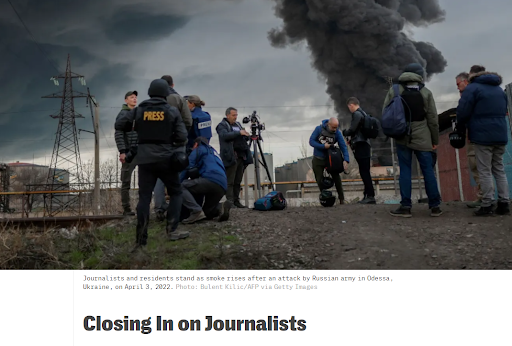
Truth is often the first victim to fall in the battlefield: The politics of war, media, and journalism

    Thursday, June 22, 2023   No comments

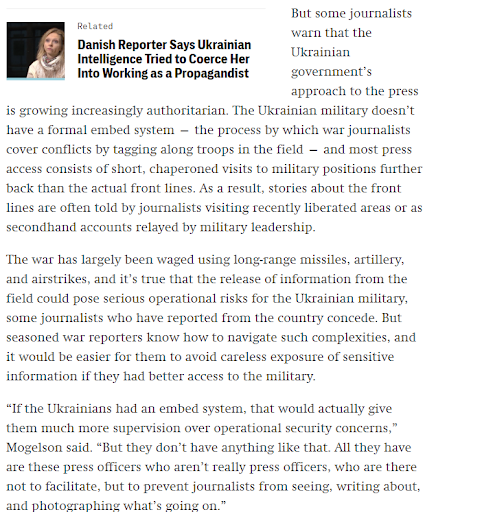
A detailed report by The Intercept, titled "Ukraine Prevents Journalists from Access to Frontlines, Escalates Censorship," has been reported by veteran war correspondents accusing Ukrainian officials of making reporting on the reality of the war, with rare exceptions, now nearly impossible.

The report, written by the Italian writer on international affairs and military issues, Alice Sperry, stated that "the Ukrainian government has intensified its efforts to control the narrative associated with the war now, by tightening access for journalists to the front lines of the conflict."

 Sipri stated that "after the Ukrainian forces regained control of the coastal city of Kherson last November, after 8 months of Russian control, some journalists entered the liberated city within hours, but the journalists' credentials were confiscated by the Ukrainian authorities, under the pretext that they were" They ignored the current restrictions.


Katerina Sergatskova, editor-in-chief of the independent Ukrainian newspaper Zaporona Media, said they "tried to impose more control on journalists, and now it's really difficult to report from Kherson, for example."


Simafor news agency reported earlier this month that since Russia launched its all-out offensive last year, Ukrainian authorities have threatened, revoked or denied press credentials to journalists working for 6 Ukrainian and foreign news outlets because of their coverage of the events. 


Sipri touched on one recent example, where "the Ministry of Defense of Ukraine did not renew the press credentials of a photographer based in Ukraine, who accused the country's security services of subjecting him to interrogations, a lie detector test, and accusations that he was working against the national interest of Ukraine."


Government officials were forced to re-accredit photographer Anton Skiba last week after a pressure campaign by colleagues and press freedom advocates, who denounced tighter access for frontline media, but the incident highlighted tensions between Ukrainian authorities and the journalists they cover. escalating conflict in recent months.


Veteran war correspondents, for their part, accuse Ukrainian officials of making coverage of the war, with rare exceptions, nearly impossible.

 “The Ukrainian government has made it virtually impossible for journalists to do real frontline reporting,” said Luke Muggleson, a journalist for The New Yorker. on the one hand, and superficially documented by the press on the other.


"It's surprising how little of what's happening is being chronicled, and the main reason, though not the only reason, is that the Ukrainian government has made it virtually impossible for journalists to do real reporting," Mugelson told The Intercept.


Mugelson explained that the restrictions come from military and political leaders, and interfere with the desire of ordinary soldiers to share their experiences.


Some Ukrainian journalists also warned that "the strict censorship practiced by the military distorts the coverage of the war," if a Ukrainian soldier said to a journalist, "I hate this war so much," and the press officer asked him to respond with, "Yes, the war is difficult, but we maintain our morale." 

"This is the narrative that many of the Ukrainian public is getting," Sipri asserted. Late last year, Zelensky signed into law a law giving the government sweeping powers over the media, and the European Union of Journalists described the initial draft of the bill as "befitting the worst authoritarian regimes."

 Earlier this year, a poll indicated that trust in the media among the Ukrainian public currently stands at 57%.

 Several Western reports talked about heavy Ukrainian losses on the front after Kiev launched its counterattack against the Russian forces, and this reflected the statements of the Ukrainian and Western leaders, as well as Moscow's assurances, but the Ukrainian media prevents the transfer of any press materials from the fronts, which was translated into the lack of documentary materials. the results of the attack.


Sunday, June 18, 2023

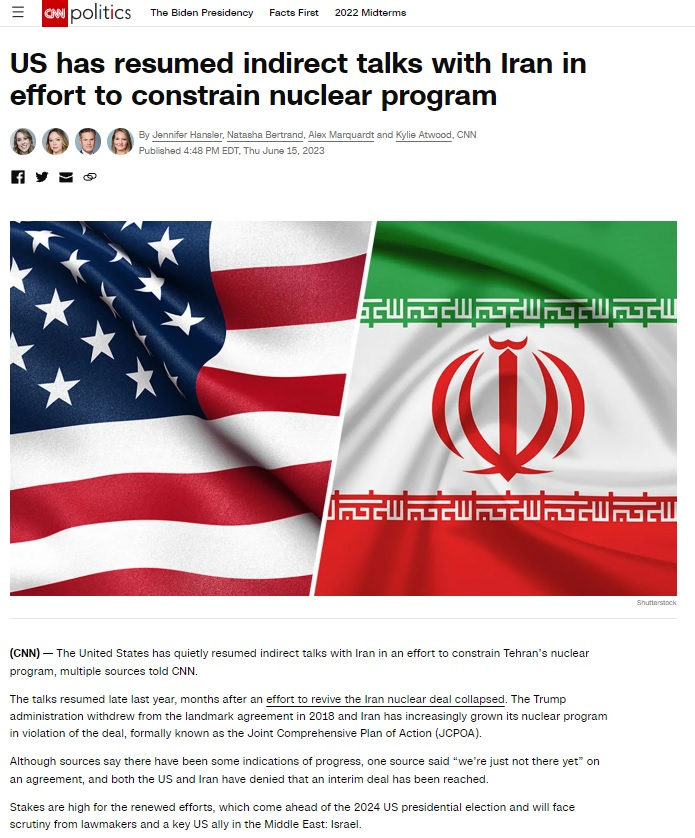
U.S. has resumed indirect talks with Iran - CNN reported

    Sunday, June 18, 2023   No comments

The U.S. administration has secretly resumed indirect talks with Iran to curb its nuclear program and release U.S. prisoners, CNN writes, citing sources. 

The talks began last December in New York and have since continued in Oman. 

According to U.S. officials, the U.S. goal is to reach a "political truce."

In return, Tehran is demanding the unfreezing of billions of dollars of Iranian assets abroad.


Chinese Foreign Minister: Relations with Washington are at their lowest level since 1979

    Sunday, June 18, 2023   No comments

Chinese Foreign Minister Chen Gang announced today, Sunday, that "relations between Beijing and Washington are at their lowest level since 1979" (the date of the start of diplomatic relations between them).

Gang told US Secretary of State Anthony Blinken that the Taiwan file represents "the most significant threat" to relations with Washington.

"The Taiwan issue is the core of China's core interests, and it is the most important issue in Sino-US relations and the most prominent threat to it," Gang added, according to what was reported by the official Chinese CCTV.


And the US State Department announced that the Chinese foreign minister had agreed to visit Washington, after holding "constructive talks" with his US counterpart, Anthony Blinken, in the capital, Beijing.


US State Department spokesman Matt Miller said that Blinken had extended an invitation to his Chinese counterpart and that they "agreed to set a date for the visit at a time convenient for both parties."


Earlier today, the Chinese Foreign Minister received his US counterpart in Beijing, amid escalating tensions between the two largest economies in the world, due to a number of issues, including Taiwan and the war in Ukraine.


The official Chinese news agency Xinhua reported that Blinken, who is the first representative of the United States at the ministerial level since the Biden administration took power in early 2021, will visit Beijing on June 18 and 19.


Blinken is spending two days in the Chinese capital as part of this visit, which was originally scheduled for February, but was suddenly canceled at the time after a Chinese balloon flew over American territory, which Washington considered to be for "espionage" purposes, while Beijing confirmed that it was a meteorological vehicle that deviated from its course.


Blinken's visit is the first by a US Secretary of State to China since a visit in October 2018 by his predecessor, Mike Pompeo, who later pursued a strategy of confrontation with Beijing in the last years of Donald Trump's presidency.


A few days ago, the US State Department reported that its secretary had made a phone call to his Chinese counterpart, during which he stressed the importance of maintaining "open lines of communication" to responsibly manage relations between the United States and the People's Republic of China to avoid miscalculation and conflict.


Earlier today, Chinese Foreign Ministry spokeswoman Hua Chunying responded to an article published by the US agency "Bloomberg", about alleged provocative activities by the Chinese army.


And the Chinese spokeswoman confirmed that "if a military conflict breaks out between the United States and China, it will be caused by the activities of the American army near Chinese territory."


read Chinese media coverage


Friday, June 16, 2023

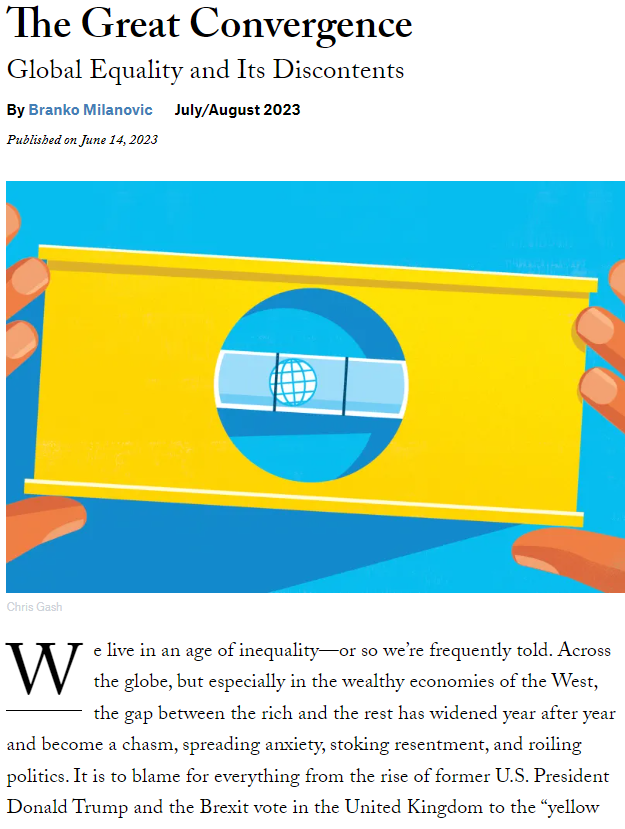
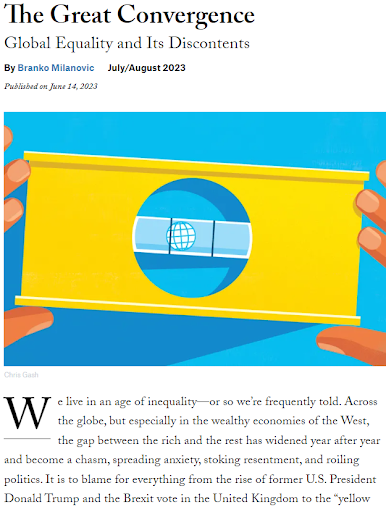
The Great Convergence: Global Equality and Its Discontents

    Friday, June 16, 2023   No comments

An article in the magazine "Foreign Affairs" talks about global income levels, within the next twenty to thirty years, and says that the number of Chinese who earn salaries equal to the salaries of middle-income Americans will be equal, which reduces American hegemony.

The current century has witnessed a significant decline in global income inequality, after falling to levels not seen in more than a century. This is the conclusion reached by Branko Milanovic, one of the world's foremost inequality researchers.


Milanovic said in an article published in the American magazine "Foreign Affairs", that "at a time when the population of the United States is only 4% of the world's population, increasing equality would be beneficial to the planet as a whole, but it heralds the end of American hegemony."


According to the author, inequality is measured using a Gini coefficient (a unit of measurement), which extends on a scale from 0 (perfect equality) to 100 (where one person gets all the income in the world).


On this measure, the inequality index fell from 69 in 2000 to 60 in 2018, and it is certainly lower today. In other words, the world is more equal now than at any time since 1875.


Recently, that number due to inequality within countries has risen slightly, and now stands at about 13, up from 7 in the 1990s. Conversely, the component decreased from a high of 63 in 1988 to only 47 in 2018 due to inequality between countries.


This is a complete reversal of what happened during most of the Cold War, when inequality between countries was increasing, but inequality within a single country was greatly reduced.


Milanovic notes in his article that "in the 1970s, India's share of global GDP was less than 3%, while the share of Germany, a major industrial power, was 7% by 2021, then these proportions reversed."


People who were poor by the standards of the United States, and other rich countries, were rich by global standards.


"People's incomes in Asia have reached unprecedented levels," adds Milanovic.


For every 100 middle-income Americans, 25 Chinese earned an equal amount.


Within the next 20 to 30 years, the number of Chinese earning salaries equal to that of middle-income Americans will be equal, and then rapidly exceed that proportion.


"This, in turn, reflects a broader shift in economic, technological and even cultural power in the world," says Milanovic.


For the global genetic coefficient (the unit of measure) to continue to decline, Africa will need to become significantly richer in the coming decades, "which is not likely to happen yet," according to Foreign Affairs.


The Four Amigos: How the close alliance grew between the far Global South Flanks

    Friday, June 16, 2023   No comments

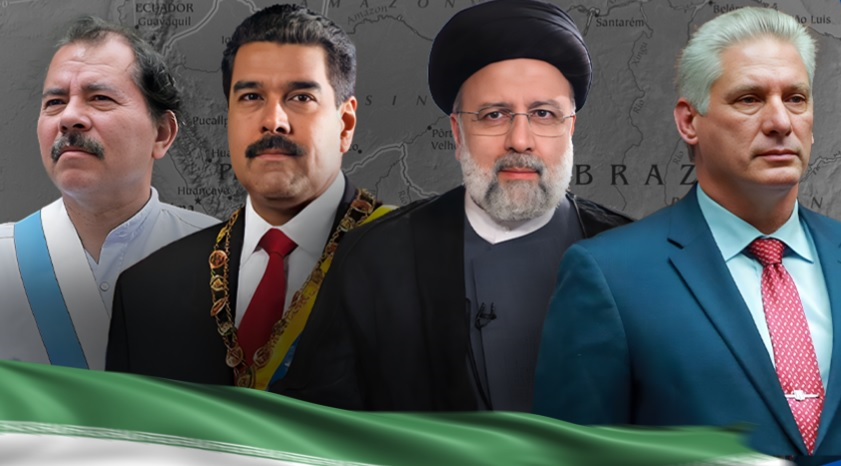
There is no doubt that Iranian President Ibrahim Raisi's current visit to South American countries, Venezuela, Nicaragua and Cuba, constitutes a strengthening of Iran's course of cooperation with Latin American countries and the confrontation of unilateral US sanctions.

This path has brought the far one closer geographically, and has developed rapidly since the beginning of the new millennium, with the emergence of a new generation of Bolivarian leaders.

And with the presence of leaders such as the late Hugo Chavez, Evo Morales, Rafael Correa and Lula da Silva, some of these relations began to enter the stage of strategic alliances, especially during the years 2005-2013, as Iran became an observer member of the Bolivarian Alliance for the Peoples of Latin America, ALBA, in 2008, in one of the manifestations of these Alliances.

As a continuation of this rapprochement, Iran and Venezuela signed more than 270 agreements between 2005 and 2012, which included automobile manufacturing projects, energy programs, and others.

In 2019, following the coup of Venezuelan Parliament Speaker Juan Guaido against elected President Nicolas Maduro and the United States announcing his recognition, America froze the Venezuelan government's assets abroad, and exacerbated the suffering of Venezuelans, in conjunction with a humanitarian crisis that struck the world as a result of the spread of the Corona virus and the subsequent economic recession.

Iran sent 5 tankers of oil derivatives to Caracas to alleviate the unprecedented fuel crisis, and helped repair a number of Venezuelan oil refineries that were damaged by US sanctions, in a message confirming the strength of this alliance, and a challenge to the hegemony of the United States whose patrols in the Caribbean did not dare to intercept the fleet yet. Iranian warnings.

The first year of Iranian President Ebrahim Raisi's term did not pass, until he signed with his Venezuelan counterpart in Tehran a map of bilateral cooperation between the two countries in June 2022. Subsequently, Raisi handed over, in a ceremony via video technology, the second Iranian-made Venezuelan oil tanker, and committed Renovation of the largest oil refinery complex in Venezuela.

For his part, the Iranian president stressed, in a joint press conference with his Venezuelan counterpart, that "relations between Tehran and Caracas are not ordinary diplomatic relations, but rather strategic relations," noting that the two countries have "common opponents, common interests and common views in the areas of seeking independence, freedom and justice." 

The Iranian president participated in the ceremony of resuming the production line of two Iranian companies for cars and tractors in Venezuela, and said during the visit: "The volume of trade exchange can be increased to 10 billion dollars in a first step, and to 20 billion dollars in a second step," after the exchanges increased from 600 million dollars in 2008. 2021 to more than $3 billion.


During his meeting with Iranian and Venezuelan businessmen, he stressed that there is a great untapped potential to increase economic exchanges between Iran and Venezuela, and stated that the way to achieve the $20 billion agreements is serious activity and investment between the two countries.


The memorandums of cooperation included the sectors of communications and information technology, energy, insurance, maritime transport, higher education, agriculture, medicine and medicine, culture, and the mining sector, in addition to Iran’s decision to transfer micro and nanotechnology through government and private institutions, in order to build a model of Iranian-Venezuelan partnership and integration. It can circulate in a lot of countries that want an equal relationship.


These agreements provide opportunities for mutual investment in the field of agriculture, facing food security problems and exchanging commodities.


Commenting on the economic sanctions imposed by the United States on Venezuela, Roy Warran tells Al-Mayadeen Net: "Iran has a clear position against sanctions, and it rejects them completely, whether sanctions against Iran or any other country." He adds, "Our position is principled against sanctions. Therefore, Iran sent tankers carrying oil production requirements to Venezuela, in a practical step to refuse, whatever the price."


In the same context, since February 2023, two ships carrying Iranian products have arrived at Venezuelan ports, after the Iranian-Venezuelan shipping line was recently launched, as the Iranian-Venezuelan cooperation map stipulates that a ship sails from Iranian shores heading to Venezuela every 3 months.


"A large part of Venezuela's refining sector, which was neglected due to sanctions, has been put into operation with the help of Iranian experts," said Iranian Oil Minister Javad Auchi.


Iran will provide technical and engineering support, as well as equipment, to help modernize petrochemical complexes, loading docks and oil terminals in Venezuela.

After the Venezuelan president's visit to Tehran in 2022, the state oil company "Petroleos de Venezuela" and the state-owned National Iranian Oil Refining and Distribution Company worked to renovate the "Paraguana" refining center, the largest refining complex in Venezuela, in a move to end Venezuela's dependence on American refinery technology. .

A unit of the National Iranian Oil Refining and Distribution Company had earlier signed a contract worth 110 million euros with Petroleos de Venezuela last May to repair the El Palito oil refinery, which has a capacity of 146,000 barrels per day.


Since December 2022, Iranian commercial ships have been moving along the road leading to Venezuela to transport petrochemical products, primarily naphtha, which Venezuela needs in the production of Venezuelan oil.


Followers


Trending now...


ISR +


Frequently Used Labels and Topics

40 babies beheaded 77 + China A Week in Review Academic Integrity Adana Agreement afghanistan Africa African Union al-Azhar Algeria Aljazeera All Apartheid apostasy Arab League Arab nationalism Arab Spring Arabs in the West Armenia Arts and Cultures Arts and Entertainment Asia Assassinations Assimilation Azerbaijan Bangladesh Belarus Belt and Road Initiative Brazil BRI BRICS Brotherhood CAF Canada Capitalism Caroline Guenez Caspian Sea cCuba censorship Central Asia Charity Chechnya Children Rights China Christianity CIA Civil society Civil War climate colonialism communication communism con·science Conflict conscience Constitutionalism Contras Corruption Coups Covid19 Crimea Crimes against humanity D-8 Dearborn Debt Democracy Despotism Diplomacy discrimination Dissent Dmitry Medvedev Earthquakes Economics Economics and Finance Economy ECOWAS Education and Communication Egypt Elections energy Enlightenment environment equity Erdogan Europe Events Fatima FIFA FIFA World Cup FIFA World Cup Qatar 2020 Flour Massacre Food Football France Freedom freedom of speech G20 G7 Garden of Prosperity Gaza GCC GDP Genocide geopolitics Germany Global Security Global South Globalism globalization Greece Grozny Conference Hamas Health Hegemony Hezbollah hijab Hiroshima History and Civilizations Hormuz Human Rights Huquq Ibadiyya Ibn Khaldun ICC Ideas IGOs Immigration Imperialism In The News india Indonesia inequality inflation INSTC Instrumentalized Human Rights Intelligence Inter International Affairs International Law Iran IranDeal Iraq Iraq War ISIL Islam in America Islam in China Islam in Europe Islam in Russia Islam Today Islamic economics Islamic Jihad Islamic law Islamic Societies Islamism Islamophobia ISR MONTHLY ISR Weekly Bulletin ISR Weekly Review Bulletin Italy Japan Jordan Journalism Kenya Khamenei Kilicdaroglu Kurdistan Latin America Law and Society Lebanon Libya Majoritarianism Malaysia Mali mass killings Mauritania Media Media Bias Media Review Middle East migration Military Affairs Morocco Multipolar World Muslim Ban Muslim Women and Leadership Muslims Muslims in Europe Muslims in West Muslims Today NAM Narratives Nationalism NATO Natural Disasters Nelson Mandela NGOs Nicaragua Nicaragua Cuba Niger Nigeria Normalization North America North Korea Nuclear Deal Nuclear Technology Nuclear War Nusra October 7 Oman OPEC+ Opinion Polls Organisation of Islamic Cooperation - OIC Oslo Accords Pakistan Palestine Peace Philippines Philosophy poerty Poland police brutality Politics and Government Population Transfer Populism Poverty Prison Systems Propaganda Prophet Muhammad prosperity Protests Proxy Wars Public Health Putin Qatar Quran Rachel Corrie Racism Raisi Ramadan Ramadan War Regime Change religion and conflict Religion and Culture Religion and Politics religion and society Resistance Rights Rohingya Genocide Russia Salafism Sanctions Saudi Arabia Science and Technology SCO Sectarianism security Senegal Shahed sharia Sharia-compliant financial products Shia Silk Road Singapore Slavery Soccer socialism Southwest Asia and North Africa Sovereignty Space War Spain Sports Sports and Politics Starvation State Power State Terror Sudan Sunni Axis sunnism Supremacism SWANA Syria Ta-Nehisi Coates terrorism Thailand The Koreas Tourism Trade transportation Tunisia Turkey Turkiye U.S. Cruelty U.S. Foreign Policy UAE uk ukraine UN under the Rubble UNGA United States UNSC Uprisings Urban warfare US Foreign Policy US Veto USA Uyghur Venezuela Volga Bulgaria Wadee wahhabism War War and Peace War Crimes War on Iran Wealth and Power Wealth Building West Western Civilization Western Sahara WMDs Women women rights Work Workers World and Communities Xi Yemen Zionism

Search for old news

Find Articles by year, month hierarchy


AdSpace

_______________________________________________

Copyright © Islamic Societies Review. All rights reserved.