Thursday, June 01, 2023

The quiet rise and rule of Singapore that cannot be unnoticed by its loud neighbors and distant friends

    Thursday, June 01, 2023   No comments

Singapore is rarely in the news. Countries, other than Western countries, are usually in the news because bad things are happening in them. That is one of the persistent biases of Western media. Here, we review several news stories covering events in Singapore, this multiethnic and multireligious countries, with its Muslim woman president, Halimah Yacob, though the position of the President of Singapore is ceremonial, her presence in the presidency will be useful in integrating Singapore's economy with that of Muslim-majority neighbors like Indonesia and Malaysia as well as the 57-nation bloc of Muslim-majority countries around the world.

Singapore overtakes Hong Kong as the most expensive Asia-Pacific city for private homes

Singapore’s private homes are now the most expensive in Asia-Pacific, having overtaken Hong Kong, according to a new report.

Data from the Home Attainability Index from the Urban Land Institute (ULI) Asia Pacific Centre for Housing showed the median price of Singapore’s private homes was $1.2 million in 2022, compared to Hong Kong’s $1.16 million.


Private rental homes in Singapore also had the highest monthly rent in the region at $2,600 — “far exceeding” other cities such as Sydney, Melbourne and Hong Kong, according to the report...

Read the full article here.


The article below makes the case for Singapore as being better in more than just one aspect.


Why Singapore is superior to Hong Kong in almost every way

It’s amusing to read comments by local property tycoon Ronnie Chan Chi-chung about places such as Singapore being “artificial”, “charmless” and “super boring”. Hong Kong, on the other hand, has the six “Gs” that are its unique advantages: genetics, geography, a culture of giving, the GBA (Greater Bay Area), its government and grey matter.

Really? The problem with tycoons everywhere, and not just in Hong Kong, is that they feel free to pontificate because they are rarely challenged, well, not in their face anyway. So I am glad reader John Chan of Singapore has written a rebuttal, pointing out that the city state enjoys both higher per capita gross domestic product (GDP) and median monthly household income. It’s doing very well, thank you very much!

Maybe Ronnie Chan can counter, as you would if you are a tycoon, that the capitalisation of Hong Kong’s stock market far exceeds that of Singapore or that the latter’s IPO market is minuscule compared to his city’s. Hong Kong has Disneyland, but hey, they have Universal Studios.

But all these comparisons are superficial.

The fundamental fact is that Singapore is a city state, rather than... read article


Politically, Singapore is oftten courted by other countries to take side in relation to global matters. This article is one example.


Europe sends big hitters to Singapore to rally Asian allies against Russia


Europe is fretting that Asia isn’t doing enough to condemn Russia and support Ukraine — and it’s revving up efforts to sway Asian officials in person. 

On Friday, an unprecedentedly high-profile European delegation will converge in Singapore at the Shangri-La Dialogue, Asia’s top security forum. Estonian Prime Minister Kaja Kallas will be there, as will EU foreign policy chief Josep Borrell, flanked by Ukrainian Defence Minister Oleksiy Reznikov. 

U.K. Defense Secretary Ben Wallace is also expected to attend in person — as are Boris Pistorius, Kajsa Ollongren and Pål Jonson, the defense ministers from Germany, the Netherlands and Sweden.

Their goal: Rally more Asian countries to help Kyiv.

While many Asian nations initially joined in condemning Russia’s invasion at the United Nations, countries like India and Vietnam continue to count on Russian military or energy supplies, while Western allies Japan and South Korea are unable to... read article

Ukrainian president said he will not talk to Russia until Putin is gone; meet his likely successor—Medvedev?

    Thursday, June 01, 2023   No comments

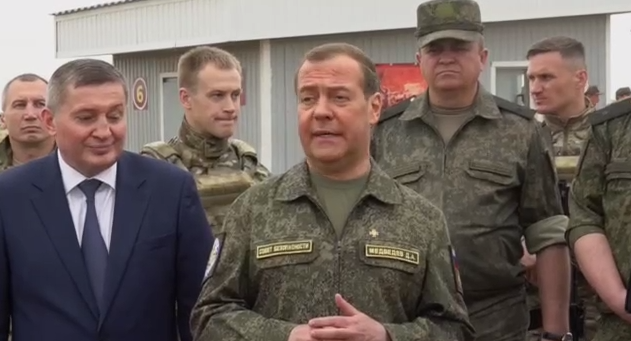
Medvedev, a lawyer and former president of Russia, just labeled the Kiev regime a terror entity and said that it must be exterminated because they act as terrorists, and described the attacks on Russia by drones as a “terrorist act”.


The Deputy Chairman of the Russian Security Council, DmitryMedvedev, said that the Ukrainian regime is behaving like a terrorist, adding that terrorists must be eliminated.

Medvedev's remarks came during his visit to a military training center in the Volgograd region, today, Thursday.

Medvedev described the Ukrainian drone attacks on Russia as a "terrorist act".

He explained, “This is not a military action,” pointing out that it is a type of weapon that cannot harm military installations.

And the deputy head of the Russian Security Council added: “It is clear to everyone that this is a terrorist attack. It does not comply with the rules of war. Its purpose is to harm the civilian population only, because the drones used cannot cause damage to military installations.

He added, "the Kiev regime must be exterminated because it is a hornet's nest, otherwise it will pose a constant threat," noting that terrorist attacks must be responded to as harshly as possible.

On Tuesday, the Russian Ministry of Defense announced that the Kiev regime launched a terrorist attack with drones on facilities in the city of Moscow.

In its statement, the ministry indicated that 8 drones participated in the attack on Moscow, and all of them were shot down by the Pantsir-S air defense system.

The Russian defense also confirmed that 3 drones were shot down in Moscow through the use of electronic warfare means, which caused the drones to lose control and deviate from their targets.

Sheikh al-Azhar: Western civilization bears the largest part of the tragedy of modern man

    Thursday, June 01, 2023   No comments

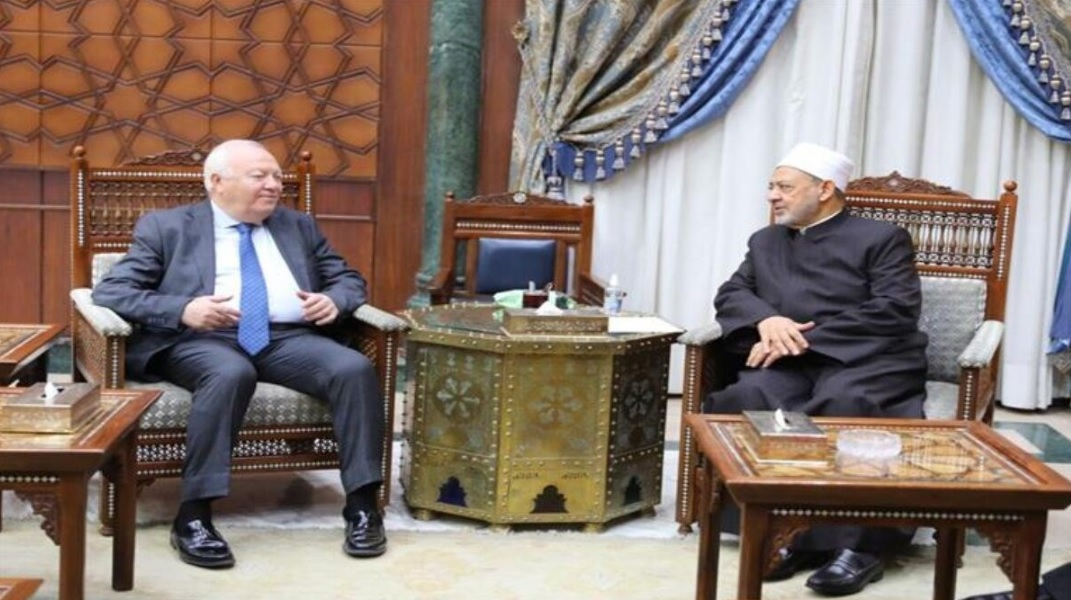
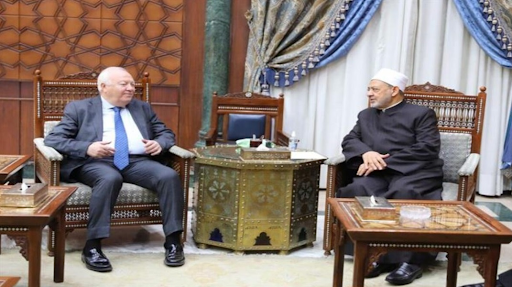
The Grand Sheikh of al-Azhar, Ahmed Al-Tayeb, received today, Thursday, at the headquarters of the Sheikh of Al-Azhar, the United Nations High Representative for the Dialogue of Civilizations, Miguel Moratinos, and ways to enhance joint cooperation were discussed.

The Sheikh of Al-Azhar welcomed Moratinos, stressing Al-Azhar's openness to dialogue with all believers in religions, cultures and civilizations.


Al-Tayeb pointed out that the world is currently facing a very complex crisis, which is the crisis of excluding religious and moral values from people's lives, stressing that this crisis does not only resonate and affect its makers, but also extends to all humanity, east and west, indicating that this crisis is The basis for all the conflicts and wars that our world is exposed to today.


The Sheikh of Al-Azhar pointed out that Western civilization bears the largest part in the tragedy of modern man, when it sought to exclude religion from people's lives, and focused on satisfying human desires and promoting material thought.


The Sheikh of Al-Azhar touched on the human suffering today, from the lack of food and medicine, and the climate change crisis, in addition to social crises.


Israeli media report: Iran can produce 7 nuclear bombs within 3 months and has enough enriched uranium to produce 6 more bombs within a few months

    Thursday, June 01, 2023   No comments

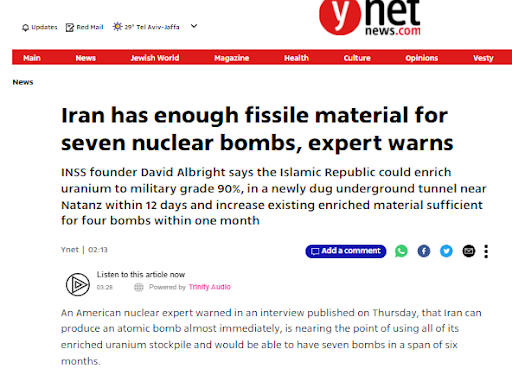
Yedioth Ahronoth newspaper quoted experts as saying that Iran can manufacture a nuclear bomb within 12 days, and has enough enriched uranium to produce 6 more bombs within a few months, “but this does not mean that it intends to do so and become a nuclear state.”

Yedioth said under the headline, “Iran has enough fissile material to make 7 atomic bombs in 3 months,” and that a week after revealing Iran’s progress in building a nuclear site that might be immune to bunker-busting bombs, and 5 years after the withdrawal of the former US president, Donald Trump, from the nuclear deal, an American nuclear expert estimates that Iran has the immediate ability to produce an atomic bomb, and if it used all its stock of enriched uranium, it could produce 7 bombs within a few months.

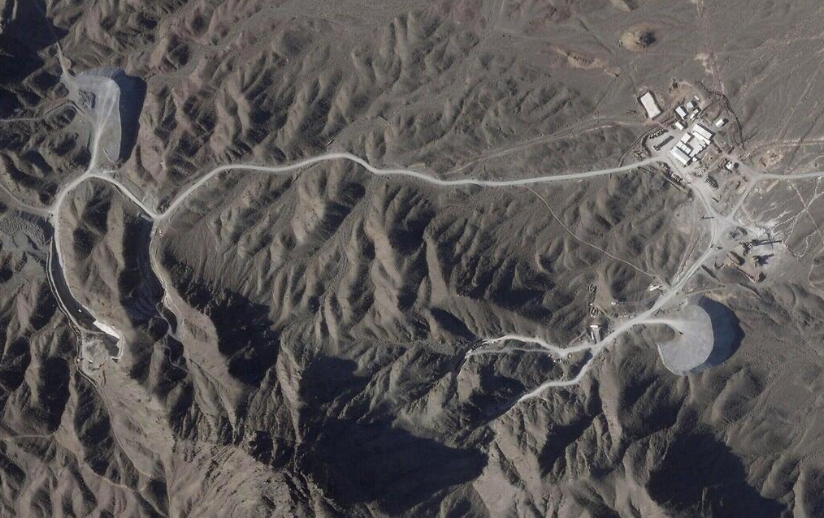
The American nuclear expert, David Albright, told the British magazine “The Economist” that satellite images show tunnels digging in the mountains near the Natanz nuclear site in central Iran, which may be at a depth of between 80 and 100 meters underground, which makes the mission of the GBU bombs difficult. -57, the main weapon of the US Army for the destruction of underground bunkers down to a depth of 60 meters.

Physicist Albright, the former chief US nuclear weapons inspector, estimated that the innermost part of the site could be used as a hall containing a small number of advanced centrifuges, which could quickly produce enough enriched uranium to the 90% level needed to produce a nuclear weapon.

The newspaper pointed out that the 2015 nuclear deal stipulates that Iran be a year away from producing enough material to make a bomb, but experts estimate that it may be able to do so immediately, and Albright believes that Tehran can enrich uranium by 90% required to produce a nuclear weapon within 12 years. just a day. To do this, it would need only three consecutive sets of advanced centrifuges and half of its current stockpile of uranium enriched to 60%.

In addition, according to estimates, Iran could enrich its uranium stockpile to the level of 90% to produce four atomic bombs within a month, and within another two months, use the low-enriched uranium to obtain material for two more bombs.


Wednesday, May 31, 2023

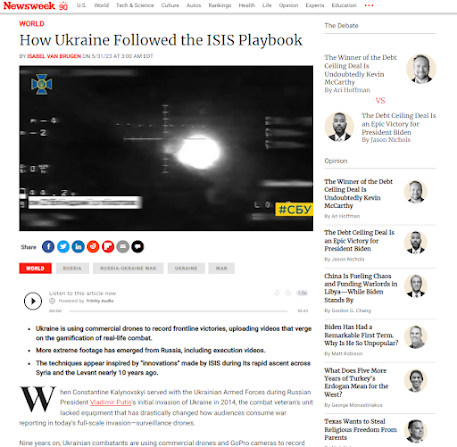
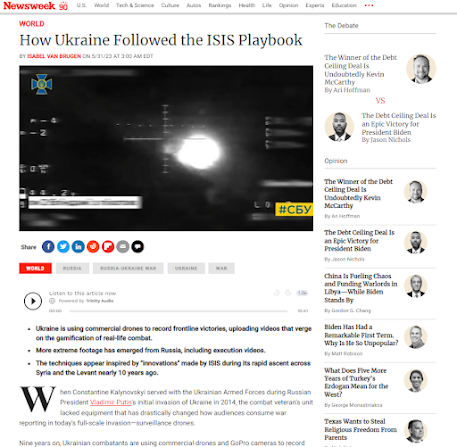
Newsweek: How Ukraine Followed the ISIS Playbook

    Wednesday, May 31, 2023   No comments

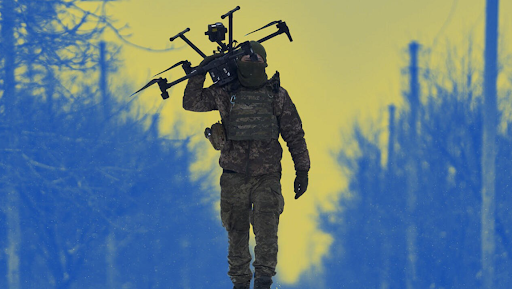
Newsweek reports that Ukraine is using commercial drones to score frontline victories, uploading videos with commercial GoPro cameras, accurately capturing enemy tank destruction, sniper kills and grenade blasts.

Inspired by the innovations made by ISIS during its rapid rise in Syria nearly 10 years ago, the terrorist group pushed out sophisticated, polished, and sometimes violent videos as part of a broader recruitment campaign, and distributed emotionally appealing footage to exploit vulnerable sentiment. I have the target.


In her speech, she referred to "Ukrainian brigades, such as the White Wolves, who film footage to publish on social media platforms, with the aim of bringing battles closer to real-life fighting games."


This unit publishes videos showing how its forces succeeded in destroying Russian targets. One such clip, posted on Twitter, published by the Security Service of Ukraine (SBU), shows an aerial view of military vehicles exploding after being hit from above, according to the magazine.

For Ukraine, “the drive to create great videos from battlefield scenes is more existential: footage from the front lines of the war must attract enough viewers globally to ensure that the country’s fight against Russia is not forgotten, and to prove that the West’s financial and military support Kiev was not in vain," according to "Newsweek."

Professor Sean Huston, who teaches courses on propaganda, social conflict, and media studies at The Citadel, a military college in South Carolina, told Newsweek that the clip is "a great example of the manipulation of combat video and the strange overlap between video games and snapshots of life." The realism associated with the video techniques used by ISIS.

"ISIS has been focusing on using this type of propaganda video, which is unfortunately more attractive to a younger audience," Houston added.

It is not clear, or the magazine did not explain, if this inspiration was due the effective tactics of ISIS or the tactics were developed by the handlers of ISIS who are now involved in the war in Ukraine.


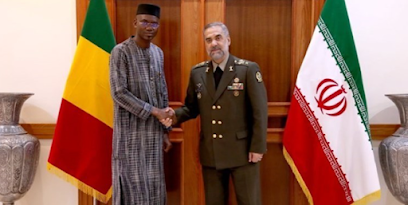
The Minister of Defense of Mali is visiting Iran, on an official visit aimed at strengthening inter-military relations between the two countries

    Wednesday, May 31, 2023   No comments

On Monday, Iranian Defense Minister Brigadier General Mohammad Reza Ashtiani received his Malian counterpart, Sadio Camara, in Tehran, on an official visit aimed at strengthening military relations.

Ashtiani stressed that after the victory of the Islamic Revolution in Iran, his country continued to develop its relations with Islamic and independent countries in Africa, including Mali, which he described as "playing an important role in the African region."


He stressed that cooperation with Islamic countries in Africa is one of the priorities of Iranian foreign policy, and that, in accordance with this policy, the Iranian Ministry of Defense has made efforts to interact with the state of Mali.


The Iranian Minister of Defense also praised the position of the Mali government in support of Palestine and its people, describing Mali's insistence in supporting the Palestinian cause as "a shining example of defending the oppressed."


Referring to the convening of the first joint economic cooperation committee between the two countries, last year, Brigadier General Ashtiani shared the recent economic developments between Iran and Mali.


The Iranian Defense Minister pointed out that the presence of the financial delegation headed by the Minister of Defense to Tehran shows the intention of the financial authorities to develop bilateral relations with Iran.


Ashtiani pointed to the pursuit of some Western countries behind "colonial goals and creating tensions," to justify the reasons for their military presence in Africa.


He explained that although the clear policy of Western countries is to "establish security," they "feed the spread of terrorism under their control in independent African countries, such as Mali," and pointed out that this was to justify and legitimize their presence in the region, in internal affairs. for these countries.


The Iranian minister also stated that "the Islamic Republic of Iran respects the decision of the government and nation of Mali regarding the diversification of its international partners, and considers it a sign of a good understanding of international developments," stressing that Iran "will spare no effort in strengthening Mali's defense capabilities against the threats of terrorist groups."


For his part, Malian Defense Minister Sadio Camara expressed his satisfaction with Iran's visit, explaining that the aim of this visit is to strengthen and consolidate bilateral relations.


He also referred to the experiences achieved by Iran in the field of combating terrorism, as well as the popular role and the involvement of citizens in achieving their security, asking for benefit from Iranian experiences in this field.


Camara criticized Western colonialism, as well as the security trends of some West African countries, considering them destabilizing, stressing that "the people and government in the Republic of Mali have decided to preserve their sovereignty, security and self-determination," noting that Iran's experiences and support are very valuable to Mali.


Tuesday, May 30, 2023

The president of the Chechen Republic reacts the election results in Turkiye

    Tuesday, May 30, 2023   No comments

The president of the Chechen Republic reacts the election results in Turkiye, posting this statement online:


In the second round of the presidential elections in Turkey, Recep Tayyip Erdogan won, with which our President Vladimir Vladimirovich Putin congratulated him.


I would like to join in the congratulations and wish the President of Turkey success both in developing his own state and in strengthening long-standing mutually beneficial relations with Russia and other allied countries.


Recep Tayyip Erdogan is undoubtedly one of the brightest politicians of our time, a subtle diplomat who not only successfully leads a huge country with a large population and an impressive army, but also actively advocates for the protection of the rights of Muslims around the world.


I congratulate the politician and the entire Turkish people on their re-election as the President of Turkey, I wish prosperity, peace and stability! I am sure that Ankara will continue the course of bilateral cooperation with Russia. And may the Almighty help us in this!


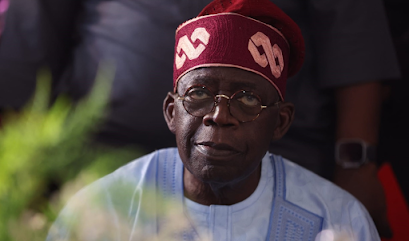
After his inauguration as President of Nigeria, Bola Ahmed Tinubu pledges to unite the country and ensure its security

    Tuesday, May 30, 2023   No comments

On Monday, Bola Ahmed Tinubu called for the unification of Nigeria, the day after his inauguration as the new president of the most populous country in Africa, and pledged that ensuring its security would be his “priority.”

The new 71-year-old head of state, in traditional dress, was sworn in during a ceremony held in Abuja in front of a crowd of officials and a number of African heads of state (Rwanda, Ghana, South Africa, Benin and Cameroon).

Tinubu, who was elected in February, pledged at the end of a ballot whose results were challenged by the opposition in court, denouncing widespread fraud, to serve Nigerians "without prejudice".


He stressed the need to unite the country of 215 million people, divided between the Muslim-majority north and the Christian-majority south, particularly by "promoting economic exchanges, social cohesion and intercultural dialogue."


He pledged that tackling insecurity would be his "absolute priority", as well as defending "the nation from terrorism and all forms of crime" by strengthening security forces.


The new president has promised to put Africa's largest economy back on track, while the oil-rich country sinks into recession, inflation, exploding debt and poverty.


Tinubu, who was called the “kingmaker” or “the spiritual father,” because of his enormous political influence, organized his election campaign, stressing that it was his “turn” to lead the largest economy on the continent.


However, the rise of the new president, who has huge wealth, was accompanied by many accusations of corruption, without being convicted at all, which he also always denied.


Tinubu will have to focus on the speedy recovery of the country's economy. One of the main challenges for Nigeria, which is rich in oil, is that it exchanges crude, which is estimated at billions of dollars, in exchange for imported fuel (due to poor operation of refineries) that it supplies to its market later.


What happens now that Erdogan is re-elected president of Turkiye?

    Tuesday, May 30, 2023   No comments

Two weeks ago, the American New York Times reported that European leaders would be happy to have an "easier Turkey," referring to the European desire for Turkish President Recep Tayyip Erdogan to lose in the current presidential elections.

The newspaper pointed out that Westerners, especially the US administration, would like to see Erdogan lose, in favor of opposition figure Kemal Kilicdaroglu.

The New York Times said that Turkey, an important and strategic member of the North Atlantic Treaty Organization (NATO), has become, under Erdogan's rule, "an increasingly troublesome partner of the European Union."


However, "NATO", according to the newspaper, hopes that the change of Turkish leadership "will lead to an end to the confrontation over the approval of Sweden's membership in the alliance," before the summit scheduled to be held in Vilnius, Lithuania, next July.


Within Turkey, the opposition and its candidate, Kemal Kilicdaroglu, whom the Western media called "Turkey's Gandhi," sought to overthrow Erdogan.


And the opposition exploited anti-refugee sentiments to try to win the elections, according to the British "Guardian". Kilicdaroglu tried to win the support of voters, especially the youth, taking advantage of the difficult economic conditions, and promised to restore the parliamentary system, after its improvement, to the country.


Now, after Erdogan announced his victory in the presidential elections in its second round, what will the picture look like, at home and abroad?


Globally:

The Carnegie Endowment for International Peace saw that the margin of creative thinking for the West will be limited with Erdogan's victory, as "21 years of experience with the current government has mostly exhausted the West's expectations of a qualitative improvement in relations."


And the Turkish president's victorious exit from this juncture means, according to the foundation, that Erdogan and his "indomitable sense" will reach new highs, which will increase what it called his "fiery behavior."


As for the relations between Ankara, Washington, and the rest of the Western capitals, the foundation said that they would be "devoid of flexibility and subject to circumstantial crises."


The reason behind this lies in the fact that Turkey will be in dire need of foreign financial flows due to the economic hardship the country is witnessing, as the Foundation said, which will prompt Erdogan to manage his country's foreign policy within the constraints of this reality, that is, with "less adventurism and more stability." .


But at the same time, the AKP leader will continue to "see Turkey as a regional power, and a member of a new club of countries," which includes China and Russia, which sees itself as an independent power bloc, according to the Institute for Turkish Studies at Stockholm University.


The European Consortium for Political Research (ECPR) said that the approach of Turkish treatment in foreign policy will continue while Erdogan remains in power, and the strained relations with the European Union will continue, "without any progress towards constructive engagement."


In the eastern Mediterranean, the site saw that tensions with Cyprus and Greece will not recede, but rather may escalate, with Ankara pressing for a two-state solution on the island.


As for Syria, the site expected the Turkish government's attempts, under Erdogan's rule, to continue to normalize its relations with Syria and other countries. This would facilitate the return of some Syrian refugees to their homeland, as the website said, bearing in mind that the issue of asylum is a top concern for Turkish voters.


For its part, the Foundation for the Defense of Democracies (FDD) suggested that the United States and Europe would remain silent, and work to find new ways to work with Erdogan upon his victory.


And while relations are expected to be turbulent with the West, it is seen that they will be more stable with Russia, especially after the participation of Erdogan and his Russian counterpart, Vladimir Putin, in an official ceremony marking the start of supplying the Akkuyu nuclear power plant with nuclear fuel, days before the start of the elections. public in Turkey.


During the ceremony, which was held last April, Putin stressed that the station is the most important project for Russia and Turkey, and promised that it would allow the development of joint economic relations and the promotion of coexistence between the two countries.


Under Erdogan, Turkey maintained its relations with Russia, at a time when the West cut it off after Moscow launched its military operation in Ukraine. Recently, Ankara played the most prominent role, along with the United Nations, in completing the "grain deal" between Ukraine and Russia, which Erdogan announced its extension two weeks ago.


This deal is an integral part of a set of specific agreements for a period of 3 years, which provide for the lifting of the ban on Russian exports of food and fertilizers, the reconnection of the Russian Agricultural Bank to the “SWIFT” system, and the resumption of the supply of agricultural machinery, spare parts and services.


Domestically:

On the domestic front, the head of the Justice and Development Party announced that his economic program for the next stage reveals a return to more traditional policies regarding the "free market" economy.


There is talk that Erdogan's economic program will be very similar to that laid out in the AKP's 2002 electoral platform. In other words, the AKP will return to its "origins" and abandon "heretical economics".


During the past months, the Turkish government has resorted to what is called the "election economy", which permeates it by increasing government spending and reducing collection, by raising the minimum wage, facilitating loans, scheduling debts, and supporting some segments.


The public coalition, led by Erdogan, seeks to increase Turkey's gross domestic product and increase annual growth by 5.5% from 2024 to 2028.


Likewise, the alliance is working to achieve a gross domestic product of $1.5 trillion by the end of 2028, to adopt a policy of developing the defense industries sector and combating terrorism, and to establish the "Istanbul Canal" project.


The Turkish president promised the voters to make Turkey "strong and multi-alliance," and also promised to create 6 million jobs, accusing the West of "trying to overthrow him, after more than two decades in power," in addition to giving tourism a big boost.


However, the opposition is suspicious of Erdogan's promises, especially on the economic issue, and its alliance has made many economic promises. However, the most prominent criticism that reached it is that it does not provide clear mechanisms and policies to achieve its promises.


Faced with this reality, the Turkish interior is vulnerable to a raging political ram between the elected president and his opponents, especially with Kilicdaroglu's statement that he is "sad for Turkey's future", without officially acknowledging the loss.


The issue of the political system that governs the country was raised as one of the main headlines over which electoral competition was intensified. While the opposition was threatening to restore the parliamentary system to rule Turkey in the event of the victory of its candidate, Kemal Kilicdaroglu, the "Justice and Development" promised to preserve the presidential system.


According to the election results, Erdogan's assumption of power for another 5 years means the continuation of the presidential system, which provides the president with broad powers, most notably the direct appointment of senior state officials, including ministers, university presidents and judges.

_________

* Adapted from Fatima Karnib's reporting on the Turkish Elections

Monday, May 29, 2023

The first Chinese-made passenger plane takes off on its first commercial flight

    Monday, May 29, 2023   No comments

 The first Chinese-made "C919" passenger plane took off today, Sunday, on its first commercial flight, which represents a quantum leap for China seeking to compete with the West in this field.


Footage broadcast by the official CCTV channel showed the take-off of Chinese Eastern Airlines Flight MU9191 from Hongqiao Airport in Shanghai at approximately 10:30 am (02:30 GMT).


The channel said that the destination of the plane, which carries more than 130 passengers, is Beijing International Airport.


Footage broadcast by state media showed dozens of passengers gathering at Shanghai airport, preparing to board the white-colored plane.


China has invested heavily in producing this aircraft locally as part of its quest to achieve self-sufficiency in key technologies.


Beijing hopes the C919 will compete with popular Western models such as the Boeing 737 Max and Airbus A320.


Interest is large: orders log

The plane is manufactured by the state-owned Commercial Aviation Corporation of China (COMAC), but many of its components come from abroad.


Starting Monday, the C919 will fly between Shanghai and the southwestern city of Chengdu, according to CCTV.


The first C919, which seats 164 passengers, was officially delivered to Eastern Airlines in December.


In January, Zhang Yujin, deputy general manager of COMAC, told the semi-official Chinese newspaper, The Paper, that the company had received more than 1,200 orders for the C919.


Zhang said at the time that COMAC plans to increase its annual production capacity to 150 aircraft within 5 years.


The countries of the continent of Asia and China in particular are major targets for the European company "Airbus" and its American competitor "Boeing", which are looking to benefit from the growing demand for air travel from the Chinese middle class.

Followers


Trending now...


ISR +


Frequently Used Labels and Topics

40 babies beheaded 77 + China A Week in Review Academic Integrity Adana Agreement afghanistan Africa African Union al-Azhar Algeria Aljazeera All Apartheid apostasy Arab League Arab nationalism Arab Spring Arabs in the West Armenia Arts and Cultures Arts and Entertainment Asia Assassinations Assimilation Azerbaijan Bangladesh Belarus Belt and Road Initiative Brazil BRI BRICS Brotherhood CAF Canada Capitalism Caroline Guenez Caspian Sea cCuba censorship Central Asia Charity Chechnya Children Rights China Christianity CIA Civil society Civil War climate colonialism communication communism con·science Conflict conscience Constitutionalism Contras Corruption Coups Covid19 Crimea Crimes against humanity D-8 Dearborn Debt Democracy Despotism Diplomacy discrimination Dissent Dmitry Medvedev Earthquakes Economics Economics and Finance Economy ECOWAS Education and Communication Egypt Elections energy Enlightenment environment equity Erdogan Europe Events Fatima FIFA FIFA World Cup FIFA World Cup Qatar 2020 Flour Massacre Food Football France Freedom freedom of speech G20 G7 Garden of Prosperity Gaza GCC GDP Genocide geopolitics Germany Global Security Global South Globalism globalization Greece Grozny Conference Hamas Health Hegemony Hezbollah hijab Hiroshima History and Civilizations Hormuz Human Rights Huquq Ibadiyya Ibn Khaldun ICC Ideas IGOs Immigration Imperialism In The News india Indonesia inequality inflation INSTC Instrumentalized Human Rights Intelligence Inter International Affairs International Law Iran IranDeal Iraq Iraq War ISIL Islam in America Islam in China Islam in Europe Islam in Russia Islam Today Islamic economics Islamic Jihad Islamic law Islamic Societies Islamism Islamophobia ISR MONTHLY ISR Weekly Bulletin ISR Weekly Review Bulletin Italy Japan Jordan Journalism Kenya Khamenei Kilicdaroglu Kurdistan Latin America Law and Society Lebanon Libya Majoritarianism Malaysia Mali mass killings Mauritania Media Media Bias Media Review Middle East migration Military Affairs Morocco Multipolar World Muslim Ban Muslim Women and Leadership Muslims Muslims in Europe Muslims in West Muslims Today NAM Narratives Nationalism NATO Natural Disasters Nelson Mandela NGOs Nicaragua Nicaragua Cuba Niger Nigeria Normalization North America North Korea Nuclear Deal Nuclear Technology Nuclear War Nusra October 7 Oman OPEC+ Opinion Polls Organisation of Islamic Cooperation - OIC Oslo Accords Pakistan Palestine Peace Philippines Philosophy poerty Poland police brutality Politics and Government Population Transfer Populism Poverty Prison Systems Propaganda Prophet Muhammad prosperity Protests Proxy Wars Public Health Putin Qatar Quran Rachel Corrie Racism Raisi Ramadan Ramadan War Regime Change religion and conflict Religion and Culture Religion and Politics religion and society Resistance Rights Rohingya Genocide Russia Salafism Sanctions Saudi Arabia Science and Technology SCO Sectarianism security Senegal Shahed sharia Sharia-compliant financial products Shia Silk Road Singapore Slavery Soccer socialism Southwest Asia and North Africa Sovereignty Space War Spain Sports Sports and Politics Starvation State Power State Terror Sudan Sunni Axis sunnism Supremacism SWANA Syria Ta-Nehisi Coates terrorism Thailand The Koreas Tourism Trade transportation Tunisia Turkey Turkiye U.S. Cruelty U.S. Foreign Policy UAE uk ukraine UN under the Rubble UNGA United States UNSC Uprisings Urban warfare US Foreign Policy US Veto USA Uyghur Venezuela Volga Bulgaria Wadee wahhabism War War and Peace War Crimes War on Iran Wealth and Power Wealth Building West Western Civilization Western Sahara WMDs Women women rights Work Workers World and Communities Xi Yemen Zionism

Search for old news

Find Articles by year, month hierarchy


AdSpace

_______________________________________________

Copyright © Islamic Societies Review. All rights reserved.