Tuesday, September 10, 2013

Unbelievably John Kerry: Once again, John Kerry’s created an unbelievably big problem out of one little phrase

    Tuesday, September 10, 2013   No comments
By: Edward-Isaac Dovere

Throughout his career, Kerry’s had a problem with words. Monday, with just two of them, he managed to illustrate the Obama administration’s overall ambivalence toward a Syria strike, the latest shift in arguments from a man whose case for action has been changing almost with the days of the week.

Saying that any Syria action would be “unbelievably small” was supposed to reassure voters that the White House isn’t hatching a new Iraq-level invasion and occupation. Instead, he just bolstered skeptics who believe the administration’s either only looking for a symbolic move against Syrian President Bashar Assad to be able to claim action or for those who believe that President Barack Obama’s about to blunder into a long-term engagement in yet another fractured Arab nation.

That’s distinct from the new international policy Kerry at first seemed to have stumbled into, but as subsequent comments from White House officials and the president showed through the day, was actually a concerted — but heavily conditional — float, that Assad could stop an attack if the Syrian president somehow turned over his entire chemical weapons arsenal immediately.

read more >>

Pierre Piccinin: Assad not Responsible for Ghouta Gas Attack, rebels used gas in Ghouta to trigger Western intervention

    Tuesday, September 10, 2013   No comments
A Belgian writer held hostage for five months in Syria has said that his own rebel captors denied that President Bashar al-Assad was responsible for the Ghouta massacre.

Pierre Piccinin said that he and fellow hostage Domenico Quirico, an Italian war reporter, heard their jailers talking about the chemical weapon attack and saying that Assad was not to blame.

Quirico confirmed to La Stampa newspaper that they had eavesdropped such a conversation through a closed door but added that he had no evidence to substantiate what he heard.


Piccinin said the captives became desperate when they heard that the US was planning to launch a punitive attack against the regime over the gas attack in the Damascus suburb.
 

"It wasn't the government of Bashar al-Assad that used sarin gas or any other gas in Ghouta," Piccinin told Belgian RTL radio after he was released.

"We are sure about this because we overheard a conversation between rebels. It pains me to say it because I've been a fierce supporter of the Free Syrian Army in its rightful fight for democracy since 2012," Piccinin added.

read more >>

Monday, September 09, 2013

If Obama is not willing to target both the regime and the terrorists in Syria, then Congress should not approve military action

    Monday, September 09, 2013   No comments
by Marc A. Thiessen


Senator Ted Cruz says that in Syria, the United States military should not “serve as al-Qaeda’s air force.” He’s right.

Al-Qaeda has two major strategic objectives: to get control of a nation-state and to get control of weapons of mass destruction. President Obama’s inaction in Syria has brought them closer to accomplishing both objectives.

After announcing that Assad must go in August 2011, Obama dithered for two years. This created a power vacuum, which al-Qaeda has filled — pouring weapons and fighters into Syria, and carving out new safe havens where it controls territory and operates with impunity.

If the United States were to employ military force sufficient to topple Assad, there is now a danger that such an attack could help al-Qaeda-affiliated Islamic radicals come to power in Damascus. This may be one reason why the administration is proposing limited, rather than decapitating, strikes against Assad.

But Assad does not have to fall for the terrorists to get their hands on his chemical stockpiles. He simply needs to be weakened enough that he cannot protect them. Al-Qaeda has successfully overrun government prisons in Iraq and military airfields in northern Syria. What is to stop them from overrunning Assad’s chemical weapons facilities? The United States has a vital national interest in making sure that does not happen.

read more >>

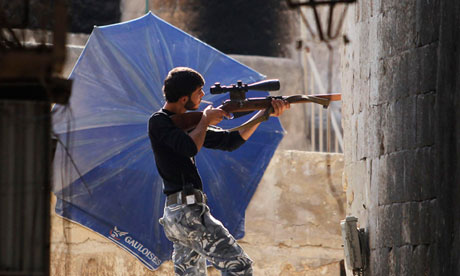
Who are the Syrian rebels: al-Qaeda in Syria leaders think that Americans are threatening war in Syria to target them, not the regime; other rebels wish U.S. will bomb jihadists

    Monday, September 09, 2013   No comments
The four men around him, jihadists from elsewhere in the Arab world, laughed among themselves and looked around to see another group enter. They too had come from far away for jihad — first against the Assad regime and now the US, again.

At a table down the hall, a group of Free Syrian Army fighters were enjoying a late lunch beside an olive grove, wondering out loud what regime targets the US would go for and revelling in the discomfort of the jihadists, whom they felt had ridden roughshod over their war in recent months. "I don't care if the Americans attack them too," said one of the men, whose unit has been joined by the jihadists in several battles. "I'd like that in fact. They need to be scared of someone." The table erupted in laughter, before the men calmed themselves. "I hope the Americans know where their headquarters are," said one.
Business is better at the restaurant than at any point since the start of the civil war, said the owner, who did not want to be named. "They are always polite and they always leave a tip. They just don't want the narghilas (water pipes smoked by locals) anywhere near them."

Outside a recently empty car park is crawling with trucks. The highway, for much of the past year as long, straight and empty as an airport runway, is a bustling thoroughfare of dilapidated trucks and clapped out motorbikes – the favourite form of transport for jihadists and regular fighters alike, who ride in pairs, guns slung across their backs.

The highway leads past a bomb-pocked concrete plant to the town of al-Bab, roughly 25 miles north-east of Aleppo and an opposition stronghold for the past 14 months. Here the evolution of Syria's civil war is written in paint on the walls of schools, civic buildings and advertising hoardings, hijacked by myriad players intent on leaving their mark.

The black banner of al-Qaida, adopted by ISIS, is more prominent in al-Bab than the gold-edged flag of the other al-Qaida-linked group, Jabhat al-Nusra, or the regular units of the Free Syrian Army.

"We don't like it this way," said a local man, Abu Nashat, pointing at a school wall that had been white-washed and then emblazoned with two giant al-Qaida logos. "But who is going to take them on over a tin of paint? We already have a big fight on our hands against the regime. Opening a new battle is not something to do lightly."

Behind two wrought-iron gates was the ISIS command centre, emptied of most of its men before the anticipated air strikes. Two young boys stood guard, their heads swathed in bandanas, their pants cut at ankle length in the manner of the men they emulate.

New-found authority resonates from the commandeered schoolyard. And ISIS members have not been shy in asserting their will here, or elsewhere in northern Syria, where an internecine struggle is in danger of eclipsing the reason for the war. "They think everyone who doesn't think and act like them is an infidel who needs to be punished," said a young fighter from the Liwa al-Tawheed Brigade – a mainstream militia – who ran a clothes shop before the conflict. "While they may have learned how to fight the Americans, they haven't learned anything else from Iraq."

One lesson from Iraq, however, is embraced by many Syrians: the Awakening Movement, also known as the Sahawa, that drove al-Qaida out of Anbar province in 2007.

"We need the same thing here," said a senior member of the Liwa al-Tawheed. "They want to kidnap this revolution. Maybe they already have. But don't mistake all the black flags you see for community support. We just don't have the stomach to fight them now. And who could we hope to support us even if we did? America? Europe? Shame on them. Do they not see that Syria will drag down the whole Middle East?"
read more >>

Israel: A powerful Middle Eastern axis of Sunni states has taken form in the region, which “does not view Israel as a sworn enemy”

    Monday, September 09, 2013   No comments
Speaking before the Institute for Counter-Terrorism’s international summit in Herzliya, Amos Gilad, who is director of the Political-Military Affairs Bureau at the Defense Ministry, said that Israel “won’t ever be accepted as a formal member” of the Sunni axis, but that the states that make it up all view the US as the sole superpower and that their regional policies are indirectly beneficial for Israel.

...
Had the Muslim Brotherhood succeeded in its plot for regional domination, a ring of hostility would have been formed around Israel, Gilad noted. From the perspective of Saudi Arabia’s King Abdullah, there are two threats to his country: Iran and the Muslim Brotherhood.
This was reflected in the billions of dollars donated to Egypt by Saudi Arabia and the UAE after Sisi took power, Gilad argued.

“Sisi didn’t act against them [the Muslim Brotherhood] on behalf of the West or Israel, but only for the good of Egypt. He simply saw that Egypt was falling into the abyss, in terms of repression and the economy...

He wishes to save Egypt,” Gilad said.

Jordan, for its part, excels at counter- terrorism due its own interest in combatting radical Islamist interests.

As a result, there are no terrorist attacks in Jordan or attacks from Jordan on Israel, Gilad said. “Their existence as an independent kingdom is impressive,” he added.


read more >>

John Kerry gives Syria a week to hand over chemical weapons or face attack

    Monday, September 09, 2013   No comments
The US secretary of state has said that President Bashar al-Assad has one week to hand over his entire stock of chemical weapons to avoid a military attack. But John Kerry added that he had no expectation that the Syrian leader would comply.

Kerry also said he had no doubt that Assad was responsible for the chemical weapons attack in east Damascus on 21 August, saying that only three people are responsible for the chemical weapons inside Syria – Assad, one of his brothers and a senior general. He said the entire US intelligence community was united in believing Assad was responsible.

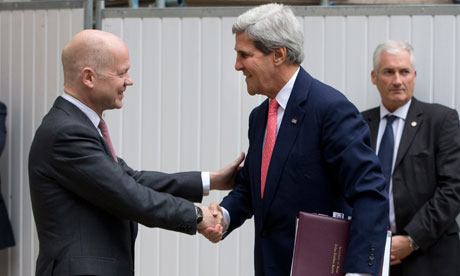
Kerry was speaking on Monday alongside the UK foreign secretary, William Hague, who was forced to deny that he had been pushed to the sidelines by the House of Commons decision 10 days ago to reject the use of UK force in Syria.

The US Senate is due to vote this week on whether to approve an attack and Kerry was ambivalent over whether Barack Obama would use his powers to ignore the legislative chamber, if it were to reject an attack.

The US state department stressed that Kerry was making a rhetorical argument about the one-week deadline and unlikelihood of Assad turning over Syria's chemical weapons stockpile. In an emailed statement, the department added: "His point was that this brutal dictator with a history of playing fast and loose with the facts cannot be trusted to turn over chemical weapons, otherwise he would have done so long ago. That's why the world faces this moment."

read more >>

Sunday, September 08, 2013

How has the West responded to ‘gassing’ in West Asia?

    Sunday, September 08, 2013   No comments
Actually the first to use chemical weapons [gas] in the Middle-East were the British. Soon after the First World War when the British created the state of Iraq consisting of the three former Turkish Vilayats [provinces] of Basra, Baghdad and Mosul; the southern Kurds much to their dislike had been added to the new state of Iraq and in protest broke out in open rebellion. Faced with the prospects of a prolonged conflict, with added financial costs and loss of British life; the British decided that the ‘best method’ for putting down the revolt was to use gas. As the then Colonial Secretary, Sir Winston Churchill had remarked, “I do not understand this squeamishness about the use of gas.” The then RAF Chief Sir Hugh Trenchard in a report to the British Cabinet admitted that this was a “cheaper form of control.” Even the redoubtable Lawrence of Arabia wrote to the London Observer that “it is odd we do not use poison gas on these occasions.” The poor Kurds were the first to receive the ‘gas’ treatment and as history would prove not the last time!

Let us move ahead in time and come to Saddam Hussein. Iranian official history records that Iraq first used chemical weapons against its soldiers on January 13, 1981. It is reported that between December 28, 1980 and March 20, 1984 Iranians list 63 separate gas attacks by the Iraqis. There is no doubt that the US was acutely aware of what was going on. In a Memorandum on November 1, 1983, officials of the State Department warned the then Secretary of State George Shultz that they had information that the Iraqis were using chemical weapons on an ‘almost daily’ basis. Equally blunt was the warning that Iraq had acquired chemical weapons capability from Western firms, including possibly from a US subsidiary. The US was also aware that chemical weapons were being used against ‘Kurdish insurgents’. At the same time the US, according to a media report, continued to provide Iraq with critical battle planning assistance and satellite data on Iranian military movements, knowing very well that Iraq was using chemical weapons against Iran as also Kurdish insurgents.

read more >>

Saturday, September 07, 2013

In Turkey, 72% of respondents to the Transatlantic Trends 2013 survey, which was conducted by the German Marshall Fund of the United States (GMF), said their country should stay out of Syria

    Saturday, September 07, 2013   No comments
A majority of Turks disapprove of any potential military intervention in Syria, much like their European and American counterparts, a survey has revealed.

In Turkey, 72 percent of respondents to the Transatlantic Trends 2013 survey, which was conducted by the German Marshall Fund of the United States (GMF), said their country should stay out of Syria, up 15 percentage points from last year, while only 21 percent – down 11 percentage points – favored intervention.

The respondents were told that there had recently been discussion about intervening in Syria, where the government has been using military force to suppress an opposition movement. They were then asked whether their government should stay out completely or intervene.

Apart from Turkey, 11 European Union member states were surveyed: France, Germany, Italy, the Netherlands, Poland, Portugal, Romania, Slovakia, Spain, Sweden, and the United Kingdom, as well as the United States. Polling was conducted between June 3 and June 27.

read more >>

Friday, September 06, 2013

Refugees Pour Out of Syria, but Number Entering Jordan Slows to Trickle

    Friday, September 06, 2013   No comments


JUDY WOODRUFF: And we come back to Syria with two takes on reaction to the conflict in the Arab world.

We begin with a look at how the crisis has spilled beyond Syria's borders. Earlier this week, the United Nations Refugee Agency announced that more than two million people have fled the fighting.

NewsHour foreign affairs producer Dan Sagalyn was in neighboring Jordan recently on a trip sponsored by CARE, the development and humanitarian organization. His story begins in the remote far eastern corner of the country.

Ray Suarez narrates our report.

RAY SUAREZ: These Syrian men, women and children are stepping into safe territory in Jordan. Some are carrying all their possessions in one suitcase.

These refugees are just a few of the now more than two million who have poured out of their homeland since fighting began in Syria more than two years ago. Jordanian soldiers provided them with food and water, and also stood guard, ready to protect them if Syrian forces opened fire. Their journey out of war was dangerous and often deadly.

read more >>

Washington Post: A majority of House members are now on the record as either against or leaning against authorizing President Obama to use military force against Syria

    Friday, September 06, 2013   No comments
As of Friday afternoon, there were 223 members in the “no” or “leaning no” category, more than the 217 that would be needed to sink the resolution. (The threshold for passage in the House is 217 votes, rather than the usual 218, since there are currently two vacancies.)

While the opposition is led by Republicans, the 106 opponents include 25 Democrats. Another 37 Democrats lean against supporting the use of force, meaning more than 30 percent of the House Democratic caucus is negatively predisposed toward the resolution.
The resolution remains in much better shape in the Senate, where just 15 senators have expressed outright opposition – four of them Democrats – and another 10 lean no. A majority of senators are currently undecided.

To be clear, this count is a moving target. While it’s hard to imagine many of the hard “no’s” reversing course, those leaning no or undecided could well come around to the president’s side by the time the actual vote in the House is held — which is expected to be in two weeks time. President Obama is set to address the country on Tuesday night, a speech the White House hopes will reverse the tide on the resolution in Congress.

read more >>

Followers


Trending now...


ISR +


Frequently Used Labels and Topics

40 babies beheaded 77 + China A Week in Review Academic Integrity Adana Agreement afghanistan Africa African Union al-Azhar Algeria Aljazeera All Apartheid apostasy Arab League Arab nationalism Arab Spring Arabs in the West Armenia Arts and Cultures Arts and Entertainment Asia Assassinations Assimilation Azerbaijan Bangladesh Belarus Belt and Road Initiative Brazil BRI BRICS Brotherhood CAF Canada Capitalism Caroline Guenez Caspian Sea cCuba censorship Central Asia Charity Chechnya Children Rights China Christianity CIA Civil society Civil War climate colonialism communication communism con·science Conflict conscience Constitutionalism Contras Corruption Coups Covid19 Crimea Crimes against humanity D-8 Dearborn Debt Democracy Despotism Diplomacy discrimination Dissent Dmitry Medvedev Earthquakes Economics Economics and Finance Economy ECOWAS Education and Communication Egypt Elections energy Enlightenment environment equity Erdogan Europe Events Fatima FIFA FIFA World Cup FIFA World Cup Qatar 2020 Flour Massacre Food Football France Freedom freedom of speech G20 G7 Garden of Prosperity Gaza GCC GDP Genocide geopolitics Germany Global Security Global South Globalism globalization Greece Grozny Conference Hamas Health Hegemony Hezbollah hijab Hiroshima History and Civilizations Hormuz Human Rights Huquq Ibadiyya Ibn Khaldun ICC Ideas IGOs Immigration Imperialism In The News india Indonesia inequality inflation INSTC Instrumentalized Human Rights Intelligence Inter International Affairs International Law Iran IranDeal Iraq Iraq War ISIL Islam in America Islam in China Islam in Europe Islam in Russia Islam Today Islamic economics Islamic Jihad Islamic law Islamic Societies Islamism Islamophobia ISR MONTHLY ISR Weekly Bulletin ISR Weekly Review Bulletin Italy Japan Jordan Journalism Kenya Khamenei Kilicdaroglu Kurdistan Latin America Law and Society Lebanon Libya Majoritarianism Malaysia Mali mass killings Mauritania Media Media Bias Media Review Middle East migration Military Affairs Morocco Multipolar World Muslim Ban Muslim Women and Leadership Muslims Muslims in Europe Muslims in West Muslims Today NAM Narratives Nationalism NATO Natural Disasters Nelson Mandela NGOs Nicaragua Nicaragua Cuba Niger Nigeria Normalization North America North Korea Nuclear Deal Nuclear Technology Nuclear War Nusra October 7 Oman OPEC+ Opinion Polls Organisation of Islamic Cooperation - OIC Oslo Accords Pakistan Palestine Peace Philippines Philosophy poerty Poland police brutality Politics and Government Population Transfer Populism Poverty Prison Systems Propaganda Prophet Muhammad prosperity Protests Proxy Wars Public Health Putin Qatar Quran Rachel Corrie Racism Raisi Ramadan Ramadan War Regime Change religion and conflict Religion and Culture Religion and Politics religion and society Resistance Rights Rohingya Genocide Russia Salafism Sanctions Saudi Arabia Science and Technology SCO Sectarianism security Senegal Shahed sharia Sharia-compliant financial products Shia Silk Road Singapore Slavery Soccer socialism Southwest Asia and North Africa Sovereignty Space War Spain Sports Sports and Politics Starvation State Power State Terror Sudan Sunni Axis sunnism Supremacism SWANA Syria Ta-Nehisi Coates terrorism Thailand The Koreas Tourism Trade transportation Tunisia Turkey Turkiye U.S. Cruelty U.S. Foreign Policy UAE uk ukraine UN under the Rubble UNGA United States UNSC Uprisings Urban warfare US Foreign Policy US Veto USA Uyghur Venezuela Volga Bulgaria Wadee wahhabism War War and Peace War Crimes War on Iran Wealth and Power Wealth Building West Western Civilization Western Sahara WMDs Women women rights Work Workers World and Communities Xi Yemen Zionism

Search for old news

Find Articles by year, month hierarchy


AdSpace

_______________________________________________

Copyright © Islamic Societies Review. All rights reserved.