Tuesday, July 02, 2013

President Mohamed Morsi rejects Egypt army's ultimatum, as ministers resign

    Tuesday, July 02, 2013   No comments
President Mohamed Morsi rejected an army ultimatum to force a resolution to Egypt's political crisis, saying that he would keep to his path even as his foreign minister added to the resignations from his cabinet.
The Islamist leader described as potentially confusing the 48-hour deadline set by the head of the armed forces on Monday for him to agree on a common platform with liberal rivals who have drawn millions into the streets demanding Morsi's resignation.
Members of his Muslim Brotherhood have used the word "coup" to describe the military manoeuvre, which carries the threat of the generals imposing their own road map for the nation.
On Tuesday morning Foreign Minister Mohammed Kamel Amr became the latest and most profile member of Mr Morsi's cabinet to desert him over the turmoil. He joined four ministers - of environment, legal affairs, communication and legal affairs, who stepped down on Monday.

read more >>

Turkey: recent unrest is Foreign powers and the Jewish diaspora conspiracy

    Tuesday, July 02, 2013   No comments
Foreign powers and the Jewish diaspora have triggered the recent unrest in Turkey, Deputy Prime Minister Beşir Atalay said Monday, adding that the international media had also played a key role in "the conspiracy".

Foreign powers and the Jewish diaspora have triggered and fomented the unrest in Turkey, Deputy Prime Minister Beşir Atalay said Monday in the Central Anatolian province of Kırıkkale.

Atalay also said the international media had played a key role in "the conspiracy". “The ones trying to block the way of Great Turkey will not succeed,” he said.

“There are some circles that are jealous of Turkey’s growth,” Atalay said. "They are all uniting, on one side the Jewish diaspora. You saw the foreign media’s attitude during the Gezi Park incidents; they bought it and started broadcasting immediately, without doing an evaluation of the [case]."

The Gezi protests began on May 31, triggered by Istanbul's plans to remove Gezi Park, which lies next to the iconic Taksim Square, to build a replica of Ottoman artillery barracks and a mall.

A sit-in by peaceful protesters soon turned into mass protests across the country with nearly two million people taking part and 79 of Turkey's 81 cities seeing unrest, according to interior ministry estimates.

read more >>

Monday, July 01, 2013

Tunisia Tiring of Transition

    Monday, July 01, 2013   No comments
Tunisia
In the third year after the revolution that toppled former dictator Ben Ali, true democracy is still work in progress in Tunisia.

“Freedom is a decision but democracy is a transformational process,” Amine Ghali, programme director of the Kawakibi Democracy Transition Centre in Tunisia tells IPS. “So far our expectations about life after the revolution have not been met.

“We went through a major transformation immediately after the revolution which led to the elections in October 2011. However, since then there has been a lack of delivery of democratic processes including transitional justice, the independence of the judiciary, improvement of the economy, and the fight against corruption. We need milestones with dates. We cannot stay in transition indefinitely.”

The democratic struggle is set against the backdrop of Tunisia’s economic problems. “We are facing inflation, devaluation of the dinar and a drop in consumer purchasing power,” says Ghali. “People cannot eat the constitution, drink elections or buy freedom of the press. They need food for their children, education and affordable transportation.”

read more >>

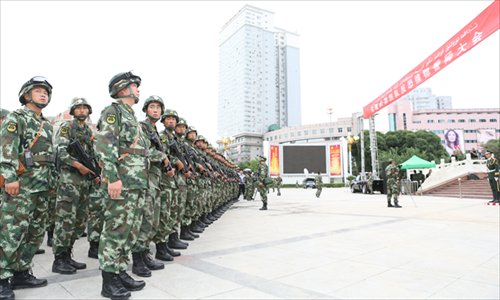
China claims that "Xinjiang terrorists finding training, support in Syria, Turkey"

    Monday, July 01, 2013   No comments
From a foreign student studying in Istanbul to a soldier receiving training in Syria's Aleppo, to a terrorist plotting attacks in China's Xinjiang Uyghur Autonomous Region, 23-year-old Memeti Aili said he felt like his dream was turned into a nightmare.

Memeti Aili was recently caught by the police when returning to Xinjiang to complete his mission to "carry out violent attack and improve fighting skills" assigned by the East Turkistan Islamic Movement (ETIM). ETIM is a terrorist group that aims to create an Islamist state in Xinjiang, which works alongside the East Turkistan Education and Solidarity Association (ETESA), an Istanbul-based exile group.

"After hearing their lectures, all I could think about was jihad and I totally abandoned my studies and my family," he told the police. "But thinking back, it was like a nightmare."

An anti-terrorism official told the Global Times in an exclusive interview that about 100 people like Memeti Aili had travelled to Syria to join the fighting alongside Syrian rebels since last year.

"Their purpose is to overcome their fears, improve their fighting skills and gain experience in carrying out terror attacks," according to the official who declined to be named.

Xinjiang, in China's far west, borders central Asia and is home to 10 million Uyghurs. It was rocked by two terror attacks that killed 35 people last week, just days ahead of the fourth anniversary of the July 5 riot in the capital Urumqi that left 197 people dead.

Yu Zhengsheng, member of the Standing Committee of the Political Bureau of the Communist Party of China (CPC) Central Committee, led a work team to Urumqi after President Xi Jinping on Friday arranged measures to safeguard social stability.

"We will step up efforts to crack down on terrorist groups and extremist organizations while tracking down those wanted for these crimes," Yu was quoted by the Xinhua News Agency.

read more >>

Foreign media portrayals of the conflict in Syria are dangerously inaccurate

    Monday, July 01, 2013   No comments
Every time I come to Syria I am struck by how different the situation is on the ground from the way it is pictured in the outside world. The foreign media reporting of the Syrian conflict is surely as inaccurate and misleading as anything we have seen since the start of the First World War. I can't think of any other war or crisis I have covered in which propagandistic, biased or second-hand sources have been so readily accepted by journalists as providers of objective facts.
A result of these distortions is that politicians and casual newspaper or television viewers alike have never had a clear idea over the last two years of what is happening inside Syria. Worse, long-term plans are based on these misconceptions. A report on Syria published last week by the Brussels-based International Crisis Group says that "once confident of swift victory, the opposition's foreign allies shifted to a paradigm dangerously divorced from reality".

Slogans replace policies: the rebels are pictured as white hats and the government supporters as black hats; given more weapons, the opposition can supposedly win a decisive victory; put under enough military pressure, President Bashar al-Assad will agree to negotiations for which a pre-condition is capitulation by his side in the conflict. One of the many drawbacks of the demonising rhetoric indulged in by the incoming US National Security Adviser Susan Rice, and William Hague, is that it rules out serious negotiations and compromise with the powers-that-be in Damascus. And since Assad controls most of Syria, Rice and Hague have devised a recipe for endless war while pretending humanitarian concern for the Syrian people.

It is difficult to prove the truth or falsehood of any generalisation about Syria. But, going by my experience this month travelling in central Syria between Damascus, Homs and the Mediterranean coast, it is possible to show how far media reports differ markedly what is really happening. Only by understanding and dealing with the actual balance of forces on the ground can any progress be made towards a cessation of violence.

read more >>

Sunday, June 30, 2013

Taking Outsize Role in Syria, Qatar Funnels Arms to Rebels

    Sunday, June 30, 2013   No comments
WASHINGTON — As an intermittent supply of arms to the Syrian opposition gathered momentum last year, the Obama administration repeatedly implored its Arab allies to keep one type of powerful weapon out of the rebels’ hands: heat-seeking shoulder-fired missiles.

The missiles, American officials warned, could one day be used by terrorist groups, some of them affiliated with Al Qaeda, to shoot down civilian aircraft.


But one country ignored this admonition: Qatar, the tiny, oil- and gas-rich emirate that has made itself the indispensable nation to rebel forces battling calcified Arab governments and that has been shipping arms to the Syrian rebels fighting the government of President Bashar al-Assad since 2011.

Since the beginning of the year, according to four American and Middle Eastern officials with knowledge of intelligence reports on the weapons, Qatar has used a shadowy arms network to move at least two shipments of shoulder-fired missiles, one of them a batch of Chinese-made FN-6s, to Syrian rebels who have used them against Mr. Assad’s air force. Deployment of the missiles comes at a time when American officials expect that President Obama’s decision to begin a limited effort to arm the Syrian rebels might be interpreted by Qatar, along with other Arab countries supporting the rebels, as a green light to drastically expand arms shipments.

Qatar’s aggressive effort to bolster the embattled Syrian opposition is the latest brash move by a country that has been using its wealth to elbow its way to the forefront of Middle Eastern statecraft, confounding both its allies in the region and in the West. The strategy is expected to continue even though Qatar’s longtime leader, Sheik Hamad bin Khalifa al-Thani, stepped down last week, allowing his 33-year-old son to succeed him.

read more >>
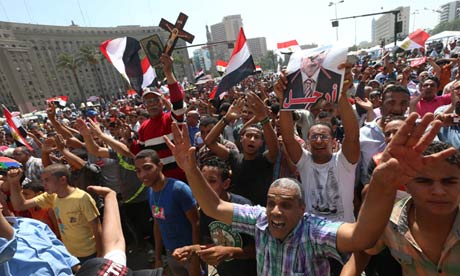
Egypt's Mohamed Morsi remains defiant as fears of civil war grow

    Sunday, June 30, 2013   No comments
In exclusive interview with the Guardian, Morsi defiantly rejects call for elections, setting stage for trial of strength on the streets

The Egyptian president, Mohamed Morsi, has vowed there will be no second revolution in Egypt, as thousands planned to gather outside his presidential palace calling for his removal after a year in power.

In an exclusive interview with the Guardian, Morsi rejected opposition calls for early presidential elections and said he would not tolerate any deviation from constitutional order. He said his early resignation would undermine the legitimacy of his successors, creating a recipe for unending chaos.

"If we changed someone in office who [was elected] according to constitutional legitimacy – well, there will be people opposing the new president too, and a week or a month later they will ask him to step down," Morsi said.

"There is no room for any talk against this constitutional legitimacy. There can be demonstrations and people expressing their opinions. But what's critical in all this is the adoption and application of the constitution. This is the critical point."

At least seven people have been killed and over 600 injured in clashes between Morsi's Islamist allies and their secular opposition over the past few days.

With tensions set to rise on Sunday, Morsi's defiant stance sets the stage for a trial of strength that will be played out on the streets of Cairo in front of his official residence. Once gathered, the opposition have vowed not to leave it until he resigns.

read more >>

Saturday, June 29, 2013

Turkish security forces fire on protesters in Diyarbakir

    Saturday, June 29, 2013   No comments
One person was killed in south-east Turkey as security forces fired shots to disperse hundreds of people protesting against the expansion of an army outpost, according to local officials.
Nine people were also wounded, two of them seriously, according to a statement from the governor's office in the southeastern city of Diyarbakir.

The army opened fire after the crowd of around 300 torched construction tents and marched on the construction site, hurling stones and Molotov cocktails at security forces, said Diyarbakir governor Cahit Kirac.

The incident shattered a lull in the volatile region, where the outlawed Kurdistan Workers' Party (PKK) has waged a bloody campaign for autonomy for nearly three decades, leaving 45,000 people dead.

The PKK, blacklisted as a terrorist organisation by Turkey and much of the West, reached a ceasefire agreement with Ankara in March. Its fighters are still withdrawing into northern Iraq in line with that deal.

read more >>

Brzezinski: Saudi Arabia, Qatar produced the crisis in Syria

    Saturday, June 29, 2013   No comments
Brzezinski: I can’t engage either in psychoanalysis or any kind of historical revisionism. He obviously has a difficult problem on his hands, and there is a mysterious aspect to all of this. Just consider the timing. In late 2011 there are outbreaks in Syria produced by a drought and abetted by two well-known autocracies in the Middle East: Qatar and Saudi Arabia. He all of a sudden announces that Assad has to go—without, apparently, any real preparation for making that happen. Then in the spring of 2012, the election year here, the CIA under General Petraeus, according to The New York Times of March 24th of this year, a very revealing article, mounts a large-scale effort to assist the Qataris and the Saudis and link them somehow with the Turks in that effort. Was this a strategic position? Why did we all of a sudden decide that Syria had to be destabilized and its government overthrown? Had it ever been explained to the American people? Then in the latter part of 2012, especially after the elections, the tide of conflict turns somewhat against the rebels. And it becomes clear that not all of those rebels are all that “democratic.” And so the whole policy begins to be reconsidered. I think these things need to be clarified so that one can have a more insightful understanding of what exactly U.S. policy was aiming at.

read more >>

Friday, June 28, 2013

Police crush protesters, block Ankara gathering

    Friday, June 28, 2013   No comments
The Dikmen district of Ankara was scene of yet another harsh police intervention on June 27, with the police not allowing crowds to gather and intervening as early as 10 p.m., using pressurized water and tear gas without warning.

For the past couple of days, Dikmen has played host to confrontations between police and protesters, but the police intervention usually comes around midnight after protesters build barricades in the late hours of the evening. On this particular occasion, the police intervened in advance, after street lights were turned off around 9:30 p.m.

The police used pressurized water and tear gas against people on side streets, without any warning, while a number of protesters were taken into custody. The intervention was particularly intense due to the presence of four Scorpion (Akrep in Turkish) jeeps and three Mass Incident Intervention Vehicles (TOMA). Both Scorpions and TOMAs are armored riot control vehicles, while the former are also used for taking individuals into custody.

Of the 19 people taken into custody during the protests, 13 were arrested, later on to be jailed, Anadolu Agency reported on June 28.

Those held under custody due to a public prosecutor’s demand were interrogated throughout the night from Article 10 of Anti-Terror Law (TMK). Judge Abdullah Bahçeci issued the ruling on the case.

read more >>

Followers


Trending now...


ISR +


Frequently Used Labels and Topics

40 babies beheaded 77 + China A Week in Review Academic Integrity Adana Agreement afghanistan Africa African Union al-Azhar Algeria Aljazeera All Apartheid apostasy Arab League Arab nationalism Arab Spring Arabs in the West Armenia Arts and Cultures Arts and Entertainment Asia Assassinations Assimilation Azerbaijan Bangladesh Belarus Belt and Road Initiative Brazil BRI BRICS Brotherhood CAF Canada Capitalism Caroline Guenez Caspian Sea cCuba censorship Central Asia Charity Chechnya Children Rights China Christianity CIA Civil society Civil War climate colonialism communication communism con·science Conflict conscience Constitutionalism Contras Corruption Coups Covid19 Crimea Crimes against humanity D-8 Dearborn Debt Democracy Despotism Diplomacy discrimination Dissent Dmitry Medvedev Earthquakes Economics Economics and Finance Economy ECOWAS Education and Communication Egypt Elections energy Enlightenment environment equity Erdogan Europe Events Fatima FIFA FIFA World Cup FIFA World Cup Qatar 2020 Flour Massacre Food Football France Freedom freedom of speech G20 G7 Garden of Prosperity Gaza GCC GDP Genocide geopolitics Germany Global Security Global South Globalism globalization Greece Grozny Conference Hamas Health Hegemony Hezbollah hijab Hiroshima History and Civilizations Hormuz Human Rights Huquq Ibadiyya Ibn Khaldun ICC Ideas IGOs Immigration Imperialism In The News india Indonesia inequality inflation INSTC Instrumentalized Human Rights Intelligence Inter International Affairs International Law Iran IranDeal Iraq Iraq War ISIL Islam in America Islam in China Islam in Europe Islam in Russia Islam Today Islamic economics Islamic Jihad Islamic law Islamic Societies Islamism Islamophobia ISR MONTHLY ISR Weekly Bulletin ISR Weekly Review Bulletin Italy Japan Jordan Journalism Kenya Khamenei Kilicdaroglu Kurdistan Latin America Law and Society Lebanon Libya Majoritarianism Malaysia Mali mass killings Mauritania Media Media Bias Media Review Middle East migration Military Affairs Morocco Multipolar World Muslim Ban Muslim Women and Leadership Muslims Muslims in Europe Muslims in West Muslims Today NAM Narratives Nationalism NATO Natural Disasters Nelson Mandela NGOs Nicaragua Nicaragua Cuba Niger Nigeria Normalization North America North Korea Nuclear Deal Nuclear Technology Nuclear War Nusra October 7 Oman OPEC+ Opinion Polls Organisation of Islamic Cooperation - OIC Oslo Accords Pakistan Palestine Peace Philippines Philosophy poerty Poland police brutality Politics and Government Population Transfer Populism Poverty Prison Systems Propaganda Prophet Muhammad prosperity Protests Proxy Wars Public Health Putin Qatar Quran Rachel Corrie Racism Raisi Ramadan Ramadan War Regime Change religion and conflict Religion and Culture Religion and Politics religion and society Resistance Rights Rohingya Genocide Russia Salafism Sanctions Saudi Arabia Science and Technology SCO Sectarianism security Senegal Shahed sharia Sharia-compliant financial products Shia Silk Road Singapore Slavery Soccer socialism Southwest Asia and North Africa Sovereignty Space War Spain Sports Sports and Politics Starvation State Power State Terror Sudan Sunni Axis sunnism Supremacism SWANA Syria Ta-Nehisi Coates terrorism Thailand The Koreas Tourism Trade transportation Tunisia Turkey Turkiye U.S. Cruelty U.S. Foreign Policy UAE uk ukraine UN under the Rubble UNGA United States UNSC Uprisings Urban warfare US Foreign Policy US Veto USA Uyghur Venezuela Volga Bulgaria Wadee wahhabism War War and Peace War Crimes War on Iran Wealth and Power Wealth Building West Western Civilization Western Sahara WMDs Women women rights Work Workers World and Communities Xi Yemen Zionism

Search for old news

Find Articles by year, month hierarchy


AdSpace

_______________________________________________

Copyright © Islamic Societies Review. All rights reserved.