Tuesday, June 18, 2013

'Standing man' inspires Turkish protesters amid raids

    Tuesday, June 18, 2013   No comments
A Turkish man has staged an eight-hour silent vigil on Istanbul's Taksim Square, as police raided homes and arrested dozens in a clampdown on three weeks of violent anti-government unrest.

Erdem Gunduz said he wanted to take a stand against police stopping demonstrations near the square, Dogan news agency reported.
He stood silently, facing the Ataturk Cultural Centre which was draped in Turkish flags and a portrait of Turkey's founder Mustafa Kemal Ataturk, from 6 pm (1500 GMT) yesterday. By 2 am (2300 GMT), when the police moved in, about 300 people had joined him. Ten people, who refused to be moved on by police, were detained.
Mr Gunduz, swiftly dubbed "standing man" on social media in Turkey, inspired hundreds of others to conduct similar protests elsewhere in Istanbul as well as in the capital Ankara and the city of Izmir on the Aegean coast.


The silent protests were in stark contrast to demonstrations at the weekend, which saw some of the fiercest clashes so far when police fired teargas and water cannon to clear thousands from Taksim Square.
What began in May as a protest by environmentalists upset over plans to build on a park adjoining Taksim has grown into a movement against Prime Minister Tayyip Erdogan, presenting the greatest public challenge to his 10-year leadership.

read more >>

Monday, June 17, 2013

US rejects claims Americans fomenting Gezi Park unrest in Turkey

    Monday, June 17, 2013   No comments
The United States rejected claims June 17 that any U.S. organizations or Americans were stirring up unrest in Turkey, where anti-government protests have raged nationwide for almost three weeks.

“We absolutely reject the accusations that U.S. groups or individuals are responsible for or have escalated … the protests in Turkey,” State Department spokeswoman Jen Psaki said, according to Agence France-Presse.

The statement came after a news story that appeared in a Turkish daily that accused a U.S.-based think tank of being behind Istanbul’s Gezi Park protests.

Turkey’s crisis began when a sit-in to save an Istanbul park from a redevelopment project prompted a brutal police response on May 31.

read more >>

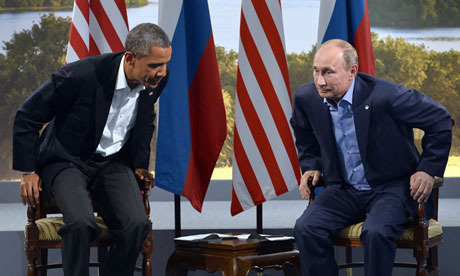
US president says talks 'very useful' but Russia admits 'our opinions do not coincide' as pair look to end conflict in Syria

    Monday, June 17, 2013   No comments
Prospects of agreement between Moscow and Washington on how to end the war in Syria looked as remote as ever on Monday after a chilly bilateral meeting between Barack Obama and Vladimir Putin ended with a stiff exchange of diplomatic pleasantries.

President Obama said the talks, on the fringes of the G8 summit in Northern Ireland, had been "very useful", but both sides acknowledged disagreements over whether President Assad should step down and if rebel groups should receive arms from the west.

President Putin agreed that Russia and the US would continue to push the warring parties in Syria to the negotiating table.

"Of course, our opinions do not coincide," said Putin. "But all of us have the intention to stop the violence in Syria, to stop the growth of victims, and to solve the situation peacefully, including by bringing the parties to the negotiations table in Geneva."

Russia's failure to respond positively to US claims of chemical weapons use in Syria and its hostile response to Obama's plan to give military support to rebel groups means the two leaders remain deeply divided.

Speaking after the meeting, Obama said: "With respect to Syria, we do have differing perspectives on the problem, but we share an interest in reducing the violence; securing chemical weapons and ensuring that they're neither used nor are they subject to proliferation; and that we want to try to resolve the issue through political means, if possible."

read more >>

Vladimir Putin accuses David Cameron of betraying humanitarian values by supporting Syrian rebels

    Monday, June 17, 2013   No comments
Russian President says his country will continue to arm the 'legitimate government' in Syria as Cameron's Coalition allies warn against involving Britain in the conflict
The Russian President, Vladimir Putin, rounded on Britain on Sunday, accusing David Cameron of betraying humanitarian values by supporting Syrian rebels with “blood on their hands”.

In harsh and undiplomatic language, Mr Putin accused the UK and other Western powers of attempting to arm rebels who “kill their enemies and eat their organs”. He insisted that Russia would continue to arm what he said was the recognised “legitimate government” in Syria and called on other countries to respect the same rules.

Mr Putin’s comments, ahead of Monday’s G8 summit in Northern Ireland, suggest that earlier British hopes of a softening of Russia’s position on Syria were misplaced. After around an hour of bilateral talks with David Cameron in Downing Street, Mr Putin’s spokesman told The Independent that the two sides remained as far apart as ever.

“There are very serious disagreements in terms of who is guilty and who is to blame,” he said. Asked what the impact of the American decision to arm Syrian rebels would be on potential peace talks, he added: “It makes it harder.”

On Monday, Foreign Secretary William Hague backed Mr Cameron's assessment, saying that the UK had to save the Syrian rebels from being "exterminated." But elsewhere in the Tory Party, London Mayor Boris Johnson warned that there could be no guarantee that weapons sent to moderate rebels wouldn't end up in the hands of "odious, twisted, hate-filled thugs."

read more >>

Is Moroccan Exceptionalism Falling Apart?

    Monday, June 17, 2013   No comments
The so-called Arab Spring, which is an “Arab Revolution” when its spirit of change is considered historically, has unveiled many masks of extremisms, be they religious or secular. The Arab Revolution has shown, until now, that there is still a long way to go for the affected countries – and the ones not affected alike – to build a “social contract” based on political consensus by the competing parties and bodies for the formation of modern nation states that could be able to cater for the major slogans of the revolution, “liberty, equality, justice, dignity.”

The demands of Moroccans – who are still moving from being subjects to being citizens – are not different from the rest of the Arabs protesting in the streets. What is different is the political history of the country and its present specificity. The seeming advantage of this specificity is that the country delights in having a reformist super-active king, Mohammed VI, who knew how to react to the Arab revolts with his speech on 09 March 2011. A new constitution was drafted by an appointed committee. About 73 % of Moroccans turned out in the referendum of 1 July 2011, and 98 % voted a “yes,” according to the official statistics.[1] The grey area is that the current government seems in a deadlock, unable to deliver its electoral campaign programme of reform because of what it claims to be “pressures” of “crocodiles and ghosts” in the system behind the scenes! The undemocratic games of the pre-Moroccan Spring still influence the political scene and ambiguity reigns over the future of the country. Will Morocco prove its exceptionalism to be that of a smooth democratic transition? If so, it will be “positive exceptionalism.” Or will it be an exceptionalism that blocks, or at least slows down, the rhythm of democratic reforms? If so, it will be “negative exceptionalism,” or “pejorative exceptionalism.” In both cases, the role of the monarchy is undoubtedly crucial, and whatever form exceptionalism takes, it will affect its place in Moroccan politics, future history, and most importantly the Moroccan psyche that overall sympathizes with the current reformist king.[2] This delicate situation of Moroccan exceptionalism stems from the broken post-2011 coalition government. There is a deep political crisis that the Moroccan Spring, and Arab Revolution in general, has not accounted for yet.

The moderate Islamist party of PJD (Justice and Development Party) won the elections of 25 November 2011, and has been running the country, in a coalition government, for the first time. The coalition is “hybrid”, composed of the Independence party that came second in elections, and now holds the offices of six ministries, the Popular Movement (MP) that runs four ministries, and the Party of Progress and Socialism (PPS) that equally runs six others, besides the leading party PJD that runs twelve ministries. (The PPS should not be confused with the largest socialist party The Socialist Union of Popular Forces (USFP) which is in the opposition.) The coalition took time to be composed, and signed a Charter of Coalition as a way of solidifying team work for one agenda and not as parties that each works its own electoral agenda in the ministries it runs. The electoral system in the country obliges such hybrid coalitions because of the fragmented political parties that it creates.[3]

read more >>

Sunday, June 16, 2013

Putin warns Cameron against arming Syrian rebels as UK weighs options

    Sunday, June 16, 2013   No comments
Russia and UK still have very different approaches to the Syrian crisis,British PM Cameron said after meeting Putin adding that the decision to arm rebels is yet to be made.Russia’s President warned against such a move citing rebels' atrocities.

"The  blood is on the hands of both parties” of the conflict, not only Bashar Assad’s government but also the rebels, Russia’s President Vladimir Putin stressed at the press conference at 10 Downing Street.

"I think you will not deny that one does not really need to support the people who not only kill their enemies, but open up their bodies, eat their intestines, in front of the public and cameras," Putin said referring to a video footage on the Internet of a rebel fighter eating the heart of a government soldier. Later however it was concluded the fighter was holding a lung.

"Is it them who you want to supply with weapons?" he said adding that it does not correspond with international humanitarian norms.

Putin also defended Russia's arms supplies to the official government of Syria saying they are "in accordance with  international laws.”

read more >>

Police lock down Taksim, PM shows off in Istanbul

    Sunday, June 16, 2013   No comments
The ruling Justice and Development Party (AKP) leader addressed hundreds of thousands of people in a landmark meeting in Istanbul today only half a day after a large-scale police crackdown on protesters in Gezi, a central Istanbul park that is at the heart of the nearly 20-day-long street action across the country.

The AKP meeting in Istanbul’s Kazlıçeşme, not very far from Gezi Park, was a part of the party‘s official launch of the local elections campaign, which is set to be held in March next year.

Party leader and Prime Minister Recep Tayyip Erdoğan himself said at an Ankara meeting, the first leg of the campaign-start, that the “Respect for National Will” meetings were by no means a move against the Gezi protests.

“Those who wonder about what’s going on in Turkey should better look at Kazlıçeşme, at Istanbul,” Erdoğan told his supporters in Istanbul.

“These hundreds of thousands of people are not the ones who have burned and destroyed; these hundreds of thousands of people are not traitors like those who throw Molotov cocktails at my people. Whatever we do, we’ll remain within the frame of democracy and the rule of law. We have never pushed the limits of legality,” he said.

read more >>

Saturday, June 15, 2013

Benghazi clashes kill 6 soldiers amid warnings of imminent ‘bloodbath’

    Saturday, June 15, 2013   No comments
Libyan Special Forces fought with armed protesters in Benghazi in clashes that killed six soldiers, officials report. The flashpoint city has been hit by a wave of bloody protests recently demanding the disbandment of militia groups.

Violence erupted during Friday night and continued into the morning with witness reports of explosions and heavy gunfire throughout the city.

"The clashes lasted from 2am (00:00 GMT) until 6am, but are over now," Colonel Mohammed Sharif, of the Special Forces in Benghazi, told Reuters. The six soldiers were killed in clashes with armed protesters outside a military base in the city.

Prior to the clashes a group of enraged protesters stormed a former militia base on Friday evening, ejecting a brigade of rebel fighters. Officials say the demonstrators also torched two military vehicles in the process.

Tensions have been escalating in Benghazi between the population and the various militia groups left behind after they aided in the ouster of Colonel Gaddafi in 2011. Last week, at least 31 people were killed in clashes after members of the militia group, the Libyan Shield Brigade opened fire on protesters demonstrating outside their base.

The army's Thunderbolt Special Forces brigade arrived to impose order, but was sucked into the violence.

"The Libya Shield don't follow orders, we don't even know whose orders they follow," said Thunderbolt Brigade lieutenant Said Alari to The Guardian.

Following the unrest, the Libyan interim government ordered the seizure of four Islamist militia bases around Benghazi. However, very few believe the militia will willingly disband.


read more >>

Gezi Park protesters refuse to leave, vow to 'continue resistance'

    Saturday, June 15, 2013   No comments
The protesters have announced today that they will continue to “stand guard” at Gezi Park and vowed to "pursue resistance," despite repeated calls for the end of the demonstrations after the government assured that it would comply with a court decision suspending the redevelopment plans for Gezi Park.

“On the 18th day of our resistance, we are continuing to stand guard for our park, city, trees, living spaces private lives, freedoms and future,” the Taksim Solidarity Platform, which has been at the center of the protests since the first day, said in a statement.

“We will follow whether our demands [are carried out]. This resistance will be the reflection of the Taksim Solidarity’s common will and the common flag of a whole struggle. From now on, we will continue the resistance against every injustice in our country with the dynamism and force of our struggle that extended to the whole nation, or even to the world,” it added, calling for concrete steps toward the investigation of the four casualties during the protests. “We will follow closely whether those responsible for this violence are brought to justice.”


read more >>

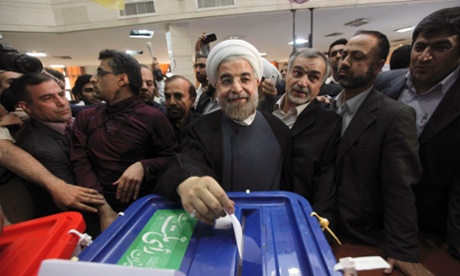
Early results suggest Rouhani may win an outright majority in presidential election, avoiding need for runoff

    Saturday, June 15, 2013   No comments
The moderate Iranian cleric Hassan Rouhani has taken a strong lead in the initial results of Iran's presidential election, threatening to win a simple majority and avoid a second-round runoff.

With more than 8 million votes counted from the 50 million electorate, Rouhani had 51.2% of votes cast, Reuters reported. Rouhani's nearest rival was the conservative Tehran mayor, Mohammad Bagher Ghalibaf, a long way behind with 16.7%. Hardline nuclear negotiator Saeed Jalili was third with about 13%.

Seven hours after polling ended, Iran's interior minister, Mostafa Mohammad-Najjar, appeared on state-run television to begin announcing the results.

The authorities had initially announced they would begin to reveal counts just after 2am local time on Saturday (10.30pm Friday BST), but the first figures did not come through until at least four hours later. This was in marked contrast to the previous vote in 2009, which many believed was rigged, when final results were announced in matter of few hours.

"It has taken them seven hours to count 800,000 votes while four years ago they counted almost 30 million votes in few hours," one Iranian living in Tehran said via online chat on Facebook. "It might be a good sign that actually this time they're really counting."

Unlike in 2009, Iranian agencies refrained for many hours from speculating on the results or publishing unofficial counts.

On Friday millions of people across the country queued to elect a successor to Mahmoud Ahmadinejad.

read more >>

Followers


Trending now...


ISR +


Frequently Used Labels and Topics

40 babies beheaded 77 + China A Week in Review Academic Integrity Adana Agreement afghanistan Africa African Union al-Azhar Algeria Aljazeera All Apartheid apostasy Arab League Arab nationalism Arab Spring Arabs in the West Armenia Arts and Cultures Arts and Entertainment Asia Assassinations Assimilation Azerbaijan Bangladesh Belarus Belt and Road Initiative Brazil BRI BRICS Brotherhood CAF Canada Capitalism Caroline Guenez Caspian Sea cCuba censorship Central Asia Charity Chechnya Children Rights China Christianity CIA Civil society Civil War climate colonialism communication communism con·science Conflict conscience Constitutionalism Contras Corruption Coups Covid19 Crimea Crimes against humanity D-8 Dearborn Debt Democracy Despotism Diplomacy discrimination Dissent Dmitry Medvedev Earthquakes Economics Economics and Finance Economy ECOWAS Education and Communication Egypt Elections energy Enlightenment environment equity Erdogan Europe Events Fatima FIFA FIFA World Cup FIFA World Cup Qatar 2020 Flour Massacre Food Football France Freedom freedom of speech G20 G7 Garden of Prosperity Gaza GCC GDP Genocide geopolitics Germany Global Security Global South Globalism globalization Greece Grozny Conference Hamas Health Hegemony Hezbollah hijab Hiroshima History and Civilizations Hormuz Human Rights Huquq Ibadiyya Ibn Khaldun ICC Ideas IGOs Immigration Imperialism In The News india Indonesia inequality inflation INSTC Instrumentalized Human Rights Intelligence Inter International Affairs International Law Iran IranDeal Iraq Iraq War ISIL Islam in America Islam in China Islam in Europe Islam in Russia Islam Today Islamic economics Islamic Jihad Islamic law Islamic Societies Islamism Islamophobia ISR MONTHLY ISR Weekly Bulletin ISR Weekly Review Bulletin Italy Japan Jordan Journalism Kenya Khamenei Kilicdaroglu Kurdistan Latin America Law and Society Lebanon Libya Majoritarianism Malaysia Mali mass killings Mauritania Media Media Bias Media Review Middle East migration Military Affairs Morocco Multipolar World Muslim Ban Muslim Women and Leadership Muslims Muslims in Europe Muslims in West Muslims Today NAM Narratives Nationalism NATO Natural Disasters Nelson Mandela NGOs Nicaragua Nicaragua Cuba Niger Nigeria Normalization North America North Korea Nuclear Deal Nuclear Technology Nuclear War Nusra October 7 Oman OPEC+ Opinion Polls Organisation of Islamic Cooperation - OIC Oslo Accords Pakistan Palestine Peace Philippines Philosophy poerty Poland police brutality Politics and Government Population Transfer Populism Poverty Prison Systems Propaganda Prophet Muhammad prosperity Protests Proxy Wars Public Health Putin Qatar Quran Rachel Corrie Racism Raisi Ramadan Ramadan War Regime Change religion and conflict Religion and Culture Religion and Politics religion and society Resistance Rights Rohingya Genocide Russia Salafism Sanctions Saudi Arabia Science and Technology SCO Sectarianism security Senegal Shahed sharia Sharia-compliant financial products Shia Silk Road Singapore Slavery Soccer socialism Southwest Asia and North Africa Sovereignty Space War Spain Sports Sports and Politics Starvation State Power State Terror Sudan Sunni Axis sunnism Supremacism SWANA Syria Ta-Nehisi Coates terrorism Thailand The Koreas Tourism Trade transportation Tunisia Turkey Turkiye U.S. Cruelty U.S. Foreign Policy UAE uk ukraine UN under the Rubble UNGA United States UNSC Uprisings Urban warfare US Foreign Policy US Veto USA Uyghur Venezuela Volga Bulgaria Wadee wahhabism War War and Peace War Crimes War on Iran Wealth and Power Wealth Building West Western Civilization Western Sahara WMDs Women women rights Work Workers World and Communities Xi Yemen Zionism

Search for old news

Find Articles by year, month hierarchy


AdSpace

_______________________________________________

Copyright © Islamic Societies Review. All rights reserved.