Tuesday, May 14, 2013

Algeria and the Shirt of Nessus

    Tuesday, May 14, 2013   No comments

Yasmina Khadra emerged as a writer in the 1980s, at a time when Islamic extremism was taking root in his native Algeria. Economic suffering gave an opportunity to the Islamists, some of them inspired by the example of the mujahideen in Afghanistan. Women were accosted for dressing immodestly, bars and restaurants attacked for serving alcohol, and traditional imams driven from their positions. The Islamists called for a Muslim regime, and succeeded in forcing the government to accept elements of Sharia law. A drop in Algeria's oil revenue drove further unrest, culminating in the violent protests of October 1988. Hundreds of people were killed in the government crackdown, and outrage at government repression gave more power to the Islamists. Understandably, the question of Muslim extremism became the core of Khadra's work as a novelist.


Sunday, May 12, 2013

Maher: Islam is a uniquely threatening and destructive force and that Muslims are uniquely oppressive and violent

    Sunday, May 12, 2013   No comments
Glenn Greenwald: Last night I was on Bill Maher's HBO show "Real Time". There have always been numerous views of Maher's with which I agree. But he has become one of the most vocal and extreme advocates of the view that - while religion generally should be criticized - Islam is a uniquely threatening and destructive force and that Muslims are uniquely oppressive and violent, and that mentality has infected many of his policy views (see here and here for some comprehensive background; just two weeks ago, he had a fairly typical outburst on this topic). When I was scheduled to do the show, I was hoping that the opportunity would arise to debate these views (or that I could create the opportunity), and last night it did.

Iran Surprises Again!

    Sunday, May 12, 2013   No comments
Saeed Jalili
by Farideh Farhi

Okay, it is time to admit that the only thing predictable about Iranian politics these days is its unpredictability!

There are people who know Iran well and as early as a few months ago thought that the next president of the country was already decided by the powers that be. There are also others who will say that they predicted all this. I am not one of these.

I am stunned. As of late yesterday (Friday), I did not think that former president and current Expediency Council chair Akbar Hashemi Rafsanjani would run for the presidency. All the talk about his entry – and the previous talk and hope about former president Mohammad Khatami’s entry – was mostly tactical, I thought. The loud calls – and pleas – for either Khatami or Hashemi Rafsanjani to run were to show the depth of their support among various sectors of Iranian society, from a good number of the urban middle classes to the business community. I thought it was sort of a flexing of social power muscle. But, given the hysterical reaction both former presidents elicit from the hardliners, I thought they would ultimately be reluctant to run, in the end preferring to throw their support to another candidate who would try to carefully pull the country to the middle.

read more >>

Saturday, May 11, 2013

Explosions hit Turkish town on border with Syria, killing four and injuring 22

    Saturday, May 11, 2013   No comments
Several explosions have hit the southern province of Hatay’s Reyhanlı district on the Turkish-Syrian border. At least four people were killed, Interior Minister Güler told reporters. Other 22 were reported injured.

"Two car [bombs] were set off in front of the municipality," Güler said, but other reports indicated that there were three or more explosions.

read more >>

Pakistani elections: more than a dozen killed by bomb blast in Karachi

    Saturday, May 11, 2013   No comments
At least 18 people have been killed in bomb attacks and gun battles in Pakistan as millions of voters turned out despite the threats of violence in landmark national and provincial elections.

A bomb attack in the port city of Karachi on Saturday morning targeted the office of the Awami National party (ANP), killing 11 people and wounding more than 40, according to Reuters. Local media also reported gunfire in the city, underlining the range of risks faced by the country's 86 million voters.

A bomb exploded outside a polling station in the north-western city of Peshawar, killing at least one person and wounding 10 others, according to local police officer, Mukhtiar Khan. An explosion also destroyed an ANP office in the north-west, though no casualties have so far been reported.

In the south-western Balochistan province where separatists oppose the election, gunmen killed two people outside a polling station in the town of Sorab and a shoot out between supporters of rival candidates in the town of Chaman ended with four people dead, according to police and government officials.

The violence follows a string of bombings and shootings by the Taliban, which have marred the runup to the elections and claimed the lives of more than 130 people.

read more >>

Scientific Journals Adapt to New U.S. Trade Sanctions on Iran

    Saturday, May 11, 2013   No comments
Scientific journals are being asked to help tighten U.S. trade sanctions on Iran. On 30 April, the Dutch publishing behemoth Elsevier of the Netherlands sent a note to its editorial network saying that all U.S. editors and U.S. reviewers must "avoid" handling manuscripts if they include an author employed by the government of Iran. Under a policy that went into effect in March -- reflecting changes in a law passed by the U.S. Congress in December -- even companies like Elsevier not based in the United States must prevent their U.S. personnel from interacting with the Iranian government.

The sanctions, aimed at punishing Iran for its pursuit of nuclear technology, have been broadened somewhat from previous rules issued by the enforcement agency, the U.S. Office of Foreign Assets Control (OFAC), a division of the Treasury Department.


Friday, May 10, 2013

Benghazi Schools Obama In The Politics Of Scandal

    Friday, May 10, 2013   No comments
President Obama has led an administration that so far has avoided a headline-grabbing, signature scandal. But now he's learning how one begins to take shape.

In many ways, the Benghazi story is following the arc of many Washington scandals of the past. It's rarely the initial incident that gets politicians in trouble. Instead, it's the way in which they respond to it.

After months of relative inattention, the media are seizing on missteps surrounding the attack on the U.S. Consulate in Benghazi, Libya, last September, during which Ambassador Chris Stevens and three other American officials were killed.

With Father and Sister Imprisoned, Exiled Bahraini Activist Maryam Alkhawaja Condemns Ongoing Abuses

    Friday, May 10, 2013   No comments
The Bahraini government continues its crackdown on opposition protesters, with demonstrations repressed and scores of dissidents held behind bars. We’re joined by Maryam Alkhawaja, a leading Bahraini human rights activist. Her family has been highly critical of the U.S.-backed monarchy, and they have paid a heavy price. Maryam’s father, human rights attorney Abdulhadi Alkhawaja, is serving a life sentence in prison. He has already spent two years in jail. Her sister, Zainab Alkhawaja, is also imprisoned. A close friend of the family, Nabeel Rajab, is also in jail. Rajab had been the head of the Bahrain Center for Human Rights. "There has hardly been any real accountability of the Bahraini government of the human rights violations that have been going on in Bahrain for more than two years now," says Alkhawaja, who is now the acting president of the Bahrain Center for Human Rights.


Syria crisis: US-Russia accord offers no easy answers

    Friday, May 10, 2013   No comments
By Jim Muir

The vogue word "game-changer" has been heavily overused in recent months. But the agreement that seems to have emerged on Syria from more than five hours of intensive talks in Moscow between US Secretary of State John Kerry, Russian President Vladimir Putin and Russian Foreign Minister Sergei Lavrov may turn out to be just that.

For the past two years, the international community has been hamstrung from taking concerted action over Syria, because the UN Security Council was paralysed by big power differences, with disputes between Washington and Moscow at the core.

Now at last the two seem to be genuinely singing from the same song sheet.

read more >>

Thursday, May 09, 2013

Free Syrian Army rebels defect to Islamist group Jabhat al-Nusra

    Thursday, May 09, 2013   No comments
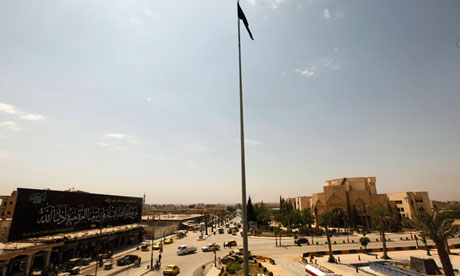
The flag of Jabhat al-Nusra flying over Raqqa

 armed opposition group, the Free Syrian Army (FSA), is losing fighters and capabilities to Jabhat al-Nusra, an Islamist organisation with links to al-Qaida that is emerging as the best-equipped, financed and motivated force fighting Bashar al-Assad's regime.
Evidence of the growing strength of al-Nusra, gathered from Guardian interviews with FSA commanders across Syria, underlines the dilemma for the US, Britain and other governments as they ponder the question of arming anti-Assad rebels.
John Kerry, the US secretary of state, said that if negotiations went ahead between the Syrian government and the opposition – as the US and Russia proposed on Tuesday – "then hopefully [arming the Syrian rebels] would not be necessary".
The agreement between Washington and Moscow creates a problem for the UK and France, which have proposed lifting or amending the EU arms embargo on Syria to help anti-Assad forces. The Foreign Office welcomed the agreement as a "potential step forward" but insisted: "Assad and his close associates have lost all legitimacy. They have no place in the future of Syria." Opposition leaders were sceptical about prospects for talks if Assad remained in power.

Followers


Most popular articles


ISR +


Frequently Used Labels and Topics

40 babies beheaded 77 + China A Week in Review Academic Integrity Adana Agreement afghanistan Africa African Union al-Azhar Algeria Aljazeera All Apartheid apostasy Arab League Arab nationalism Arab Spring Arabs in the West Armenia Arts and Cultures Arts and Entertainment Asia Assassinations Assimilation Azerbaijan Bangladesh Belarus Belt and Road Initiative Brazil BRI BRICS Brotherhood CAF Canada Capitalism Caroline Guenez Caspian Sea cCuba censorship Central Asia Charity Chechnya Children Rights China Christianity CIA Civil society Civil War climate colonialism communication communism con·science Conflict conscience Constitutionalism Contras Corruption Coups Covid19 Crimea Crimes against humanity D-8 Dearborn Debt Democracy Despotism Diplomacy discrimination Dissent Dmitry Medvedev Earthquakes Economics Economics and Finance Economy ECOWAS Education and Communication Egypt Elections energy Enlightenment environment equity Erdogan Europe Events Fatima FIFA FIFA World Cup FIFA World Cup Qatar 2020 Flour Massacre Food Football France Freedom freedom of speech G20 G7 Garden of Prosperity Gaza GCC GDP Genocide geopolitics Germany Global Security Global South Globalism globalization Greece Grozny Conference Hamas Health Hegemony Hezbollah hijab Hiroshima History and Civilizations Human Rights Huquq Ibadiyya Ibn Khaldun ICC Ideas IGOs Immigration Imperialism In The News india Indonesia inequality inflation INSTC Instrumentalized Human Rights Intelligence Inter International Affairs International Law Iran IranDeal Iraq Iraq War ISIL Islam in America Islam in China Islam in Europe Islam in Russia Islam Today Islamic economics Islamic Jihad Islamic law Islamic Societies Islamism Islamophobia ISR MONTHLY ISR Weekly Bulletin ISR Weekly Review Bulletin Italy Japan Jordan Journalism Kenya Khamenei Kilicdaroglu Kurdistan Latin America Law and Society Lebanon Libya Majoritarianism Malaysia Mali mass killings Mauritania Media Media Bias Media Review Middle East migration Military Affairs Morocco Multipolar World Muslim Ban Muslim Women and Leadership Muslims Muslims in Europe Muslims in West Muslims Today NAM Narratives Nationalism NATO Natural Disasters Nelson Mandela NGOs Nicaragua Nicaragua Cuba Niger Nigeria Normalization North America North Korea Nuclear Deal Nuclear Technology Nuclear War Nusra October 7 Oman OPEC+ Opinion Polls Organisation of Islamic Cooperation - OIC Oslo Accords Pakistan Palestine Peace Philippines Philosophy poerty Poland police brutality Politics and Government Population Transfer Populism Poverty Prison Systems Propaganda Prophet Muhammad prosperity Protests Proxy Wars Public Health Putin Qatar Quran Rachel Corrie Racism Raisi Ramadan Ramadan War Regime Change religion and conflict Religion and Culture Religion and Politics religion and society Resistance Rights Rohingya Genocide Russia Salafism Sanctions Saudi Arabia Science and Technology SCO Sectarianism security Senegal Shahed sharia Sharia-compliant financial products Shia Silk Road Singapore Slavery Soccer socialism Southwest Asia and North Africa Sovereignty Space War Spain Sports Sports and Politics Starvation State Power State Terror Sudan sunnism Supremacism SWANA Syria Ta-Nehisi Coates terrorism Thailand The Koreas Tourism Trade transportation Tunisia Turkey Turkiye U.S. Cruelty U.S. Foreign Policy UAE uk ukraine UN under the Rubble UNGA United States UNSC Uprisings Urban warfare US Foreign Policy US Veto USA Uyghur Venezuela Volga Bulgaria Wadee wahhabism War War and Peace War Crimes Wealth and Power Wealth Building West Western Civilization Western Sahara WMDs Women women rights Work Workers World and Communities Xi Yemen Zionism

Search for old news

Find Articles by year, month hierarchy


AdSpace

_______________________________________________

Copyright © Islamic Societies Review. All rights reserved.