Showing posts with label religion and society. Show all posts

Friday, September 25, 2026

Current Events: How Salafism Became Saudi Arabia's Weapon of Last Resort in Yemen

    Friday, September 25, 2026   No comments

 When the Mufti Goes to War

For more than a decade, Riyadh's framing of its war in Yemen was deliberately political. The Saudi-led coalition, launched in March 2015, described the Sanaa government led by the Houthi movement (Ansar Allah) as a militia, an Iranian proxy, an illegitimate power grabber — language drawn from the vocabulary of statecraft, not scripture. That vocabulary has now been abandoned. In a statement issued on September 25, 2026, Saudi Arabia's Grand Mufti and head of the Council of Senior Scholars, Sheikh Saleh bin Fawzan al-Fawzan, declared the Houthis "a misguided faction and deviant group" guilty of corrupting the creed itself, urged front-line troops to be ready to sacrifice their lives, and proclaimed that restoring security in Yemen under its "legitimate leadership" was among the most binding of duties.

The timing is not incidental. The statement came as the kingdom faced one of its most sustained Houthi escalations in years — ballistic missiles intercepted over Taif and Yanbu, drone strikes that killed coalition soldiers, renewed fighting around Taiz, and attacks that Riyadh says targeted its cities, with civil defense alerts even reaching the vicinity of Makkah before the all-clear was sounded. Washington, meanwhile, has declined to back its Saudi ally's push, holding to the ceasefire framework it negotiated with the Houthis in 2025.


This is what losing a war sounds like in the language of theology.

From "militia" to "apostate"

The shift is subtle but momentous. Calling an adversary a militia implies a political settlement is possible — militias can be disarmed, absorbed, negotiated with. Calling them a deviant sect that "excommunicates the companions of the Prophet," "sheds the blood of Muslims," and wages war on wali al-amr (those in authority) forecloses that possibility. A corrupt political actor can reform; a corrupt creed must be defeated. Al-Fawzan's message to the "stationed fighters and coalition forces" was explicit: unite your ranks, obey your commanders, and fight until the enemy's roots are cut — a call amplified by state media as one for the movement's complete defeat.

This is the grammar of sectarian war, and it is being activated now — eleven years into a conflict Riyadh once promised would end in weeks — for a reason that has nothing to do with theology and everything to do with the battlefield.

The audible silence of the ulama

What makes this intervention revealing is not what the mufti said, but what he and his institution have not said for over a decade. The Saudi religious establishment — the mufti, the Council of Senior Scholars, the sprawling Salafi scholarly apparatus built and bankrolled by the state — was notably quiet while the Yemen war became one of the gravest humanitarian catastrophes of the century. Tens of thousands dead, famine conditions, the bombing of markets, weddings, and a school bus — the ulama, who can pronounce on everything from Valentine's Day to video games, largely withheld judgment while the coalition carried the kingdom's name. Their silence was required by the political leadership, and it was faithfully observed.

But in the Syrian war, in Libya, in the blockade of Qatar, in the internal repression of dissident clerics — wherever the state needed either thunder or quiet, the institutions delivered. The pattern is consistent enough that the exception proves the rule: these bodies speak as independent moral authorities only in the moments when the ruling authority wants them to speak.

This is not a secret, but it is rarely spoken aloud, because the legitimacy of the Saudi state rests on the carefully cultivated fiction that the scholars' fatwas descend from revelation rather than from instructions. Al-Fawzan's statement, carried by the official Saudi Press Agency and swiftly amplified by Al Jazeera and Qatari media — Riyadh's rivals who understand perfectly the propaganda value of the kingdom's own clerics being conscripted into open-ended war — shatters that fiction in public.

Qatar's amplification

There is a second irony here. Qatari media, which has spent years branding the Saudi religious establishment as a fount of extremist ideology, now broadcasts the Saudi mufti's declaration to cut off the Houthis to a regional audience, because it serves Doha's immediate interest: embarrassing and bleeding Riyadh. The same Doha that shelters and platforms Muslim Brotherhood and various Salafi currents deploys the Salafi idiom against Saudi Arabia's enemies when convenient. Both Gulf monarchies, for all their feud, treat the region's religious vocabulary as an arsenal — loaded, aimed, and fired by political calculation, shelved when the calculation changes.

The Houthis, for their part, are acutely aware of the game; their own movement has long instrumentalized religious motifs against Saudi Arabia (accusing Saudi rulers of betraying religion). But here the mufti's charge deserves scrutiny rather than repetition. That the Houthis "excommunicate the companions of the Prophet" is an accusation, not a fact. Classical Zaydi doctrine — the theological tradition in which the movement is rooted — is distinguished from other sects precisely by its refusal to curse the sahaba or condemn the first caliphs as apostates; Zayd ibn Ali himself refused to renounce Abu Bakr and Umar, and the mainstream Hadawi school holds that they erred, not that they became unbelievers. The allegation of takfir (salafi doctrine that is a feature of Saudi religious teachings) is thus doing political work: it imports the most inflammatory sectarian charge in the Salafi repertoire and pins it on a movement whose own theology, whatever its other polemics, does not straightforwardly contain it. That the mufti's accusation need not be accurate to be effective is exactly what makes it a weapon. Sectarianism in this war is not a cause; it is a recruiting sergeant, a morale patch, and an exit-blocker.

The price of conscription

Riyadh's gamble carries a real cost, and it falls on the very institution being conscripted. The Saudi religious establishment spent the better part of a century and untold billions building global authority as the custodian of Salafi-Wahhabi orthodoxy — endowing chairs, printing Qurans, training imams from Indonesia to Michigan, branding itself as above the grubby business of politics. That authority is finite. Every time the mufti declares an open-ended holy war at the state's behest, the brand depreciates. A religious institution that can be summoned to bless a war it was silent about during its worst atrocities will, eventually, be seen for what the serious reader has always suspected it is: a department of the state, not a conscience above it.

There is a further danger. Sectarian framing is easy to escalate and nearly impossible to de-escalate. Once the Houthis are officially declared a deviant sect warring against true Islam — rather than a political-military adversary — any future Saudi government seeking the negotiated exit that Oman has been mediating for years inherits a theological obstacle of its own construction. You can sign a ceasefire with a militia. You cannot easily sign one with a heresy. The recent track of Saudi-Houthi talks, including the first Houthi delegation's visit to Riyadh, ran precisely on the older, political framing; the new religious framing threatens to lock the kingdom into a cycle of violence its own diplomats had been trying to escape.

What this tells us about religious institutions

The lesson of this episode is not about Islam, or even about Salafism as a body of doctrine. It is about the sociology of institutions that claim transcendent authority while depending on state patronage. Whether in Riyadh (Salafism), Cairo (al-Azhar) or Doha (Muslim Brotherhood), such institutions exhibit a remarkable elasticity: they can be silent about grotesque violence when silence serves, and thunderous about doctrine when thunder serves. Their scholars are not hypocrites in any simple sense — many are sincere men doing what the system demands — which is precisely the point. The system, not the men, sets the volume.

Al-Fawzan's statement should thus be read less as a religious event than as a battlefield communiqué issued in theological dress. The Saudi state, pressured on the ground, abandoned by its patron's caution, watching its Red Sea shipping and even its capital come under fire, has reached for its weapon of last resort: not a missile, but a fatwa. That it felt the need to do so says more about the state of the war than any intercepted drone ever could — and it will say even more, in the years to come, about the price the kingdom's religious authority paid for being, in the end, just another armory.

Update: Yemen Reponse


Wednesday, April 15, 2026

Analyzing the Potential Role of General Asim Munir in Iran‑U.S. Diplomacy

    Wednesday, April 15, 2026   No comments
Diplomacy between Iran and the United States has traditionally been channeled through civilian foreign ministries, backchannel envoys, and multilateral frameworks. Should Pakistani Army Chief General Asim Munir assume an active, visible role in facilitating talks between the two nations, it would represent a deliberate recalibration of diplomatic signaling. Such a move would not merely reflect personal stature, but would communicate institutional commitment, security prioritization, and alignment with an evolving regional security architecture.

Analyzing this scenario reveals why a military figure, rather than Pakistan’s prime minister or foreign minister, could carry unique diplomatic weight, what cultural and strategic dimensions his involvement introduces, and how this might intersect with broader efforts to stabilize an emerging network of Muslim-majority security partnerships.

The primary rationale for deploying a military chief lies in the nature of the assurances Iran has historically sought from Washington: binding security guarantees, non-interference commitments, and mechanisms that outlast electoral cycles or partisan shifts. Civilian leaders in Pakistan, like their counterparts elsewhere, operate within volatile political ecosystems, coalition dependencies, and shifting parliamentary majorities. A military chief, by contrast, embodies institutional continuity, direct command over national security apparatuses, and a long-standing role in Pakistan’s strategic foreign policy. By placing General Munir at the center of Iran‑U.S. dialogue, Pakistan would signal that any resulting understandings are backed by its defense establishment, not merely by a transient government. For Tehran, which has repeatedly emphasized regime security and protection from external coercion, this military-backed diplomacy offers a tangible anchor of credibility.

The religious and cultural dimensions of Munir’s involvement also warrant careful consideration, though not through a reductive sectarian lens. Pakistan’s military leadership has historically operated at the intersection of Islamic cultural diplomacy, counterterrorism coordination, and regional security management. General Munir’s operational experience across diverse Muslim contexts, combined with Pakistan’s tradition of leveraging shared religious-cultural frameworks to build trust, could facilitate discreet channels of communication that civilian diplomats might find constrained by protocol or domestic political optics. For Washington, recognizing these dimensions means understanding that Pakistani military diplomacy often functions as a stabilizing interlocutor in regions where religious identity intersects with security calculus. The strategic implication is clear: a figure who commands institutional respect across sectarian and national lines can help de-escalate mistrust, provided the U.S. engages with cultural fluency rather than instrumentalization.

This diplomatic posture gains further significance when viewed against Pakistan’s deepening defense ties with Saudi Arabia and Turkey. Joint exercises, training agreements, and strategic dialogues have increasingly positioned Pakistan as a connective node in a loose but consequential security corridor spanning the Gulf, Anatolia, and South Asia. While this is not a formalized alliance, it reflects a pragmatic convergence of interests: counterterrorism coordination, defense industrial cooperation, and efforts to reduce regional polarization. Integrating Iran into a Pakistan-mediated diplomatic framework could serve as a stabilizing counterweight to isolation-driven security dilemmas. If Munir’s involvement helps translate Iran‑U.S. understandings into actionable security arrangements, it could function as a missing link in a broader architecture that prioritizes de-escalation, economic reintegration, and institutionalized crisis management among Muslim-majority states.

Nevertheless, the potential of such military-led diplomacy must be weighed against inherent constraints. Over-militarizing diplomatic processes risks marginalizing civilian institutions, complicating long-term democratic accountability, and triggering skepticism from Iranian hardliners or U.S. congressional actors wary of defense-centric negotiations. Moreover, Pakistan’s own economic vulnerabilities and domestic political transitions could limit its capacity to sustain high-stakes mediation without robust international backing. For the arrangement to succeed, military diplomacy must eventually interface with civilian statecraft, multilateral verification mechanisms, and transparent economic incentives to ensure durability beyond security guarantees.

In sum, General Asim Munir’s active participation in Iran‑U.S. talks would signal a strategic shift toward institutionalized, security-first diplomacy. It would underscore Pakistan’s evolving role as a regional stabilizer, leverage cultural and operational credibility to bridge trust deficits, and align with a nascent network of Muslim-state security cooperation. While not a substitute for comprehensive civilian diplomacy, such military-backed engagement could provide the continuity and assurance necessary to convert fragile understandings into durable stability. The ultimate test will lie in whether this approach can be integrated into inclusive, multilateral frameworks that balance security, sovereignty, and economic development across a deeply interconnected region.


Monday, November 04, 2024

Sistani to the UN representative: We regret the international community's inability to stop the Israeli aggression on Gaza and Lebanon

    Monday, November 04, 2024   No comments

The highest religious authority in Iraq, Sayyid Ali al-Sistani, stressed today, Monday, the prevention of foreign interventions in all its forms, while expressing his regret for the inability of the international community and its institutions to impose effective solutions to stop the Israeli aggression on the Gaza Strip and Lebanon.

Sayyid al-Sistani received the representative of the Secretary-General of the United Nations and head of its mission in Iraq (UNAMI) Mohammed al-Hassan and his accompanying delegation. In a statement issued by Sayyid al-Sistani's office, he said that "Sayyid provided a brief explanation of the tasks of the international mission and the role it seeks to play in the coming period. In return, he welcomed the presence of the United Nations in Iraq and wished its mission success in carrying out its tasks."

Sayyid al-Sistani added that "Iraqis - especially the conscious elites - should learn from the experiences they have gone through and do their utmost to overcome their failures and work hard to achieve a better future for their country in which everyone enjoys security, stability, progress and prosperity."

He also stressed that "this cannot be achieved without preparing scientific and practical plans to manage the country based on the principle of competence and integrity in assuming positions of responsibility, preventing foreign interventions in all their aspects, and enforcing the rule of law."

Regarding the volatile situations in our region, Mr. Sistani expressed his "deep sorrow over the ongoing tragedy in Lebanon and Gaza and his deep regret over the inability of the international community and its institutions to impose effective solutions to stop it or at the very least to neutralize civilians from the tragedies of the fierce aggression practiced by the Israeli entity."

For his part, the United Nations representative in Iraq, Mohammed Al-Hassan, confirmed today, Monday, that any infringement on the status of the supreme religious authority represented by Sayyid Ali al-Sistani cannot be accepted.

Al-Hassan said during a press conference following his meeting with Sayyid al-Sistani in Najaf, Iraq: "I was honored to meet His Eminence Sayyid al-Sistani, and I listened to his wisdom and visions for the region and Iraq."

He added, "You know the status of the Sayyid in the Islamic and international worlds, and I am happy with this meeting, and I agreed with His Eminence to work together to enhance the status of Iraq."

Al-Hassan also noted that "Sayyid al-Sistani asked him to implement priorities in the interests of Iraq," expecting that "Iraq will strengthen its relations with its neighbors."

He also stated that "the United Nations is committed to supporting Iraq's priorities and does not interfere except in consultation."

It is noteworthy that Israeli sources published, last month, pictures of leaders Israel assassinated or plans to assassinate and included Sayyid Ali al-Sistani in the list, which angered the Iraqi government.


Monday, April 08, 2024

The Saudi Mufti Prohibits giving money for Iftar charity, legitimizes slavery

    Monday, April 08, 2024   No comments

Saudi Arabia’s highest religious authority, issuing a religious decree concerning the practice of giving Iftar sadaqa in the form of cash (money), provided reference that can be seen as legitimizing slavery despite its abolition all around the world and despite the evidence in the Quran that designated slavery as evil and encouraged Muslims to free slaves when unable to fast, break an oath, or commit other moral or legal infractions. The Fatwa comes in a time when more than 2 million people in Gaza are starved to death and could need cash provided to them through aid organizations who can only receive money from the world community.

According to the Saudi Press Agency, the Grand Mufti of the Kingdom said, the Grand Mufti of Saudi Arabia, Chairman of the Council of Senior Scholars and Chairman of the Permanent Committee for Scholarly Research and Fatwa, Sheikh Abdul Aziz Al Sheikh, issued a ruling that giving Zakat al-Fitr in money is not valid “because that is contrary to the Sunnah of the Messenger of God, may God’s prayers and peace be upon him. May God bless him and grant him peace and the Rightly Guided Caliphs who used to remove it from food.”

The Saudi Mufti added that “Zakat al-Fitr has been prescribed for all Muslims, males and females, old and young, free and slaves.”

It should be noted that other Sunni schools of law consider giving iftar charity in the form of cash (or anything of value), to be valid.

The kingdom has been run through an arrangement that granted Wahhabi scholars from Al Sheikh clan, religious power in return for their blessing of the form of governance in the kingdom under the control of the Al Saudi clan. Saudi Arabia’s official religious practices are derived from the Wahhabism, the strictest religious sect in Islamic societies and Wahhabi religious figures use textual evidence irrespective of rational facts and changed circumstances. The same sect is followed by members of al-Qaeda and the “Islamic State”.


Saturday, February 10, 2024

Media review: The Gaza war creates a new Islamic front and threatens American influence--Foreign Affairs

    Saturday, February 10, 2024   No comments

The American magazine Foreign Affairs published a long article dealing with the impact of the Gaza war on the Islamic and Arab worlds, saying that this war created a new Islamic front that may be the greatest challenge facing America.


The article, written by Toby Matthiesen, a senior lecturer in global religious studies at the University of Bristol in the United Kingdom, explained that the Gaza war is no longer limited to the Islamic Resistance Movement (Hamas) and Israel.


He pointed out the extension of this war and the participation of the so-called “Axis of Resistance” that includes Iran, Lebanon, Syria, Iraq and Yemen in it, and it has gone beyond that until it has now become, 4 months after its beginning, a strong unifying force for Sunnis and Shiites and has awakened a comprehensive Islamic front that includes the Sunni Arab masses, who are opposed by a majority. Overwhelming, Arab normalization.

The article added that for the United States and its partners, this development constitutes a strategic challenge that goes far beyond confronting the Iraqi factions and the Houthis with targeted strikes. By bringing together a region long divided, the war in Gaza threatens to further undermine American influence and, in the long term, could make many American military missions untenable.

He said that this new rapprochement also raises major obstacles to any US-led efforts to impose a top-down peace agreement that excludes Palestinian Islamists.

The writer reported that Arab opinion polls and social media show great Arab support for the Hamas movement and its strategy of armed resistance, and a significant decline in support for the United States and the regimes closely associated with it.

The same opinion polls now show, according to the article, that an overwhelming percentage of the population - more than 90% - opposes establishing relations with Israel, adding that the Arab Opinion Index for last January, a survey conducted in Doha that included 16 Arab countries, shows agreement. More than 3 quarters of respondents said their views of the United States had become more negative since the war began.

Matthiesen advised the pro-Western Arab countries to seek to bridge the widening gap between their policies and the sympathy of their citizens, saying that after years of neglect, these masses will urgently press for a just solution to the Palestinian issue, which threatens to spark a new wave of Arab uprisings.

He stressed that it is increasingly clear that it will be impossible for Washington to stop the regional escalation unless it is able to secure a ceasefire in Gaza, end the occupation, and finally establish a viable Palestinian state, adding that in the absence of concrete, credible steps in this direction, the pressure will continue. Popular influence on governments in the region.

Matthiesen concluded his article by emphasizing that without a just and broad solution to the Palestinian issue, the Middle East will never achieve lasting peace or the kind of political and economic cooperation that many have long dreamed of, indicating that the alternative is an endless cycle of violence, the decline of Western influence, and the integration of the region. In a way that is completely different from what the West wants, and even fundamentally hostile to it.

Thursday, June 01, 2023

Sheikh al-Azhar: Western civilization bears the largest part of the tragedy of modern man

    Thursday, June 01, 2023   No comments

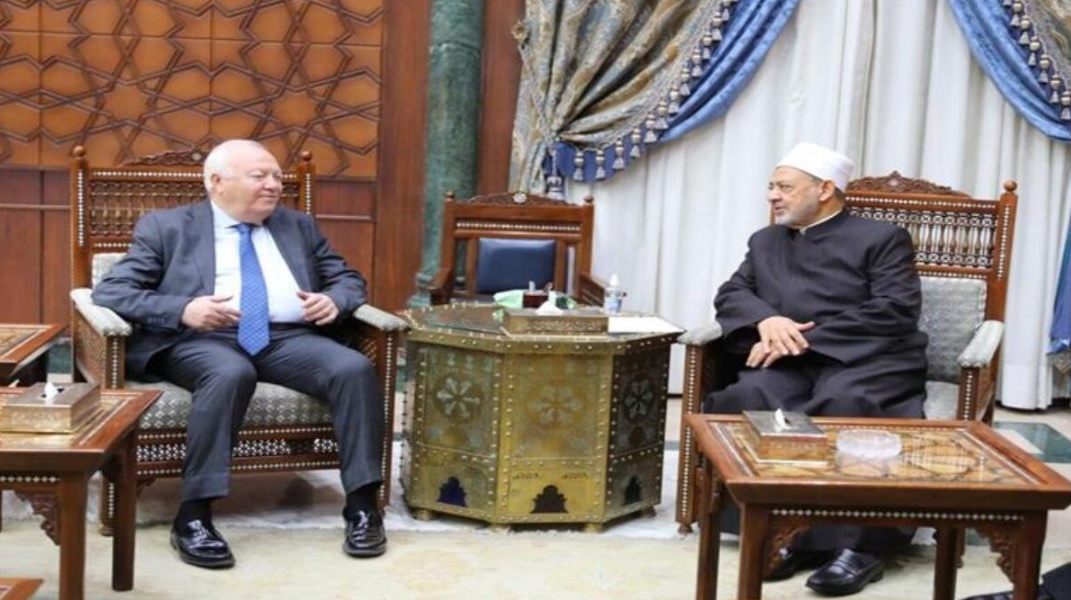
The Grand Sheikh of al-Azhar, Ahmed Al-Tayeb, received today, Thursday, at the headquarters of the Sheikh of Al-Azhar, the United Nations High Representative for the Dialogue of Civilizations, Miguel Moratinos, and ways to enhance joint cooperation were discussed.

The Sheikh of Al-Azhar welcomed Moratinos, stressing Al-Azhar's openness to dialogue with all believers in religions, cultures and civilizations.


Al-Tayeb pointed out that the world is currently facing a very complex crisis, which is the crisis of excluding religious and moral values from people's lives, stressing that this crisis does not only resonate and affect its makers, but also extends to all humanity, east and west, indicating that this crisis is The basis for all the conflicts and wars that our world is exposed to today.


The Sheikh of Al-Azhar pointed out that Western civilization bears the largest part in the tragedy of modern man, when it sought to exclude religion from people's lives, and focused on satisfying human desires and promoting material thought.


The Sheikh of Al-Azhar touched on the human suffering today, from the lack of food and medicine, and the climate change crisis, in addition to social crises.


Submit your story (pitch an article)

Name

Email *

Message *


Trending Today...


ISR +


Frequently Used Labels and Topics

40 babies beheaded 77 + China A Week in Review Academic Integrity Adana Agreement afghanistan Africa African Union al-Azhar Algeria Aljazeera All Apartheid apostasy Arab League Arab nationalism Arab Spring Arabs in the West Armenia Arts and Cultures Arts and Entertainment Asia Assassinations Assimilation Azerbaijan Bahrain Bangladesh Belarus Belt and Road Initiative Brazil BRI BRICS Brotherhood CAF Canada Capitalism Caroline Guenez Caspian Sea cCuba censorship Central Asia Charity Chechnya Children Rights China Christianity CIA Civil society Civil War climate colonialism communication communism con·science Conflict conscience Constitutionalism Contras Corruption Coups Covid19 Crimea Crimes against humanity D-8 Dearborn Debt Democracy Despotism Diplomacy discrimination Dissent Dmitry Medvedev Earthquakes Economics Economics and Finance Economy ECOWAS Education and Communication Egypt Elections energy Enlightenment environment Epstein equity Erdogan ethics Europe Events Fatima FIFA FIFA World Cup FIFA World Cup Qatar 2020 Flour Massacre Food Football France Freedom freedom of speech G20 G7 Garden of Prosperity Gaza GCC GDP Genocide geopolitics Germany Global Security Global South Globalism globalization Greece Grozny Conference Hamas Health Hegemony Hezbollah hijab Hiroshima History and Civilizations Hormuz hum Human Rights Huquq Ibadiyya Ibn Khaldun ICC Ideas IGOs Immigration Imperialism In The News india Indonesia inequality inflation INSTC Instrumentalized Human Rights Intelligence Inter International Affairs International Law Iran IranDeal Iraq Iraq War ISIL Islam in America Islam in China Islam in Europe Islam in Russia Islam Today Islamic economics Islamic Jihad Islamic law Islamic Societies Islamism Islamophobia ISR MONTHLY ISR Weekly Bulletin ISR Weekly Review Bulletin Italy Japan Jordan Journalism Kenya Khamenei Kilicdaroglu Kurdistan Latin America Law and Society Lebanon Libya Majoritarianism Malaysia Mali mass killings Mauritania Media Media Bias Media Review Middle East migration Military Affairs Morocco Multipolar World Muslim Ban Muslim Women and Leadership Muslims Muslims in Europe Muslims in the USA Muslims in West Muslims Today NAM Narratives Nationalism NATO Natural Disasters Nelson Mandela NGOs Nicaragua Nicaragua Cuba Niger Nigeria Normalization North America North Korea Nuclear Deal Nuclear Technology Nuclear War Nusra October 7 Oman OPEC+ Opinion Polls Organisation of Islamic Cooperation - OIC Oslo Accords Pakistan Palestine Peace Philippines Philosophy poerty Poland police brutality Politics and Government Population Transfer Populism Poverty Prison Systems Propaganda Prophet Muhammad prosperity Protests Proxy Wars Public Health Putin Qatar Quran Rachel Corrie Racism Raisi Ramadan Ramadan War Regime Change religion and conflict Religion and Culture Religion and Politics religion and society Resistance Rights Rohingya Genocide rule of law Russia Salafism Sanctions Saudi Arabia Science and Technology SCO Sectarianism Secularism security Senegal Shahed sharia Sharia-compliant financial products Shia Silk Road Singapore Sistani Slavery Soccer socialism Southwest Asia and North Africa Sovereignty Space War Spain Sports Sports and Politics Starvation State Power State Terror Sudan Sunni Axis sunnism Supremacism SWANA Syria Ta-Nehisi Coates terrorism Thailand The Koreas Tourism Trade transportation Tunisia Turkey Turkiye U.S. Cruelty U.S. Foreign Policy UAE uk ukraine UN under the Rubble UNGA United Arab Emirates United States UNSC Uprisings Urban warfare US Foreign Policy US Veto US-Iran MoU USA Uyghur Venezuela Volga Bulgaria Wadee wahhabism War War and Peace War Crimes War on Iran Wealth and Power Wealth Building West Western Civilization Western Sahara WMDs Women women rights Work Workers World and Communities Xi Yemen Zionism

Search for old news

Find Articles by year, month hierarchy


WEEKLY AdSpace 3

_______________________________________________

Copyright © Islamic Societies Review. All rights reserved.