

Media Review: Will AI Make Work Optional?
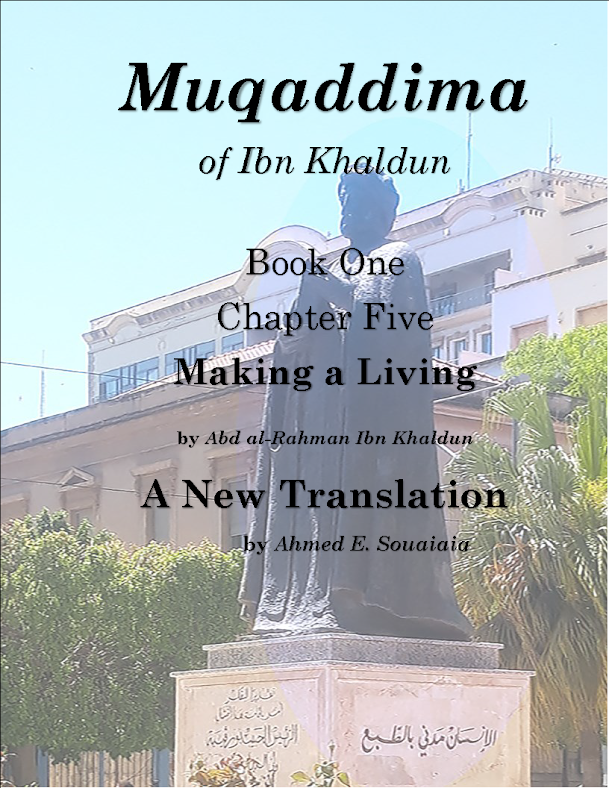
An Ibn Khaldunian Response to the Myth of the Post-Work Society
Each new technological revolution has inspired predictions about the end of work. The industrial revolution promised liberation from physical labor. Computers were expected to eliminate paperwork and usher in an era of leisure. Today, artificial intelligence has given rise to an even more ambitious claim: that work itself will become optional.

This assertion is repeated with increasing confidence by technology executives, futurists, and investors. Some envision a future in which AI performs virtually all productive labor while human beings receive a universal income, freeing them to pursue creativity, recreation, or personal fulfillment. It is an appealing vision. It is also, upon closer examination, conceptually confused.
The confusion arises from treating employment and work as though they were the same thing.
They are not.
Employment is a social institution. Work is an ontological reality.
This distinction, articulated with remarkable clarity by Ibn Khaldun more than six centuries ago, exposes the central weakness in the contemporary narrative surrounding artificial intelligence.
According to Ibn Khaldun, all value originates in work. Human prosperity does not emerge from money, markets, or ownership alone. Rather, every form of wealth traces its origin to productive activity. Agriculture, manufacturing, construction, transportation, education, governance, and commerce all create value because they involve work. Money merely records and facilitates the exchange of that value. In this framework, money is not wealth itself. It is a store of the value created by work. The implications of this principle are profound.
Artificial intelligence may indeed perform an increasing share of productive activities. Machines may design buildings, diagnose diseases, write software, conduct scientific research, and manufacture goods with minimal human intervention. None of this abolishes work. It merely changes the system performing it.
The work has not disappeared. It has shifted from one productive system to another.
This observation reveals the first conceptual error in the claim that AI will make work optional. If an AI system produces a bridge, writes a legal brief, or discovers a new medicine, those outcomes remain the products of work. They are events produced by a system operating through energy over time. Work continues to exist because every event remains the consequence of work performed by some system.
What disappears is not work. What may disappear is human employment. This distinction fundamentally changes the discussion. Once employment is separated from work, a much more difficult question emerges.
If AI performs the productive work, who receives the value created by that work?
The popular answer is that society will simply redistribute the resulting abundance through universal income or some similar mechanism. However, this answer quietly assumes the very conclusion it must prove. Where does the money come from?
The answer cannot be "from AI." Artificial intelligence does not own itself. Robots do not collect profits. Algorithms do not pay taxes. Every productive AI system is owned by someone—individuals, corporations, governments, or investment funds. Consequently, the economic value produced by AI flows first to its owners. This is not speculation. It is precisely how modern economic systems already operate. The irony is difficult to ignore.
Many of the strongest advocates of a post-work society owe their extraordinary fortunes to institutions that rigorously protect private ownership of productive capital. Their wealth was accumulated because existing legal and economic systems reward ownership, investment, and capital appreciation. Those same institutions have produced some of the greatest concentrations of wealth in history.
If these ownership structures remain unchanged, AI will not eliminate inequality. It will likely magnify it. The contradiction is obvious. One cannot simultaneously celebrate an economic system that concentrates the returns to ownership while assuming that its future outputs will somehow be distributed equally to everyone. Technology does not produce redistribution. Institutions do. The question therefore is not whether AI can create abundance. The question is whether those who own the productive systems will willingly surrender a substantial portion of the value generated by those systems. History offers little reason for such confidence.
Indeed, one need only consider the incentives facing the owners of advanced AI. If enormous productive capacity generates unprecedented profits, the rational response within existing institutions is to reinvest those profits, acquire additional productive assets, expand market dominance, and increase future returns. Nothing in contemporary capitalism naturally converts concentrated ownership into universal prosperity. To assume otherwise is not economic analysis. It is wishful thinking.
This is precisely where Ibn Khaldun's analysis proves remarkably contemporary. His insight was never merely that people must work. His deeper claim was that work is the source from which all economic value ultimately flows. Whenever value becomes detached from productive contribution and instead accumulates primarily through institutional mechanisms that bypass work, societies begin to experience structural distortions. Wealth becomes increasingly concentrated, productive incentives weaken, social cohesion deteriorates, and political instability follows.
The real challenge is whether societies can redesign their institutions so that the value generated by increasingly autonomous productive systems continues to circulate in ways that preserve economic participation, social legitimacy, and political stability.
That is an institutional question—not a technological one.
Artificial intelligence may become one of the greatest productive tools humanity has ever created.
But no technology, regardless of its sophistication, abolishes the fundamental principle that value originates in work.
Six centuries ago, Ibn Khaldun recognized this principle with extraordinary clarity. Today, as the world imagines a future beyond work, his insight deserves renewed attention.
AI changes who—or more precisely, what—performs productive work. It does not eliminate the necessity of work as the source of value.
The future is not post-work
The future is a struggle over who owns the systems that perform the work, who receives the value those systems create, and whether our institutions continue to recognize that money is not wealth itself, but only a representation of work already performed.
The dream that AI will make work optional mistakes a transformation in the organization of production for the disappearance of production itself. It confuses employment with work, ownership with creation, and technological possibility with institutional reality. The machines may change. The principle does not: Work remains the foundation upon which every event—and every civilization—ultimately rests.







 Posts
Posts





