Showing posts with label Globalism. Show all posts

Monday, April 06, 2026

Media Review: NYT on How America’s Centralized Rule Accelerates a World Forged by Iran’s Decades of Systemic Resilience

    Monday, April 06, 2026   No comments

 The Strait of Power

A recent analysis published in prominent American media delivers a sobering reassessment of the U.S.-Israeli attack on Iran. Rather than triggering the rapid collapse long anticipated in Western policy circles, the conflict has laid bare a deeper structural reality: Iran’s strategic endurance is not the product of temporary political maneuvering, but of a governance architecture meticulously constructed over four decades. Meanwhile, the United States finds itself constrained by a decision-making model increasingly concentrated in executive hands, one that repeatedly overrides institutional statecraft in favor of unilateral, short-term interventions. The result is a geopolitical reversal that Washington has struggled to anticipate.

For years, Western capitals operated under the assumption that Iran’s political and military architecture was brittle, vulnerable to economic pressure, diplomatic isolation, or targeted force. The prevailing narrative suggested the system could be dismantled in days or months. Yet the current crisis has demonstrated the opposite. Iran’s ability to exert decisive control over the Strait of Hormuz without resorting to a full blockade reveals a deeply institutionalized strategic doctrine. Over forty years, Tehran has cultivated layered capabilities in asymmetric warfare, maritime deterrence, insurance market psychology, and regional diplomatic coordination. This is not crisis improvisation; it is the output of a system engineered for strategic patience, where military, economic, and diplomatic instruments operate in sustained, interlocking harmony. The West’s narrative of fragility has collided with the reality of institutionalized resilience.

In sharp contrast, the American response reflects a governance model increasingly detached from long-term strategic continuity. Decision-making has become highly centralized, driven by one-man rule that routinely sidelines interagency consensus, institutional memory, and diplomatic frameworks. This top-down approach treats complex geopolitical ecosystems as problems solvable through executive decree or rapid military posturing. The result is a foreign policy that burns through diplomatic capital, fractures allied coordination, and substitutes systemic governance with personalized authority. Where Iran has spent generations embedding strategic redundancy and adaptive capacity into its state apparatus, the United States has increasingly outsourced long-term planning to the immediacy of centralized command, eroding the very institutional foundations that once sustained its global leadership.

The analytical core of the published view centers on how Iran’s selective control of the Strait of Hormuz has already rewritten global energy dynamics. By creating a persistent environment of risk through measured strikes, drone operations, and maritime deterrence, Iran has triggered a collapse in commercial insurance coverage and a sharp decline in shipping traffic, even while the waterway remains technically open. Modern economies do not merely require oil; they require predictable, insurable, and timely delivery. As premiums spike, shipping routes fracture, and governments treat energy procurement as a strategic vulnerability rather than a market transaction, the old Gulf order has unraveled. For decades, the region operated on a simple formula: producers exported, markets priced, and Washington guaranteed passage. That architecture is now collapsing under the weight of miscalculation.

Asian economies, deeply integrated into Gulf energy infrastructure, face immediate inflationary and trade pressures. Europe confronts the reality that energy security can no longer be assumed. Meanwhile, the United States is trapped by an asymmetry it helped create: protecting every single vessel requires a permanent, resource-draining military presence, while Iran needs only occasional strikes to make the entire insurance and logistics market unviable. As French leadership has publicly acknowledged, securing the strait now requires coordination with Tehran, not coercion against it.

This disruption is accelerating a quiet but profound realignment. China, Russia, and Iran do not require a formal alliance to reshape global energy flows; their strategic incentives naturally converge. Together, they could control nearly a third of the world’s accessible oil and gas, creating a de facto architecture that marginalizes Western economic leverage. The United States now faces a stark choice: commit to an indefinite military campaign to reclaim absolute control of the strait, or accept a new energy order where Washington no longer dictates the terms. Neither option preserves the status quo, but the latter acknowledges a structural shift that centralized decision-making has repeatedly failed to anticipate.

The crisis has laid bare a fundamental asymmetry. Iran’s endurance is not accidental; it is the product of four decades of systemic institution-building, strategic patience, and adaptive governance. America’s vulnerability, conversely, stems from a political culture that increasingly substitutes institutional continuity with executive immediacy, sacrificing long-term strategic coherence for short-term tactical assertions. The war has not shattered Iran. Instead, it has accelerated the emergence of a multipolar reality where resilience, not rupture, dictates the future. If the United States continues to prioritize one-man rule over systemic statecraft, it will not merely cede influence over global energy—it will witness the institutional foundations of its own global role erode in real time.


Friday, August 30, 2024

The colonial pillaging and plunder continues

    Friday, August 30, 2024   No comments

In 2022, Josep Borell, the European Union’s High Representative for Foreign Affairs and Security Policy, triggered a controversy by saying that Europe was a garden of prosperity and “most of the rest of the world” was a jungle. 

Some accused him of tone-deafness and racism. He defended his statement saying that his "reference to 'jungle' has no racist, cultural or geographical connotation." But he never explained how the "jungle" has become, in his mind, a jungle and how the garden of prosperity has become a garden of prosperity and how has it been kept a garden of prosperity. That task was left to the French president who, in a different context, identified the systems by which the Western world accumulated wealth and siphoned it from the rest of the world causing not only a desert of capital in the Global South, but also created a brain drain that continues to pillage and plunder the human resources of the rest of the world, turning them into the "jungle" they describe. 

The plunder and pillaging continue without direct war, allowing the pillagers to plunder and claim the moral high ground at the same time, which, the moral posturing that is, too, can be used to suppress resisters and attract willing collaborators.

Here is France's president explaining how the Russian citizen, who is now worth $15 billion, became a French citizen, a member of the garden of prosperity:


"It's a decision we made in 2018, which I fully stand by," Macron said Thursday. He added that it was "part of a strategy to allow women and men when they are artists, sportsmen, entrepreneurs, when they make the effort to learn the language, when they create wealth, when they ask for it, to grant them French citizenship. I did it for Mr Durov, who took the trouble to learn French, just as I did it for Spiegel. I think it's good for our country," he declared as reported Politico.


... excerpted from The colonial pillaging and plunder continues.


Thursday, June 01, 2023

The quiet rise and rule of Singapore that cannot be unnoticed by its loud neighbors and distant friends

    Thursday, June 01, 2023   No comments

Singapore is rarely in the news. Countries, other than Western countries, are usually in the news because bad things are happening in them. That is one of the persistent biases of Western media. Here, we review several news stories covering events in Singapore, this multiethnic and multireligious countries, with its Muslim woman president, Halimah Yacob, though the position of the President of Singapore is ceremonial, her presence in the presidency will be useful in integrating Singapore's economy with that of Muslim-majority neighbors like Indonesia and Malaysia as well as the 57-nation bloc of Muslim-majority countries around the world.

Singapore overtakes Hong Kong as the most expensive Asia-Pacific city for private homes

Singapore’s private homes are now the most expensive in Asia-Pacific, having overtaken Hong Kong, according to a new report.

Data from the Home Attainability Index from the Urban Land Institute (ULI) Asia Pacific Centre for Housing showed the median price of Singapore’s private homes was $1.2 million in 2022, compared to Hong Kong’s $1.16 million.


Private rental homes in Singapore also had the highest monthly rent in the region at $2,600 — “far exceeding” other cities such as Sydney, Melbourne and Hong Kong, according to the report...

Read the full article here.


The article below makes the case for Singapore as being better in more than just one aspect.


Why Singapore is superior to Hong Kong in almost every way

It’s amusing to read comments by local property tycoon Ronnie Chan Chi-chung about places such as Singapore being “artificial”, “charmless” and “super boring”. Hong Kong, on the other hand, has the six “Gs” that are its unique advantages: genetics, geography, a culture of giving, the GBA (Greater Bay Area), its government and grey matter.

Really? The problem with tycoons everywhere, and not just in Hong Kong, is that they feel free to pontificate because they are rarely challenged, well, not in their face anyway. So I am glad reader John Chan of Singapore has written a rebuttal, pointing out that the city state enjoys both higher per capita gross domestic product (GDP) and median monthly household income. It’s doing very well, thank you very much!

Maybe Ronnie Chan can counter, as you would if you are a tycoon, that the capitalisation of Hong Kong’s stock market far exceeds that of Singapore or that the latter’s IPO market is minuscule compared to his city’s. Hong Kong has Disneyland, but hey, they have Universal Studios.

But all these comparisons are superficial.

The fundamental fact is that Singapore is a city state, rather than... read article


Politically, Singapore is oftten courted by other countries to take side in relation to global matters. This article is one example.


Europe sends big hitters to Singapore to rally Asian allies against Russia


Europe is fretting that Asia isn’t doing enough to condemn Russia and support Ukraine — and it’s revving up efforts to sway Asian officials in person. 

On Friday, an unprecedentedly high-profile European delegation will converge in Singapore at the Shangri-La Dialogue, Asia’s top security forum. Estonian Prime Minister Kaja Kallas will be there, as will EU foreign policy chief Josep Borrell, flanked by Ukrainian Defence Minister Oleksiy Reznikov. 

U.K. Defense Secretary Ben Wallace is also expected to attend in person — as are Boris Pistorius, Kajsa Ollongren and Pål Jonson, the defense ministers from Germany, the Netherlands and Sweden.

Their goal: Rally more Asian countries to help Kyiv.

While many Asian nations initially joined in condemning Russia’s invasion at the United Nations, countries like India and Vietnam continue to count on Russian military or energy supplies, while Western allies Japan and South Korea are unable to... read article


Wednesday, April 05, 2023

Media Review: The world of the dollar reserve system is coming to an end

    Wednesday, April 05, 2023   No comments

The American magazine "The National Interest" reported that "the American president said that the ruble will turn to rubble, and the French finance minister said that the Russian economy will collapse, but despite these statements, the sanctions did not result in any major tsunami of regime change."

And it reported that “the movement to (Eurasian) resource-backed currencies was accelerated by the United States’ recognition of the trend and its attempt to reverse it, ostensibly through the war in Ukraine,” noting that “the revolution in the economy is not Bitcoin, but rather resource-based currencies.”


She explained, “With the Russians capping the price of their gold, Russian investors were stuck with an undervalued ruble, forcing it to appreciate against the dollar. In the past six months, the ruble has strengthened steadily. Then Putin added the double whammy that buyers of Oil can be bought with rubles or gold.


According to her, "If they buy oil with gold, they actually get a discount on oil, which leads to increased pressure on the supply of gold, which raises the price."


Therefore, "the West's commitment to burning the ruble backfired, and the strengthening of oil prices had a reinforcing effect on the ruble. As a result, in the land of paper, Russia and China are now able to control gold and oil prices," she says.


"The world of the dollar reserve system is coming to an end, as domestic funds were artificially inflated by the West in order to buy the assets of the East cheaply, and now it is payback time for the East," The National Interest confirmed.


The magazine concluded: "The dollar is still the reserve currency. This seismic change will not happen overnight, but the seeds were sown," stressing that "the current banking crisis is a symptom of the weakness of the monetary system, and what is happening in the West is the gradual death of paper currencies."


Wednesday, March 08, 2023

Media Review: A multipolar world is indeed good for the disempowered, it has always been that way

    Wednesday, March 08, 2023   No comments

It is no secret that our bias is heavily tilted towards stories that touch on human rights, and that bias is decidedly on the side of those whose human rights have been abused. From this position of bias, we never fudge the facts and bend the truth. With that in mind, it is our biased position also that a multipolar world is always better for disempowered peoples whose human rights are often abused. It would seem that that position is now shared by another expert from an elite institution that is in fact the pipeline that produces the smart people who have been running the United States for decades. 

Harvard's Prof. Stephen Walt makes a good case for multipolarity being better than US hegemony, even for the US. To him, hegemony fed the US's worst instincts and led them to effectively become the world's bully, which they couldn't do in a multipolar world.

Walt just published a piece titled, America Is Too Scared of the Multipolar World. It is prefaced as an expert's point of view on a current event. Some excerpts might help make the case for us, though we might be motivated by different interests:

ISR Editorial Team 


Read the rest for yourself.


By Stephen M. Walt, a columnist at Foreign Policy and the Robert and Renée Belfer professor of international relations at Harvard University. 


Sunday, January 22, 2023

Will next week be decisive in determining the fate of the global economy?

    Sunday, January 22, 2023   No comments

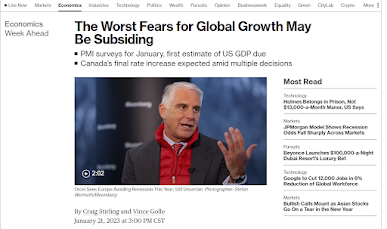
Bloomberg Agency presents a reading of the most important global economic changes, and indicates the possibility of a total change in global markets, especially after the Chinese decision to completely abandon the steps to combat Corona.


Next week may show more reasons for hope about the global economy, after bleak months filled with negative signs of a deep recession, as some data could reflect the gradual improvement of business partnerships in most parts of the developed world.

Economists expect purchasing managers' indices for both the United States and the eurozone to rise, while many metrics will still point to contraction, the upward trend of travel could add to optimism, according to a Bloomberg report.


Global Purchasing Managers Activity

Such possibilities are reinforced by China's post-pandemic reopening, evidence of slowing inflation, and the emphatic views of some senior European officials that their economies will not stagnate. International Monetary Fund Managing Director Kristalina Georgieva hinted on Friday that the lender may soon raise its forecasts for this year.


"We have, clearly, the strength of labor markets translating into consumer spending and sustaining the economy, and as China reopens, we expect growth this year to again exceed the global average," Kristalina Georgieva said at the World Economic Forum in Davos, Switzerland.


But prices in the US will also be decisive, and the first estimate of Q4 GDP there, due on Thursday, could be helpful. The economy is expected to show expansion at an annual rate of 2.7% in the last three months of 2022, after a pace of 3.2% in the third quarter.


While this data points to strong growth, recent data, including retail sales, home construction and industrial production, showed that momentum was starting to fade in late 2022.


Economists, polled by Bloomberg, see US gross domestic product falling for two consecutive quarters in the middle of this year as sharp interest rate increases by the Federal Reserve curbed demand.


While Asian momentum could provide a boost to these expectations, the IMF chief noted that there is a risk that its contribution to the global economy could be derailed.


Expert point of view

America's fourth-quarter GDP will be boosted largely by strong consumer spending on services, even as goods decline.


Households continued to benefit from excess savings from the stimulus and benefit from strong wage gains, and tightening monetary policy means that 2023 will see significantly weaker demand.


Elsewhere, multiple interest rate decisions may include a possible eventual BoC hike, and a 12th consecutive rate hike in Colombia.


Australia and New Zealand may report slowing consumer price growth, while Eurozone policymakers have one last chance to speak before they meet the following week.


United States and Canada

Apart from the US PMI and GDP reports, the government is expected to announce on Friday that inflation-adjusted personal spending on goods and services fell in December for the first time in a year.


The data is also expected to show moderate inflation rates on an annual basis, but they will remain high. Fed officials, who are watching ahead of the end-of-month meeting, will take note of signs of a slowing economy and moderate inflation. Other reports are expected to show a decline in new home sales and core capital goods.


Looking north, the Bank of Canada appears to have put a cap on one of the most aggressive tightening campaigns in its history, with what economists and markets expect to be a final 25 basis point increase in borrowing costs on Wednesday.


Policy makers led by Governor Tiff Macklem will likely refrain from announcing a complete halt to hikes, opting instead to keep the benchmark rate at 4.5% while maintaining a hawkish tone while watching how quickly the economy declines.


The decision is complicated by conflicting data. Canada's ultra-tight labor market continues to add jobs with unemployment near a record low, and economic output is set to expand in the fourth quarter of 2022 at twice the pace of the central bank's previous forecast.


Annual inflation remains uncomfortably high at 6.3%, but the underlying pressures are showing clear signs of abating. Meanwhile, heavily indebted Canadian households are feeling the crunch of higher rates and are starting to cut back on their spending.


Asia

Australia and New Zealand reported their latest inflation figures in the middle of the week, as the RBA contemplates halting its tightening cycle and the RBNZ contemplates its next move after a big rally in November.


In South Korea, Thursday's GDP results may show the economy contracting, a result that could reinforce caution in the central bank.


In Japan, Friday's Tokyo CPI data should indicate whether inflation is closer to peaking in the world's third-largest economy.


Two closely watched South Asian economies, Pakistan and Sri Lanka, will decide key interest rates, along with Thailand.


In turn, the Philippines reported the performance of its economy in 2022, which President Ferdinand Marcos Jr. estimated would grow at 7%.


The Thai Ministry of Finance will provide its latest economic estimate later next week. China will be closed all week due to the Lunar New Year holiday.


Europe and Africa

The last window for ECB officials to communicate ahead of the February 2 interest rate decision will close on Thursday. At the same time, Eurozone data may give more indications of the health of the economy.


Officials are scheduled to appear several times before then, including Bank President Christine Lagarde, who pledged to the Davos audience that she would "stay the course" on monetary policy.


In Germany, where Chancellor Olaf Scholz is now convinced a recession will be avoided, Wednesday's Ifo Business Confidence report is expected to show improvement across all measures. Meanwhile, the first estimate of Spain's GDP for the fourth quarter may reveal a slight expansion.


The UK faces a few quieter days than it has lately, with no monetary policy speakers from the Bank of England and the PMI survey and fiscal data among the only items expected.


And in Hungary, the central bank will set the base interest rate at a monthly meeting on Tuesday, as investors eye a possible pivot towards monetary easing at the depository tender two days later. To the east, Ukrainian officials are expected to keep their benchmark unchanged at 25%.


Regarding Africa, the Central Bank of Nigeria is expected to slow its monetary tightening on Tuesday, with an increase of 50 basis points. Inflation slowed unexpectedly in December, but remained well above the policy target, deterring saving.


On Wednesday, Mozambique's policymakers are likely to leave official borrowing costs unchanged for the second consecutive meeting as inflation expectations slow.


Having prepared early for its battle against the worst global inflation shock in a generation, the Reserve Bank of South Africa is also likely to slow its rate hike on Thursday. Investors expect a more than 80% chance of a rate hike of 25 basis points.


Latin America

On Tuesday, consumer price reports are likely to confirm the formidable challenge facing policymakers in the region's two largest economies.


On an annual basis, Brazil may record a gradual move down from the level of 5.9%, while the main and fundamental results in Mexico as a whole remain unchanged from their latest readings at 7.86% and 8.34%, respectively.


In Argentina, GDP data could be disappointing for a third month, with an overvalued peso and near triple-digit inflation threatening deflation in the fourth quarter.


All certainty, the Central Bank of Chile will keep its benchmark rate at a two-decade high of 11.25% for the second consecutive meeting on Thursday. Inflation that has reached 4 times the target as the economy slips into recession puts Central Bank President Rosana Costa in an awkward position.


Observers in Colombia largely expect the central bank to extend a record cycle of interest increases, with 12 consecutive rate hikes to 13%, in the face of the sharpest wave of inflation in a generation.


Surprisingly, Finance Minister Jose Antonio Ocampo, who is a voting member of the bank's board of directors, said on Tuesday that "the bank does not need to raise again and inflation has peaked, both of which contradict the bank's own polls of analysts."


Followers


Trending now...


ISR +


Frequently Used Labels and Topics

40 babies beheaded 77 + China A Week in Review Academic Integrity Adana Agreement afghanistan Africa African Union al-Azhar Algeria Aljazeera All Apartheid apostasy Arab League Arab nationalism Arab Spring Arabs in the West Armenia Arts and Cultures Arts and Entertainment Asia Assassinations Assimilation Azerbaijan Bangladesh Belarus Belt and Road Initiative Brazil BRI BRICS Brotherhood CAF Canada Capitalism Caroline Guenez Caspian Sea cCuba censorship Central Asia Charity Chechnya Children Rights China Christianity CIA Civil society Civil War climate colonialism communication communism con·science Conflict conscience Constitutionalism Contras Corruption Coups Covid19 Crimea Crimes against humanity D-8 Dearborn Debt Democracy Despotism Diplomacy discrimination Dissent Dmitry Medvedev Earthquakes Economics Economics and Finance Economy ECOWAS Education and Communication Egypt Elections energy Enlightenment environment equity Erdogan Europe Events Fatima FIFA FIFA World Cup FIFA World Cup Qatar 2020 Flour Massacre Food Football France Freedom freedom of speech G20 G7 Garden of Prosperity Gaza GCC GDP Genocide geopolitics Germany Global Security Global South Globalism globalization Greece Grozny Conference Hamas Health Hegemony Hezbollah hijab Hiroshima History and Civilizations Hormuz Human Rights Huquq Ibadiyya Ibn Khaldun ICC Ideas IGOs Immigration Imperialism In The News india Indonesia inequality inflation INSTC Instrumentalized Human Rights Intelligence Inter International Affairs International Law Iran IranDeal Iraq Iraq War ISIL Islam in America Islam in China Islam in Europe Islam in Russia Islam Today Islamic economics Islamic Jihad Islamic law Islamic Societies Islamism Islamophobia ISR MONTHLY ISR Weekly Bulletin ISR Weekly Review Bulletin Italy Japan Jordan Journalism Kenya Khamenei Kilicdaroglu Kurdistan Latin America Law and Society Lebanon Libya Majoritarianism Malaysia Mali mass killings Mauritania Media Media Bias Media Review Middle East migration Military Affairs Morocco Multipolar World Muslim Ban Muslim Women and Leadership Muslims Muslims in Europe Muslims in West Muslims Today NAM Narratives Nationalism NATO Natural Disasters Nelson Mandela NGOs Nicaragua Nicaragua Cuba Niger Nigeria Normalization North America North Korea Nuclear Deal Nuclear Technology Nuclear War Nusra October 7 Oman OPEC+ Opinion Polls Organisation of Islamic Cooperation - OIC Oslo Accords Pakistan Palestine Peace Philippines Philosophy poerty Poland police brutality Politics and Government Population Transfer Populism Poverty Prison Systems Propaganda Prophet Muhammad prosperity Protests Proxy Wars Public Health Putin Qatar Quran Rachel Corrie Racism Raisi Ramadan Ramadan War Regime Change religion and conflict Religion and Culture Religion and Politics religion and society Resistance Rights Rohingya Genocide Russia Salafism Sanctions Saudi Arabia Science and Technology SCO Sectarianism security Senegal Shahed sharia Sharia-compliant financial products Shia Silk Road Singapore Slavery Soccer socialism Southwest Asia and North Africa Sovereignty Space War Spain Sports Sports and Politics Starvation State Power State Terror Sudan Sunni Axis sunnism Supremacism SWANA Syria Ta-Nehisi Coates terrorism Thailand The Koreas Tourism Trade transportation Tunisia Turkey Turkiye U.S. Cruelty U.S. Foreign Policy UAE uk ukraine UN under the Rubble UNGA United States UNSC Uprisings Urban warfare US Foreign Policy US Veto USA Uyghur Venezuela Volga Bulgaria Wadee wahhabism War War and Peace War Crimes War on Iran Wealth and Power Wealth Building West Western Civilization Western Sahara WMDs Women women rights Work Workers World and Communities Xi Yemen Zionism

Search for old news

Find Articles by year, month hierarchy


AdSpace

_______________________________________________

Copyright © Islamic Societies Review. All rights reserved.