Showing posts with label Economics. Show all posts

Thursday, March 19, 2026

Media Review: Gulf States, International Law, and the Unspoken Link Between Iran Strikes and Regional Complicity

    Thursday, March 19, 2026   No comments

 The Sovereignty Paradox

In the corridors of the United Nations Human Rights Council this week, a diplomatic note from Gulf Cooperation Council (GCC) states described ballistic missile and drone attacks on Bahrain, Jordan, Kuwait, Oman, Qatar, Saudi Arabia, and the United Arab Emirates as a "situation of serious concern for international peace and security." The note characterized these strikes as "unprovoked attacks" requiring urgent international attention, calling for reparations for civilian, infrastructure, and environmental damage.

Beneath this unified diplomatic appeal lies a complex legal and strategic reality that most international actors have been reluctant to articulate plainly: the attacks on Gulf territories are occurring within the context of a broader military campaign against Iran that numerous legal scholars and a small number of Western governments—including Spain—have characterized as inconsistent with international law.

The Legal Framework: Sovereignty, Retaliation, and Contradiction

Under the United Nations Charter, Article 2(4) prohibits the threat or use of force against the territorial integrity or political independence of any state. Article 51 recognizes the inherent right of self-defense if an armed attack occurs. These principles form the bedrock of the post-1945 international legal order.

When Iran launched strikes targeting military and energy infrastructure in Gulf states hosting U.S. forces, Tehran framed these actions not as aggression against sovereign neighbors, but as targeted responses to facilities being used to conduct what it characterizes as an illegal armed campaign against Iranian territory. In a letter to the UN Secretary-General cited by Iranian state media, Iran's UN ambassador Amir Saeid Iravani stated that the UAE's decision to allow its territory to be used in attacks on Iran amounted to "an internationally wrongful act that entailed state responsibility."

This legal argument presents a challenge for states seeking to condemn Iranian actions while remaining silent on the initial use of force against Iran. As one principle of international law holds: a state cannot claim for itself rights it denies to others. If the use of another state's territory to launch attacks violates sovereignty, then the same standard must apply consistently.

Oman's Distinctive Diplomatic Position

Amid regional consensus, Oman has maintained a notably different diplomatic posture. Foreign Minister Badr Albusaidi, writing in The Economist, argued that the United States has "effectively lost control of its own foreign policy" by allowing itself to be drawn into what he termed an "unwanted entanglement" with Iran.

Albusaidi described Iranian strikes on Gulf states hosting U.S. bases as "inevitable, if deeply regrettable," calling them "probably the only rational option available" in response to a war "designed to terminate" Iran. His analysis underscores a reality that complicates simple narratives of aggression: military infrastructure hosted on sovereign territory does not exist in a legal vacuum. When that infrastructure is used to project force against a neighboring state, the hosting state becomes, in the eyes of international law and strategic calculation, a participant in the conflict.

Targeting the Architecture of War: Radar Sites and Military Infrastructure

An analysis by ABC News of satellite imagery and verified footage indicates that Iranian drones and missiles have struck at least 10 radar sites used by the U.S. and its allies across West Asia since the conflict escalated. These include facilities at Prince Sultan Air Base in Saudi Arabia, sites in the UAE, Muwaffaq Salti Air Base in Jordan, Camp Arifjan in Kuwait, Al Udeid Air Base in Qatar, and the U.S. Fifth Fleet headquarters in Bahrain.

Experts note that radar systems are both vital and vulnerable: their emissions make them detectable, and even partial damage can degrade detection capabilities, effectively "blinding" segments of missile defense networks. The targeting of these assets reflects a strategic calculation: disrupting the early-warning architecture that enables offensive operations.

From a legal perspective, the distinction between "military" and "civilian" infrastructure becomes critical. International humanitarian law requires parties to distinguish between military objectives and civilian objects. However, when military assets are embedded within or adjacent to civilian infrastructure—as is often the case with radar installations near population centers—the legal and humanitarian consequences multiply.

International Responses: A Spectrum of Legal Interpretation

While Gulf states have sought emergency UN debate over Iranian strikes, the international response has revealed significant divergence in legal interpretation.

Spanish Prime Minister Pedro Sánchez has been among the clearest Western voices, stating ahead of a recent EU summit that the war on Iran is "illegal," has "no reason behind it," and is causing significant harm to civilians, refugees, and economies. Sánchez linked the conflict to wider Middle East tensions, emphasizing that the EU must send a clear message supporting multilateralism and international law.

China's Foreign Ministry stated it is "always opposed to the use of force in international relations" and expressed shock at remarks by Israeli officials regarding targeting Iranian leadership. The UN Secretary-General has called on all parties to end a conflict "that is risking to get completely out of control, causing immense suffering on civilians."

EU foreign policy chief Kaja Kallas emphasized that "member states do not have an appetite to go to this war" and that "we need an exit from this war, not escalation." These statements reflect a growing recognition that military escalation carries profound humanitarian and economic risks without clear strategic resolution.

Economic Dimensions: Hormuz, Sanctions, and Energy Security

The conflict's economic stakes are substantial. Iran is reportedly weighing legislation to impose transit fees on ships moving through the Strait of Hormuz, through which approximately 20% of global oil trade passes. An advisor to Iran's supreme leader suggested that "a new regime for the Strait of Hormuz" could enable Tehran to enforce maritime limits on countries that have imposed sanctions.

Meanwhile, U.S. Treasury Secretary Scott Bessent indicated that the United States "may unsanction the Iranian oil that's on the water"—approximately 140 million barrels—to manage global energy prices. This potential policy shift underscores how economic instruments are being recalibrated in response to military realities.

Strikes on key gas fields have sparked fears of broader energy market disruption. With three of the world's top gas producers facing sustained attacks, analysts warn of risks that could reshape global energy supply chains.

The Narrative Imperative: Consistency and Credibility in International Discourse

The central diplomatic challenge emerging from this crisis is not merely military but narrative. States that condemn attacks on their sovereignty while facilitating military operations against others from their territory face a credibility gap that undermines their diplomatic standing.

International law does not permit selective application. If sovereignty is inviolable, it must be inviolable for all. If the use of force requires justification under Article 51, that justification must meet the same threshold regardless of the actor. When states house radar stations, military bases, and allow airspace to be used for operations against a neighbor, they cannot credibly claim non-participation in the resulting conflict.

This is not a matter of assigning blame but of upholding the consistency that gives international law its authority. As legal scholars have noted, the prohibition on the use of force is a jus cogens norm—a peremptory principle from which no derogation is permitted. Its application cannot be contingent on political alignment.

Pathways Forward

Oman's Foreign Minister suggested that while diplomacy may be "certainly difficult" after repeated shifts from negotiations to military action, "the path away from war … may have to lie through precisely this resumption." This perspective acknowledges that sustainable resolution requires addressing root causes, not merely managing symptoms.

For Gulf states, the immediate challenge is balancing legitimate security concerns with the long-term strategic imperative of regional stability. For the international community, the test is whether principles of international law can be applied consistently, even when politically inconvenient.

The current crisis underscores a fundamental truth of international relations: narratives matter. Credibility is earned not through selective condemnation but through principled consistency. In a region where historical grievances and strategic competition intersect, the only durable foundation for peace is a shared commitment to the rules that were designed to prevent exactly this kind of escalation.

As the UN chief warned, this conflict risks getting "completely out of control." Preventing that outcome requires more than emergency debates or targeted sanctions. It requires the courage to state obvious truths: that sovereignty is indivisible, that international law applies to all, and that lasting security cannot be built on the selective application of principles that were meant to protect everyone.

Sunday, March 15, 2026

The High Cost of Reactive Strategy

    Sunday, March 15, 2026   No comments

Oil, Sanctions, and the Global Economy


In the complex arena of geopolitical economics, few tools are as potent as oil sanctions, and few markets are as sensitive as global energy. A recent policy shift involving the temporary suspension of sanctions on Russian oil has sparked intense debate among economists and strategists. The decision, framed as a necessary move to stabilize soaring energy prices following heightened tensions in the Middle East, reveals a deeper tension between short-term economic relief and long-term strategic coherence. While the immediate goal is to lower costs for consumers, the underlying logic risks creating perverse incentives that could prolong instability and undermine the very mechanisms designed to enforce global norms.

The Mechanics of the Crisis

To understand the gravity of this decision, one must first understand the leverage points involved. Oil is the lifeblood of the modern industrial economy. When supply is disrupted—whether by conflict in the Strait of Hormuz or production cuts—prices spike. These spikes ripple outward, increasing the cost of transportation, manufacturing, and food production, ultimately fueling inflation that hurts households worldwide.

Sanctions are traditionally used as a non-military tool to pressure nations into changing behavior. There are most effective when they are done by consensus and in accordance to international norms. By cutting a country like Russia off from the global oil market, the anti-Russia block aims to deprive it of the revenue needed to fund conflict. However, this tool is a double-edged sword. Restricting supply from a major producer inevitably tightens the global market, driving prices up.

The recent announcement to pause these sanctions was justified by the need to flood the market with additional supply to counteract price hikes caused by regional conflict involving Iran. The stated intention is temporary: once the crisis abates and prices stabilize, the sanctions will return. On the surface, this appears to be a pragmatic humanitarian adjustment. Yet, when examined through the lens of game theory and strategic incentives, the move exposes a significant vulnerability in reactive policymaking.

The Strategic Flaw: A Lesson in Incentives


The core criticism of this policy is not about the desire for affordable oil, but about the signal it sends to adversarial actors. By linking the relief of sanctions on one front (Russia) to the resolution of a conflict on another (Iran), the policy inadvertently creates a profitable alliance between disparate actors who benefit from continued instability.

This dynamic can be understood through a simple analogy. Imagine a neighborhood where a child, let's call him R, is banned from selling lemonade because his friend, I, is sharing profits with him. The ban is meant to punish I. However, I responds by blocking other kids from selling lemonade too, creating a shortage that drives prices sky-high. Seeing the high prices, R's father lifts the ban on R, saying he can sell again until I stops blocking the others.

In this scenario, what is R's best move? Rational self-interest dictates that R should encourage I to keep blocking the competition. As long as the shortage persists, the price of lemonade remains high. R can sell less volume but make more profit, sharing the excess with I. The punishment intended for I has been neutralized, and both parties are now financially incentivized to maintain the crisis rather than resolve it.

Translating this to the global stage, the temporary easing of sanctions on Russian oil removes the pressure on Moscow to seek peace or de-escalate. Instead, it allows Russia to continue generating revenue while global prices remain elevated due to the unrelated conflict with Iran. If the promise to "reinstate sanctions later" lacks credibility or enforceability, the leverage is lost entirely. The market perceives the pause not as a temporary fix, but as a weakening of resolve, encouraging other nations to test the limits of economic coercion.

Implications for the World Economy

The economic implications of this strategic misalignment are profound. First, it introduces volatility into energy markets. Investors and industries thrive on predictability. When sanctions policy becomes reactive—shifting based on the latest headline rather than a cohesive long-term plan—it creates uncertainty. This uncertainty can lead to hoarding, speculative trading, and further price swings, negating the intended stabilizing effect of the policy.

Second, it risks entrenching inflation. If the structural incentives keep oil supplies artificially constrained by geopolitical maneuvering rather than genuine scarcity, the baseline cost of energy remains high. This "conflict premium" becomes embedded in the global economy, slowing growth and reducing the standard of living for consumers worldwide.

Third, and perhaps most dangerously, it erodes the efficacy of sanctions as a diplomatic tool. Sanctions rely on the threat of economic pain to change behavior. If that pain can be easily alleviated by shifting geopolitical winds, the threat loses its teeth. Future attempts to use economic pressure to halt aggression may be ignored by adversaries who anticipate similar waivers will be granted when prices rise.

The Need for Strategic Coherence

The situation underscores a fundamental principle of statecraft: tactics must serve strategy, not replace it. Lowering oil prices is a worthy goal, but not if it comes at the cost of empowering aggressors or dismantling the frameworks designed to maintain international security. A more robust approach would involve stopping aggression: any and all acts attacking sovereign nations outside the framework of International Law.

Using the most powerful hammer, armed forces, to hit every nail that appears, without a plan for the structural damage left behind, risks leaving a trail of destruction that will be costly to repair. The global economy requires leadership that anticipates second-order effects—understanding that a decision made to solve today's price spike could tomorrow's conflict longer and more expensive.

In the end, the lesson is clear. In an interconnected world, economic decisions are never isolated. They send signals, create incentives, and shape the behavior of nations. When those signals are mixed, and the incentives reward instability, the entire global system pays the price. True stability comes not from reactive pauses, but from a consistent, strategic vision that aligns economic tools with long-term peace and security.

Wednesday, May 21, 2025

China, Pakistan agree with Kabul to expand CPEC to Afghanistan

    Wednesday, May 21, 2025   No comments

Pakistan, China, and Afghanistan agreed in a trilateral meeting in Beijing to formally extend the China-Pakistan Economic Corridor (CPEC) to Afghanistan, strengthening regional connectivity under the Belt and Road Initiative (BRI).

The foreign ministers emphasized deeper cooperation in trade, infrastructure, and security, reaffirming their commitment to counterterrorism and regional stability. 


The next trilateral meeting will be held in Kabul. The talks took place during Deputy PM Ishaq Dar’s visit to China, which also addressed the recent Pakistan-India tensions and reaffirmed the strong China-Pakistan partnership.

Thursday, May 15, 2025

The Political Instrumentalization of “Terrorism” and Sanctions in Contemporary Foreign Policy

    Thursday, May 15, 2025   No comments

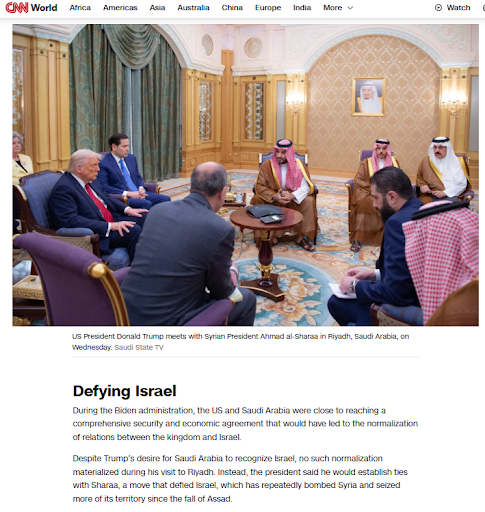
 The recent developments surrounding former jihadist Ahmed al-Sharaa—formerly known as Abu Mohammed al-Jolani—and his transformation from a wanted terrorist leader into a sitting president welcomed by the President of the United States illustrate a deeply troubling fact in international relations: the arbitrary use of the “terrorism” label and economic sanctions as tools of political convenience rather than principled governance.

In 2013, al-Sharaa was designated by the United States as a “Specially Designated Global Terrorist” due to his leadership of the al-Qaeda affiliate in Syria, Jabhat al-Nusra, and his alleged role in orchestrating suicide bombings. At one point, the U.S. placed a $10 million bounty on his capture. Today, however, he shares tea and diplomatic smiles with President Donald Trump, without any transparent legal or procedural process to formally clear his name of terrorism charges. This dramatic pivot—absent any public renunciation of past actions, judicial review, or commitment to democratic norms like elections—exposes the malleability of the terrorism designation when it becomes inconvenient for geopolitical strategy... read more >>

Tuesday, May 13, 2025

Trump’s “America First” and the Shifting Middle East

    Tuesday, May 13, 2025   No comments

Under the banner of “America First,” President Donald Trump’s second term is leaving an unmistakable imprint on the Middle East. The traditional American posture—strongly aligned with Israel and antagonistic toward Iran—is giving way to a new configuration driven more by economic pragmatism and regional stability than ideology. At the heart of this shift is a surprising warming of ties between Iran and Saudi Arabia, a recalibration in U.S.-Israel relations amid the Gaza war, and a relentless push for commercial deals that serve both American and regional interests.

Trump's Strategic Bet: Trade Over Troops


Trump’s latest Middle East tour, which began with a high-profile stop in Riyadh, highlights a clear message: economic engagement is now Washington’s primary tool of influence. In Saudi Arabia, he and Crown Prince Mohammed bin Salman signed a “Strategic Economic Partnership” encompassing energy, mining, and defense. The visit was touted by Trump as “historic,” with the New York Times reporting the president’s desire to announce deals worth over $1 trillion, which he believes will bolster American jobs and global influence.

Instead of pursuing a comprehensive foreign policy doctrine, Trump’s second term appears guided by transactional diplomacy—striking business deals and forging bilateral agreements without broader regional conditions. This is a marked departure from previous administrations that often tied economic or military cooperation to political reform or diplomatic alignment, especially concerning Israel.

Practical decisions:Saudi Arabia and the United States have signed a historic $142 Billion dollar arms deal, the largest in history. Saudi Crown Prince Bin Salman also pledged that Saudi Arabia would invest a staggering $600 Billion USD into the U.S. economy.


Gaza War Reveals Strains in U.S.-Israel Ties

Meanwhile, the ongoing war in Gaza is exposing growing daylight between Washington and Tel Aviv. Trump, once hailed by Israeli leaders as one of their strongest allies, is now signaling fatigue with the conflict. According to The Guardian, Trump’s envoy Steve Witkoff criticized Israel’s prolongation of the war, stating plainly that “Israel is not ready to end it,” while the U.S. wants it resolved—especially with American hostages involved.

Trump’s reluctance to visit Israel during this regional tour, and his administration’s quiet disengagement from Israeli military priorities—like launching strikes on Iran or continuing the Gaza war indefinitely—signals a pivot. One former Israeli diplomat noted bluntly: “Trump is not anti-Israel, but he doesn’t care that much.”

This pragmatism is echoed in Trump’s decision to finalize a ceasefire with the Iran-backed Houthis in Yemen—without consulting Israel—and even referring to the Houthis as “brave.” These actions underscore a major shift: the U.S. is prioritizing regional calm and economic deals over ideological battles or military entanglements.

Israeli Prime Minister Benjamin Netanyahu: "There will be no scenario in which we stop the war...even if Hamas releases additional Israeli prisoners, IDF operations in Gaza will continue."

Iran-Saudi Talks: A New Regional Axis?

Perhaps the most striking development of all is the quiet but determined rapprochement between Iran and Saudi Arabia—two rivals long seen as polar opposites in the region. Iranian Foreign Minister Abbas Araghchi recently visited Jeddah to meet his Saudi counterpart, Faisal bin Farhan. The two discussed bilateral cooperation and regional challenges, signaling a thaw in relations that were icy during Trump’s first term.

The visit came on the heels of indirect U.S.-Iran nuclear talks, which Araghchi described as entering a “detailed” and “constructive” phase. Oman, playing mediator, confirmed a shared desire to reach a “dignified agreement.” Trump’s administration appears to be backing this diplomatic track quietly, a sign that America no longer seeks to isolate Iran at any cost.

More significantly, Saudi Arabia is engaging with Iran not because of American pressure, but despite it. The economic rationale is compelling: both nations are navigating uncertain oil markets, diversifying their economies, and facing youth-driven demand for growth and jobs. Regional stability is no longer optional—it’s essential for survival.


Normalization with Israel? Not at Any Price

While Trump continues to advocate for Saudi-Israeli normalization, the path is increasingly steep. As long as the war in Gaza rages, Riyadh has made clear it will not move forward. The Jerusalem Post warned that normalization “is no longer given for free,” and Israel may no longer be a necessary partner for American-Arab relations.

This mirrors Trump’s broader approach: if a deal serves economic interests, it’s pursued; if not, it's sidelined—regardless of who the traditional allies are.

The Middle East Reorders Around Stability and Commerce

Trump’s “America First” no longer means a blanket commitment to old alliances or ideological battles. It means pushing American interests through trade and stability. This pivot has encouraged unlikely conversations—between Iran and Saudi Arabia, between economic development and military restraint. It has also cooled previously unquestionable loyalties, as seen in Washington’s growing impatience with Israel’s war strategy.

The new Middle East is one where economic realism outweighs ideological loyalty, and where Trump’s transactional instincts are reshaping the region—not through force, but through a cold calculation of mutual benefit.

Tuesday, November 21, 2023

Argentina will likely withdraw its application to join BRICS

    Tuesday, November 21, 2023   No comments

With a new president who wants to align Argentina with the US, especially if Trump returns to the White House next year, Argentina is likely to halt its pursuit of joining BRICS.

Diana Mondino, the candidate for Argentine Foreign Minister, relayed to Sputnik after the elections that Argentina will not be joining BRICS.

 “I don’t know why there is such interest in BRICS,” Mondino added.

 Mondino further added that joint collaborations with China and Brazil will stop, despite them being Argentina's main trading partners, as she stressed that the country intends to stay in the South American trade bloc Mercosur.

 It is worth noting that Milei is against joining BRICS.

Earlier in August, Argentina, alongside Egypt, Iran, Ethiopia, UAE, and Saudi Arabia were invited to join BRICS.

Argentinian president Fernandez articulated at the time that Buenos Aires is grappling with an economic crisis with high inflation and weak foreign currency reserves, and was looking to join the bloc.

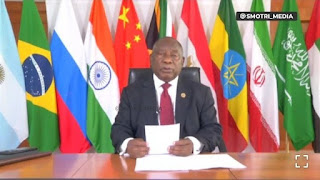
Meanwhile, BRICS nations meet today in a virtual summit to discuss the crisis in Gaza. After the meeting, the President of South Africa read the final statement of the BRICS countries regarding the situation in the Gaza Strip.

The statement expresses condolences to all those affected in Israel and the Gaza Strip, while also accusing Israel of violating international law. Ramaphosa, states that the primary cause of the conflict is Israel's illegal construction of settlements. The President of South Africa calls for the release of hostages taken during the Palestinian-Israeli conflict — a statement from the BRICS countries. The President of South Africa urges the International Criminal Court to initiate an investigation into those who committed war crimes during the Palestinian-Israeli conflict — a statement from the BRICS countries.


Tuesday, September 12, 2023

Inflation contributes to declining income and increasing poverty in the United States

    Tuesday, September 12, 2023   No comments

The US Census Bureau announced that inflation caused a decline in real income by 2.3% in the United States in 2022 despite raising wages, while poverty increased with the cessation of government aid, which was provided during the Corona pandemic.

Liana Fox, a Census Bureau official, explained during an online press conference that “high inflation led to a decline in real average family income,” which amounted to $47,960.


The official poverty rate remained stable compared to last year, at 11.5%, or 37.9 million people, living on less than $14,880 annually, or $29,950 for a family of four.


But another measurement showed a completely different truth. This measure, also published by the Census Bureau, adjusts the income below which a person is considered poor, taking into account government assistance and the cost of child care and medical expenses.

According to this measure, the poverty rate rose for the first time since 2010, increasing from 7.8% to 12.4% between 2021 and 2022.

The child poverty rate doubled, rising to 12.4%, while it was 5.2% in 2021, a historic low.

Followers


Most popular articles


ISR +


Frequently Used Labels and Topics

40 babies beheaded 77 + China A Week in Review Academic Integrity Adana Agreement afghanistan Africa African Union al-Azhar Algeria Aljazeera All Apartheid apostasy Arab League Arab nationalism Arab Spring Arabs in the West Armenia Arts and Cultures Arts and Entertainment Asia Assassinations Assimilation Azerbaijan Bangladesh Belarus Belt and Road Initiative Brazil BRI BRICS Brotherhood CAF Canada Capitalism Caroline Guenez Caspian Sea cCuba censorship Central Asia Charity Chechnya Children Rights China Christianity CIA Civil society Civil War climate colonialism communication communism con·science Conflict conscience Constitutionalism Contras Corruption Coups Covid19 Crimea Crimes against humanity D-8 Dearborn Debt Democracy Despotism Diplomacy discrimination Dissent Dmitry Medvedev Earthquakes Economics Economics and Finance Economy ECOWAS Education and Communication Egypt Elections energy Enlightenment environment equity Erdogan Europe Events Fatima FIFA FIFA World Cup FIFA World Cup Qatar 2020 Flour Massacre Food Football France Freedom freedom of speech G20 G7 Garden of Prosperity Gaza GCC GDP Genocide geopolitics Germany Global Security Global South Globalism globalization Greece Grozny Conference Hamas Health Hegemony Hezbollah hijab Hiroshima History and Civilizations Hormuz Human Rights Huquq Ibadiyya Ibn Khaldun ICC Ideas IGOs Immigration Imperialism In The News india Indonesia inequality inflation INSTC Instrumentalized Human Rights Intelligence Inter International Affairs International Law Iran IranDeal Iraq Iraq War ISIL Islam in America Islam in China Islam in Europe Islam in Russia Islam Today Islamic economics Islamic Jihad Islamic law Islamic Societies Islamism Islamophobia ISR MONTHLY ISR Weekly Bulletin ISR Weekly Review Bulletin Italy Japan Jordan Journalism Kenya Khamenei Kilicdaroglu Kurdistan Latin America Law and Society Lebanon Libya Majoritarianism Malaysia Mali mass killings Mauritania Media Media Bias Media Review Middle East migration Military Affairs Morocco Multipolar World Muslim Ban Muslim Women and Leadership Muslims Muslims in Europe Muslims in West Muslims Today NAM Narratives Nationalism NATO Natural Disasters Nelson Mandela NGOs Nicaragua Nicaragua Cuba Niger Nigeria Normalization North America North Korea Nuclear Deal Nuclear Technology Nuclear War Nusra October 7 Oman OPEC+ Opinion Polls Organisation of Islamic Cooperation - OIC Oslo Accords Pakistan Palestine Peace Philippines Philosophy poerty Poland police brutality Politics and Government Population Transfer Populism Poverty Prison Systems Propaganda Prophet Muhammad prosperity Protests Proxy Wars Public Health Putin Qatar Quran Rachel Corrie Racism Raisi Ramadan Ramadan War Regime Change religion and conflict Religion and Culture Religion and Politics religion and society Resistance Rights Rohingya Genocide Russia Salafism Sanctions Saudi Arabia Science and Technology SCO Sectarianism security Senegal Shahed sharia Sharia-compliant financial products Shia Silk Road Singapore Slavery Soccer socialism Southwest Asia and North Africa Sovereignty Space War Spain Sports Sports and Politics Starvation State Power State Terror Sudan sunnism Supremacism SWANA Syria Ta-Nehisi Coates terrorism Thailand The Koreas Tourism Trade transportation Tunisia Turkey Turkiye U.S. Cruelty U.S. Foreign Policy UAE uk ukraine UN under the Rubble UNGA United States UNSC Uprisings Urban warfare US Foreign Policy US Veto USA Uyghur Venezuela Volga Bulgaria Wadee wahhabism War War and Peace War Crimes War on Iran Wealth and Power Wealth Building West Western Civilization Western Sahara WMDs Women women rights Work Workers World and Communities Xi Yemen Zionism

Search for old news

Find Articles by year, month hierarchy


AdSpace

_______________________________________________

Copyright © Islamic Societies Review. All rights reserved.