Showing posts with label World and Communities. Show all posts

Wednesday, September 10, 2025

Israeli Airstrike in Doha Sparks Global Condemnation and Regional Upheaval

    Wednesday, September 10, 2025   No comments

DOHA, QATAR – In a dramatic and unprecedented escalation that has sent shockwaves across the Middle East and the world, Israel launched a military strike on the capital of Qatar yesterday, targeting and killing senior leaders of the Palestinian militant group Hamas. The attack, which violated the airspace of multiple sovereign nations, has been universally condemned as a severe breach of international law and has critically damaged diplomatic efforts to end the war in Gaza, potentially signaling a major realignment of global power in the region.

The operation, codenamed "Summit of Fire" by the Israeli military, saw warplanes travel approximately 1,800 kilometers to reach Doha. According to reports from Arab media outlets, the Israeli Air Force breached the airspace of Jordan, Saudi Arabia, Iraq, and Syria to reach its target. Once over the Qatari capital, the jets fired missiles at a residential compound housing members of Hamas's political bureau, who were in the country for talks. A Qatari security official was also reported killed in the attack.

The timing of the strike is seen by many observers as highly significant. It came just one day after the US President publicly issued a new proposal for a Gaza ceasefire deal, urging Hamas to accept it or "face consequences." With top Hamas leadership gathered in Doha—a key mediator throughout the conflict—to discuss the very proposal, the Israeli attack has led to widespread accusations that the diplomatic effort was a trap designed to eliminate the group's leadership in one fell swoop.

"This, as many observers noted, suggested that it might have been a trap to kill all Hamas top leadership, and that destroys US credibility as an honest broker of deals for peace," a point echoed by numerous diplomatic sources. The incident has placed the United States in a deeply awkward position, raising serious questions about its foreknowledge and role in the event.

Further intensifying the crisis is the glaring question of the massive US military presence in Qatar. Al-Udeid Air Base, the largest US military installation in the Middle East, houses advanced defense systems. The failure of these systems to intercept the Israeli aircraft or to provide Qatar with an early warning has sparked a crisis of confidence in Doha.

"The US not to use those defense resources to defend Qatar or at least warn it, suggests that US presence in Qatar is useless and does not provide any protection to Qatar," a consensus view emerging in the region. This perception was seemingly acknowledged by the US administration itself, with the President announcing he had ordered the State Department to finalize a new strategic defense deal with Qatar, an move interpreted as damage control for a severely weakened alliance.

The strategic ramifications are immediate. Global powers Russia and China were swift and forceful in their condemnation. They warned of a dangerous escalation and accused Israel of deliberately sabotaging peace negotiations. Analysts suggest that Qatar, now questioning the value of its US security umbrella, may rapidly pivot towards Moscow and Beijing for advanced defense systems, a move that would fundamentally alter the security architecture of the Gulf and could spell the end of the US military footprint in Qatar.

The attack also strains relations within the Gulf Cooperation Council (GCC), which promises collective security to its members. By violating the airspace of fellow GCC member Saudi Arabia to attack another member state, Israel has placed these US-allied nations in a difficult position, forcing them to confront a blatant violation of their sovereignty.

Global Outcry and Condemnation

The international response was swift and severe:

  • United Nations: Secretary-General António Guterres condemned the attack "without ambiguity," calling it a "flagrant violation of the sovereignty of Qatar" and a blow to mediation efforts.

  • Russia: Its foreign ministry stated the attack aimed to "undermine international efforts to reach a peaceful settlement in the Middle East."

  • China: Expressed "strong dissatisfaction with the deliberate sabotage of the Gaza ceasefire negotiations" and urged major countries to play a "constructive role in easing regional tensions."

  • European Union: Denounced the strike as a "violation of international law" and a "serious threat that could further escalate violence in the region."

  • Turkey: President Recep Tayyip Erdoğan decried the "reckless Netanyahu government" for its actions.

  • Organization of Islamic Cooperation: Denounced the aggression "in the strongest terms."

Qatar issued a furious statement, vowing it "would not tolerate this reckless Israeli behavior" and emphasizing that the "criminal assault is a violation of all international laws and a serious threat to the security and safety of Qataris and residents."

The strike marks a dangerous new chapter in the Gaza conflict, moving the battlefield into the heart of a mediator's capital and risking a much broader regional war. It has not only targeted Hamas leadership but has also severely damaged America's standing as a security partner and honest broker, potentially creating a vacuum that rivals Russia and China are poised to fill.


Wednesday, June 04, 2025

USA, again, alone, vetoes Gaza ceasefire resolution

    Wednesday, June 04, 2025   No comments

A draft resolution calling for an immediate and permanent ceasefire in Gaza failed to pass in the UN Security Council on Wednesday after the United States, again, cast its veto – blocking the initiative backed by all ten elected members of the Council.

The text, co-sponsored by Algeria, Denmark, Greece, Guyana, Pakistan, Panama, the Republic of Korea, Sierra Leone, Slovenia, and Somalia – collectively known as the E-10 – received 14 votes in favour, with the US casting the lone vote against.

As one of the council’s five permanent members, the US holds veto power – a negative vote that automatically blocks any resolution from going forward.

Had it been adopted, the draft would have demanded “an immediate, unconditional and permanent ceasefire in Gaza” to be respected by all parties.US has opposed all UNSC resulutions that could have brought an end to the carnage in Gaza.

 Russia’s UN envoy, Vasily Nebenzya, made it clear during a Security Council session: the world can now see who genuinely wants peace, and who continues to exploit global crises for geopolitical games.

His statement came in response to the United States vetoing yet another resolution calling for a ceasefire in Gaza.


Friday, April 11, 2025

France will recognize Palestine Soon

    Friday, April 11, 2025   No comments

The West is behind in recognizing the rights of the Palestinians to self-determination. But it is better late then never.

West's refusal to recognize Palestine as an independent state could have prevented the October attacks and the cycle of wars in Gaza. Now some Western countries, including France, are coming to accept that potential.

France's president just announced that France will recognize Palestine in months.  France’s potential recognition of Palestine as a sovereign state is quite important, despite the fact that 147 out of 193 UN member states have already done so. Here's why France’s stance carries significant weight:

1. France's Influence in the West

France is a major Western power—a permanent member of the UN Security Council, a founding member of the European Union, and part of the G7. Most of the countries that haven’t recognized Palestine are Western or aligned with the U.S. position, including the U.S., UK, Germany, and others. So, a shift in France’s stance could:

  • Encourage other Western countries to reconsider their position.
  • Break the perception of a unified Western front against recognition.

2. European Policy Shift

Macron's statement might signal a broader shift in EU policy, especially since he hinted this move could happen in coordination with other states or at a UN summit in June. This could:

  • Build momentum for a multilateral recognition initiative.
  • Put pressure on other EU members to align or clarify their positions.

3. Symbolic & Diplomatic Impact

  • Recognition from a country like France is more than symbolic:
  • It could increase diplomatic legitimacy for Palestine on the global stage.
  • It might influence international forums, aid flows, and negotiations.
  • It adds pressure on Israel by elevating the statehood issue beyond bilateral talks.

4. Tactical Timing

France possibly tying this recognition to a UN event in June also gives it diplomatic weight—it suggests recognition could become part of a broader international initiative, maybe even linked to Arab normalization with Israel.

Tuesday, August 06, 2024

Is Western civilization on the verge of collapse?

    Tuesday, August 06, 2024   No comments

Human civilization has been a topic for historians, sociologists, philosophers, thinkers, and scientists throughout history. The discussion of the rise and fall of human civilization often leads to a look back at the work of the Muslim thinker Abd al-Rahman Ibn Khaldun who is often described as the originator of the theory of cyclicality of human civilization. Although Ibn Khaldun did not take credit for such idea, and many modern researchers have concluded that that idea was not Ibn Khaldun's original idea, it is nonetheless part of his work and his contribution to the field of social history. Related to this topic, we examine and re-present ideas by a scientist from the modern time, one who used statistical data to predict social trends.

On the New Scientist website, Peter Valentinovich Turchin, a Russian-American scientist specializing in mathematical modeling and statistical analysis, presents his analysis of the decline of Western civilization and its causes by studying mathematical patterns in complex systems and applying them to history. Turchin believes that Western societies are rapidly moving toward the brink of destruction, and that they must make important decisions to avoid this collapse. Here are some of  Turchin's ideas and assertions. 


Is Western civilization on the verge of collapse?
The collapse of civilizations seems to have been a natural and recurring pattern in the development of cultures throughout history, with a period of decline and weakness often following a period of prosperity. The closest examples of this are what happened to the ancient Egyptian Empire, the Roman Empire, the Mayan civilization (one of the ancient civilizations that emerged in the region of Central and South America*), and the Qing Dynasty in China, which experienced periods of prosperity followed by collapse, and this seems to be the inevitable path of any civilization.

Today, Western civilization may face the same fate, as there are clear signs of a variety of crises, including widening economic inequalities, political divisions, violent conflicts, and environmental disasters. Some observers see this as a sign of a “multiple global crises” that pose a serious, perhaps existential, threat to contemporary societies.

More than two decades ago, I predicted that this was the end of things, based on studying mathematical patterns in complex systems and applying them to history. Using this approach, I discovered that violent political upheavals follow certain time cycles, one peaking every 50 years or so, and the other peaking every two or three centuries.

Tuesday, November 21, 2023

Chinese Foreign Ministry: We are good friends of the Arab and Islamic countries

    Tuesday, November 21, 2023   No comments

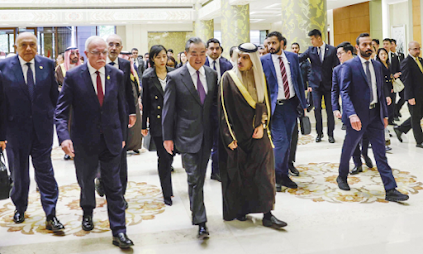
Chinese Foreign Minister Wang Yi announced on Monday before a delegation including Arab foreign ministers that the international community must take urgent measures to stop the “humanitarian catastrophe” unfolding in Gaza.
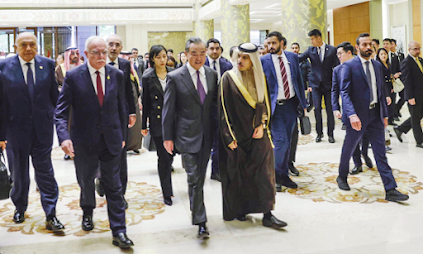
"Let us work together to quickly calm the situation in Gaza and restore peace in the Middle East as soon as possible," Wang said in his opening speech in Beijing.

Wang added to the diplomats that “there is a humanitarian catastrophe unfolding in Gaza,” noting that “the situation in Gaza affects all countries around the world and reconsiders the principle of good and evil and the basic principles of humanity.”


He stressed that "the international community must act urgently and take effective measures to prevent the spread of this tragedy."


Wang said, "China is a good friend and brother of the Arab and Islamic countries," adding that it "firmly defended the legitimate rights and interests of the Arab and Islamic countries, and strongly supported the efforts of the Palestinian people to restore their legitimate national rights and interests."


Earlier, the Chinese Foreign Minister expressed "China's strong sympathy for the Palestinians, especially in the Gaza Strip," adding that "what the people of Gaza need most is security, food and medicine, not war, weapons and ammunition."
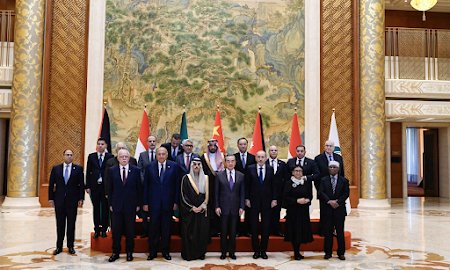
Wang Yi stressed that "the historical injustice against Palestine cannot continue," and that "China is currently working closely with all parties to strengthen the ceasefire and end the war."


The Arab delegation includes the foreign ministers of Saudi Arabia, Egypt, Jordan and Palestine, and the Secretary-General of the Council of Islamic Cooperation.


The visit of the Arab ministerial delegation comes as part of a tour to the capitals of a number of countries that are permanent members of the Security Council, with the participation of the foreign ministers of the committee formed from the recent Arab-Islamic summit, with the aim of advancing the process of stopping the war on Gaza, and dealing with the deteriorating humanitarian conditions in the Strip.


China backs an international peace conference to push the Palestinian issue back to the track of two-state solution: top diplomat


China supports the convening of a more authoritative, broader and more effective international peace conference as soon as possible to push the Palestinian issue back to the track of the two-state solution, said Chinese Foreign Minister Wang Yi, in a phone conversation on Wednesday with Omani Foreign Minister Sayyid Badr Albusaidi.

Wang, also a member of the Political Bureau of the Communist Party of China Central Committee, noted that the current situation in Gaza continues to deteriorate, with an increasing number of casualties among the civilians. Any country with a conscience and a sense of responsibility can't allow such a tragedy to continue. The recent emergency special session of the UN General Assembly passed a resolution calling for an immediate humanitarian truce, reflecting the strong call from the international community, Wang said.


Friday, September 01, 2023

Presidential elections in Singapore.. Tharman is the likely successor to Halima Yaqoub

    Friday, September 01, 2023   No comments

Since its secession from the Federation of Malaysia in 1965 until today, Singapore has known only 3 prime ministers, while 8 presidents have succeeded in that small country in Southeast Asia, which is described as a "city-state"; With an area of 710 square kilometers, and a population of 5 million people, half of whom are foreigners coming to work, making it the fourth country in the world in terms of population density.

Singapore is a country of many races, ethnicities and religions, 3 quarters of its citizens are of the Chinese race, while the rest of the population belongs to the Malay race or mixed Indian or Eurasian race. As many ethnicities as there are many religions in Singapore as well and include Buddhism, Islam, Taoism, Hinduism and Christianity.

All three prime ministers that Singapore has known came from ethnic Chinese - the largest of Singapore's ethnicities - and from one party, the People's Action Party (PAP), which has governed Singapore continuously since 1959.


And while the presidency of the government remained confined to the Chinese ethnicity, the ethnicities of those who assumed the position of head of state, which is an honorary position, varied, as they include, in addition to the Chinese ethnicity, the Malay and Indian ethnicities, and others of mixed ethnicities as well.


The religions of these presidents also varied between Buddhism, Hinduism and Islam. The first president of the state was Youssef bin Ishaq, whose image is placed on the country’s banknotes. He is a Malay Muslim who held the position for 3 consecutive terms from the founding of the state until his death in 1970. While it was Executive power is in the hands of Lee Kuan Yew, the founder and builder of Singapore and its first prime minister, who has been in office for 3 continuous decades.


The current president, Halima Yaqoub, 70, is a Muslim of the Malay ethnicity. She took office in 2017 after winning by acclamation, without a competitor, declaring that she was satisfied with one 6-year term that ends on September 17. Then, today, Friday, multi-party elections will be held to choose a successor.

In contrast to the position of prime minister, which the parties compete for in general legislative elections; The position of the president is non-partisan under the constitution, and the parliament remained the one who elects the president, until the constitution was amended in 1991, allowing him to be elected through presidential elections. Today's elections, Friday, are only the third since the constitutional amendment that transformed this position into a position elected by the public and gave the public the right to choose.


What is unique to Singapore in the requirements for a candidate for the presidency is that he has worked either as a senior government employee or CEO of a company whose shareholders have a value of at least 500 million Singapore dollars (370 million US dollars).


Although the role of the president in Singapore is largely ceremonial, there are strict requirements for the position, which formally oversees the country's accumulated financial reserves that can only be relied upon in exceptional circumstances, such as the Covid-19 pandemic and the 2009 global financial crisis. With the power to veto certain actions and to approve anti-corruption investigations.


Three candidates who meet the conditions are competing in the elections taking place today, namely the Deputy Prime Minister and former Finance Minister Tharman Shanmugaratnam, who is the youngest of the three candidates (65) and the most fortunate, compared to his competitors; They are Ing Kok Song, 75, and Tan Kin Lien, 75.

Economic backgrounds and a major public position appear to be the common denominator among the three contenders, who the election administration announced that they met the strict criteria for competition among the applicants for candidacy.


The announcement of their official acceptance of the candidacy came less than two weeks before the elections were held today, which is a very short period compared to the rest of the world, and was the object of the complaint of the candidate, Tan Kin Lien, who saw it as an insufficient period for the electoral campaign that ended last Wednesday before the election day of silence yesterday, Thursday.


The nominee, Ing Kok Song, is a former chief investment officer at the Singaporean sovereign wealth fund that manages the country's foreign reserves, and spent more than 4 decades working in public service until his retirement in 2013. Ing is currently Chairman of the Board of Directors of Avanda Management Corporation. Investments worth billions of dollars.


Having spent years working closely with Prime Minister Lee Hsien Loong, Eng admitted he might be seen as "part of the establishment". However, he believes that the lack of direct political affiliation makes him an independent candidate. He never joined the Popular Action Party, which has ruled the country since its independence six decades ago. He believes that his long experience in the financial sector puts him in a good position to protect the national reserves.


As for Tan Kin Lien, a former presidential candidate in Singapore, this is his second attempt to win the position. Having come last out of 4 candidates in the 2011 presidential election, he is a former chairman of one of Singapore's leading insurance companies and has the support of several opposition leaders.


Layan presided over the International Federation of Cooperative and Mutual Insurance from 1992 to 1997, and the federation was an international organization that at that time represented 123 insurance groups in 65 countries, and employed 260,000 people. The total assets of the members of this international association amounted to 1.5 trillion US dollars in 1997.

As for the most likely candidate, Deputy Prime Minister and former Finance Minister Tharman Shanmugaratnam, he is a multi-ethnic Singaporean citizen (Tamil-Indian-Ceylon) who is known as a supporter of the ruling People's Action Party, but he submitted his resignation before his candidacy. He is widely seen as having the support of the government, and has been questioned about his independence during the election campaign.


Before resigning his government positions to contest this election, Tharman spent more than two decades in office with the People's Action Party, rising to the position of Deputy Prime Minister.


He was first elected to Parliament in 2001 and was Chairman of the Monetary Authority of Singapore. He also served as the Coordinating Minister for Social Policy, and provided economic advice to Prime Minister Lee.


He said that if given the opportunity to lead, he would be "total and impartial in the discharge of the constitutional duties of office in respect of the prudent use of the country's reserves".


While his rivals seemed preoccupied with their party independence, Tharman urged voters to judge candidates on their record, rather than their past affiliations.


"If I am lucky enough to be elected president, I will represent the unity of Singaporeans, of all races, religions, social backgrounds and political leanings, at a time when views among the population are becoming more diverse," he said.


Since Tharman entered Singaporean politics just over two decades ago, he has avoided constant calls from the public that he should become the next prime minister of the Southeast Asian country.


Tharman - who is very popular and has risen in the ranks of the ruling People's Action Party, and is very popular among members of the opposition - insists that he is not suitable for the position of prime minister. He even likened his refereeing skills to those of a soccer goal-maker, saying that he is better as a team player who can provide assists than a superstar who scores goals. "I enjoy making long passes," he said. "But I'm not the striker."


His candidacy is thus a far cry from the quest for the premiership currently held by Lee Hsien Loong, the son of Singapore's founding prime minister. He is expected to retire and choose his successor before the country's next general election in 2025.


But it is a step that helps avoid the looming question of whether the Chinese-majority country (or the ruling party) that promotes its multi-ethnic and pluralistic society is ready or reluctant to elevate someone from an ethnic minority to the position of prime minister.


Also unique to Singapore is voting, which is compulsory for more than 2.7 million eligible citizens of Singapore. Those who do not vote without valid reason are subject to being removed from the voter list.


He also notes the absence of long, orderly lines at polling stations, as well as the raucous atmosphere that can accompany elections in other countries, with supporters cheering or handing out flyers to push for last-minute votes. And "presidential elections are increasingly being treated as a general election."


Today's presidential elections are being watched closely as an indication of support for the ruling Popular Action Party after a rare series of political scandals that rocked the party recently, which is rare in a country that has benefited from the reputation of its clean government, and has become an international center for a group of industries such as finance and aviation, especially since the party has suffered from its worst electoral performance ever in 2020; However, he maintained his majority of more than two-thirds.

Observers said the vote could indicate the level of support for the PAP ahead of general elections scheduled for 2025 or discontent after recent scandals that include a corruption investigation into the transport minister and the resignation of two PAP lawmakers over an affair.

Keeping our readers informed about the most consequential events in this fast changing worldManage your Subscription; invite a friend to subscribe to ISR’s Weekly Review Bulletin

Followers


Most popular articles


ISR +


Frequently Used Labels and Topics

40 babies beheaded 77 + China A Week in Review Academic Integrity Adana Agreement afghanistan Africa African Union al-Azhar Algeria Aljazeera All Apartheid apostasy Arab League Arab nationalism Arab Spring Arabs in the West Armenia Arts and Cultures Arts and Entertainment Asia Assassinations Assimilation Azerbaijan Bangladesh Belarus Belt and Road Initiative Brazil BRI BRICS Brotherhood CAF Canada Capitalism Caroline Guenez Caspian Sea cCuba censorship Central Asia Charity Chechnya Children Rights China Christianity CIA Civil society Civil War climate colonialism communism con·science Conflict conscience Constitutionalism Contras Corruption Coups Covid19 Crimea Crimes against humanity D-8 Dearborn Debt Democracy Despotism Diplomacy discrimination Dissent Dmitry Medvedev Earthquakes Economics Economics and Finance Economy ECOWAS Education and Communication Egypt Elections energy Enlightenment environment equity Erdogan Europe Events Fatima FIFA FIFA World Cup FIFA World Cup Qatar 2020 Flour Massacre Food Football France Freedom freedom of speech G20 G7 Garden of Prosperity Gaza GCC GDP Genocide geopolitics Germany Global Security Global South Globalism globalization Greece Grozny Conference Hamas Health Hegemony Hezbollah hijab Hiroshima History and Civilizations Human Rights Huquq Ibadiyya Ibn Khaldun ICC Ideas IGOs Immigration Imperialism In The News india Indonesia inequality inflation INSTC Instrumentalized Human Rights Intelligence Inter International Affairs International Law Iran IranDeal Iraq Iraq War ISIL Islam in America Islam in China Islam in Europe Islam in Russia Islam Today Islamic economics Islamic Jihad Islamic law Islamic Societies Islamism Islamophobia ISR MONTHLY ISR Weekly Bulletin ISR Weekly Review Bulletin Italy Japan Jordan Journalism Kenya Khamenei Kilicdaroglu Kurdistan Latin America Law and Society Lebanon Libya Majoritarianism Malaysia Mali mass killings Mauritania Media Media Bias Media Review Middle East migration Military Affairs Morocco Multipolar World Muslim Ban Muslim Women and Leadership Muslims Muslims in Europe Muslims in West Muslims Today NAM Narratives Nationalism NATO Natural Disasters Nelson Mandela NGOs Nicaragua Nicaragua Cuba Niger Nigeria Normalization North America North Korea Nuclear Deal Nuclear Technology Nuclear War Nusra October 7 Oman OPEC+ Opinion Polls Organisation of Islamic Cooperation - OIC Oslo Accords Pakistan Palestine Peace Philippines Philosophy poerty Poland police brutality Politics and Government Population Transfer Populism Poverty Prison Systems Propaganda Prophet Muhammad prosperity Protests Proxy Wars Public Health Putin Qatar Quran Rachel Corrie Racism Raisi Ramadan Regime Change religion and conflict Religion and Culture Religion and Politics religion and society Resistance Rights Rohingya Genocide Russia Salafism Sanctions Saudi Arabia Science and Technology SCO Sectarianism security Senegal Shahed sharia Sharia-compliant financial products Shia Silk Road Singapore Slavery Soccer socialism Southwest Asia and North Africa Space War Spain Sports Sports and Politics Starvation State Terror Sudan sunnism Supremacism SWANA Syria Ta-Nehisi Coates terrorism Thailand The Koreas Tourism Trade transportation Tunisia Turkey Turkiye U.S. Cruelty U.S. Foreign Policy UAE uk ukraine UN under the Rubble UNGA United States UNSC Uprisings Urban warfare US Foreign Policy US Veto USA Uyghur Venezuela Volga Bulgaria Wadee wahhabism War War and Peace War Crimes Wealth and Power Wealth Building West Western Civilization Western Sahara WMDs Women women rights Work Workers World and Communities Xi Yemen Zionism

Search for old news

Find Articles by year, month hierarchy


AdSpace

_______________________________________________

Copyright © Islamic Societies Review. All rights reserved.