Showing posts with label UAE. Show all posts

Tuesday, December 30, 2025

Saudi-UAE Rift Deepens--A Regional Power Struggle with Global Implications

    Tuesday, December 30, 2025   No comments

A dramatic escalation between Saudi Arabia and the United Arab Emirates (UAE) has laid bare the fractures within the once-unified Gulf coalition, revealing a deepening strategic schism over influence in Yemen—and, by extension, the broader Middle East. The latest trigger came on December 30, 2025, when Saudi Arabia launched airstrikes on the Yemeni port of Mukalla, targeting vessels it alleges were carrying weapons from the UAE destined for separatist militias. Simultaneously, Riyadh issued a 24-hour ultimatum demanding the UAE withdraw all military forces from Yemen and cease financial and logistical support to factions operating within the country.

The implications of this confrontation go far beyond Yemen’s fragile borders. They expose the UAE’s increasingly assertive—and often destabilizing—foreign policy, fueled by vast petro-wealth and an ambition to project power disproportionate to its small geographic size and population. More critically, they spotlight the contradictions at the heart of the Emirati state: a gleaming global city built on the backs of a disenfranchised foreign workforce, ruled by a hereditary elite that constitutes just 14% of the population, while the rest—millions of expatriates—are denied basic civil and political rights.

The Yemen Flashpoint

Yemen has long been the proving ground for Gulf rivalries, but the Saudi-UAE split has now reached a breaking point. While both nations ostensibly joined forces in 2015 under the banner of the “Arab Coalition” to restore Yemen’s internationally recognized government, their objectives diverged sharply over time. Saudi Arabia prioritized border security and countering Houthi influence, while the UAE invested heavily in southern separatist groups like the Southern Transitional Council (STC), viewing a fragmented Yemen as strategically advantageous.


Recent developments confirm Saudi Arabia’s worst fears. The STC, with evident Emirati backing, has seized large swaths of land in Hadhramaut and Al-Mahra—governorates adjacent to Saudi territory. Riyadh interprets this not as a local power grab but as a direct threat to its national security. The Saudi Foreign Ministry’s unusually blunt language—calling UAE actions “extremely dangerous” and “incompatible with the foundations of the coalition”—signals a dramatic rupture in bilateral trust.


Yemen’s Presidential Leadership Council, under President Rashad al-Alimi, responded by declaring a 90-day state of emergency, revoking a security agreement with the UAE, and imposing a comprehensive blockade on ports and crossings. These measures underscore the extent to which Emirati interference is now seen as an existential threat to Yemeni sovereignty—even by a government that once welcomed UAE support.


The UAE’s Destabilizing Regional Ambitions

The Yemen crisis is not an isolated case. The UAE has consistently leveraged its financial might to back proxy forces across the region—often in defiance of international law and regional stability:


Sudan: The UAE has been accused by the UN and Western intelligence agencies of supplying weapons to the Rapid Support Forces (RSF), intensifying the brutal civil war that has killed tens of thousands and displaced millions. Abu Dhabi sees the RSF as a counterweight to Islamist and Turkish influence, but its intervention has prolonged and deepened the conflict.

Libya: The UAE openly backed Khalifa Haftar’s Libyan National Army (LNA) in its failed 2019 assault on Tripoli, providing drones, air support, and mercenaries. Its actions contradicted UN arms embargoes and undermined diplomatic efforts to unify the country.

Somalia: Emirati military presence in Berbera and its port investments have fueled tensions with the Somali federal government, which accuses Abu Dhabi of undermining national sovereignty and cultivating separatist sentiment in Somaliland.

This pattern reveals a consistent Emirati strategy: exploit regional chaos to install pliable local actors, secure strategic ports and military bases, and project influence far beyond its borders—all while avoiding democratic accountability at home.


A Domestic System Built on Exclusion

The UAE’s aggressive external posture is mirrored by a deeply hierarchical internal order. Despite hosting over 9 million foreign workers—many of whom have lived and labored in the country for decades—they are systematically denied pathways to citizenship, political representation, or even basic labor protections. Human rights organizations have long documented systemic abuses: wage theft, passport confiscation, unsafe working conditions, and the absence of collective bargaining rights.


Meanwhile, the Emirati citizen elite—roughly 14% of the population—enjoy immense privileges, including state-funded housing, education, and employment guarantees. This de facto caste system is rarely scrutinized due to the UAE’s carefully cultivated image as a modern, tolerant hub. Yet beneath the skyscrapers and luxury malls lies a rigid social contract: obedience in exchange for wealth, with dissent tolerated only when it comes from the palace, never the pavement.


The Danger of Emirati Supremacism

What makes the UAE’s regional behavior particularly alarming is its ideological underpinning. Unlike Iran or Turkey, whose regional ambitions are framed in religious or civilizational terms, the UAE promotes a form of Gulf-centric supremacism: the belief that small, oil-rich monarchies have the right—and duty—to shape the political destiny of larger, poorer nations through coercion, patronage, and covert warfare.


This worldview is not merely opportunistic; it is imperial in spirit. And it thrives in the absence of accountability. While Saudi Arabia, despite its own human rights record, is increasingly aligning with international diplomatic frameworks the UAE remains defiantly opaque, operating through shadowy networks of private military contractors, offshore finance, and media manipulation.


A Turning Point?

The Saudi ultimatum may mark a historic inflection point. For years, Abu Dhabi skillfully played Riyadh and Washington against each other, presenting itself as a reliable counterterrorism partner while quietly undermining Saudi interests in Yemen and beyond. But with Saudi Arabia now asserting red lines and Yemen’s government turning against its former Emirati patrons, the UAE risks diplomatic and strategic isolation.

More importantly, this crisis could force a long-overdue reckoning with the UAE’s role in the region. If the world continues to treat Abu Dhabi as a benign economic hub while ignoring its role in fueling wars in Sudan, Libya, and Yemen, it will only embolden further adventurism. The cruelty of the Emirati model—both at home and abroad—must no longer be excused by its skyscrapers or sovereign wealth funds.

Saudi Arabia’s warning is clear: destabilization has consequences. Whether the UAE heeds it—or doubles down—will determine not just the fate of Yemen, but the future balance of power in the entire Middle East.

Updated: UAE claims it is ending its presence in Yemen


  UPDATE:

 In an official statement released by the United Arab Emirates' Ministry of Foreign Affairs, the UAE expressed "deep regret" over statements made by Saudi Arabia over the Saudi airstrike on Yemen’s Mukalla port, calling for restraint and warning against further escalation between the two Gulf partners. The UAE also rejected claims that the targeted shipment included weapons and denied that it was supplying arms to local factions.

The statement further reads:

"The Ministry affirms that the shipment in question did not contain any weapons, and the vehicles unloaded were not intended for any Yemeni party but were shipped for use by UAE forces operating in Yemen."


Friday, September 12, 2025

Media review: Israeli Airstrike on Qatar Shakes Gulf States' Confidence in US Protection, Report Says

    Friday, September 12, 2025   No comments

A recent Israeli military strike on Qatar’s capital has triggered a significant crisis of confidence among Gulf Arab states, casting serious doubt on the reliability of American security guarantees, according to a report by The Washington Post.


The attack, which targeted Doha, has reportedly fueled deep-seated anger and a sense of insecurity across the Persian Gulf. Analysts suggest that Israel’s apparent ease in carrying out the strike led many regional powers to a stark conclusion: if a U.S. partner like Qatar can be attacked, then no neighboring American ally is truly safe.

At the core of the growing disillusionment is the perception that the United States was either unable or unwilling to restrain its close ally, Israel, even when its actions directly threatened another American partner. This has fundamentally shaken the long-standing pillar of Gulf security, which has heavily relied on U.S. military and diplomatic backing for decades.

One researcher from the International Institute for Strategic Studies (IISS) noted that the uniquely close relationship between Washington and Jerusalem made this strike "qualitatively different" from previous conflicts. Rather than acting as a deterrent, the U.S. response was perceived as weak, often limited to "pro-forma expressions of dissatisfaction" without imposing any concrete, deterrent measures to stop what is seen as "Israel’s unrestricted military aggression in the region."

The strike has "reinforced the feeling that Washington is an unreliable security partner," the analyst stated.

This incident is not an isolated event but the latest in a years-long erosion of trust. The Post highlights that Gulf confidence in American protection has been declining through both Democratic and Republican administrations. This trend is driven by a perceived U.S. "strategic pivot" towards Asia and the diminished strategic importance of Middle Eastern oil to Washington.

Furthermore, the attack on Doha has undermined a previously held belief among some Gulf leaders that a close personal relationship with a U.S. president could directly influence policy. Hopes that such a bond with former President Donald Trump would shape American actions were decisively dashed by the bombing of Qatar.

The event signals a potential strategic inflection point, forcing Gulf nations to seriously reconsider the foundation of their security architecture and question the dependability of a partnership that has been a cornerstone of regional stability for over half a century.

Wednesday, January 08, 2025

Are the fighting in the north and the resisting in the south signs of disintegration of Syria?

    Wednesday, January 08, 2025   No comments

Weeks since the fall of the Baath regime in Syria, one main armed faction, the most organized and powerful group—HTS, took control of the country. The group’s leader has been acting as the country’s leader and governments that supported the armed rebellion are accepting his role as the de facto leader. However, instead of starting a process of reconciliation, the new rulers are placing themselves in a positions that would allow them to control the future of the country. This approach appears to be pushing other groups to do the same: hold tight to whatever power they secured in the past 14 years and leverage such power to secure a significant role in the future. This trend may result in the breakdown of Syrian into at least three regions, similar to what happened in Libya. These are some of the signs that point to that possibility.

Violent clashes between Turkey-supported "National Army" and US-supported "SDF"

Newsmedia correspondents in Syria reported on Wednesday that a Turkish drone targeted a SDF vehicle in the countryside of Ayn al-Arab "Kobani" in the eastern countryside of Aleppo.

The report detailed that the vicinity of the Qarqozak Bridge, located south of the city of Ayn al-Arab "Kobani", was subjected to Turkish artillery shelling, while the factions of the "National Army", affiliated with Turkey, bombed the SDF sites at the bridge with missiles. A Turkish drone targeted a SDF rocket launcher in the village of Sakul in the countryside of Manbij, east of Aleppo.

In the same context, the media center of the Syrian Democratic Forces (SDF) confirmed that "Turkish warplanes bombed Tishrin Dam and its surroundings with a number of raids, coinciding with attacks carried out by the mercenary factions affiliated with Turkey on villages north of Tishrin Dam and southeast of Manbij, where violent clashes are taking place between the forces of the Manbij Military Council and the mercenaries."

In Kobani, Turkish drones bombed a civilian car in the village of "Kirk-Girik", in addition to artillery shelling on the village of "Aslanki" south of the city.

According to the center, the danger of the Tishrin Dam collapsing is increasing, as the Turkish state bears any disaster that may befall the dam and other Syrian regions as a result of the Turkish air and artillery attacks that reached their peak during the morning hours today, and which continue until now.

The center confirmed that "the forces of the Manbij Military Council destroyed two vehicles loaded with Dushka weapons belonging to the mercenaries of the Turkish occupation north of Tishrin Dam during the ongoing clashes there."

The Turkish drone targeted a "Qasd" car in an airstrike in the vicinity of the city of Al-Malikiyah, northeast of Al-Hasakah, in the far northeast of Syria.


In Southern Syria, armed groups' leaders say they are not convinced to hand over weapons

The spokesman for the Southern Operations Room, which controls Daraa province, Nassim Abu Ara, said that the room’s fighters are not convinced by the idea of dissolving the armed groups announced by the new Syrian administration on December 25 of last year, when the new rulers confirmed that they had reached an agreement with the armed groups regarding their dissolution and integration under the Ministry of Defense.

In an interview with Agence France-Presse, Abu Ara confirmed that the fighters are hesitant to disarm and disband their ranks as ordered by the new rulers, noting that he and those with him are "an organized force in the south, possessing heavy weapons and equipment, and led by officers who defected from the army of the former regime," suggesting that they be merged as a military body with the Ministry of Defense. Abu Ara added that the "Southern Operations Room" led by local leader Ahmed al-Awda includes thousands of men who have no Islamic affiliation, and sources close to the group indicated that al-Awda enjoys good relations with Russia, as well as Jordan and the Emirates.

Tuesday, April 16, 2024

Saudi Arabia UAE--two allies no longer able to solve their problems on their own

    Tuesday, April 16, 2024   No comments

Disagreements in secret come to light with the Saudi complaint to the United Nations due to a border dispute.. “Al Yasat” is showing that the two allies and regional economic powers no longer able to solve their problems on their own.

In a letter addressed to the United Nations, Saudi Arabia accused Abu Dhabi of encroaching on the Kingdom’s borders, through the UAE authorities issuing an Emiri decree in 2019, declaring Al Yasat a “marine protected area.”

The complaint indicated that Saudi Arabia does not recognize any measures or practices taken, or their consequences, by the UAE government in the area off the Saudi coast, the “Al Yasat area,” including the Kingdom’s territorial sea and the area of joint sovereignty on the two islands of Makasib.

The UAE demanded the completion of implementation of Article Five of the agreement demarcating the land and sea borders dated between the two countries in 1974.

Riyadh considered the memorandum official, and also called on the United Nations to circulate it to the members of the United Nations, according to established procedures.

This step, according to Gulf affairs experts, means that both Saudi Arabia and the Emirates are no longer able to solve their problems on their own, or within Gulf frameworks such as the Gulf Cooperation Council or Arab ones such as the Arab League, and that the dispute has reached the United Nations, the highest international body for conflict resolution. The issue of the “Al Yasat” region is not the only controversial issue between the two countries, as there is something bigger than it, according to what experts point out. The dispute over the “Shaybah” oil field is considered one of the most prominent headlines at the core of the border disputes, and the silent struggle between the two countries over influence in Yemen. Both Abu Dhabi and Riyadh were unable to hide it, or solve it through understandings, and it remained like fire under the ashes. The UAE’s support for the Transitional Council in Yemen, its efforts to divide it north and south, and its fight against the Islah Party, are all actions that worry Riyadh, and push it to thwart Emirati projects and stand up to them. Although the conflict has so far been in its silent and hidden context, most odds say that the clash is not coming. A dispute between groups affiliated with both parties in Yemen.

These are some of the forces that are reshaping a critical region in the world, Southwest Asia and North Africa, the center of gravity of human civilizations for thousands of years,


Sunday, December 24, 2023

Iran Summons Russian Envoy Over Statement on Disputed Gulf Islands

    Sunday, December 24, 2023   No comments

Those familair with Iranian culture would say that Iran's leaders do not do "ta`aruf" when it comes to their sovereignty. That is, “no kidding allowed” on the matter. In a move similar to its reaction to China putting its name on an Arab-Chinese joint statement when the Chinese president visit the Gulf region, Iran foreign ministry summoned the Russian diplomat to protest a similar event that took place in Morocco earlier this month. 

Iran has summoned the Russian chargé d'affaires to Tehran in protest at a recent statement issued by Russia and several Arab countries on Iran’s three Persian Gulf islands of Abu Musa, the Greater Tunb, and the Lesser Tunb.

The Russian diplomat was summoned by the assistant to the Iranian Foreign Ministry's director general for the Persian Gulf affairs on Saturday.

The development came after the final statement of the 6th Arab-Russian Cooperation Forum, which was held in Morocco on December 20, reiterated the United Arab Emirates' baseless claims about the three Iranian islands.


Iran has summoned Russia's envoy to protest a recent statement by Moscow and Arab countries calling for talks over three islands controlled by Tehran but claimed by the United Arab Emirates.


The summoning of Moscow's charge d'affaires came days after Iran's key ally Russia signed a joint declaration with Arab countries which "supported peaceful solutions and initiatives" to resolve the dispute over the islands.

Iran's foreign ministry said on Saturday it summoned Moscow's charge d'affaires in Tehran, in the absence of its ambassador, to submit a "note of protest" on the contents of the joint statement.


"The Islamic Republic of Iran considers any claim from any side in this regard as rejected and unacceptable," Iran's foreign ministry said in a statement.


Iran's top diplomat Hossein Amir-Abdollahian also called the islands "an integral part of Iran's territorial integrity" in a phone call with his Russian counterpart Sergei Lavrov on Friday.


"Tehran will not compromise with any side on the issue of respect for territorial integrity and sovereignty," he added.


Iran in July summoned the Russian ambassador to protest a similar joint statement signed by Moscow and Arab countries on the islands.


Located in the Gulf, the three strategic islands of Greater Tunb, Lesser Tunb and Abu Musa are located near the Strait of Hormuz, through which a fifth of world oil output passes.


Monday, September 04, 2023

The aftermath of BRICS expansion: The West will warn its Arab Allies who joined the Bloc

    Monday, September 04, 2023   No comments

BRICS membership expanded, and with that expansion comes benefits and responsibilities. Among them is closer economic cooperation among member states. This would mean that Russia, the hardest hit country by Western sanctions, and Iran, the second longest hit country by Western sanctions will be able to trade without fear of Western limits. Tow of the Arab nations that joined BRICS recently, Saudi Arabia and UAE, will feel the heat from their Western allies. It already started.

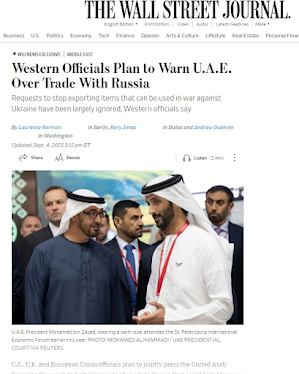
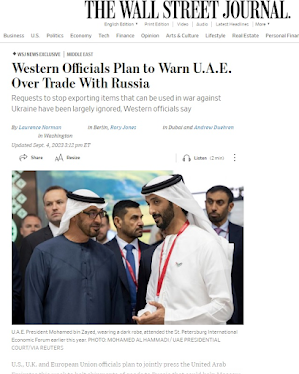
Officials from the US, UK, and EU are planning to “jointly press” the UAE into halting shipments of goods to Russia that "could help Moscow in its war against Ukraine,' according to western officials who spoke with the Wall Street Journal (WSJ).

Several US and European officials started a trip to the Gulf monarchy on 4 September “as part of a collective global push to keep computer chips, electronic components, and other so-called dual-use products” away from Russia.

Western envoys also traveled “jointly and separately” to countries such as Turkiye and Kazakhstan to pressure authorities into preventing western dual-use products from reaching Russia.


Despite ongoing pressure from the west, Abu Dhabi has not enforced sanctions imposed on Russia, instead deepening cooperation with the Kremlin. Nonetheless, the Gulf nation has condemned the invasion of Ukraine at the UN several times, and an Emirati official told the WSJ that the country enforces UN-imposed sanctions on Russia.


The official added the Gulf state is monitoring the export of dual-use products and is committed to protecting “the integrity of the global financial system.”


In response to the position taken by the UAE, US officials publicly labeled the UAE "a country of focus" earlier this year as they look to clamp down on Russia's ties with independent nations.


Dubai, in particular, has reaped the benefits of the Emirati government's neutrality, as Russian nationals have become the largest buying group of real estate in the luxurious Emirate, which has also become a hub for Russian oil traders.


The new pressure campaign from the west comes less than two weeks after the UAE was officially invited to join the Russian and Chinese-led BRICS+ group of nations. The expanded bloc also pledged to help Africa develop its local economy through investments by member states who have the cash and loans from the New Development Bank (BRICS bank). UAE, a country with cash that need to be invested, is taking advantage of this new opportunity.


The UAE pledged $4.5 billion in clean energy investments for the African continent on 5 September during the second day of the three-day African Climate Summit held in the Kenyan capital, Nairobi.


“We will deploy $4.5 billion … to jumpstart a pipeline of bankable clean energy projects in this very important continent,” Sultan Ahmed al-Jaber, the head of state-owned renewable energy firm Masdar and the Emirati national oil company ADNOC, told attendees on Tuesday.


“If Africa loses, we all lose,” warned Jaber, adding that the investment aims “to develop 15 GW (gigawatts) of clean power by 2030” and “catalyze at least an additional $12.5 billion from multilateral, public and private sources.”


Jaber, who is also president of the upcoming COP28 climate summit to be hosted by the UAE, said a consortium including Masdar would help achieve the clean power goals and stressed that a “surgical intervention of the global financial architecture that was built for a different era” is needed, urging institutions to lower debt burdens.


According to the International Renewable Energy Agency (IREA), Africa’s renewable generation capacity was 56 GW in 2022. Despite possessing an abundance of natural resources, just 3 percent of energy investments worldwide are made in Africa.


The three-day climate summit in Nairobi has attracted heads of state, government, and industry, including UN head Antonio Guterres, EU chief Ursula von der Leyen, and US climate envoy John Kerry.


“Renewable energy could be the African miracle, but we must make it happen,” Guterres told the summit on Monday. He also addressed the member states of the G20 to “assume your responsibilities” in the battle to combat climate catastrophe.


Kenyan President William Ruto said trillions of dollars in “green investment opportunities” would be needed as the climate crisis accelerates.


“Africa holds the key to accelerating decarbonization of the global economy. We are not just a continent rich in resources. We are a powerhouse of untapped potential, eager to engage and fairly compete in the global markets,” Ruto said.


Abu Dhabi sealed a deal with Egypt in June to build Africa's largest wind farm as the nation looks to rapidly expand the use of clean energy abroad and at home, where it operates three nuclear power reactors. The UAE also has three of the world's largest and lowest-cost solar plants. 


This focus on clean energy is part of the UAE’s Net Zero by 2050 Strategic Initiative.


The development of renewable energy sources has recently become a priority for Gulf states, including Saudi Arabia, which plans to source 50 percent of its energy requirements from renewables by 2030.


Keeping our readers informed about the most consequential events in this fast changing worldManage your Subscription; invite a friend to subscribe to ISR’s Weekly Review Bulletin

Followers


Most popular articles


ISR +


Frequently Used Labels and Topics

40 babies beheaded 77 + China A Week in Review Academic Integrity Adana Agreement afghanistan Africa African Union al-Azhar Algeria Aljazeera All Apartheid apostasy Arab League Arab nationalism Arab Spring Arabs in the West Armenia Arts and Cultures Arts and Entertainment Asia Assassinations Assimilation Azerbaijan Bangladesh Belarus Belt and Road Initiative Brazil BRI BRICS Brotherhood CAF Canada Capitalism Caroline Guenez Caspian Sea cCuba censorship Central Asia Charity Chechnya Children Rights China Christianity CIA Civil society Civil War climate colonialism communication communism con·science Conflict conscience Constitutionalism Contras Corruption Coups Covid19 Crimea Crimes against humanity D-8 Dearborn Debt Democracy Despotism Diplomacy discrimination Dissent Dmitry Medvedev Earthquakes Economics Economics and Finance Economy ECOWAS Education and Communication Egypt Elections energy Enlightenment environment equity Erdogan Europe Events Fatima FIFA FIFA World Cup FIFA World Cup Qatar 2020 Flour Massacre Food Football France Freedom freedom of speech G20 G7 Garden of Prosperity Gaza GCC GDP Genocide geopolitics Germany Global Security Global South Globalism globalization Greece Grozny Conference Hamas Health Hegemony Hezbollah hijab Hiroshima History and Civilizations Human Rights Huquq Ibadiyya Ibn Khaldun ICC Ideas IGOs Immigration Imperialism In The News india Indonesia inequality inflation INSTC Instrumentalized Human Rights Intelligence Inter International Affairs International Law Iran IranDeal Iraq Iraq War ISIL Islam in America Islam in China Islam in Europe Islam in Russia Islam Today Islamic economics Islamic Jihad Islamic law Islamic Societies Islamism Islamophobia ISR MONTHLY ISR Weekly Bulletin ISR Weekly Review Bulletin Italy Japan Jordan Journalism Kenya Khamenei Kilicdaroglu Kurdistan Latin America Law and Society Lebanon Libya Majoritarianism Malaysia Mali mass killings Mauritania Media Media Bias Media Review Middle East migration Military Affairs Morocco Multipolar World Muslim Ban Muslim Women and Leadership Muslims Muslims in Europe Muslims in West Muslims Today NAM Narratives Nationalism NATO Natural Disasters Nelson Mandela NGOs Nicaragua Nicaragua Cuba Niger Nigeria Normalization North America North Korea Nuclear Deal Nuclear Technology Nuclear War Nusra October 7 Oman OPEC+ Opinion Polls Organisation of Islamic Cooperation - OIC Oslo Accords Pakistan Palestine Peace Philippines Philosophy poerty Poland police brutality Politics and Government Population Transfer Populism Poverty Prison Systems Propaganda Prophet Muhammad prosperity Protests Proxy Wars Public Health Putin Qatar Quran Rachel Corrie Racism Raisi Ramadan Regime Change religion and conflict Religion and Culture Religion and Politics religion and society Resistance Rights Rohingya Genocide Russia Salafism Sanctions Saudi Arabia Science and Technology SCO Sectarianism security Senegal Shahed sharia Sharia-compliant financial products Shia Silk Road Singapore Slavery Soccer socialism Southwest Asia and North Africa Sovereignty Space War Spain Sports Sports and Politics Starvation State Power State Terror Sudan sunnism Supremacism SWANA Syria Ta-Nehisi Coates terrorism Thailand The Koreas Tourism Trade transportation Tunisia Turkey Turkiye U.S. Cruelty U.S. Foreign Policy UAE uk ukraine UN under the Rubble UNGA United States UNSC Uprisings Urban warfare US Foreign Policy US Veto USA Uyghur Venezuela Volga Bulgaria Wadee wahhabism War War and Peace War Crimes Wealth and Power Wealth Building West Western Civilization Western Sahara WMDs Women women rights Work Workers World and Communities Xi Yemen Zionism

Search for old news

Find Articles by year, month hierarchy


AdSpace

_______________________________________________

Copyright © Islamic Societies Review. All rights reserved.